
HSE-218 · Lesson 1 of 12 · 32 min
Why lift trucks hurt people
A lift truck looks like a small, slow machine. In fact it is a heavy, rear-steered vehicle that carries loads high above the ground, often in narrow aisles shared with people on foot. Its mass, its narrow wheelbase, its blind spots and the way it pivots on its front wheels make it one of the most dangerous pieces of equipment in an ordinary workplace. This lesson explains how lift truck incidents happen, who gets hurt, and why the controls in the rest of this course are needed.
This course is an awareness course for workers, supervisors, safety committee members and managers. It is not operator training and it does not qualify anyone to drive a forklift. Under OSHA's 29 CFR 1910.178(l), the employer must make sure each operator is competent for the specific type of truck and the specific workplace, which means formal instruction, practical training and an evaluation of the operator's performance in the workplace. Treat this course as background that helps you plan, supervise and recognize unsafe conditions.
What a lift truck is
The terms lift truck, forklift, fork truck and powered industrial truck all describe a mobile, power-driven vehicle used to carry, push, pull, lift, stack or tier material. The familiar counterbalanced truck carries the load on forks in front of the front wheels and balances it with a heavy counterweight at the back. Other designs, such as reach trucks, order pickers and powered pallet trucks, carry the load within the wheelbase or lift the operator with the load. Lesson 3 describes the types and classes in detail.
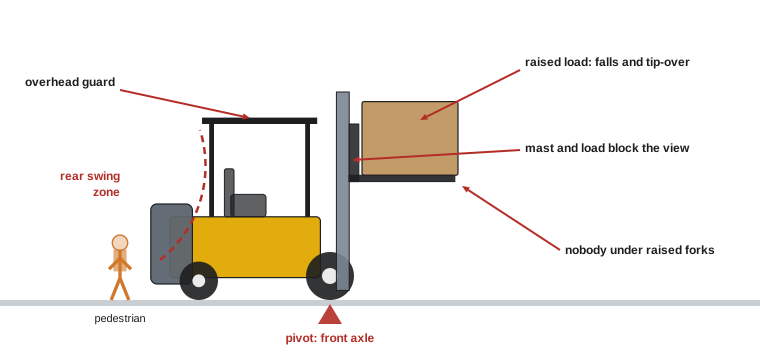
Several features of a counterbalanced truck explain most of its hazards:
- It is heavy. An empty truck rated to lift a modest load usually weighs two to three times its rated capacity, because the counterweight must balance the load. A collision with a pedestrian is a collision with several tons of steel.
- It steers with the rear wheels. The back of the truck swings out wide in a turn, so a person standing beside the truck can be struck by the counterweight even though the forks pass them safely.
- It pivots on the front axle. The front wheels act like the fulcrum of a seesaw: the load on the forks on one side, the truck and counterweight on the other. Raising, tilting or overloading changes that balance.
- It has poor visibility. The mast, the load, the overhead guard and the counterweight all block the operator's view. With a bulky load the operator may be unable to see forward at all.
- It is often operated in shared space. Warehouses, loading docks, retail backrooms and factories put lift trucks and people on foot in the same aisles.
- It stops slowly when loaded. Small wheels, hard tires and smooth or wet floors limit braking, and hard braking can drop or shift the load.
How incidents happen
Investigations of lift truck incidents return to the same handful of event types again and again. Knowing them lets a supervisor look at a work area and see where the next incident is likely to come from.
| Event | What happens | Typical contributing factors |
|---|---|---|
| Pedestrian struck | A worker on foot is hit by the truck, the forks, the load or the swinging counterweight | Shared aisles, blind corners, reversing, noise, phones, no separation |
| Tip-over | The truck rolls sideways or tips forward, and the operator is crushed by the overhead guard or mast | Turning too fast, turning on a slope, raised load while traveling, no seatbelt, jumping out |
| Falling load | Material falls from the forks or from racking onto the operator or someone nearby | Unstable or unsecured loads, damaged pallets, raised load travel, rack strikes |
| Fall from dock or trailer | The truck drives off a dock edge or a trailer moves away from the dock | Trailer creep, early departure, no restraint, open dock doors |
| Caught between | A person is pinned between the truck and racking, a wall or another vehicle | Working in tight spaces, riding on the truck, reaching through the mast |
| Struck by elevated parts | A person under the raised forks or platform is struck when they descend | Standing under loads, using forks as a work platform, hydraulic failure |
| Fire, fuel and exhaust | Burns, explosions or carbon monoxide poisoning | Leaking fuel, battery charging, engines run indoors with poor ventilation |
Two patterns stand out. First, many of the people killed or seriously injured are not the operator but someone on foot nearby, often a worker from another department or a truck driver waiting at the dock. Second, many tip-over deaths happen because the operator tries to jump clear. The overhead guard that protects the operator in the seat becomes the part that crushes them when they leave it. Lesson 4 explains why staying in the seat with the seatbelt fastened is the rule.
The size of the problem
In the United States, the National Safety Council's analysis of Bureau of Labor Statistics data counted 84 work-related deaths with a forklift as the source in 2024 and 67 in 2023. For 2023 to 2024 combined, forklifts were the source of about 25,110 injuries serious enough to cause days away from work, job restriction or transfer, including about 15,460 cases with days away from work. Most of these injuries are coded as transportation incidents or contact with objects and equipment.
Treat any summary statistic with care: the BLS now reports detailed nonfatal data in two-year blocks, and a year with fewer deaths does not mean the hazard has gone. For a workplace, the more useful numbers are its own: near misses, damaged racking, damaged trucks and product, and the number of times a pedestrian and a truck share the same space.
Worked problem
Reading damage as a leading indicator
A distribution center with 14 lift trucks logs the following over three months: 46 rack upright repairs, 9 damaged dock door frames, 120 damaged pallets of product and 2 reported near misses with pedestrians. The manager says the site is safe because no one has been hurt. What do these numbers suggest?
Show solution
- Each rack strike, door strike and dropped load is an event where the truck hit something it was not meant to hit. The only difference between hitting an upright and hitting a person is who was standing there.
- Damage events: 46 + 9 + 120 = 175 contacts in about 13 weeks, roughly 13 a week.
- Only 2 near misses were reported against 175 contacts. That ratio suggests near misses are badly under-reported, not that they are rare.
- The useful conclusion is that operators are regularly losing control of position or speed, and the site needs to look at training, speed, aisle widths, lighting and traffic separation before an injury happens.
Answer: The site has a high rate of uncontrolled contacts and a reporting culture that hides near misses. The absence of injuries so far is luck, not evidence of control.
Why the controls matter
The rest of this course follows the hierarchy of controls introduced in HSE-103. Some lift truck hazards can be eliminated: a conveyor, a pallet flow rack or a redesigned layout may remove the need for a truck to travel through a pedestrian area at all. Others are reduced by engineering: physical barriers between walkways and aisles, dock restraints, speed limiters, presence sensing and well-designed charging areas. Administrative controls such as traffic rules, training, inspection and supervision carry the rest, and personal protective equipment such as high-visibility clothing and safety footwear is the last layer.
| Control level | Lift truck examples |
|---|---|
| Elimination | Conveyors or automated storage instead of truck travel; moving a pedestrian route out of the truck area entirely |
| Substitution | An electric truck instead of a propane truck indoors; a walkie pallet truck instead of a rider truck in a small store |
| Engineering | Barriers and guardrails along walkways, vehicle restraints at docks, speed limiting, blue or red zone lights, proximity detection, operator restraints |
| Administrative | Traffic management plan, one-way aisles, speed limits, pre-use inspection, operator training and evaluation, supervision, maintenance |
| Personal protective equipment | High-visibility clothing for pedestrians, safety footwear, hearing protection where needed |
Most serious incidents involve several failures at once. A pedestrian struck at a blind corner usually reflects a layout with no separation, a truck traveling too fast, a missing mirror or light, an operator under time pressure and a pedestrian who did not expect a truck there. Fixing only the last of these, by telling people to be careful, rarely works.
Worked problem
Mapping a single incident to the hierarchy
A shipper walking from the office to a trailer was struck by a reversing lift truck at the corner of a dock aisle. The truck was carrying a tall load and traveling in reverse to see past it. The shipper was reading a phone. List one control at each level that could have prevented the incident.
Show solution
- Elimination: move the office door or create a route to the trailers that does not cross the dock aisle.
- Substitution: use a truck type with better rearward visibility, or break the load down so the truck can travel forward.
- Engineering: install a guarded pedestrian walkway with a gated crossing, a convex mirror at the corner and a rear-facing light that projects a warning zone on the floor.
- Administrative: a site rule that pedestrians stop at marked crossings, no phone use while walking in operating areas, and a lower speed limit in the dock zone.
- Personal protective equipment: high-visibility clothing for everyone who enters the dock area.
Answer: The strongest controls change the layout so the shipper never needs to be in the aisle; the weakest rely on both people noticing each other in time.
Who this course is for
The lessons that follow are written for the people who shape the conditions operators work in: supervisors who assign work and enforce rules, safety committee members and representatives who inspect workplaces, managers who buy equipment and design layouts, and workers on foot who share space with trucks. Operators will find it useful too, but it is not a substitute for training on the truck they will drive.
Lesson 2 sets out the law and the standards. Lessons 3 to 6 cover the truck itself: types, stability, inspection and safe operation. Lessons 7 to 10 cover the workplace around it: traffic management, fuel and batteries, docks and trailers, and other powered mobile equipment. Lesson 11 covers supervision, evaluation and incident investigation, and Lesson 12 brings everything together in a traffic management plan for a warehouse.
The people on foot
A pedestrian has no protection against a moving truck except distance. High-visibility clothing helps an operator notice a person, but it cannot stop a truck. People on foot who share space with trucks should understand a few facts that operators know well and pedestrians often do not:
- The operator may not see you, even if you can see the truck. A tall load, the mast and the overhead guard hide large areas.
- The back of the truck swings out when it turns. Stand well clear of the rear as well as the front.
- A loaded truck cannot stop quickly. Do not step out in front of a moving truck expecting it to stop.
- Never walk or stand under raised forks or a raised load, even for a moment.
- Make eye contact with the operator before crossing in front of a truck, and wait for a clear signal.
- Never ride on a truck or on its forks unless it is designed for a passenger and you are authorized.
These points are covered in more depth in Lesson 7, which deals with traffic management and separation.
Worked problem
Rear swing clearance
A counterbalanced forklift has an outside turning radius of 84 in measured at the rear corner of the counterweight. The truck turns 90 degrees at an aisle end where a worker stands 60 in from the truck's pivot point. Is the worker in the swing zone?
Show solution
- The rear corner sweeps a circle of radius 84 in about the turning center.
- Anything closer than 84 in to the turning center, on the side the rear swings toward, can be struck.
- The worker at 60 in is inside that circle by 24 in.
- Allowing a margin for operator error and the truck creeping forward during the turn, a clear zone of about 10 ft from the turning point is a reasonable planning figure for this truck.
Answer: Yes. The worker is 24 in inside the swing circle and could be struck by the counterweight even though the forks never come near.
Common myths
Several beliefs about lift trucks keep causing harm. Each is worth confronting directly in toolbox talks and orientation:
- 'It's just like driving a car.' It is not. A car steers with the front wheels, is stable on curves, carries its load low and has good visibility. A lift truck does none of these.
- 'Experienced drivers don't need refresher training.' Many incidents involve experienced operators who have developed shortcuts, such as traveling with a raised load or turning on ramps.
- 'If it tips, jump.' Jumping is how many operators die. Stay in the seat, hold on and lean away from the direction of the tip.
- 'A quick lift on the forks is fine.' Standing on forks or a pallet raised by a truck is a fall and crush hazard. Only use a platform designed and approved for lifting people, as described in Lesson 10.
- 'The pedestrian has the right of way, so the truck will stop.' Rules about right of way do not change physics. Both the operator and the pedestrian must act as if the other has not seen them.
Common mistakes
MistakeTreating this awareness course as operator certification.
InsteadOperators need training on the specific truck and a practical evaluation arranged by the employer.
MistakeJudging safety by the number of injuries alone.
InsteadTrack near misses, rack and door strikes and product damage as leading indicators.
MistakeWatching only the forks when a truck turns.
InsteadRemember the rear swing; the counterweight sweeps a wide arc.
MistakeRelying on high-visibility clothing to keep pedestrians safe.
InsteadSeparate pedestrians and trucks first; clothing is the last layer of control.
MistakeTelling operators to jump clear if the truck tips.
InsteadStay in the seat with the seatbelt fastened, brace and lean away from the tip.
Summary and key terms
- A lift truck is a heavy, rear-steered vehicle that pivots on its front axle and has large blind spots.
- This course builds awareness; the employer must train and evaluate every operator on the specific truck and workplace.
- The main incident types are pedestrians struck, tip-overs, falling loads, falls from docks and caught-between events.
- Many victims are people on foot, and many tip-over deaths involve operators who tried to jump clear.
- Damage and near misses are leading indicators of loss of control.
- The hierarchy of controls applies: separate people and trucks by design before relying on rules and clothing.
- Powered industrial truck
- A mobile, power-driven vehicle used to carry, push, pull, lift, stack or tier material; the regulatory term in the United States.
- Lift truck
- The common Canadian term for a forklift or other powered industrial truck.
- Counterbalanced truck
- A lift truck that carries the load in front of the front wheels, balanced by a counterweight at the rear.
- Counterweight
- The heavy mass at the rear of a counterbalanced truck that offsets the load.
- Rear swing
- The arc swept by the rear of a rear-steered truck when it turns.
- Tip-over
- A lateral or longitudinal overturn of a lift truck.
- Leading indicator
- A measure that signals rising risk before an injury occurs, such as near misses or rack strikes.
Practice problems
Work each problem on paper first, then reveal the answer to check.
Name four features of a counterbalanced lift truck that make it hazardous.
Show answer
Its mass, rear-wheel steering, pivoting on the front axle, poor visibility, shared space and long stopping distances.
Why does this course not qualify a person to operate a lift truck?
Show answer
Operators must be trained on the specific truck and workplace and evaluated by a qualified person arranged by the employer.
List the main event types in lift truck incidents.
Show answer
Pedestrian struck, tip-over, falling load, fall from dock or trailer, caught between, struck by elevated parts, and fire, fuel and exhaust events.
Why is jumping from a tipping truck dangerous?
Show answer
The operator is often crushed by the overhead guard or mast; staying in the seat keeps them inside the protected space.
Give two leading indicators of lift truck risk.
Show answer
Near misses, rack strikes, door strikes, product damage and truck damage.
What is rear swing?
Show answer
The wide arc swept by the counterweight when a rear-steered truck turns.
Give an elimination control for lift truck hazards.
Show answer
Replace truck travel with a conveyor or move a pedestrian route out of the truck area.
Why is telling pedestrians to be careful a weak control?
Show answer
It relies on both people noticing each other in time; it does not change the layout or separate them.
What should a pedestrian do before crossing in front of a truck?
Show answer
Stop, make eye contact with the operator and wait for a clear signal.
Why does a lift truck stop slowly when loaded?
Show answer
Its mass, small hard tires, smooth floors and the need to avoid dropping the load limit braking.
Lesson quiz · 5 questions
Score 60% or more to complete this lesson.
Create a free account to save your progress, take quizzes and earn a certificate.