
HSE-215 · Lesson 10 of 12 · 27 min
Guard removal, bypassing, maintenance and lockout
Most machines that injure people were guarded at some point. The guard had been removed for maintenance and not replaced, an interlock had been taped down to save time, a light curtain had been moved out of the way, or a worker reached in to clear a jam while the machine was still energized. This lesson looks at why safeguards are defeated, how to prevent it, and how guarding connects with the control of hazardous energy during maintenance and servicing.
How common is defeating safeguards?
Defeating safeguards, sometimes called bypassing, manipulation or tampering, is widespread. A frequently cited study by the German Institute for Occupational Safety and Health (IFA) estimated that roughly a third of protective devices on machines in Germany were manipulated, permanently or temporarily, and that manipulation contributed to a substantial share of machine accidents. Inspection blitzes in Canada and enforcement data in the United States tell the same story: missing, removed and defeated guards are among the most common findings.
Why people defeat safeguards
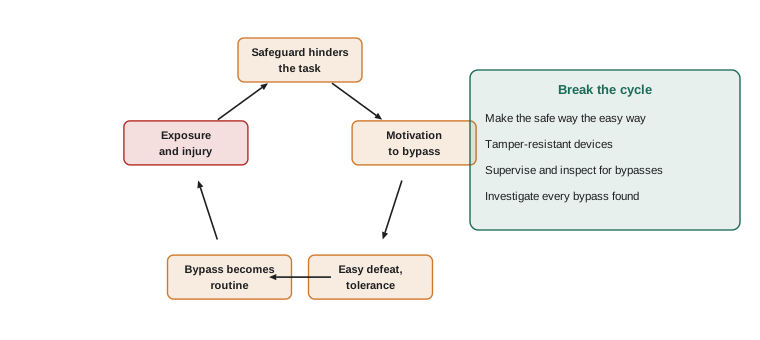
People rarely defeat safeguards out of carelessness alone. They usually do it because the safeguard makes the job harder, slower or impossible, and because the organization rewards output. Common reasons include:
- The guard blocks the view of the work, so the operator cannot see what they are doing.
- Jams are frequent, and opening an interlocked door means a long restart sequence.
- The interlock trips during setup or adjustment tasks that the designers did not consider.
- The guard makes loading or unloading awkward or slow.
- The light curtain causes nuisance trips from swinging workpieces, chips or reflections.
- There is production pressure, piece-rate pay or a supervisor who tolerates shortcuts.
- The safeguard is poorly maintained and fails often, so people learn to work around it.
Understanding these reasons points to the solution. If a safeguard is being defeated, the safeguard or the task design is often the problem. Asking operators why they bypass a guard, without blame, often reveals a design fix that makes the safe way the easy way.
Worked problem
Estimating the motivation to bypass an interlock
An operator clears an average of 12 jams per shift on a packaging machine. With the interlocked door, each jam requires stopping, opening the door, clearing, closing and a 45 s restart sequence, taking about 90 s in total. With the interlock defeated, a jam takes about 20 s. How much time per shift does bypassing appear to save, and what does this suggest?
Show solution
- Time with the interlock: \( 12 \times 90 = 1{,}080 \text{ s} = 18 \text{ min} \).
- Time with the interlock defeated: \( 12 \times 20 = 240 \text{ s} = 4 \text{ min} \).
- Apparent saving: 14 minutes a shift, about 3 % of an 8-hour shift.
Answer: Bypassing appears to save about 14 minutes a shift, which creates a strong incentive. The fix is not just discipline. Reduce the jam rate (adjust the infeed, improve material quality), shorten the safe restart sequence, add a safe means of clearing jams from outside the guard, and only then enforce the rule. A risk-based target is to make the safe method nearly as fast as the unsafe one.
Preventing defeat by design
Standards now require machine designers to anticipate manipulation. ISO 14119 asks designers to assess the motivation to defeat interlocking devices and to take measures against it: tamper-resistant mounting with one-way screws, hidden or coded actuators, monitoring that detects a device permanently held in the actuated state, and designing operating modes so that every reasonable task can be done without defeating the safeguard. Users can also choose coded RFID interlocks, trapped-key systems and safety controllers that detect abnormal patterns.
Good design gives workers a legitimate way to do every task. Setup modes with reduced speed and enabling devices allow observation and adjustment. Viewing windows let operators see the work. Jam-clearing tools let people reach in from outside the hazard zone. Fast, simple restart sequences remove the time penalty for opening a guard. When the safe way is also the easy way, bypassing becomes rare.
Management and culture
Design is not enough on its own. Supervisors must not tolerate defeated safeguards, and they must be seen to stop production when a guard is missing. Inspections should look specifically for bypasses: tape, cable ties, spare actuators, jumpers in panels, magnets on reed switches, and moved or blanked light curtains. When a bypass is found, investigate why it happened, fix the cause and only then consider discipline. If workers fear punishment, they will hide bypasses rather than report the problems that cause them.
OSHA holds the employer responsible for ensuring guards are in place. The employer cannot rely on telling workers not to remove guards; it must supervise and enforce. An employer that knew guards were being removed and did nothing can face willful citations.
Maintenance, servicing and lockout
Maintenance and servicing tasks such as repairs, adjustments, lubrication, cleaning, changeovers and jam clearing often require people to remove guards or enter hazard zones. At those times the guard no longer protects them, so the hazardous energy itself must be controlled. HSE-210 covers lockout in depth. The key points for machine guarding are:
- Before removing a guard or entering a hazard zone for maintenance, stop the machine and isolate all energy sources with energy-isolating devices: electrical disconnects, valves, blocks.
- Apply personal locks and tags so the machine cannot be restarted while anyone is exposed.
- Release or restrain stored energy: bleed air and hydraulics, block raised parts, let flywheels stop, discharge capacitors.
- Verify zero energy by trying to start the machine and testing for voltage before beginning work.
- Replace all guards and check that interlocks work before removing locks and restarting.
OSHA 1910.147 requires lockout or tagout for servicing and maintenance. A minor servicing exception, in 1910.147(a)(2)(ii), allows minor tool changes, adjustments and other servicing that are routine, repetitive and integral to production to be done without full lockout, but only if the work is performed using alternative measures that provide effective protection. ANSI/ASSP Z244.1 explains how to assess and design such alternative methods. The exception does not allow reaching into a running machine with no protection.
Worked problem
Is full lockout needed for this task?
An operator replaces a worn cutting blade on a packaging machine twice a shift. The task takes 5 minutes. The machine has a safety-rated interlocked door that removes power from the blade motor and engages a brake. Is it acceptable to change the blade with only the interlocked door open, without applying a personal lock?
Show solution
- Identify the task: routine, repetitive and integral to production, so it could fall under the minor servicing or alternative-method provisions.
- Check the alternative measure: does the interlock meet the required performance level, does it isolate all hazardous energy, including stored energy in the blade or pneumatics, and can anyone restart the machine while the operator is inside?
- If the interlock does not prevent restart by someone else, or the blade can rotate under its own inertia or by air pressure, the protection is not equivalent.
- Document the risk assessment and the alternative procedure, and train operators.
Answer: It may be acceptable if a documented risk assessment shows that the safety-rated interlock, combined with measures such as a captive key or personal control over restart, gives protection equivalent to lockout for this task. If not, the operator must lock out. When in doubt, lock out. Tasks such as repairing the drive or adjusting inside the frame always need full lockout.
Returning machines to service
Many injuries happen when a machine is returned to service after maintenance with a guard missing or an interlock not reconnected. A return-to-service check should confirm that all guards are back in place and fastened, all interlocks and devices work, safety distances have not changed, tools and materials are removed, everyone is clear, and the operator is told the machine is ready. For safety-related control changes, a competent person should revalidate the safety functions, as Lesson 7 described.
| Return-to-service check | Why it matters |
|---|---|
| All fixed guards refitted with all fasteners | Missing fasteners make guards easy to remove or allow gaps |
| Interlocks tested by opening each guard | Wiring may have been disturbed during the work |
| Light curtains and scanners tested with test pieces | Alignment and configuration may have changed |
| Emergency stops tested | Confirms the stop function still works |
| Stopping time checked if brakes or valves were worked on | Repairs can change stopping performance |
| Area clear of tools and people | Prevents ejection and unexpected contact on start-up |
| Locks removed only by those who applied them | Ensures everyone is accounted for |
Cleaning and sanitation
Cleaning, especially in food plants, is a special case. Cleaning crews often work at night, under time pressure, with water, chemicals and hoses. Some cleaning appears to require the machine to move, for example to expose all parts of a belt. These tasks need specific engineering solutions: cleaning modes at limited speed with enabling devices, clean-in-place systems, belt lifters, and procedures developed with the cleaning crew. Many serious amputations in food processing happen during sanitation, often to young workers or workers employed through staffing agencies or contract cleaning firms, so host employers must make sure contractors are trained and that lockout applies to them too.
Making the safe method visible
Some plants post a simple card at each machine showing the approved way to clear a jam, change a blade or clean the machine, with photographs. The card names the energy sources, the isolation points and the steps. When a safe method is easy to see and quick to follow, workers are far less likely to invent their own. Cards are reviewed whenever the machine or the task changes, and workers are asked whether the method still works in practice.
Supervisors can also ask a simple question at the end of every jam or breakdown: how was it fixed, and was the machine locked out? Asking routinely, without blame, makes lockout a normal part of the job rather than an exception.
Common mistakes
MistakeTreating every bypass as a discipline problem only.
InsteadFind out why the safeguard was defeated and fix the task or design first.
MistakeUsing the minor servicing exception to reach into a running machine.
InsteadAlternative methods must give effective, equivalent protection, documented by a risk assessment.
MistakeReturning a machine to service without testing interlocks.
InsteadTest every guard, interlock, device and emergency stop before restarting.
MistakeLeaving contract cleaners out of lockout training.
InsteadHost employers must ensure contractors are trained and follow lockout.
MistakeInspecting only whether guards are present.
InsteadLook for tape, ties, spare actuators, jumpers, magnets and moved devices.
Summary and key terms
- Defeating safeguards is common and usually happens because the safeguard hinders the task.
- Designing the task so the safe way is the easy way prevents most bypassing.
- ISO 14119 requires designers to anticipate and resist defeat of interlocks.
- Supervisors must not tolerate bypasses, and inspections should look for them specifically.
- Maintenance and servicing require lockout or a documented equivalent alternative method.
- OSHA's minor servicing exception requires effective alternative protection.
- Machines must be checked and safety functions tested before being returned to service.
- Bypassing
- Defeating or circumventing a guard or safeguarding device.
- Manipulation
- Altering a safeguard so it no longer works as intended.
- Tamper-resistant mounting
- Fixing a device so it cannot easily be removed or defeated, for example with one-way screws.
- Lockout
- Isolating energy sources and applying personal locks so a machine cannot start.
- Energy-isolating device
- A device, such as a disconnect or valve, that physically prevents energy transmission.
- Stored energy
- Energy remaining in springs, air, hydraulics, capacitors or raised parts after isolation.
- Minor servicing exception
- The OSHA provision allowing routine tasks without full lockout if effective alternative protection is used.
- Alternative method
- A risk-assessed means of energy control other than full lockout.
- Return to service
- The checks and steps taken before a machine is restarted after maintenance.
- Jam-clearing tool
- A tool that lets a person clear a jam from outside the hazard zone.
Practice problems
Work each problem on paper first, then reveal the answer to check.
Give three reasons people defeat safeguards.
Show answer
The guard blocks the view, jams are frequent, restart is slow, nuisance trips, or production pressure.
What should happen first when a bypass is found?
Show answer
Stop the machine, restore the safeguard and investigate why it was defeated.
Name two design measures against interlock defeat.
Show answer
Coded actuators, tamper-resistant mounting, monitoring for permanently actuated devices or suitable setup modes.
A safe jam-clearing method takes 60 s and the unsafe method 20 s, 15 times a shift. What is the apparent saving?
Show answer
10 minutes a shift, from 15 × 40 s.
What are the basic steps of lockout before maintenance?
Show answer
Stop, isolate, lock and tag, release stored energy, verify zero energy.
When can an alternative to full lockout be used?
Show answer
When a documented risk assessment shows it gives equivalent, effective protection for that task.
Name three return-to-service checks.
Show answer
Guards refitted, interlocks tested, devices tested, emergency stops tested, area clear, locks removed by owners.
Why is sanitation a high-risk time in food plants?
Show answer
Night work, time pressure, water and chemicals, and tasks that seem to require motion, often by less experienced workers.
What should inspections look for besides missing guards?
Show answer
Tape, ties, spare actuators, jumpers, magnets and moved or blanked devices.
Why can fear of discipline make bypassing worse?
Show answer
Workers hide bypasses instead of reporting the problems that cause them.
Lesson quiz · 5 questions
Score 60% or more to complete this lesson.
Create a free account to save your progress, take quizzes and earn a certificate.