
HSE-215 · Lesson 8 of 12 · 28 min
Emergency stops, stopping performance and safe restart
Every safeguarding measure eventually depends on one thing: stopping the hazard. A light curtain detects a hand, an interlock senses a door opening, an operator hits an emergency stop button. In each case the machine must then come to a safe state quickly and stay there until someone deliberately restarts it. This lesson covers how machines stop, how stopping performance is measured, how emergency stops work, and how to prevent unexpected start-up.
Stop categories
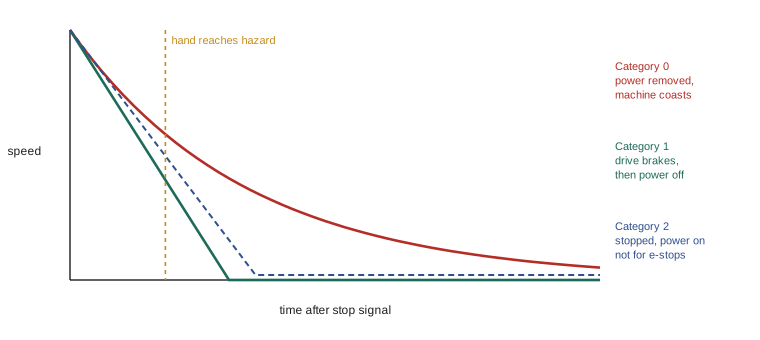
NFPA 79, Electrical Standard for Industrial Machinery, which the NEC references for industrial machinery, and IEC 60204-1 define three stop categories:
| Stop category | How the machine stops | Typical use |
|---|---|---|
| Category 0 | Immediate removal of power to the actuators: an uncontrolled stop, possibly with a mechanical brake | Emergency stops on simple machines; machines that stop quickly when power is removed |
| Category 1 | A controlled stop with power available to the actuators to achieve the stop, then power removed | Emergency stops on machines with high inertia, where braking with the drive is faster and safer |
| Category 2 | A controlled stop with power left available to the actuators | Normal operational stops, holding position; not for emergency stops |
An emergency stop must be Category 0 or Category 1. Category 2 leaves power on the actuators, so a fault could restart motion, and it is not permitted for emergency stops. Choosing between Category 0 and Category 1 is an engineering decision: cutting power immediately can let a heavy spindle coast for a long time, while a controlled stop using the drive's braking can stop it much faster before removing power.
Emergency stop devices
An emergency stop is a complementary protective measure, not a substitute for guarding. It is for situations where something has already gone wrong: a person caught, a part flying, a fire starting. ISO 13850 sets the requirements. The key points are:
- The actuator is red, on a yellow background where practicable, usually a mushroom-head push button, a pull cord or a foot pedal designed for emergency use.
- It latches when operated, so the stop command is maintained until the device is deliberately reset by hand.
- Resetting the emergency stop must not by itself restart the machine; a separate start command is needed.
- Emergency stop devices are placed at each operator station and other places where they may be needed, readily accessible and not hidden behind guards.
- The emergency stop function overrides all other functions and operating modes, and it must be available and operational at all times.
- The emergency stop function must meet the performance level required by the risk assessment; PL c or higher is common, and many machines need PL d.
Pull-cord or rope-pull switches along conveyors let a person stop the conveyor from anywhere along its length. They must be tensioned correctly, detect both a pull and a broken or slack cord, and be tested regularly. On roll mills and calenders, body bars and trip wires at the front of the rolls allow an operator who is being drawn in to stop the machine, and standards set how quickly the rolls must stop.
Stopping performance
The time and distance a machine takes to stop decide whether a safeguarding device can protect anyone. They also change over time. Brakes wear, hydraulic valves slow down, clutches slip, loads change and settings are adjusted. A machine that stopped in 120 ms when it was commissioned may take 200 ms after years of use, and a light curtain positioned for 120 ms is then too close.
Stopping time is measured with a stop-time measurement device. A probe or beam break triggers the stop, and an encoder or sensor records how long and how far the hazardous part travels before it stops. Measurements are repeated several times in the worst-case condition, for example at maximum speed with the heaviest tooling, and the longest time is used. Presses with presence-sensing devices need brake monitors that warn or stop the press if stopping time increases beyond a set limit.
Worked problem
How far does a press ram travel while stopping?
A press ram moves down at 10 in/s when a light curtain is broken. The control system takes 30 ms to respond, and then the ram decelerates uniformly to a stop in a further 90 ms. How far does the ram travel after the curtain is broken?
Show solution
- During the response time the ram keeps moving at full speed: \( 10 \times 0.030 = 0.30 \text{ in} \).
- During uniform deceleration the average speed is half the initial speed: \( 5 \times 0.090 = 0.45 \text{ in} \).
- Total: \( 0.30 + 0.45 = 0.75 \text{ in} \).
Answer: The ram travels about 0.75 in after the curtain is broken. If the die opening at that point is less than that from closing, a finger could still be caught, which is why safety distances are based on total stopping time and why some presses also limit the die opening.
Worked problem
Why stopping time must be rechecked
A light curtain was installed using Ds = 63 × Ts with Ts = 150 ms, at 9.5 in from the hazard. A year later the measured stopping time is 190 ms. Is the curtain still far enough away?
Show solution
- New required distance: \( D_s = 63 \times 0.190 \approx 12.0 \text{ in} \).
- The curtain is at 9.5 in, which is about 2.5 in too close.
Answer: No. The machine must be taken out of service until the brake or valve is repaired so the stopping time returns to the design value, or the curtain is moved and the gaps re-guarded. Periodic stopping-time checks catch this kind of drift before it causes an injury.
Preventing unexpected start-up
Many serious injuries happen when a machine starts while someone is inside it: a co-worker presses a start button not knowing a maintainer is behind the guard, an automatic cycle resumes when a sensor clears, stored pneumatic pressure moves a cylinder, or a control fault energizes a motor. ISO 14118 covers the prevention of unexpected start-up. The main measures are:
- Isolating and locking out energy sources before entering a hazard zone, covered in HSE-210 and Lesson 10.
- Designing controls so that closing a guard, resetting an emergency stop or clearing a sensor does not restart the machine by itself; a separate deliberate start command is needed.
- Placing reset and start buttons where the person pressing them can see the whole hazard zone and confirm no one is inside, and outside the zone so they cannot be pressed from inside.
- Using trapped-key or personal lock systems on walk-in cells so the machine cannot start while a key is with the person inside.
- Releasing or blocking stored energy: bleeding air and hydraulic pressure, lowering or blocking raised parts, discharging capacitors.
- Providing start-up warnings, such as horns or lights before an automatic machine starts, where people could be near it.
Reset, restart and operating modes
Machines often have several modes: automatic production, manual or jog for setup, maintenance and cleaning modes. Each mode can change which safeguards are active. For example, a setup mode might allow the machine to run at limited speed with a guard open, using an enabling device held by the setter. Standards require that mode selection be controlled, for example by a key switch, that the selected mode override other modes, that only the safeguards appropriate for that mode are suspended, and that reduced speed, hold-to-run or enabling devices replace them. A common cause of injury is a machine left in a mode in which guards are muted.
| Mode | Typical safeguarding while in that mode |
|---|---|
| Automatic | All guards closed and interlocks active; devices active |
| Setup or teach | Reduced speed, hold-to-run or three-position enabling device, limited motion; guards may be open for the setter only |
| Cleaning | Machine locked out, or running at limited speed with specific measures where cleaning requires motion |
| Maintenance | Energy isolated and locked out; test runs only under controlled conditions |
Emergency stop placement and testing
Emergency stop devices are only useful if a person can reach them when needed. They are typically placed at each operator station, at each entry to a cell, along conveyors at intervals so a person is never far from one, and on portable teach pendants. A good test is to stand where a person could be trapped and ask whether they, or someone nearby, could reach an emergency stop. Emergency stops should be tested regularly, often at the start of each shift on high-risk machines and at least as often as the manufacturer recommends. A test confirms that all hazardous motion stops, that the device latches, and that resetting it does not restart the machine.
Worked problem
Spacing pull-cord stops on a conveyor
A 200 ft belt conveyor has pull-cord switches. Each switch can serve a cord up to 100 ft long. How many switches are needed if cords must run the full length on both sides?
Show solution
- Per side: \( 200 / 100 = 2 \) cord runs, so 2 switches.
- Both sides: \( 2 \times 2 = 4 \) switches.
- Check that each switch is accessible, that the cord is visible, and that the conveyor stops within the distance assumed in the design.
Answer: Four switches, two per side. Manufacturers' maximum cord lengths, tension settings and sag limits must be followed, and the cords tested regularly.
Records matter here too. Keep a log of measured stopping times for each safeguarded machine, with the date, conditions and the safety distance they support. A rising trend is an early warning that brakes, clutches or valves need attention, long before the stopping time becomes dangerous.
A final point concerns power failures. When power returns after an outage, machines must not restart by themselves. Controls should require a deliberate start command after power is restored, so that people who entered the machine during the outage are not caught when it resumes.
Common mistakes
MistakeTreating an emergency stop as a substitute for a guard.
InsteadAn emergency stop is a complementary measure for when something goes wrong; it does not prevent contact.
MistakeUsing a Category 2 stop for emergency stopping.
InsteadEmergency stops must be Category 0 or Category 1.
MistakeLetting the machine restart when an emergency stop is reset.
InsteadReset must only allow restart; a separate deliberate start command is needed.
MistakeMeasuring stopping time only at commissioning.
InsteadMeasure it periodically in worst-case conditions; brakes and valves wear.
MistakeLeaving machines in setup or maintenance mode after the task.
InsteadControl mode selection with key switches and return machines to automatic with all safeguards active.
Summary and key terms
- Stop Category 0 removes power immediately; Category 1 is a controlled stop then power removal; Category 2 keeps power on.
- Emergency stops must be Category 0 or 1, latch, override other functions and need deliberate reset.
- Emergency stops complement guarding; they do not prevent contact.
- Stopping time decides whether devices protect anyone and increases with wear, so it must be remeasured.
- Unexpected start-up is prevented by lockout, separate restart commands, trapped keys and releasing stored energy.
- Operating modes must be controlled and suspended safeguards replaced by other measures.
- Emergency stops and pull cords must be placed within reach and tested regularly.
- Stop category 0
- Stopping by immediate removal of power to the actuators.
- Stop category 1
- A controlled stop with power available, followed by removal of power.
- Stop category 2
- A controlled stop with power left on the actuators.
- Emergency stop
- A latching device and function used to stop a machine in an emergency.
- Latching
- Maintaining the stop command until the device is deliberately reset.
- Stopping time
- The time from a stop signal to the end of hazardous motion.
- Brake monitor
- A device that detects increases in a press's stopping time.
- Unexpected start-up
- Any start that a person in or near the hazard zone does not expect.
- Enabling device
- A three-position hand-held switch that allows motion only in the middle position.
- Pull-cord switch
- An emergency stop operated by pulling a cord along a conveyor or machine.
Practice problems
Work each problem on paper first, then reveal the answer to check.
Which stop categories are permitted for emergency stops?
Show answer
Category 0 and Category 1.
What colors are used for emergency stop actuators?
Show answer
Red actuator on a yellow background where practicable.
What must happen when an emergency stop is reset?
Show answer
The machine must not restart until a separate start command is given.
A part moves at 16 in/s and decelerates uniformly to rest in 0.1 s. How far does it travel while decelerating?
Show answer
0.8 in, from 8 × 0.1.
Why should stopping time be measured in worst-case conditions?
Show answer
Maximum speed and heaviest loads give the longest stopping times, which set the safety distance.
Name three measures that prevent unexpected start-up.
Show answer
Lockout, separate restart commands, trapped-key systems, releasing stored energy or start-up warnings.
Where should reset buttons be placed?
Show answer
Outside the hazard zone, where the person can see that no one is inside.
What does a three-position enabling device do?
Show answer
Allows motion only when held in the middle position; releasing or squeezing hard stops motion.
Why is a pull-cord switch designed to detect a slack cord?
Show answer
A broken or slack cord would otherwise leave the conveyor without an emergency stop unnoticed.
What should an emergency stop test confirm?
Show answer
All hazardous motion stops, the device latches and resetting does not restart the machine.
Lesson quiz · 5 questions
Score 60% or more to complete this lesson.
Create a free account to save your progress, take quizzes and earn a certificate.