
HSE-215 · Lesson 5 of 12 · 26 min
Guards: fixed, interlocked, adjustable and self-adjusting
A guard is a physical barrier that keeps people out of a hazard zone. Guards are the backbone of machine safeguarding because they work without anyone having to remember them. A well-designed guard is strong, securely fastened, does not create new hazards, lets the operator see and work where needed, and stays in place. This lesson describes the main types of guard and the rules that decide whether a guard actually protects people.
OSHA 1910.212(a)(2) requires that guards be affixed to the machine where possible and secured elsewhere if attachment is not possible, and that the guard not offer an accident hazard in itself. ANSI B11.19 sets out performance requirements for guards and devices, and refers to safety distance tables based on the same research as ISO 13857.
Fixed guards
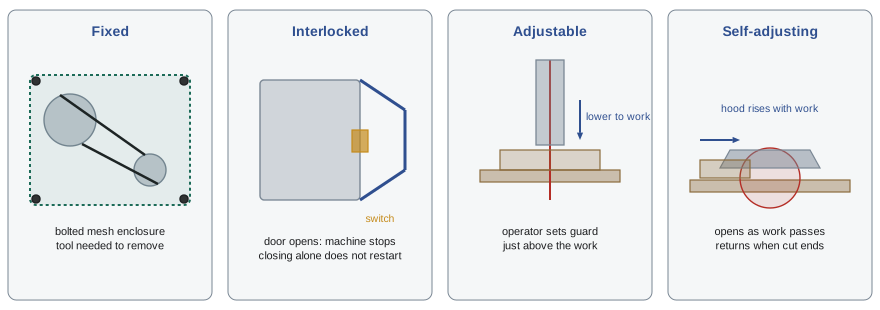
A fixed guard is held in place permanently, by welding, or by fasteners that need a tool to remove. It has no moving parts and does not depend on the control system, which makes it the simplest and most reliable form of safeguarding. Fixed guards are the first choice wherever people do not need regular access to the hazard zone, such as for belts, pulleys, chains, sprockets, gears, shafts and couplings.
The fasteners matter. A guard held by wing nuts or hand knobs is easy to remove without tools, so it is not a fixed guard in the sense of the standards. Current practice, reflected in ISO 14120 and CSA Z432, prefers captive fasteners that stay attached to the guard or the machine when the guard is removed, so they are not lost and the guard is more likely to be refitted. If a fixed guard must be removed often, say more than about once a shift, it should probably be an interlocked movable guard instead, because frequent removal invites people to leave it off.
Interlocked movable guards
An interlocked guard is a movable guard, such as a hinged door or sliding panel, connected to the machine's control system by an interlocking device. When the guard is opened, the hazardous functions stop, or cannot start; when it is closed, the machine can run, but closing the guard should not by itself restart the machine. Interlocked guards are used where people need frequent access, for example to load parts, change tooling or clear jams.
Interlocking devices come in several forms: tongue-actuated switches, hinge switches, non-contact coded magnetic or RFID sensors, trapped-key systems and solenoid locking switches. ISO 14119 classifies them and sets requirements to make them hard to defeat. A plain magnetic reed switch can be defeated with a magnet; a coded RFID sensor that only accepts its own actuator is much harder to defeat. The control system that processes the interlock signal must also be reliable enough for the risk, as Lesson 7 explains.
Where the hazardous motion takes time to stop after the guard is opened, such as a flywheel, a spindle running down or a robot completing a move, an interlocked guard with guard locking is needed. Guard locking keeps the guard closed and locked until the hazard has stopped, often by monitoring the speed or using a timer. Otherwise a person could open the door and reach the hazard before it stops.
Worked problem
Does an interlocked door need guard locking?
A machine has a cutting head that takes 4 s to coast to a stop after power is removed. The interlocked access door is 12 in from the cutter. An adult can open a door and reach in at about 63 in/s, the hand speed used in OSHA's press formula. Is a simple interlock enough?
Show solution
- Time for a person to reach the cutter after opening the door: \( t = d / v = 12 / 63 \approx 0.19 \text{ s} \).
- Time for the cutter to stop: 4 s.
- The person can reach the hazard about 20 times faster than it stops.
Answer: A simple interlock is not enough. The door needs guard locking that keeps it locked until the cutter has stopped, for example using a zero-speed monitor or a time delay set longer than the measured stopping time with a margin. Alternatively, a brake could reduce the stopping time, but it would still have to beat the reach time.
Adjustable and self-adjusting guards
An adjustable guard is a fixed or movable guard that the operator adjusts to suit the work, such as the blade guard on a band saw that is lowered to just above the workpiece. It is useful where the size of the opening must change with the material, but it depends on the operator setting it correctly each time, so it is less reliable than a fixed or interlocked guard.
A self-adjusting guard opens automatically as the workpiece passes through and closes when the work is removed, such as the spring-loaded or gravity hood on a circular saw. It provides some protection while allowing the work to be fed, but it still leaves part of the hazard exposed during the cut and can stick or be wedged open.
Safety distances: the most important design check
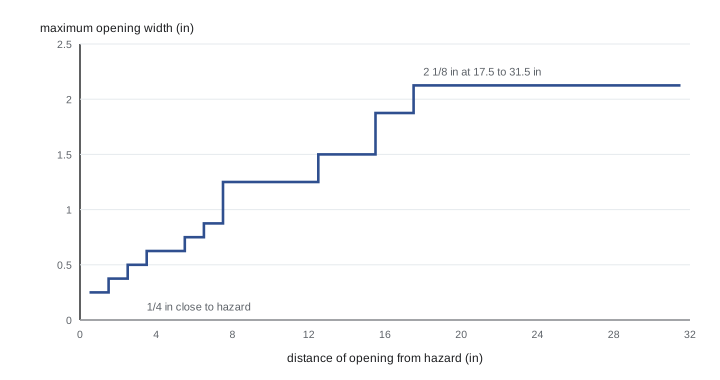
A guard only protects if no one can reach the hazard over it, under it, around it or through it. A mesh guard with openings large enough for a hand, placed close to a sprocket, is not a guard at all. The relationship between the size of an opening and how far it must be from the hazard is set out in safety distance tables, based on measurements of how far people can reach.
| Distance of opening from point-of-operation hazard (in) | Maximum width of opening (in) |
|---|---|
| 1/2 to 1 1/2 | 1/4 |
| 1 1/2 to 2 1/2 | 3/8 |
| 2 1/2 to 3 1/2 | 1/2 |
| 3 1/2 to 5 1/2 | 5/8 |
| 5 1/2 to 6 1/2 | 3/4 |
| 6 1/2 to 7 1/2 | 7/8 |
| 7 1/2 to 12 1/2 | 1 1/4 |
| 12 1/2 to 15 1/2 | 1 1/2 |
| 15 1/2 to 17 1/2 | 1 7/8 |
| 17 1/2 to 31 1/2 | 2 1/8 |
Worked problem
Checking a mesh guard
A fixed guard on a power press has slot openings 1/2 in wide. The nearest point-of-operation hazard is 2 in behind the guard. Does it meet OSHA Table O-10?
Show solution
- Find the row for a distance of 2 in: 1 1/2 to 2 1/2 in, which allows a maximum opening of 3/8 in.
- The actual opening is 1/2 in, which is more than 3/8 in.
Answer: No. At 2 in from the hazard the maximum opening is 3/8 in, so a 1/2 in opening is too large. The fix is to use a finer mesh with openings of 3/8 in or less, or move the guard so the openings are at least 2 1/2 in from the hazard, where 1/2 in openings are allowed.
Reaching over a guard and reaching around the edge of a guard are also covered by the standards. A low barrier near a hazard can be reached over; ISO 13857 has a table relating the height of the hazard, the height of the barrier and the horizontal distance needed. A perimeter fence around a robot cell, for example, is often at least 1,400 mm (about 55 in) high and placed far enough from the robot's reach. Gaps under a fence must also be small enough that no one can crawl or reach under; ISO 13857 and CSA Z432 give values for lower limbs.
What makes a guard good
Whatever its type, a guard should meet a set of basic requirements:
- Prevent contact: no part of the body can reach the hazard through, over, under or around the guard.
- Be secure: it cannot be easily removed or defeated, and fixed guards need a tool to remove.
- Be strong and durable: it withstands normal use, impacts, vibration, the environment and the forces of ejected parts.
- Create no new hazards: no sharp edges, pinch points or shearing points between the guard and the machine.
- Allow the job to be done: the operator can see the work, feed material and do necessary tasks without removing the guard, ideally with lubrication and adjustment points outside it.
- Protect from falling objects and ejection where needed: for example, polycarbonate windows that can withstand chips.
- Be maintainable: inspected regularly and repaired promptly.
A guard that makes the job harder will eventually be removed. When operators complain about a guard, take the complaint seriously. Often a better design, a window, a feeding slot or a tool for clearing jams solves the problem without weakening protection.
Materials and visibility
Guards are made from sheet metal, perforated metal, wire mesh, expanded metal, polycarbonate and other plastics, and sometimes wood in low-risk applications. Mesh and perforated metal allow ventilation and visibility but must meet the opening tables. Polycarbonate gives excellent visibility and impact resistance but can be scratched, clouded by some cutting fluids and weakened by certain chemicals and ultraviolet light, so it needs inspection and replacement. Dark mesh with a light background is easier to see through than shiny mesh in bright light.
When checking an existing guard, measure rather than estimate. A tape measure, a set of feeler gauges or a simple test probe shaped like a finger can show whether an opening is too large or a guard too close. Record the measurements so the next inspector can see whether anything has changed.
Guards also need to be considered for the whole body, not just hands. Large openings in perimeter fences, gaps under fences and the space between a fence and a machine can let a person walk or crawl into a hazard zone. The standards give values for these too.
Common mistakes
MistakeUsing hand knobs or wing nuts on a fixed guard.
InsteadFixed guards need fasteners that require a tool; captive fasteners are preferred.
MistakeChoosing mesh by eye without checking the safety distance tables.
InsteadCheck the opening size and shape against the distance to the hazard.
MistakeFitting a simple interlock on a door in front of a slow-stopping hazard.
InsteadUse guard locking when the hazard takes longer to stop than a person takes to reach it.
MistakeUsing an easily defeated reed switch as an interlock.
InsteadChoose coded or otherwise tamper-resistant interlocking devices as ISO 14119 recommends.
MistakeIgnoring operator complaints about a guard.
InsteadImprove the design so the job can be done with the guard in place, or the guard will be removed.
Summary and key terms
- Guards are physical barriers and the backbone of machine safeguarding.
- Fixed guards are the simplest and most reliable and suit areas that do not need regular access.
- Interlocked guards stop hazardous functions when opened and suit frequent access.
- Guard locking is needed when the hazard takes longer to stop than a person takes to reach it.
- Adjustable and self-adjusting guards depend more on correct use and leave some exposure.
- OSHA Table O-10 relates the distance from the hazard to the maximum opening width.
- Good guards are secure, strong, create no new hazards and let the job be done.
- Fixed guard
- A guard held permanently in place, removable only with a tool.
- Interlocked guard
- A movable guard linked to the control system so hazardous functions stop when it opens.
- Guard locking
- A device that keeps an interlocked guard locked until the hazard has stopped.
- Adjustable guard
- A guard the operator adjusts to suit the work.
- Self-adjusting guard
- A guard that opens as the workpiece passes and closes afterwards.
- Captive fastener
- A fastener that stays attached when a guard is removed.
- Safety distance
- The minimum distance between a guard or device and the hazard that prevents a person reaching it.
- Coded interlock
- An interlocking device that responds only to its own actuator, making it harder to defeat.
- Trapped-key system
- An interlocking system that uses keys transferred between locks to control access.
- Perimeter guard
- A fence or barrier around a machine or cell that keeps people out of the hazard zone.
Practice problems
Work each problem on paper first, then reveal the answer to check.
When is a fixed guard the best choice?
Show answer
When people do not need regular access to the hazard zone.
What must an interlocked guard do when it is opened?
Show answer
Stop the hazardous functions or prevent them from starting.
Why should closing an interlocked guard not restart the machine by itself?
Show answer
A person could still be inside or near the hazard; restart needs a separate deliberate action.
A guard is 7 in from the hazard. What maximum opening does Table O-10 allow?
Show answer
7/8 in.
Why are captive fasteners preferred on fixed guards?
Show answer
They are not lost when the guard is removed, so the guard is more likely to be refitted properly.
When is guard locking needed?
Show answer
When the hazard takes longer to stop than a person takes to reach it after opening the guard.
Name two weaknesses of self-adjusting guards.
Show answer
They leave part of the hazard exposed during work and can stick or be wedged open.
Why is a plain magnetic reed switch a poor interlock?
Show answer
It can be defeated with any magnet.
What can happen to polycarbonate guard windows over time?
Show answer
They can scratch, cloud and be weakened by some chemicals and ultraviolet light.
Name three requirements of a good guard.
Show answer
Prevents contact, is secure, is strong, creates no new hazards and lets the job be done.
Lesson quiz · 5 questions
Score 60% or more to complete this lesson.
Create a free account to save your progress, take quizzes and earn a certificate.