
HSE-215 · Lesson 1 of 12 · 28 min
Why machines injure: motions, actions and nip points
Machines multiply human effort. A press can bend steel that no person could bend, a saw can cut a plank in a second, and a conveyor can move metric tons of product without anyone lifting a box. The same energy that makes machines useful makes them dangerous. A moving part does not know whether it is shaping metal or a hand. When a person's body meets a moving part, the machine usually wins, and the injuries are among the most severe in any workplace: crushed hands, amputated fingers and arms, scalping, degloving, and deaths from entanglement or crushing.
This is an awareness course for operators, maintenance helpers, supervisors, safety committee members, purchasers and anyone who works around machinery. It explains how machines injure, what OSHA 29 CFR 1910 Subpart O and the ANSI B11 standards expect, how guards and safeguarding devices work, and how to recognize when a machine is not adequately safeguarded. It does not qualify anyone to design safeguarding, to validate safety-related control systems or to certify a machine as safe. That work needs a competent person, often a registered professional engineer or a qualified machine safety specialist.
The scale of the problem
Machinery injuries are less common than slips or strains, but they are far more likely to be permanent. The US Bureau of Labor Statistics counted about 6,200 amputation cases with days away from work in 2018, and 58 % of them, about 3,580 cases, involved some kind of machinery. Machine guarding, 29 CFR 1910.212, appeared tenth on OSHA's list of most frequently cited standards for fiscal year 2025 (October 2024 to September 2025), with 1,498 violations. OSHA has run a National Emphasis Program on amputations in manufacturing since 2006; the current version, CPL 03-00-022, was issued in December 2019.
Behind the numbers are a handful of recurring stories. A worker reaches into a machine to clear a jam without stopping it. A guard was removed for maintenance and never put back. A light curtain was muted, or an interlock was taped over because it slowed production. A new worker was never shown where the danger zone was. A machine started unexpectedly while someone was inside it. Almost every one of these injuries was preventable with known, affordable controls.
Where the danger is: three areas of a machine
Safety specialists divide a machine into three areas. Thinking in these areas helps you look at any machine, however unfamiliar, and find the places where a person could be hurt.
- The point of operation is where the machine does its work on the material: where the press die closes, the blade cuts, the drill bores, the roll forms or the mold closes. It is usually the most dangerous area because the work requires force, and because operators feed, position or remove material there.
- The power transmission apparatus is every part that carries energy from the motor to the point of operation: shafts, couplings, belts, pulleys, chains, sprockets, gears, flywheels, cams, spindles and connecting rods. These parts often run fast and continuously, and they create nip points and entanglement hazards even though no one needs to touch them during normal work.
- Other moving parts include everything else that moves while the machine runs: feed mechanisms, auxiliary parts, rotating stock, reciprocating tables, ejectors, robots, conveyors and the material itself.
Some hazards do not come from moving parts at all. Machines can release stored energy, eject chips, sparks or broken tooling, produce noise and vibration, leak hydraulic fluid at high pressure, generate dust and fumes, and expose people to electrical and thermal hazards. This course focuses on mechanical hazards, but a full risk assessment considers them all.
Hazardous motions
Mechanical hazards come from a few basic kinds of motion. Each has a characteristic way of catching and injuring people.
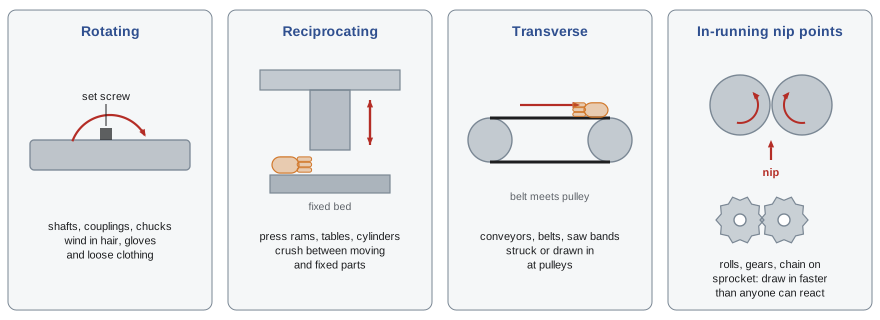
Rotating motion is the most common and often underestimated. Even a smooth shaft turning slowly can grip hair, a glove, a sleeve, a lanyard or loose jewelry and wind it around itself, pulling the person in. Projections such as set screws, keyways, couplings and bolt heads make the hazard worse. Rotating parts include shafts, spindles, flywheels, collars, chucks, drill bits, fan blades and rotating stock in a lathe.
Reciprocating motion is back-and-forth or up-and-down movement, such as a press ram, a shaper ram, a hydraulic cylinder or a sliding table. The hazard is being struck by the moving part or caught between it and a fixed object at the end of its travel.
Transverse motion is movement in a straight, continuous line, such as a conveyor belt, a saw band or a moving web of paper or film. A person can be struck or caught in a pinch point between the moving part and a fixed one, or drawn into the point where a belt meets a pulley.
Hazardous actions
Motions describe how parts move. Actions describe what the machine does to the material, and therefore what it can do to a body part placed in the same spot.
| Action | What it does | Typical machines | Typical injury |
|---|---|---|---|
| Cutting | Removes material with a blade, saw, cutter or abrasive | Table saws, band saws, milling machines, slicers, grinders | Lacerations, amputations, eye injuries from flying chips |
| Punching | Drives a tool through material to make a hole or shape | Power presses, punch presses, stamping machines | Crush and amputation of fingers and hands |
| Shearing | Cuts material between two edges moving past each other | Power shears, guillotines, paper cutters, alligator shears | Amputation at the point where the edges meet |
| Bending | Forms material by force between a punch and die | Press brakes, tube benders, folding machines | Crush and amputation, being struck by the moving workpiece |
A single machine often combines several actions and motions. A meat slicer has a rotating blade that cuts, a reciprocating carriage and a point where the product meets the blade. A press brake bends but also creates pinch points between the workpiece and the bed, and the workpiece itself can whip upward and strike the operator. When you look at a machine, ask what moves, how it moves, what it does to the material and where a person could be when it happens.
Nip points and pinch points
An in-running nip point, sometimes called a pinch point, is formed where two parts move together and draw material in between them, or where a moving part meets a fixed one. Common examples are two rolls turning toward each other, a belt running onto a pulley, a chain running onto a sprocket, gears meshing, and a rotating wheel running past a fixed rest. Once a finger or glove is caught in an in-running nip, the machine pulls it in faster than a person can react.
Worked problem
How fast does a nip point draw a hand in?
A pair of feed rolls 6 in in diameter turns at 120 revolutions per minute. A worker's glove is caught at the nip. How far does the surface of the roll travel in a typical human reaction time of 0.25 s?
Show solution
- The surface speed of a roll is the circumference times the rotational speed: \( v = \pi D N \).
- \( v = \pi \times 6 \text{ in} \times 120 \text{ rev/min} = 2{,}262 \text{ in/min} \), which is \( 2{,}262 / 60 = 37.7 \text{ in/s} \).
- In 0.25 s the surface moves \( 37.7 \times 0.25 = 9.4 \text{ in} \).
Answer: Before the worker can even begin to pull back, the rolls can draw the glove and hand in more than 9 in, far enough to reach the wrist or forearm. This is why nip points must be guarded rather than relying on people to react.
Entanglement, crushing, shearing and impact
Standards such as ISO 12100 list the ways mechanical hazards cause harm. Knowing the names helps you describe hazards clearly in a risk assessment or an inspection report.
- Entanglement: hair, clothing, gloves or jewelry caught by rotating parts and wound in.
- Drawing-in or trapping: a body part pulled into an in-running nip.
- Crushing: a body part trapped between a moving part and a fixed part, or between two moving parts closing together.
- Shearing: a body part caught between two edges passing each other.
- Cutting or severing: contact with a sharp edge, blade or abrasive surface.
- Impact: being struck by a moving part, such as a robot arm or a swinging gate.
- Stabbing or puncture: contact with a pointed tool, needle or the end of a moving rod.
- Friction or abrasion: contact with a fast-moving rough surface such as a grinding wheel or sanding belt.
- Ejection: parts, chips, broken tools or the workpiece thrown out by the machine.
Worked problem
Why gloves can make rotating parts more dangerous
A drill press operator wears loose cotton gloves to protect against chips. The supervisor wants to know whether gloves are a good idea near the rotating spindle.
Show solution
- Identify the motion: the spindle and drill bit rotate continuously at several hundred to several thousand revolutions per minute.
- Identify the mechanism of harm: entanglement. A glove gives the rotating part something to grip, and a strong glove will not tear free; it pulls the hand in with it.
- Compare the risks: small chip cuts are minor and can be controlled with a chip shield, a brush for clearing chips and eye protection. Entanglement can cause fractures, degloving or amputation.
- Choose controls: a guard around the spindle and chuck, a chip shield, a rule against gloves near rotating parts unless a risk assessment shows a specific glove is safe, and training.
Answer: Loose gloves should not be worn where they can contact rotating parts such as drill spindles, lathe chucks and stock. The risk of entanglement outweighs the minor cuts they prevent. The same reasoning applies to loose sleeves, long hair, lanyards, rings and necklaces.
Who gets hurt, and when
It is natural to picture an operator at the point of operation, and operators do suffer many machine injuries. But many serious injuries happen to people who are not running production at all. Maintenance workers, cleaners, setters, millwrights, electricians and contractors spend time inside or behind guards, often when the machine is in an unusual state: partly disassembled, running slowly, jammed, being adjusted or being tested. Sanitation crews in food plants clean machines at night, often under time pressure. New and young workers are over-represented because they do not yet recognize the danger and may be reluctant to ask.
Injuries also cluster around particular tasks: clearing jams, adjusting settings while the machine runs, removing scrap, changing tooling, threading material and troubleshooting. These are exactly the tasks that tempt people to reach past a guard or to keep the machine running. Later lessons show how lockout, safe tooling, interlocked guards and well-designed procedures remove the temptation.
The machine safety vocabulary
A few terms appear throughout this course and in the standards.
- A hazard zone, or danger zone, is any space within or around a machine where a person can be exposed to a hazard.
- A guard is a physical barrier that prevents access to the hazard zone.
- A safeguarding device, or protective device, is something other than a guard that reduces risk, such as a light curtain, two-hand control, pressure-sensitive mat or interlock switch.
- Safeguarding is the combination of guards and devices used to protect people.
- A safety function is a function of the machine's control system whose failure would immediately increase the risk, such as stopping when a guard opens.
- Risk is the combination of how severe the possible harm is and how likely it is to happen.
This lesson has focused on recognizing hazards. The rest of the course follows the logic of the machine safety standards: understand the law, apply the hierarchy of controls, assess risk, choose and design safeguarding, make sure the control system is reliable enough, and keep the safeguarding working throughout the machine's life.
Common mistakes
MistakeLooking only at the point of operation.
InsteadCheck power transmission parts and all other moving parts too; nip points and entanglement hazards are often hidden behind panels.
MistakeAssuming a slow-moving or smooth part is harmless.
InsteadEven slow, smooth rotating shafts can wind in hair, gloves and clothing with great force.
MistakeRelying on a worker to pull back from a nip point.
InsteadNip points draw a hand in faster than human reaction time; they must be guarded.
MistakeWearing loose gloves near rotating spindles and chucks.
InsteadGloves can be caught and pull the hand in; follow the risk assessment and keep gloves away from rotating parts.
MistakeThinking only operators are at risk.
InsteadMaintenance, cleaning and setup workers are often exposed in unusual machine states and need protection too.
Summary and key terms
- Machines cause some of the most severe and permanent workplace injuries, including amputations.
- Hazards are found at the point of operation, in power transmission parts and in other moving parts.
- Rotating, reciprocating and transverse motions each catch people in characteristic ways.
- Cutting, punching, shearing and bending actions can do to a hand what they do to the material.
- In-running nip points draw body parts in faster than anyone can react.
- Maintenance, cleaning, setup and jam clearing are high-risk tasks, not only production work.
- This awareness course does not qualify anyone to design or certify machine safeguarding.
- Point of operation
- The area of a machine where work is performed on the material.
- Power transmission apparatus
- Shafts, belts, pulleys, chains, gears and other parts that carry energy from the motor to the point of operation.
- Rotating motion
- Circular movement of shafts, spindles, flywheels, chucks and similar parts.
- Reciprocating motion
- Back-and-forth or up-and-down movement, such as a press ram.
- Transverse motion
- Movement in a straight, continuous line, such as a conveyor belt.
- In-running nip point
- A point where two parts move together, or a moving part meets a fixed part, and draw material in.
- Entanglement
- Being caught and wound in by a rotating part.
- Hazard zone
- Any space within or around a machine where a person can be exposed to a hazard.
- Guard
- A physical barrier that prevents access to a hazard zone.
- Safeguarding device
- A device other than a guard, such as a light curtain or interlock, that reduces risk.
Practice problems
Work each problem on paper first, then reveal the answer to check.
Name the three areas of a machine where hazards are found.
Show answer
The point of operation, the power transmission apparatus and other moving parts.
Give two examples of in-running nip points.
Show answer
Two counter-rotating rolls, a belt running onto a pulley, a chain onto a sprocket or meshing gears.
What kind of motion does a press ram have?
Show answer
Reciprocating motion.
Which machine action cuts material between two edges passing each other?
Show answer
Shearing.
A roll 0.2 m in diameter turns at 60 rev/min. What is its surface speed?
Show answer
About 0.63 m/s, from \( \pi \times 0.2 \times 60 / 60 \).
Why are rotating set screws and keyways especially hazardous?
Show answer
They project from the surface and grip clothing, gloves or hair, increasing the entanglement hazard.
Name three tasks during which machine injuries cluster.
Show answer
Clearing jams, adjusting while running, changing tooling, threading material, cleaning and troubleshooting.
What is the difference between a guard and a safeguarding device?
Show answer
A guard is a physical barrier; a device, such as a light curtain or interlock, reduces risk in another way.
Why are new and young workers over-represented in machine injuries?
Show answer
They may not recognize hazards, lack training and be reluctant to ask questions or refuse unsafe work.
Name two non-mechanical hazards a machine can create.
Show answer
Noise, vibration, electrical shock, hot surfaces, high-pressure fluid, dust or fumes.
Lesson quiz · 5 questions
Score 60% or more to complete this lesson.
Create a free account to save your progress, take quizzes and earn a certificate.