
HSE-215 · Lesson 11 of 12 · 26 min
New, used and modified machines: pre-start reviews, purchasing and conformity
The best time to make a machine safe is before it arrives. Once a machine is installed, every change costs more, interrupts production and meets resistance. Yet many organizations buy machines on price and capacity alone, accept whatever safeguarding the supplier provides, and discover the gaps only when an inspector writes an order or a worker is hurt. This lesson covers how to specify, accept, modify and relocate machines so that safeguarding is built in from the start.
Why new does not mean safe
A new machine can still be unsafe in your workplace. It may have been designed for another market with different standards. It may have been built to a price, with safeguarding left to the buyer. It may be safe for the tasks the designer imagined but not for the way your workers will actually load, clean or maintain it. It may be integrated with other equipment, such as conveyors, robots and feeders, creating new hazards at the interfaces that neither supplier assessed. Responsibility for safe use stays with the employer.
ANSI B11.0 assigns duties to suppliers, integrators and users. Suppliers should design to the standards and provide a risk assessment and information for use; integrators assemble machines into systems and must assess the combined system; users must assess the machine in their own application and keep it safe. Under the OSH Act, the employer is legally responsible for compliance regardless of what the supplier provided.
Specifying safety in the purchase
A purchasing specification is the cheapest safety tool available. It should state, in writing, what standards the machine must meet and what the supplier must deliver. Typical requirements include:
- Compliance with ANSI B11.0, B11.19 and any machine-specific standards such as ANSI B11.1 or ANSI/A3 R15.06, and with OSHA requirements.
- Electrical equipment listed or labeled by a nationally recognized testing laboratory (NRTL) where OSHA 1910.303 requires approval, and built to NFPA 79.
- A documented risk assessment from the supplier covering all life-cycle phases and tasks.
- Safety-related control functions designed to stated performance levels, with verification documents.
- Guards meeting the safety distance tables, adjustments and lubrication points outside guards where possible, and means of clearing jams without entering hazard zones.
- Energy isolation points for lockout, with all energy sources identified, and a machine-specific lockout procedure.
- Operating modes, including setup and cleaning, with appropriate safeguarding.
- Manuals, training and spare parts for safety components.
- Acceptance testing, including validation of safety functions and measured stopping times, before final payment.
Worked problem
The cost of designing safety in early
A plant is buying a new forming machine for $400,000. Adding complete safeguarding, safety-rated controls and lockout points to the specification raises the price by 4 %. The plant's experience is that retrofitting the same safeguarding after delivery costs about three times as much, plus five days of lost production at $8,000 a day. Compare the two approaches.
Show solution
- Safeguarding in the specification: \( 0.04 \times 400{,}000 = 16{,}000 \) dollars.
- Retrofit: \( 3 \times 16{,}000 = 48{,}000 \) dollars for the work, plus \( 5 \times 8{,}000 = 40{,}000 \) dollars of lost production, for \( 88{,}000 \) dollars.
- Difference: \( 88{,}000 - 16{,}000 = 72{,}000 \) dollars.
Answer: Specifying safeguarding up front costs about $16,000; retrofitting costs about $88,000, more than five times as much, and the machine runs inadequately guarded until the retrofit is done. The figures are illustrative, but the pattern is consistent.
Machines from other markets
Machines imported from Europe often carry the CE mark, which means the manufacturer declares conformity with the European Union's machinery rules. The EU Machinery Directive 2006/42/EC is being replaced by the EU Machinery Regulation 2023/1230, which applies from January 2027. CE marking is a useful sign that the designer followed a risk-based process and harmonized standards such as ISO 12100 and ISO 13849-1, but it is not proof of compliance with North American requirements. Electrical standards, voltages, wiring colors, certification marks and some guarding details differ. Machines from markets without strong machinery rules may have little or no safeguarding at all. Every imported machine needs its own assessment against local requirements.
Acceptance and commissioning in the US
There is no federal OSHA equivalent of a mandatory pre-start review, but good practice under ANSI B11.0 and many employers' programs is a formal acceptance and commissioning process for new, relocated and modified machines. A qualified person reviews the supplier's risk assessment, checks the installation against the standards, validates safety functions, measures stopping times, confirms that lockout points and procedures are in place and that operators and maintainers are trained, and signs off before production use. Some states, insurers and corporate standards require this formally. Documenting it also helps show OSHA that hazards were recognized and controlled.
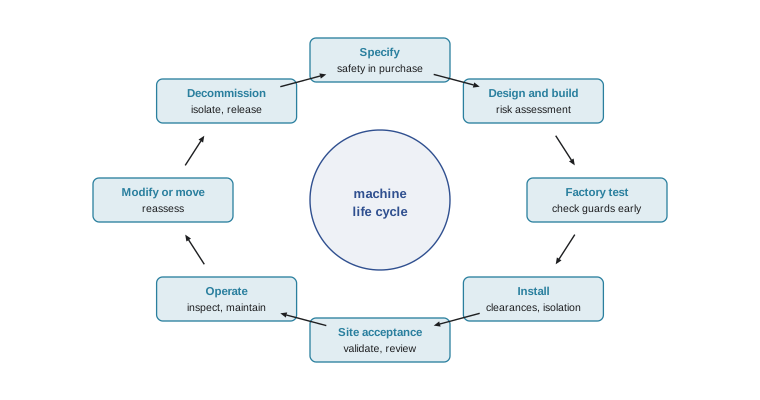
Factory and site acceptance tests
Large machines are often tested twice: a factory acceptance test (FAT) at the supplier's facility before shipping, and a site acceptance test (SAT) after installation. Safety should be part of both. At the factory, the buyer can check guard distances, interlock behavior, emergency stops and modes before the machine is crated, when changes are still cheap. At the site, the safeguarding is validated in its final position, with the actual floor, the connected equipment and the real material, and stopping times are measured under worst-case conditions.
| Acceptance item | What to check |
|---|---|
| Documentation | Risk assessment, declaration of conformity, electrical certification, safety function verification, manuals |
| Guards | Safety distances, fasteners, materials, no new hazards, visibility |
| Interlocks and devices | Each guard and device stops hazardous motion; no restart on closing; guard locking where needed |
| Emergency stops | Location, latching, reset behavior, all motion stops |
| Stopping time | Measured under worst-case conditions and compared with safety distances |
| Modes | Setup and cleaning modes with reduced speed, enabling devices and key-switch selection |
| Energy isolation | All sources identified, lockable isolation points, stored energy release, lockout procedure |
| Training | Operators, setters and maintainers trained, and records kept |
Used and relocated machines
Used machines bought at auction or transferred from another plant often have missing guards, outdated controls, removed interlocks and no documentation. They may have been safe in their original setting and become hazardous in a new layout. Before a used or relocated machine is put into service, treat it like a new machine: perform a risk assessment, bring the safeguarding up to current standards, check the electrical equipment, write a lockout procedure, and in Ontario determine whether a pre-start review is required. Moving a machine changes clearances, access routes and interactions with nearby equipment, so relocation is itself a reason to reassess.
Modifications
Modifications are a common source of hidden hazards. Increasing speed changes stopping distances. Adding a feeder creates a new interface. Changing tooling changes nip points. Replacing a control panel or reprogramming a safety controller can change how safety functions behave. A change that seems minor to production can be major for safety. Organizations need a management of change process for machines: any modification is reviewed for its effect on the risk assessment, safeguarding and safety functions, and significant changes are revalidated before use. In Ontario, some modifications trigger a new pre-start review.
Worked problem
Does a speed increase need a review?
A production manager wants to raise the speed of a press by 25 %. The current light curtain was positioned using Ds = 63 × Ts with Ts = 175 ms. Assume the stopping time increases in proportion to speed. What is the new required distance, and what should happen?
Show solution
- New stopping time: \( 175 \times 1.25 \approx 219 \text{ ms} \).
- New distance: \( D_s = 63 \times 0.219 \approx 13.8 \text{ in} \), compared with the original \( 63 \times 0.175 \approx 11.0 \text{ in} \).
- The curtain would be about 2.8 in too close.
Answer: The speed change requires the safeguarding to be reassessed: stopping time must be measured at the new speed, the curtain repositioned and gaps re-guarded, and the change documented. In Ontario this may trigger a pre-start review. Treat speed changes as modifications.
Decommissioning
At the end of its life, a machine must be safely decommissioned: energy isolated and permanently disconnected, stored energy released, hazardous materials such as hydraulic oil and lubricants removed, and the machine either scrapped or sold with clear information about its condition. Selling an unsafe machine without warning can create liability, and buying one without assessing it repeats the cycle.
Working with suppliers and integrators
Buyers often have more influence than they realize. A supplier that wants the order will usually provide a risk assessment, adapt guarding and attend acceptance tests if these are written into the contract. Clear contract language helps: state who is responsible for safeguarding at interfaces between machines from different suppliers, who integrates the safety controls of the whole line, and who signs off the final validation. When several suppliers each assume someone else is responsible, gaps appear at exactly the places where conveyors meet machines and robots meet fixtures.
It also helps to involve the people who will run and maintain the machine early. Operators can point out where they will need to load, watch and clear jams; maintainers can ask for lockout points, lifting points and access platforms. Their input at the specification and factory acceptance stages prevents the guards that get in the way and the workarounds that follow.
Keep the resulting documents together in a machine file: the purchase specification, the supplier's risk assessment and declarations, NRTL listing information, acceptance test results, the lockout procedure and training records. The file travels with the machine if it is moved or sold.
Finally, plan training before the machine arrives. Operators, setters and maintainers should be trained on the new safeguarding, the operating modes and the lockout procedure before the machine enters production, not after the first jam.
Training records should show who was trained, on which machine and modes, by whom and when, and they should be refreshed when the machine or the procedures change.
Common mistakes
MistakeAssuming a new or CE-marked machine is automatically compliant.
InsteadAssess every machine against local requirements and your actual tasks.
MistakeLeaving safeguarding out of the purchase specification.
InsteadSpecify standards, risk assessment, performance levels, lockout points and acceptance tests.
MistakeTesting safety only after installation.
InsteadInclude safety in the factory acceptance test, when changes are cheap.
MistakePutting used machines straight into service.
InsteadTreat used and relocated machines like new ones: assess, upgrade and document.
MistakeTreating speed or tooling changes as production matters only.
InsteadRun them through management of change and revalidate safeguarding.
Summary and key terms
- New machines may not be safe for your tasks, layout or integration; the employer remains responsible.
- Purchase specifications should require standards compliance, risk assessments, performance levels and acceptance tests.
- CE marking shows a risk-based process but is not proof of North American compliance.
- In the US, formal acceptance and commissioning reviews are good practice under ANSI B11.0.
- Factory and site acceptance tests should validate guards, devices, emergency stops, modes and stopping times.
- Used and relocated machines need full reassessment before use.
- Modifications such as speed changes need management of change and revalidation.
- Purchasing specification
- A written statement of the requirements a machine must meet.
- Supplier
- A manufacturer, distributor or other party that provides a machine.
- Integrator
- A party that combines machines and equipment into a system.
- CE marking
- The manufacturer's declaration of conformity with European Union requirements.
- Pre-start health and safety review (PSR)
- An Ontario review of certain new or modified machines before use.
- Factory acceptance test (FAT)
- Testing a machine at the supplier's facility before shipping.
- Site acceptance test (SAT)
- Testing a machine after installation at the user's site.
- Management of change
- A process for reviewing changes for their effect on safety before they are made.
- Relocation
- Moving a machine to a new location, which requires reassessment.
- Decommissioning
- Safely taking a machine out of service at the end of its life.
Practice problems
Work each problem on paper first, then reveal the answer to check.
Why might a new machine be unsafe in your workplace?
Show answer
It may be designed for another market, built to a price, not assessed for your tasks or integrated with other equipment.
Name four items to include in a machine purchase specification.
Show answer
Standards compliance, electrical certification, supplier risk assessment, performance levels, lockout points, modes, manuals and acceptance tests.
What does CE marking indicate?
Show answer
The manufacturer declares conformity with EU machinery requirements; it does not prove North American compliance.
Who should perform a US acceptance review?
Show answer
A qualified person with machine safety competence.
What is the difference between a FAT and a SAT?
Show answer
A FAT is at the supplier before shipping; a SAT is after installation at the site.
Why should safety be part of the factory acceptance test?
Show answer
Changes are cheaper before the machine is shipped and installed.
A stopping time rises from 150 ms to 200 ms after a speed change. By how much does a 14 mm curtain's safety distance change?
Show answer
It rises from 300 mm to 400 mm, an increase of 100 mm.
What should be done before putting a used machine into service?
Show answer
Risk assessment, safeguarding upgrade, electrical check, lockout procedure and any required review.
Give two examples of modifications that can affect safeguarding.
Show answer
Speed increases, new feeders, tooling changes, control panel replacement or safety program changes.
What happens to the EU machinery rules in January 2027?
Show answer
The Machinery Regulation 2023/1230 replaces the Machinery Directive 2006/42/EC.
Lesson quiz · 5 questions
Score 60% or more to complete this lesson.
Create a free account to save your progress, take quizzes and earn a certificate.