
HSE-213 · Lesson 5 of 12 · 28 min
Setting up portable ladders
Most ladder falls start with a ladder that was set up badly. It slid out at the base, tipped sideways, slipped at the top, sank into soft ground or was struck by a door or a vehicle. HSE-106 introduced the basic four-to-one rule. This lesson goes further: how to choose a location, calculate the length you need, set the angle, extend the ladder above a landing, secure it top and bottom, deal with uneven or soft ground, and keep clear of doors, traffic and power lines.
Plan the location first
Before carrying the ladder in, look at where it will stand and where the top will rest.
- The base needs a firm, level, clean surface that will not shift or sink. Concrete and asphalt are good; mud, gravel, loose boards, ice and polished floors are not, unless you use the right feet or a base plate.
- The top support must be strong and flat enough to take the load: a wall, roof edge or structural member, not a window pane, gutter, pipe or a stack of boxes.
- Check the area above and around for overhead power lines, lights, pipes, sprinkler heads and moving equipment.
- Check the area at the base for doors, walkways, vehicle routes and other workers.
- Think about how materials will get up, because carrying them while climbing is not allowed.
Getting the angle right
A non-self-supporting ladder that is too steep can tip backwards when the user leans away. One that is too shallow puts large forces on the base and can slide out. The standard set-up gives an angle of about 75 degrees from the ground.
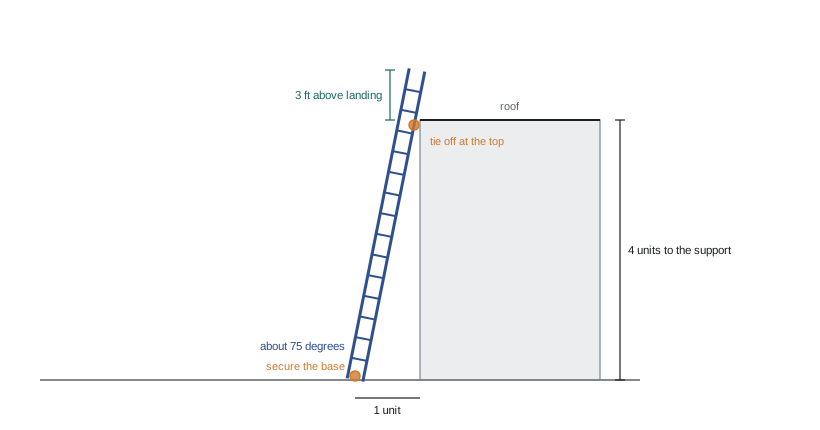
- For every 4 units of height to the point where the ladder rests, move the base out 1 unit. This gives an angle of about 75.5 degrees.
- OSHA's 1926.1053(b)(5)(i) requires the horizontal distance from the top support to the foot to be about one quarter of the working length of the ladder.
- A quick field check: stand with your toes against the ladder feet and stretch your arms straight out. Your palms should just touch the rung in front of you. Many ladders carry an angle indicator sticker, and free apps such as NIOSH's ladder safety app use a phone's sensor to check the angle.
Self-supporting ladders such as stepladders are not leaned against walls. They must be fully opened with the spreaders locked. A closed stepladder leaned against a wall is used at the wrong angle, its feet are not designed for that loading and it can slide out.
Worked problem
Calculating the base distance and angle
An extension ladder will rest against a wall at a point 18 ft above the ground. How far out should the base be, and what is the angle? What happens if the base is placed 8 ft out?
Show solution
- Base distance = height ÷ 4 = 18 ÷ 4 = 4.5 ft.
- Angle = \( \arctan(18/4.5) = \arctan(4) \approx 76 \) degrees.
- With the base 8 ft out, the angle is \( \arctan(18/8) \approx 66 \) degrees, much too shallow.
- At a shallower angle the horizontal force the feet must resist roughly doubles, so the base is far more likely to slide out, especially on a smooth floor.
Answer: Set the base 4.5 ft out for about 76 degrees. At 8 ft the ladder is at about 66 degrees and at real risk of sliding.
Choosing the length of an extension ladder
Extension ladders are sold by their total length, the sum of the sections. The usable working length is shorter, because the sections must overlap. Manufacturers mark the maximum working length and the minimum overlap. A common rule is about 1 m (3 ft) of overlap for ladders up to about 11 m (36 ft), with more for longer ladders. Never separate the sections of an extension ladder to make two ladders unless the manufacturer allows it, and never tie two ladders together to make a longer one.
Worked problem
How long a ladder do you need to reach a roof?
A worker needs to get onto a flat roof whose edge is 20 ft above the ground. The ladder must extend 3 ft above the roof edge, be set at four to one and have at least 3 ft of overlap between sections. What total ladder length is needed?
Show solution
- Length from the ground to the roof edge along the ladder: \( \sqrt{20^2 + 5^2} \approx 20.6 \) ft (the base is 20 ÷ 4 = 5 ft out).
- Add the extension above the roof edge, about 3 ft along the rails: working length ≈ 23.6 ft.
- Add the overlap: 23.6 + 3 = 26.6 ft total ladder length.
- Choose the next standard size up, a 28 ft extension ladder, checking that its marked maximum working length is at least 23.6 ft.
Answer: A 28 ft extension ladder. A 24 ft ladder would be too short once overlap and extension are counted.
Extending above the landing
When a ladder is used to get onto a roof, platform or floor, OSHA's 1926.1053(b)(1) requires the side rails to extend at least 3 ft above the landing. If that is not possible because of the ladder's length, the ladder must be secured at its top to a rigid support and a grasping device such as a grab rail provided. In general industry, 1910.23(c)(9) has a similar requirement.
Securing the ladder
Ladders slip in three ways: the base slides out, the top slides sideways or the whole ladder tips. Securing the ladder at both ends prevents all three.
- Tie off at the top: secure both rails to the structure with straps, rope or a ladder clamp, so that the top cannot slide sideways or lift. Many commercial roofs have permanent ladder tie-off points.
- Secure the base: use a base tie, cleats, a ladder stop or a heavy anchor block; or have a second worker foot the ladder while the first worker climbs up and ties off the top.
- Footing a ladder by hand is only a temporary measure. It works for short ladders and only while the person holding it stays in place, alert and away from falling objects.
OSHA requires ladders to be secured to prevent accidental displacement when used on surfaces that could make them slip, and in locations where they could be displaced by activities or traffic (1926.1053(b)(6) to (8)).
Uneven, soft or slippery ground
- Never prop a ladder on bricks, boxes or loose blocks to level it.
- Use manufacturer-approved leg levelers or a ladder leveling base to compensate for slopes and steps.
- On soft ground, use spurs or a wide base plate on firm footing; on smooth floors use rubber feet and secure the base; on ice, clear the area or use ice spurs designed for the ladder.
- Check that both feet bear evenly. A ladder that rocks before you climb will rock more under load.
Doors, traffic and people
A ladder in front of a door can be knocked over when the door opens. Lock or block the door and post a sign, or station someone to guard it. In walkways and parking areas, set up barricades or cones around the base. In stores and offices, keep the public away from the work zone. Never place a ladder on a truck bed, scaffold, box or other object to gain height unless the ladder and set-up are designed for it.
Power lines and electrical equipment
Look up before raising a ladder. Carrying and raising long ladders near overhead lines is a common cause of electrocution, because the ladder swings above the worker's head. Under 1910.333(c)(3), unqualified workers and the conductive objects they handle must stay at least 10 ft from overhead lines up to 50 kV, plus 4 in for every 10 kV above that. Keep metal ladders well clear of any electrical equipment, lower long ladders before moving them and use ladders with nonconductive side rails for electrical work.
Worked problem
Checking clearance before raising a ladder
A painter plans to raise a 28 ft aluminum extension ladder against a house. An overhead distribution line carrying 14.4 kV runs 22 ft from the wall at a height of 26 ft. Is the plan safe?
Show solution
- While being raised, the ladder sweeps an arc with a radius roughly equal to its length, 28 ft, around the person raising it.
- The line is only 22 ft from the wall, so a ladder raised near the wall could easily come within 10 ft of it, or touch it.
- An aluminum ladder would conduct a fault directly through the worker.
Answer: No. Raise the ladder well away from the line, use a fiberglass ladder with nonconductive rails, or have the utility de-energize or cover the line.
Raising and lowering extension ladders
Raise extension ladders with the fly section on the side recommended by the manufacturer. With the base against a wall or footed by a helper, walk the ladder up hand over hand, then pull it out to the correct angle. Extend the fly section with the rope while the ladder is vertical or nearly so, check that both rung locks engage, then set the angle. Long ladders need two people. Reverse the process to lower the ladder, and never let it fall.
A set-up checklist
Before anyone climbs, a quick set-up check confirms that the ladder is ready:
- base on a firm, level, clean surface, both feet bearing evenly;
- angle about four to one, checked with the arm test, a sticker or an app;
- top resting on a solid surface with both rails in contact, using a stand-off where needed;
- extension above the landing or a grab rail in place;
- rung locks engaged and overlap correct on extension ladders;
- ladder tied off at the top and secured at the base, or footed for the initial climb to tie off;
- doors locked or guarded, area barricaded, and overhead lines checked.
Only when every item is confirmed should the climb begin.
If any item cannot be met, change the plan: move the ladder, get a longer one or choose a different means of access.
Common mistakes
MistakeLeaning a closed stepladder against a wall.
InsteadOpen stepladders fully and lock the spreaders; use an extension ladder for leaning.
MistakeSetting the base far out so the ladder feels easier to climb.
InsteadUse four to one; shallow angles let the base slide out.
MistakeStopping the ladder level with the roof edge.
InsteadExtend the side rails at least 3 ft above the landing.
MistakeRelying on someone to foot the ladder for a long job.
InsteadTie the ladder off at the top and secure the base.
MistakeRaising a long metal ladder without looking up.
InsteadCheck for power lines and keep the required clearance.
Summary and key terms
- Plan the base, the top support, overhead hazards, doors, traffic and materials handling before setting up.
- Set non-self-supporting ladders at four to one, about 75 degrees.
- Calculate extension ladder length including the angle, the extension above the landing and the overlap.
- Extend side rails at least 3 ft above a landing, or secure the top and provide a grab device.
- Secure ladders at the top and bottom; footing by hand is temporary.
- Use approved levelers, spurs and feet; never prop a ladder on loose objects.
- Guard doors and traffic routes, and keep ladders clear of power lines.
- Four-to-one rule
- Set the base 1 unit out for every 4 units of height to the top support.
- Working length
- The usable length of an extension ladder after subtracting the overlap.
- Overlap
- The length by which extension ladder sections must overlap when extended.
- Fly section
- The upper, sliding section of an extension ladder.
- Base section
- The lower section of an extension ladder.
- Tie-off
- Securing the top or bottom of a ladder to prevent movement.
- Footing a ladder
- Holding the base of a ladder by hand to stop it moving, a temporary measure.
- Leg leveler
- An approved device that adjusts one leg to level a ladder on uneven ground.
- Ladder stand-off
- An accessory that spaces the top of a ladder from the wall.
- Limit of approach
- The minimum distance from energized lines that people and objects must keep.
Practice problems
Work each problem on paper first, then reveal the answer to check.
Where should the base of a ladder be if the top rests at 16 ft?
Show answer
4 ft out.
What angle does four to one give?
Show answer
About 75 degrees.
Why is a shallow angle dangerous?
Show answer
It increases the horizontal force at the base, which can slide out.
How far must ladder side rails extend above a landing?
Show answer
At least 3 ft.
What is the difference between total and working length?
Show answer
Working length is total length minus the required overlap.
How should a ladder be secured for a long job?
Show answer
Tie off at the top and secure the base.
What can you use on soft ground?
Show answer
Spurs or a wide base plate on firm footing.
What should you do about a door near the ladder base?
Show answer
Lock or block it, sign it or station a guard.
What minimum distance must an unqualified worker keep from a 13 kV line?
Show answer
10 ft.
How should an extension ladder be raised?
Show answer
Walk it up with the base secured, extend the fly while near vertical, check the locks, then set the angle.
Lesson quiz · 5 questions
Score 60% or more to complete this lesson.
Create a free account to save your progress, take quizzes and earn a certificate.