
HSE-213 · Lesson 7 of 12 · 29 min
Fixed ladders, ladder safety systems and job-built ladders
Not every ladder is portable. Fixed ladders are permanently attached to buildings, tanks, towers, silos, machines and roofs, and they are often the only way to reach equipment that needs regular maintenance. On construction sites, carpenters sometimes build wooden ladders to suit the job. This lesson covers the design features of fixed ladders, the move away from cages toward ladder safety systems and personal fall arrest, inspection of fixed ladders, and the rules for job-built ladders.
Features of a fixed ladder
A fixed ladder is attached to a structure and usually rises vertically or nearly so. Because it is permanent, it must be designed and installed correctly from the start, usually to a national standard and the building code.
OSHA's 1910.23(d) sets design requirements for fixed ladders in general industry. Typical requirements include:
- rungs spaced 10 to 14 in apart, evenly, and at least 16 in clear width between rails;
- at least 7 in of clearance behind the rungs for the toes, and 30 in on the climbing side;
- side rails extending 42 in above the top landing, or grab bars that provide the same support;
- rungs, rails and anchorages strong enough for the expected loads;
- landings and platforms with guardrails and self-closing gates at the top, so that the climber is not exposed to the edge when stepping off;
- rest platforms at intervals on tall ladders;
- protection against corrosion, ice and slippery surfaces.
From cages to ladder safety systems
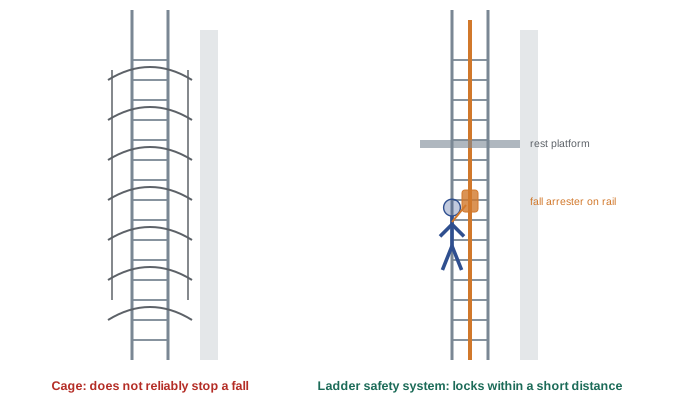
For decades, tall fixed ladders were fitted with cages: hoops around the climbing space attached to vertical bars. Cages give a sense of security, but research and incident experience show they do little to stop a fall. A falling climber can slide down inside the cage, hit the hoops and bars, or be trapped with injuries. Cages also make rescue difficult.
Modern practice uses ladder safety systems, also called fall arrest systems for fixed ladders or climbing protection. A rigid rail or a vertical cable runs the height of the ladder. The climber wears a full body harness and connects the front chest D-ring to a sliding device, the fall arrester, which travels with them and locks automatically if they fall. The free fall is very short, usually well under 0.6 m. Alternatively, a self-retracting device anchored above the ladder can be used for some climbs.
OSHA's 2016 walking-working surfaces rule changed the requirements for general industry. Under 1910.28(b)(9), fixed ladders that extend more than 24 ft above a lower level must have a ladder safety system or personal fall arrest system. New fixed ladders installed on or after November 19, 2018 must have one. When a section of an existing ladder is replaced, that section must get one. By November 18, 2036, all fixed ladders over 24 ft must have a ladder safety system or personal fall arrest system, and cages and wells will no longer count as fall protection. Construction rules in 1926.1053(a)(19) still allow cages, wells, ladder safety devices or self-retracting lifelines on fixed ladders over 24 ft.
| Feature | Cage | Ladder safety system |
|---|---|---|
| Stops a fall? | Not reliably; the climber can slide or fall inside it | Yes; locks within a short distance |
| Needs a harness? | No | Yes, connected to the front D-ring |
| Free fall distance | Can be the full height | Usually well under 0.6 m (2 ft) |
| Rescue | Difficult inside the cage | Easier; climber held on the rail |
| Inspection | Hoops and bars | Rail or cable, sleeve, anchors and harness |
Worked problem
Rest platforms on a tall fixed ladder
A fixed ladder on a tower rises 400 ft and has a ladder safety system. OSHA's 1910.28(b)(9)(iii) requires rest platforms at maximum intervals of 150 ft for ladder safety systems. How many intermediate rest platforms are needed?
Show solution
- Divide the height by the maximum interval: 400 ÷ 150 ≈ 2.7.
- Round up to 3 equal spans, which means 2 intermediate platforms.
- Each span is then 400 ÷ 3 ≈ 133 ft, within the 150 ft limit.
Answer: Two intermediate rest platforms, giving three spans of about 133 ft.
Using a fixed ladder safely
- Inspect the ladder safety system, the fall arrester and your harness before climbing. The arrester must suit the rail or cable and be installed the right way up.
- Connect to the system from a safe position before you reach the fall hazard, and stay connected until you are on a guarded landing.
- Climb with three points of contact. The ladder safety system is a backup, not a handrail; do not lean back on it.
- Do not carry tools or materials by hand. Use a hoist or bag on a line.
- Use rest platforms on long climbs. Climbing a tall ladder is tiring, and fatigue leads to slips.
- Have a rescue plan. A worker arrested on a ladder safety system may be injured or exhausted. HSE-212 covers suspension intolerance and rescue.
Inspecting fixed ladders
Fixed ladders are exposed to weather, corrosion and damage, and they are often in places nobody looks at closely. Include them in the periodic inspection program. Check:
- anchorage to the structure, including bolts, welds and brackets;
- rungs for looseness, bending, corrosion and wear;
- side rails for cracks, corrosion and deformation;
- the ladder safety system rail or cable, tension, anchors, gates and stops;
- cages and hoops, if present, for damage;
- landings, platforms, guardrails and self-closing gates;
- ice, bird droppings, oil or other slippery build-up.
OSHA's 1910.22(d) requires walking-working surfaces, including fixed ladders, to be inspected regularly and as necessary and maintained in safe condition; ladder safety systems also need inspection by a competent person as the manufacturer requires, usually at least once a year.
Roof ladders and access hatches
Roof hatches and ladders from inside buildings are a common route to rooftop equipment. The opening at the top is a fall hazard both for the climber and for anyone walking on the roof. Hatches should have guardrails or a self-closing safety railing system around the opening, and grab bars or rail extensions to help the climber step out. Keep the hatch closed when nobody is using it, and never leave it open unguarded. Roof ladders that hook over a ridge are used on steep roofs by roofers and should be secured and used with fall protection.
Job-built ladders
On construction sites, a carpenter may build a wooden ladder for a specific location, for example to reach a formwork deck or to get in and out of an excavation. Job-built ladders must be built to a recognized design.
OSHA's 1926.1053(a) applies to job-made ladders as well, including rung spacing of 10 to 14 in, and ANSI A14.4 covers job-made wooden ladders. Single-cleat ladders are for limited lengths and one-way traffic; double-cleat ladders, with a center rail, are used where 25 or more workers use the ladder or two-way traffic is expected (1926.1051). The ladder must still extend above the landing and be secured.
Worked problem
Building a job-made ladder
A crew needs a single-cleat wooden ladder to reach a deck 10 ft above grade. The ladder will be set at four to one and must extend 3 ft above the deck. Cleats will be spaced at 12 in. About how many cleats are needed?
Show solution
- Length to the deck along the ladder ≈ \( 10 \times 1.031 \approx 10.3 \) ft.
- Add the extension above the deck: total rail length ≈ 10.3 + 3 = 13.3 ft.
- Cleats run from about 12 in above the base to the deck level: 10.3 ÷ 1 ≈ 10 cleats, plus the rails above the deck for handholds.
Answer: About 10 cleats on rails about 13.3 ft long, with the rails extending 3 ft above the deck.
Job-built ladders must be inspected like any other ladder, kept clean and removed when no longer needed. Nailed cleats should be fastened as the design specifies, with filler blocks between cleats where required, and never made of scrap or damaged lumber.
Planning for the change to ladder safety systems
Building owners with many fixed ladders face a long upgrade program. A typical approach is to survey every fixed ladder, record its height, condition and protection, rank the ladders by risk and frequency of use, and schedule upgrades. Ladders that can be replaced by stairs or eliminated by moving equipment should be considered first. Budgeting a few ladders a year is easier than replacing all of them at the last minute.
Ladders on equipment and vehicles
Fixed ladders are also found on machines, trucks, tanks, rail cars and mobile equipment. Getting on and off equipment is a common cause of falls in mining, transport and agriculture. The same principles apply: steps and rungs evenly spaced and slip-resistant, handholds at the right places, three points of contact, facing the equipment when climbing down, and never jumping from the last step. Keep equipment ladders clean of mud, ice and oil, and replace bent or broken steps promptly. Many equipment standards set step and handhold dimensions, and manufacturers' operating manuals describe safe mounting and dismounting.
Ships' ladders and alternating tread devices
Some workplaces have steep stairs called ship stairs, or alternating tread-type stairs, where space is too tight for ordinary stairs. OSHA's 1910.25 sets angles and dimensions for ship stairs (between 50 and 70 degrees) and alternating tread-type stairs (between 50 and 70 degrees, with specific tread rules). Users should descend facing the treads and hold both handrails. Where possible, replace them with standard stairs during renovations.
Retrofitting a fixed ladder
Retrofitting a ladder safety system to an existing fixed ladder is usually done by a specialist installer. The installer checks that the ladder and its anchorage can take the arrest loads, chooses a system compatible with the ladder's rungs or rails, installs it per the manufacturer's instructions and provides training and an inspection schedule. Owners should also check the top landing: a ladder safety system is of limited use if the climber has to unclip to step over an unguarded parapet at the top. A guarded landing with a self-closing gate completes the system.
Worked problem
Budgeting a fixed ladder upgrade program
A property company has 30 fixed roof ladders over 24 ft high, all with cages. Installing a ladder safety system costs about 4,500 dollars per ladder, and a self-closing gate and grab rails at the top about 1,500 dollars. If the company upgrades 6 ladders a year, how many years will it take and what is the annual budget?
Show solution
- Cost per ladder = 4,500 + 1,500 = 6,000 dollars.
- Years = 30 ÷ 6 = 5.
- Annual budget = 6 × 6,000 = 36,000 dollars, before inflation.
- Prioritize ladders used most often, the tallest, and those with damaged cages or unguarded tops.
Answer: Five years at about 36,000 dollars a year, starting with the highest-risk ladders. These figures are illustrative; get quotes for real budgets.
Common mistakes
MistakeTreating a cage as fall protection.
InsteadUse a ladder safety system or personal fall arrest system on tall fixed ladders.
MistakeConnecting the fall arrester to the back D-ring.
InsteadConnect to the front chest D-ring as the manufacturer specifies.
MistakeLeaving a roof hatch open and unguarded.
InsteadGuard the opening or keep the hatch closed when not in use.
MistakeBuilding a job ladder from scrap lumber with uneven cleats.
InsteadUse construction-grade lumber and a recognized design with even spacing.
MistakeNever inspecting fixed ladders because they are permanent.
InsteadInclude fixed ladders and their safety systems in periodic inspections.
Summary and key terms
- Fixed ladders need even rungs, toe clearance, rail extensions, strong anchorage and guarded landings.
- Cages do not reliably stop falls; ladder safety systems and personal fall arrest do.
- Fixed ladders over 24 ft need ladder safety or fall arrest systems, with cages not accepted after November 18, 2036.
- Connect to the ladder safety system before reaching the hazard and stay connected until on a guarded landing.
- Inspect fixed ladders, rails, anchors, landings and safety systems regularly.
- Guard roof hatches and keep them closed when not in use.
- Build job-made ladders to a recognized design with construction-grade lumber and even cleats.
- Fixed ladder
- A ladder permanently attached to a structure.
- Cage
- Hoops around the climbing space of a fixed ladder; not reliable fall protection.
- Ladder safety system
- A rail or cable with a sliding fall arrester connected to the climber's harness.
- Fall arrester
- The sliding device that travels on a rail or cable and locks if the climber falls.
- Rest platform
- A platform at intervals on a tall ladder where the climber can rest.
- Self-closing gate
- A gate at a ladder landing that closes behind the user to guard the opening.
- Roof hatch
- An opening in a roof reached by a fixed ladder from inside.
- Job-built ladder
- A ladder built on site for a specific location.
- Single-cleat ladder
- A job-built ladder with one row of cleats between two rails.
- Double-cleat ladder
- A job-built ladder with a center rail and two rows of cleats for two-way traffic.
Practice problems
Work each problem on paper first, then reveal the answer to check.
Why are cages no longer considered fall protection?
Show answer
A falling climber can slide or fall inside the cage and be injured.
Where does a ladder safety system connect to the harness?
Show answer
To the front chest D-ring.
When did new fixed ladders over 24 ft first need a ladder safety system?
Show answer
On or after November 19, 2018.
How many rest platforms does a 300 ft ladder need at 150 ft intervals?
Show answer
One intermediate platform (two spans of 150 ft).
Name four things to check on a fixed ladder.
Show answer
Anchorage, rungs, rails, safety system, landings and slippery build-up.
How should a roof hatch be protected?
Show answer
With a guardrail or self-closing railing system, and kept closed when not in use.
When is a double-cleat job-built ladder used?
Show answer
Where many workers use it or two-way traffic is expected.
What spacing do job-built ladder cleats use?
Show answer
10 to 14 in, evenly spaced.
Why plan upgrades of fixed ladders early?
Show answer
There are often many ladders and replacing them all at once is costly and slow.
Is a ladder safety system a handrail?
Show answer
No. It is a backup; climb with three points of contact.
Lesson quiz · 5 questions
Score 60% or more to complete this lesson.
Create a free account to save your progress, take quizzes and earn a certificate.