
HSE-213 · Lesson 4 of 12 · 29 min
Ladder inspection, care and storage
A ladder can look sound from a distance and still be dangerous. A hairline crack in a fiberglass rail, a worn foot, a rung lock that does not fully engage or a bent stepladder brace can turn an ordinary climb into a fall. Inspection is how those defects are found before they hurt someone. This lesson covers who inspects ladders and when, what to look for on each type, how to tag and remove defective ladders, and how to clean, store and transport ladders so that they stay in good condition.
Who inspects, and when
OSHA requires ladders to be inspected by a competent person for visible defects on a periodic basis and after any occurrence that could affect their safe use (1926.1053(b)(15)), and in general industry before the initial use in each work shift and more often as necessary (1910.23(b)(9)). In practice, three levels of inspection work together:
- Pre-use inspection by the user, every time the ladder is used. It takes a minute or two and focuses on obvious damage, missing parts and function.
- Periodic inspection by a competent person, often monthly or quarterly depending on use, with a written record. It is more thorough and includes parts that users may not check closely.
- Special inspection after an incident, a fall, a drop from a vehicle, exposure to fire, chemicals or heat, or when someone reports a problem.
Many employers mark each ladder with an identification number and keep a simple log of periodic inspections. A tag or sticker on the ladder showing the last inspection date helps users see that the system is working.
What to check on every ladder
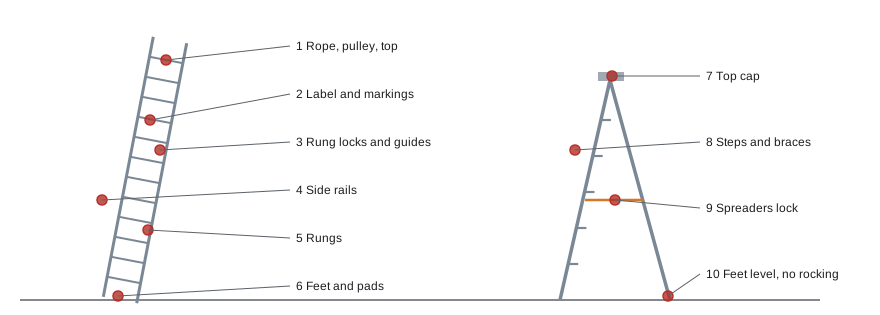
- Labels and markings: the manufacturer's label, the grade or duty type, the maximum length and the safety instructions must be present and readable. A ladder without its label cannot be confirmed to meet the standard.
- Side rails: no cracks, splits, bends, dents, corrosion, burns or chemical damage. On fiberglass look for cracks, chips, fiber bloom and delamination. On aluminum look for bends, dents and sharp kinks. On wood look for splits, rot, warping and loose joints.
- Rungs and steps: tight, straight, not bent, worn smooth or missing, and free of oil, grease, paint and mud. Slip-resistant surfaces should be intact.
- Feet and pads: present, the right type for the surface, swivelling freely, not worn through to the metal and not loose.
- Hardware: rivets, bolts, braces and brackets tight and undamaged; no missing fasteners.
- Cleanliness: no slippery contamination, and no build-up that could conceal defects or conduct electricity.
Extra checks by ladder type
| Ladder type | Extra checks |
|---|---|
| Stepladder | Spreaders lock fully and are straight; top cap secure and undamaged; rear braces intact; legs equal length; ladder does not wobble when open |
| Extension ladder | Rung locks engage fully on each rung and are not worn; guide brackets hold the sections; rope not frayed and pulley turns; sections slide freely; stops and end caps present |
| Multi-position ladder | Every hinge lock engages and releases correctly; locking indicators visible; no play in the hinges |
| Platform ladder | Platform secure and level; guardrail or knee rail tight; casters, if any, lock |
| Telescoping ladder | Every rung latch locks with an audible or visible indication; no damaged or bent tubes; sections retract smoothly |
| Fixed ladder | Anchorage to the structure; rungs secure; cage or ladder safety system intact; landings and gates working |
What to do with a defective ladder
A ladder with any defect that could affect its safety must be removed from service immediately. Do not try a quick fix such as taping a crack, wiring a broken spreader or straightening a bent rail. Ladders are designed as a system, and field repairs usually cannot restore the original strength.
- Tag it as dangerous or do not use, with the date, the defect and your name.
- Move it out of the work area so that nobody picks it up by mistake.
- Report it to the supervisor.
- Repair it only if the manufacturer allows the repair and uses approved parts, done by a competent person, and inspect it again before return to service.
- Otherwise, destroy it so that it cannot be used, for example by cutting it in half, and dispose of it.
Worked problem
Pre-use inspection decision
During a pre-use check on an aluminum extension ladder, a worker finds that the upper rung lock on one side snaps only halfway over the rung, the rope is slightly frayed near the pulley, and one foot pad is worn but the swivel works. What should the worker do?
Show solution
- A rung lock that does not fully engage could let the fly section slide down under load. This is a critical defect.
- A frayed rope is a defect that should be repaired with an approved replacement, but on its own it does not usually cause a fall once the locks are engaged.
- A worn foot pad reduces slip resistance and should be replaced, and is serious on smooth floors.
- The rung lock alone makes the ladder unsafe.
Answer: Do not use the ladder. Tag it out of service, remove it from the work area and report it. It may return to service only after a competent repair with manufacturer-approved parts and a fresh inspection.
Periodic inspection records
A periodic inspection record usually includes:
- ladder identification number, type, grade or duty type, material and length;
- inspection date and inspector's name;
- a checklist of each component with pass or fail;
- defects found and actions taken: repaired, tagged out or destroyed;
- the next inspection due date.
Records help show that the employer met the inspection requirements if OSHA investigates, and they reveal patterns such as a particular model failing repeatedly or a crew damaging ladders during transport.
Worked problem
Planning an inspection program
A facilities department has 64 portable ladders. Each periodic inspection takes 6 minutes, and 10 % of ladders are expected to need follow-up of 20 minutes each. The department chooses quarterly inspections. How much time is needed each year?
Show solution
- Inspections per year = 64 × 4 = 256.
- Inspection time = 256 × 6 = 1,536 minutes, or 25.6 hours.
- Follow-ups = 10 % of 256 ≈ 26, at 20 minutes = 520 minutes, or about 8.7 hours.
- Total ≈ 25.6 + 8.7 = 34.3 hours a year.
Answer: About 34 hours a year, less than one working week, to keep 64 ladders under a documented quarterly inspection program.
Cleaning and care
Clean ladders regularly with mild soap and water, especially after exposure to mud, paint, oil, grease, concrete or chemicals. Contamination makes rungs slippery and can hide defects. On fiberglass ladders, manufacturers may recommend periodic application of a protective coating to slow UV weathering. Lubricate locks, pulleys and hinges as the manufacturer directs, and never use a ladder that has been exposed to fire or strong chemicals until a competent person has inspected it.
Storage
Poor storage damages ladders as surely as misuse does.
- Store ladders indoors or under cover, away from heat sources, sunlight and moisture.
- Support straight and extension ladders horizontally on racks with supports at several points so that they do not sag, or store them vertically secured against falling.
- Do not hang ladders from a single rung or stack heavy material on them.
- Keep stepladders closed and secured so they cannot fall over.
- Keep ladders out of traffic routes and away from vehicles and doors.
- Secure ladders against unauthorized use, especially near open excavations, roofs or by the public.
Transport
Ladders are often damaged on vehicles. Use proper ladder racks with padded supports, secure the ladder at both ends so it cannot slide or bounce, and avoid overhanging loads that can strike other vehicles or pedestrians. Flag long overhangs as required by provincial or state traffic rules. Do not drop ladders from vehicles; impact can crack fiberglass and bend aluminum. After a ladder has been dropped or hit, give it a special inspection before use.
Inspecting in the field
Pre-use checks are quick only if they become a habit. Keep a short checklist on the ladder or in the truck, and make inspection part of the job briefing. Supervisors should spot-check ladders during site visits and ask workers to show them a pre-use inspection. A culture where workers feel comfortable tagging out a ladder and asking for a replacement prevents the pressure to make do with damaged equipment.
A pre-use inspection routine
A routine makes pre-use checks quick and thorough. One practical sequence is to inspect from the bottom up and then test the ladder:
- Lay the ladder down or stand it up in a clear area with good light.
- Check the label: grade or duty type, length and instructions present and readable.
- Check the feet and pads, then work up each side rail looking for damage.
- Check each rung or step, and the hardware holding it.
- On a stepladder, open it, lock the spreaders and check that it stands square without rocking; check the top cap.
- On an extension ladder, raise the fly a few rungs and check that both locks engage, the guides hold and the rope runs freely.
- Look for contamination on rungs and on the soles of your own boots.
If anything fails, stop there, tag the ladder and get another one. A two-minute check is far quicker than an incident investigation.
Why ladders get damaged
Knowing how ladders are damaged helps prevent it. Common causes are dropping ladders from vehicles or roofs, overloading, using ladders as planks or ramps, leaving them in the sun or in the weather, storing them under heavy materials, side loading during use, and contact with chemicals such as acids, solvents and concrete. Fiberglass is more sensitive to impact and sunlight than aluminum; aluminum is more prone to bending and denting. A ladder fleet that is being damaged quickly is a sign that work methods, storage or transport need attention, not just more replacement ladders.
Worked problem
Spotting a trend in the ladder log
A facilities manager reviews the ladder log for the year. Of 18 ladders removed from service, 11 were extension ladders with cracked fiberglass rails near the top, all assigned to the roofing and gutter crew. What does the pattern suggest?
Show solution
- Cracks near the top of extension ladders suggest impact or point loading at the top support, for example resting the rails on gutter edges or dropping the ladder against the wall.
- Concentration in one crew suggests a work method or transport issue rather than a defective model.
- Possible fixes include stand-offs that bear on the wall instead of the gutter, padded vehicle racks and training on raising and lowering.
Answer: The damage points to how the crew uses and transports its ladders. Fix the method with stand-offs, better racks and training, then watch the log to see whether the trend improves.
Common mistakes
MistakeUsing a ladder with a small crack because it held yesterday.
InsteadRemove any ladder with a defect from service immediately.
MistakeFixing a broken spreader with wire or tape.
InsteadRepair only with manufacturer-approved parts by a competent person, or destroy the ladder.
MistakeLeaving a tagged ladder leaning in the work area.
InsteadMove it out of the area so it cannot be picked up by mistake.
MistakeHanging ladders from one rung on a wall hook.
InsteadSupport ladders at several points on racks.
MistakeSkipping inspection after a ladder falls off a truck.
InsteadGive it a special inspection before anyone uses it.
Summary and key terms
- Inspect ladders before each use, periodically by a competent person, and after any incident.
- Check labels, rails, rungs or steps, feet, hardware and cleanliness on every ladder.
- Check spreaders and top caps on stepladders, and rung locks, guides and ropes on extension ladders.
- Remove defective ladders from service: tag, move, report, then repair properly or destroy.
- Keep simple records of periodic inspections.
- Clean, store and transport ladders so that they are not contaminated, sagging or impact-damaged.
- Make pre-use checks a habit supported by supervisors.
- Pre-use inspection
- A quick check by the user before each use.
- Periodic inspection
- A scheduled, documented inspection by a competent person.
- Special inspection
- An inspection after an incident, drop, fire or chemical exposure.
- Out-of-service tag
- A tag that marks equipment as unsafe and not to be used.
- Rung lock
- The latch that holds the sections of an extension ladder at a set length.
- Guide bracket
- A bracket that holds the fly and base sections of an extension ladder together.
- Top cap
- The top piece of a stepladder, which must not be stood on.
- Delamination
- Separation of the layers in a composite material such as fiberglass.
- Swivel foot
- A pivoting foot with a slip-resistant pad.
- Ladder log
- A record of each ladder and its inspections.
Practice problems
Work each problem on paper first, then reveal the answer to check.
What are the three levels of ladder inspection?
Show answer
Pre-use by the user, periodic by a competent person, and special after an incident.
Name four things to check on every ladder.
Show answer
Labels, rails, rungs or steps, feet, hardware and cleanliness.
What extra checks does an extension ladder need?
Show answer
Rung locks, guide brackets, rope and pulley, and free sliding.
What should you do with a ladder whose spreader is bent?
Show answer
Tag it, remove it from the area, report it and do not use it.
Why not tape a crack in a fiberglass rail?
Show answer
Field repairs cannot restore the original strength.
How should extension ladders be stored?
Show answer
Horizontally on racks with several supports, or vertically and secured.
What must happen after a ladder falls off a vehicle?
Show answer
A special inspection before use.
What goes in a periodic inspection record?
Show answer
Ladder ID, date, inspector, checklist, defects and actions, and next due date.
How long would 52 inspections of 5 minutes take?
Show answer
260 minutes, about 4.3 hours.
Why clean ladders?
Show answer
Contamination makes rungs slippery, hides defects and can conduct electricity.
Lesson quiz · 5 questions
Score 60% or more to complete this lesson.
Create a free account to save your progress, take quizzes and earn a certificate.