
HSE-108 · Lesson 6 of 12 · 25 min
Prevention: environmental design, work practices and training
Once the risks are understood, the next step is to control them. The hierarchy of controls applies to violence and harassment as it does to any hazard: eliminate the hazard where possible, substitute safer ways of working, use engineering and environmental controls to separate people from harm, use administrative controls to change how work is organized, and use personal protective equipment and personal alarms as a last layer. In practice, effective programs combine several layers, because no single control stops every incident. This lesson explains the main types of control and how to choose among them.
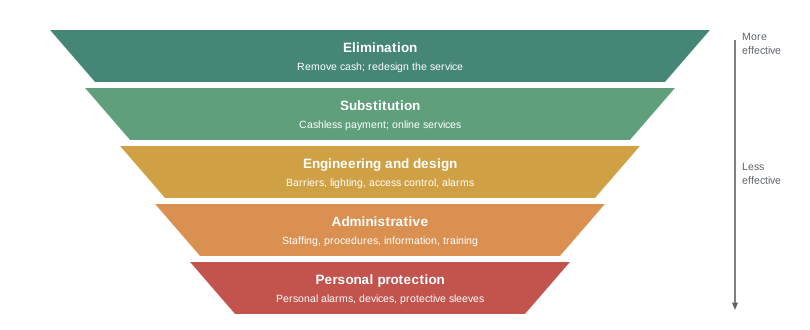
Elimination and substitution
The most effective controls remove the source of risk. A retail chain that moves to cashless payment at night removes the main motive for robbery. A government office that lets people renew documents online reduces the number of tense face-to-face interactions. A transit agency that stops requiring drivers to enforce fares, and instead uses fare inspectors in pairs, removes a common trigger for assaults on drivers. A hospital that redesigns its admission process to reduce waiting times reduces the frustration that fuels aggression. These changes are not always possible, but they should always be considered first, because they protect everyone without relying on anyone remembering to do the right thing.
Environmental design
Crime prevention through environmental design, often shortened to CPTED, is an approach that uses the design and management of physical space to reduce opportunities for crime and violence. It rests on four main principles:
- Natural surveillance: arrange spaces so that people can see and be seen. Use good lighting, clear sight lines, windows into interview rooms, convex mirrors and open counters, and avoid hidden corners.
- Access control: guide and limit who can enter which areas, with reception points, locked doors, card access, visitor sign-in and clear separation between public and staff areas.
- Territorial reinforcement: make it clear which spaces are private and who is responsible for them, using signs, landscaping and design features.
- Maintenance: keep spaces clean, repaired and well lit, because neglected spaces signal that no one is watching.
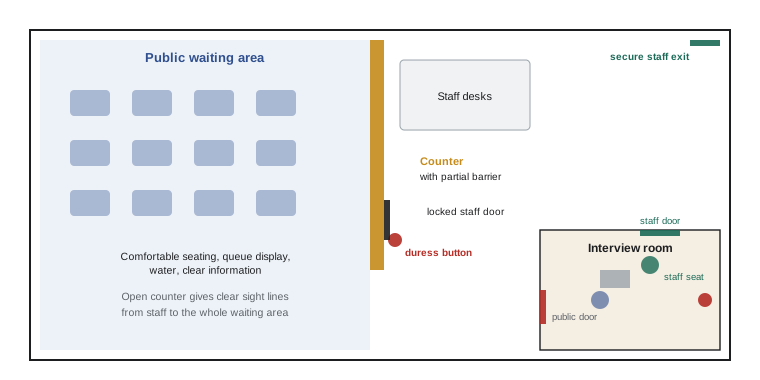
Specific engineering and environmental controls for violence include:
- Barriers and counters: deep or raised counters, partial or full barriers, and pass-through trays at cash and service points, chosen so that they protect without making communication impossible.
- Room layout: interview and treatment rooms with two exits where possible, staff seated nearest the exit, furniture that cannot easily be thrown, and no objects that could be used as weapons.
- Alarms and communication: fixed duress buttons, personal alarms, radios or mobile safety devices linked to a monitored response, with regular testing.
- Surveillance: video cameras, visible monitors and signs, used in line with privacy law and with clear rules about who can view recordings.
- Access: locked doors, keypads, controlled entry to wards and staff areas, safe rooms where staff can retreat, and secure staff parking with good lighting.
- Comfort: waiting areas with comfortable seating, natural light, low noise, information about waiting times, water and toilets, which reduce frustration and agitation.
- Cash and valuables: drop safes, time-delay safes, low cash limits and signs stating that staff cannot open the safe.
Administrative controls
Administrative controls change how work is organized. They depend on people following procedures, so they need supervision and review, but they are essential because most workplaces cannot design out every risk.
- Staffing: enough staff, with the right skills, at the right times. Avoid having one worker alone at high-risk times, and plan for breaks, peak periods and sick leave. Short staffing increases waiting times, reduces supervision and leaves workers isolated.
- Procedures: clear procedures for opening and closing, handling cash, admitting visitors, home visits, transporting clients, responding to alarms, and refusing service to abusive customers.
- Information sharing: systems to tell staff about clients or situations with a known risk of violence, consistent with privacy law, including flags, care plans and handover reports.
- Work scheduling: avoiding late-night solo shifts, rotating high-stress assignments and scheduling visits to high-risk clients in pairs or at safer times.
- Codes of conduct: posted expectations for customers and visitors, such as a statement that abuse of staff will not be tolerated, with the authority for staff to end interactions that become abusive.
- Policies on alcohol at work events, relationships between supervisors and subordinates, and use of social media and messaging tools, which help prevent harassment.
- Emergency response: trained response teams, such as hospital codes for violent situations, clear roles and regular drills.
Personal protection
Personal alarms, mobile duress devices, two-way radios, protective sleeves against bites and scratches, and stab-resistant vests for some security and corrections roles are the last layer of protection. They do not prevent incidents, but they can summon help faster and reduce injury. Their value depends on the response behind them: a personal alarm is useless if nobody hears it or nobody knows what to do. Test devices regularly, make sure workers wear them, and track response times.
Worked problem
Is the alarm response fast enough?
A mental health unit wants help to arrive within 2 minutes (120 s) of a duress alarm. When an alarm is pressed, the monitoring desk takes about 20 s to identify the location and dispatch the response team. The response team is based 180 m away, and responders move at about 2.0 m/s when hurrying through corridors. They then need about 15 s to pass through two locked doors. Does the current arrangement meet the target? If not, what are the options?
Show solution
- \[t_{\text{travel}} = \frac{d}{v} = \frac{180}{2.0} = 90\ \text{s}\]
- \[t_{\text{total}} = 20 + 90 + 15 = 125\ \text{s}\]
- Compare: 125 s is just over the 120 s target, and real conditions (lifts, crowded corridors, a second alarm) will make it worse.
- Options: base at least some responders on or next to the unit; make the alarm display location automatically to cut dispatch time; give responders badge access that opens doors faster; train unit staff as the first response layer.
- \[\text{If responders are 60 m away: } t = 20 + \frac{60}{2.0} + 15 = 65\ \text{s}\]
Answer: The current arrangement takes about 125 s and does not reliably meet the 2-minute target. Moving responders closer, automating location display and speeding door access would bring it to about 65 s, well within the target.
Training
Training is an administrative control, but it is so central that it deserves its own section. Effective training is matched to the risk: everyone needs basic awareness, while workers in high-risk roles need more in-depth, practical training with refreshers. A typical training program includes:
| Audience | Core content | Format |
|---|---|---|
| All workers | Policy, definitions, rights, how to report, where to get support, respectful behavior | Orientation and periodic refresher, often online plus discussion |
| Workers facing the public | Recognizing warning signs, de-escalation, safe positioning, summoning help, post-incident steps | Interactive, scenario-based, with practice |
| High-risk roles | Advanced de-escalation, team response, safe physical intervention or breakaway techniques where appropriate, risk screening | Hands-on training by qualified trainers with regular refreshers |
| Supervisors and managers | Receiving complaints, early intervention, investigations, supporting staff, preventing reprisal, modeling behavior | Workshop with case studies |
| Investigators and committee members | Investigation procedure, interviewing, evidence, confidentiality, trauma-informed practice | Specialized course |
Training works best when it is interactive and realistic, uses scenarios from the actual workplace, is delivered by credible trainers, and is backed up by management behavior and working systems. A training session that tells workers to report incidents, followed by a manager who ignores reports, teaches the opposite lesson. Training alone cannot make up for unsafe staffing levels or a poor layout, but without training, workers may not recognize risks or know how to use the controls available.
Preventing harassment
Many of the controls above also help prevent harassment, but harassment prevention has some distinctive features. It depends heavily on leadership and culture: what leaders say, what they tolerate and what they do when a complaint is made. Effective measures include a clear, plain-language policy endorsed by senior leaders; consistent consequences regardless of a person's seniority or value to the business; several reporting channels, including one outside the direct chain of command; training that includes bystander intervention; attention to work events and social activities; and regular climate surveys with visible action on the results. Reducing power imbalances, for example by making scheduling transparent or ensuring more than one person evaluates performance, can also reduce the opportunity for harassment.
Choosing and checking controls
When choosing controls, ask several questions. Does the control address the specific risk identified in the assessment? Is it as high in the hierarchy as reasonably practicable? Does it create new risks, such as a locked door that blocks an escape route? Will workers accept and use it? Who is responsible for maintaining it? How will you know if it works? Involve workers in choosing and testing controls, and check them after implementation by observing practice, testing alarms, reviewing incident data and asking workers whether they feel safer.
Involving workers and evaluating cost
Workers who do the job are the best source of ideas for practical controls, and they are more likely to use controls they helped design. A front-line team asked how to reduce aggression at a service counter may suggest changes that managers had not considered: moving the queue so that people can see staff are busy, adding a sign that explains common delays, giving staff authority to offer small goodwill gestures, or changing the time when appointment reminders are sent so fewer people arrive at once. Pilot new controls in one area, ask workers whether they help, and adjust before rolling them out widely.
Cost is often raised as a barrier, but many effective controls are inexpensive, such as better lighting, rearranging furniture, changing procedures or adjusting schedules. When larger investments are needed, such as additional staff, security systems or redesigned reception areas, compare their cost with the cost of incidents, absences and turnover estimated in Lesson 2. In many workplaces, especially health care, the business case for prevention is strong, and the legal duty to take every reasonable precaution means that cost alone is rarely a valid reason for doing nothing.
Finally, document the controls chosen, the reasons for choosing them, who is responsible and when they will be reviewed. This record shows regulators and workers that the employer has taken every reasonable precaution, and it makes the next review of the risk assessment much easier.
Common mistakes
MistakeRelying on training alone to prevent violence.
InsteadCombine elimination, environmental design, staffing and procedures with training.
MistakeInstalling personal alarms without a reliable response.
InsteadTest alarms and measure how quickly help actually arrives.
MistakeDesigning interview rooms where the worker is trapped behind the client.
InsteadProvide two exits where possible and seat staff nearest the exit.
MistakeLetting high-value employees break the harassment policy without consequences.
InsteadApply consequences consistently regardless of seniority or revenue.
MistakeAdding controls that create new hazards, such as locked fire exits.
InsteadCheck every control for unintended risks before implementation.
Summary and key terms
- Apply the hierarchy of controls: elimination, substitution, engineering and environmental design, administrative controls, personal protection.
- CPTED uses natural surveillance, access control, territorial reinforcement and maintenance to reduce opportunities for violence.
- Barriers, room layout, alarms, surveillance, access control and comfortable waiting areas are key environmental controls.
- Staffing, procedures, information sharing, scheduling and codes of conduct are key administrative controls.
- Personal alarms are only as effective as the response behind them; measure response times.
- Training should be matched to risk, interactive and supported by management behavior.
- Harassment prevention depends on leadership, consistent consequences, multiple reporting channels and culture.
- Hierarchy of controls
- Ranking of control methods from most to least effective.
- CPTED
- Crime prevention through environmental design.
- Natural surveillance
- Design that lets people see and be seen.
- Access control
- Measures that limit who can enter an area.
- Duress alarm
- Device that summons help in an emergency, often silently.
- Safe room
- Secure space where staff can retreat during a violent incident.
- Code of conduct
- Stated expectations for behavior of staff, customers or visitors.
- Breakaway technique
- Taught method for safely escaping a grab or hold.
- Response time
- Time from an alarm to the arrival of help.
- Climate survey
- Anonymous survey of workers' experiences and perceptions of the workplace.
Practice problems
Work each problem on paper first, then reveal the answer to check.
Give an example of eliminating a robbery risk.
Show answer
Going cashless at night, or keeping minimal cash with a time-delay safe.
Name the four CPTED principles.
Show answer
Natural surveillance, access control, territorial reinforcement and maintenance.
Where should a worker sit in an interview room with one door?
Show answer
Nearest the door, with a clear path to it.
A response team is 120 m away and moves at 2 m/s; dispatch takes 20 s and doors 10 s. What is the response time?
Show answer
20 + 60 + 10 = 90 s.
Why might a locked door be a problem as a violence control?
Show answer
It could block an emergency exit or trap a worker.
Name two administrative controls for violence.
Show answer
Adequate staffing and procedures for home visits (also information sharing, scheduling, codes of conduct).
What training do supervisors need beyond basic awareness?
Show answer
Receiving complaints, early intervention, investigations, preventing reprisal and supporting staff.
Why are comfortable waiting areas a violence control?
Show answer
They reduce frustration and agitation that can lead to aggression.
Name two features of effective harassment prevention.
Show answer
Leadership commitment and consistent consequences (also multiple reporting channels, bystander training).
How can you check whether a new control works?
Show answer
Observe practice, test equipment, review incident data and ask workers.
Lesson quiz · 5 questions
Score 60% or more to complete this lesson.
Create a free account to save your progress, take quizzes and earn a certificate.