
HSE-108 · Lesson 11 of 12 · 25 min
Supporting affected workers: trauma-informed response and recovery
Violence and harassment can leave lasting effects long after the incident has been reported and investigated. How the organization treats the people affected, in the hours, days and months that follow, has a strong influence on their recovery, on whether they stay in their jobs and on whether others feel safe to report. This lesson describes common reactions to traumatic incidents and ongoing harassment, the principles of a trauma-informed response, practical support in the immediate aftermath and the longer term, workers' compensation for psychological injuries, and how to plan a safe return to work. It also covers support for witnesses, co-workers and the supervisors who manage these situations.
Common reactions
People react to violence and harassment in many different ways, and there is no right way to feel. Common reactions in the days and weeks after a traumatic incident include shock and disbelief; fear and anxiety, especially in situations that remind them of the incident; anger, guilt or self-blame; difficulty sleeping and nightmares; intrusive memories or flashbacks; trouble concentrating; feeling on edge or easily startled; avoiding the place, person or task associated with the incident; withdrawal from colleagues; and physical symptoms such as headaches, fatigue or stomach upset. For most people these reactions ease over several weeks, especially with good support.
Some people develop longer-lasting problems such as post-traumatic stress disorder (PTSD), depression, anxiety disorders or substance use problems. Signals that someone may need professional help include reactions that are getting worse rather than better after a few weeks, inability to work or carry out daily activities, persistent nightmares and flashbacks, heavy use of alcohol or drugs to cope, or thoughts of self-harm or suicide. Ongoing harassment and bullying can cause similar effects, often building up gradually: targets may lose confidence, become isolated, doubt their own perceptions and experience depression or burnout.
Trauma-informed principles
A trauma-informed approach recognizes that traumatic experiences affect how people think, feel and behave, and aims to avoid causing further harm. It is not a therapy; it is a way of organizing responses so that people feel safe, respected and in control. Commonly cited principles include:
- Safety: physical and psychological safety come first, including protection from further contact with the aggressor and from reprisal.
- Trustworthiness and transparency: explain what will happen, why and when, and do what you say you will do.
- Choice and control: give the affected person meaningful choices wherever possible, such as how and when to give a statement, whether to have a support person and what support to use.
- Collaboration: work with the person rather than doing things to them.
- Empowerment: recognize the person's strengths and coping skills rather than treating them as fragile.
- Cultural humility and equity: be aware of how culture, identity and past experiences, including experiences of discrimination or of institutions, may shape a person's reactions and needs.
In practice, this means avoiding responses that blame the victim ("Why didn't you just leave the room?"), minimize the experience ("It's part of the job"), pressure the person to return to work before they are ready, or require them to retell their story repeatedly to different people.
Immediate support
In the first hours after an incident, practical and emotional support make the biggest difference. Psychological first aid is an evidence-informed approach used by many organizations. It involves making sure the person is safe and comfortable, attending to their immediate needs such as medical care, water, a quiet space and contacting family, listening without pressure to talk, providing accurate information about what will happen next, connecting them with support, and checking that they can get home safely. Supervisors and peer supporters can be trained in these skills.
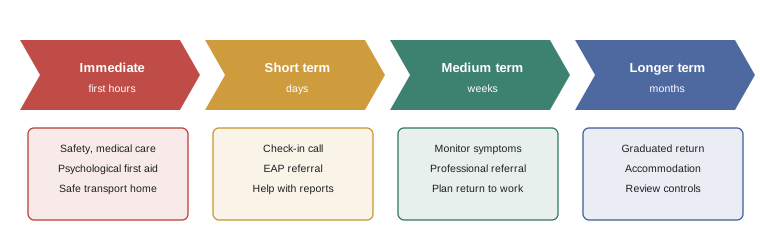
Critical incident debriefing, in which a group of workers is required to describe their experience in detail soon after a traumatic event, is no longer recommended as a routine intervention, because research has found it does not prevent PTSD and may cause harm for some people. Instead, most guidance recommends psychological first aid, practical support, voluntary opportunities to talk, monitoring and referral to professional treatment for those who need it. Operational debriefs that focus on what happened and what to change are still useful for learning, provided they are not used to make people relive the trauma.
Short and medium-term support
In the days and weeks after an incident, the supervisor or a designated person should check in regularly with the affected worker, by phone if they are off work, to see how they are doing and what they need. Useful support includes:
- Information about the employee assistance program (EAP), community counseling services and crisis lines.
- Help completing incident reports and workers' compensation claims, and information about leave entitlements.
- Time off, flexible hours or temporary changes in duties if needed.
- Updates on what is being done to prevent a repeat, such as changes to controls or a client's care plan.
- Information about legal options, such as reporting to police, victim services and court support programs, without pressure to use them.
- Peer support programs, where trained colleagues offer informal support.
- Referral to a physician or psychologist for assessment and treatment if symptoms persist, such as evidence-based therapies for PTSD.
Workers' compensation for psychological injuries in the US
Workers' compensation covers physical injuries caused by workplace violence in every state, generally regardless of fault. Coverage for psychological injuries varies widely. Most states compensate mental conditions that result from a physical injury, such as PTSD after an assault. Many states limit or exclude so-called mental-mental claims, in which a psychological injury results from psychological stress without physical injury, or require the stress to be extraordinary or unusual compared with ordinary work stress. A growing number of states have created presumptions or special rules for PTSD in police officers, firefighters, emergency medical workers and, in some states, health care workers and others. Check your state's rules and your employer's insurer. Employers must report injuries promptly and must not discourage or retaliate against workers for filing claims.
Return to work
Returning to work after a violent incident or serious harassment can be hard. Going back too early can worsen symptoms; staying away too long can increase avoidance and isolation. A good return-to-work plan is developed with the worker, their health care provider and, where applicable, the union and the workers' compensation board or insurer. It considers the worker's medical restrictions and readiness, any ongoing risk from the person who caused the harm, and changes needed to the job or workplace.
| Element | Examples |
|---|---|
| Graduated hours | Starting with short shifts and increasing over several weeks |
| Modified duties | Temporarily avoiding the unit, client or task involved in the incident |
| Changed location or schedule | Working at another site or on a different shift, without penalty |
| Safety measures | Confirming that controls are in place and the aggressor is managed or removed |
| Support | Buddy system, regular check-ins, continued EAP or treatment appointments |
| Review | Scheduled reviews of progress and adjustments as needed |
Worked problem
Planning a graduated return to work
A personal support worker normally works 37.5 hours a week in five 7.5-hour shifts. After an assault by a resident, she is off work for six weeks. Her psychologist recommends a graduated return over four weeks, starting at 40% of normal hours and increasing in equal steps to full hours by week 4, with no assignments to the unit where the assault occurred during the first two weeks. Plan her weekly hours.
Show solution
- Start: week 1 at 40% of 37.5 h.
- \[0.40 \times 37.5 = 15\ \text{h}\]
- Increase in equal steps from 40% (week 1) to 100% (week 4): three steps of 20% each, so weeks 2 and 3 are 60% and 80%.
- \[0.60 \times 37.5 = 22.5\ \text{h}, \quad 0.80 \times 37.5 = 30\ \text{h}, \quad 1.00 \times 37.5 = 37.5\ \text{h}\]
- Schedule: for example, week 1 as four shifts of 3.75 h; week 2 as three 7.5-hour shifts; week 3 as four 7.5-hour shifts; week 4 as five 7.5-hour shifts.
- Restrictions: assign her to a different unit in weeks 1 and 2, confirm the resident's care plan has been updated, and arrange check-ins at the end of each week.
Answer: Weekly hours of 15, 22.5, 30 and 37.5, with a different unit for the first two weeks, weekly check-ins and confirmation that controls are in place before she returns to her usual unit.
Support for witnesses, co-workers and supervisors
Violence and harassment affect more than the person directly targeted. Colleagues who witnessed an assault, who were present during a threatening incident, or who saw a colleague being bullied for months may experience distress, guilt about not intervening or fear for their own safety. Offer them information, check-ins and access to the EAP. Supervisors who deal with incidents, manage investigations and support staff are also at risk of stress and vicarious trauma, especially in sectors where incidents are frequent. Organizations should provide them with training, peer support and their own access to counseling, and should recognize this work as part of their role rather than an extra burden.
Supporting the respondent fairly
People accused of harassment or violence also need fair treatment. Being the subject of a complaint is stressful, and procedural fairness requires that respondents be told about the allegations, given a chance to respond and treated with respect. They should be told about the EAP and other support, kept informed of the process and protected from gossip. If a complaint is substantiated, corrective action should still respect the person's dignity. If it is not, the organization may need to help repair working relationships.
Building a supportive culture
The organizations that support affected workers best are those that have prepared in advance: they have trained supervisors and peer supporters, clear procedures for post-incident support, good relationships with EAP providers and community services, and leaders who speak openly about the impact of violence and harassment. Recognizing the psychological toll of this work, including in sectors where aggression is frequent, helps reduce stigma and encourages people to seek help early.
Supervisors play a central role throughout. They do not need to be counselors, but they should know the signs that someone is struggling, how to start a supportive conversation, what resources are available and how to make practical adjustments. A short, private check-in that asks how the person is doing and what would help is often more valuable than any formal program.
Common mistakes
MistakeTelling a worker who was assaulted that it is "part of the job".
InsteadAcknowledge the harm, offer support and act to prevent a repeat.
MistakeRequiring everyone involved to attend a detailed group debriefing.
InsteadOffer psychological first aid, voluntary support and referral; use operational debriefs for learning.
MistakeAsking the worker to repeat their story to many different people.
InsteadCoordinate so that the person tells their account as few times as necessary.
MistakeBringing the worker back to the same unit and client without changes.
InsteadPlan a graduated return with modified duties and confirmed controls.
MistakeForgetting witnesses and supervisors.
InsteadOffer support to everyone affected, including those managing the incident.
Summary and key terms
- Common reactions include fear, anxiety, sleep problems, intrusive memories and avoidance; most ease over weeks with support.
- Persistent or worsening symptoms may indicate PTSD, depression or anxiety and need professional help.
- Trauma-informed principles: safety, trustworthiness, choice, collaboration, empowerment and cultural humility.
- Psychological first aid is recommended; mandatory detailed group debriefing is not.
- US state compensation laws cover physical injuries and, to varying degrees, psychological injuries; many limit mental-mental claims.
- A graduated return-to-work plan considers medical advice, ongoing risk, modified duties and support.
- Witnesses, co-workers, supervisors and respondents also need support and fair treatment.
- Trauma-informed approach
- Responses that recognize the effects of trauma and avoid further harm.
- Psychological first aid
- Practical, supportive help in the immediate aftermath of a traumatic event.
- Post-traumatic stress disorder (PTSD)
- A mental health condition that can follow a traumatic event, with intrusive memories, avoidance and hyperarousal.
- Vicarious trauma
- Distress resulting from exposure to others' traumatic experiences.
- Peer support
- Support from trained colleagues with shared experience.
- Return-to-work plan
- A plan for safely resuming work after an injury or absence.
- Graduated return
- Gradual increase in hours or duties over a set period.
- Modified duties
- Temporary changes to tasks to suit a worker's restrictions.
- Presumptive coverage
- Rule that a condition is presumed work-related for certain workers.
- Operational debrief
- Review focused on what happened and how to improve controls.
Practice problems
Work each problem on paper first, then reveal the answer to check.
Name four common reactions after a traumatic incident.
Show answer
Fear, sleep problems, intrusive memories and avoidance (also anger, guilt, difficulty concentrating).
Name three signs that someone may need professional help.
Show answer
Worsening symptoms after weeks, inability to work and thoughts of self-harm (also heavy substance use).
List the six trauma-informed principles.
Show answer
Safety, trustworthiness and transparency, choice, collaboration, empowerment and cultural humility.
Why is mandatory critical incident debriefing no longer recommended?
Show answer
Research shows it does not prevent PTSD and may harm some people.
A worker on 40-hour weeks returns at 50%, rising in equal steps to 100% in week 3. What are the weekly hours?
Show answer
20, 30 and 40 hours.
Give two examples of modified duties after an assault.
Show answer
Avoiding the client or unit involved and working a different shift.
Who else besides the target may need support after an incident?
Show answer
Witnesses, co-workers and supervisors.
What is vicarious trauma?
Show answer
Distress caused by exposure to others' traumatic experiences.
Give one victim-blaming phrase to avoid.
Show answer
"Why didn't you just leave the room?" or "It's part of the job."
What support should a respondent receive?
Show answer
Information about the allegations, a chance to respond, respectful treatment and access to the EAP.
Lesson quiz · 5 questions
Score 60% or more to complete this lesson.
Create a free account to save your progress, take quizzes and earn a certificate.