
HSE-108 · Lesson 4 of 12 · 25 min
Title VII, sexual harassment and anti-discrimination law
Occupational health and safety law treats violence and harassment as hazards to be prevented. A second body of law treats harassment linked to personal characteristics such as sex, race, religion or disability as a form of discrimination. The two overlap but are not the same: they have different definitions, different enforcement bodies, different remedies and different procedures. Supervisors and anyone handling complaints need to understand both, because a single complaint can raise safety duties and discrimination duties at the same time. This lesson introduces the main principles.
Federal anti-discrimination law
Title VII of the Civil Rights Act of 1964 prohibits employment discrimination based on race, color, religion, sex and national origin by employers with 15 or more employees. The Supreme Court held in Bostock v. Clayton County (2020) that discrimination because of sexual orientation or gender identity is discrimination because of sex. The Age Discrimination in Employment Act protects workers aged 40 and older (employers with 20 or more employees), the Americans with Disabilities Act protects qualified people with disabilities (15 or more employees), the Pregnancy Discrimination Act and the Pregnant Workers Fairness Act protect pregnant workers, and the Genetic Information Nondiscrimination Act covers genetic information. Harassment based on any of these protected characteristics can be unlawful discrimination. The Equal Employment Opportunity Commission (EEOC) enforces these laws for private employers and state and local governments.
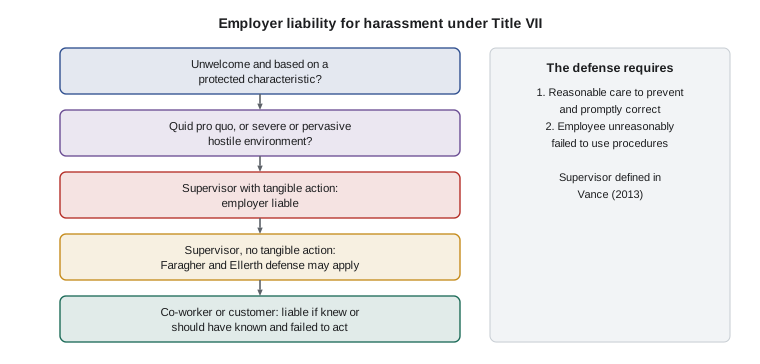
Federal law recognizes two broad forms of unlawful harassment. Quid pro quo harassment occurs when a supervisor conditions an employment decision, such as hiring, promotion, pay or continued employment, on submission to sexual or other unwelcome conduct. Hostile work environment harassment occurs when unwelcome conduct based on a protected characteristic is severe or pervasive enough to alter the conditions of employment and create a work environment that a reasonable person would find hostile or abusive, and that the victim actually perceives as hostile. The Supreme Court set out this standard in Meritor Savings Bank v. Vinson (1986) and Harris v. Forklift Systems (1993). Courts look at the totality of the circumstances, including the frequency and severity of the conduct, whether it was physically threatening or humiliating rather than merely offensive, and whether it unreasonably interfered with work. A single serious incident, such as a sexual assault, can be enough.
When is the employer liable?
The Supreme Court addressed employer liability in Faragher v. City of Boca Raton and Burlington Industries v. Ellerth, both decided in 1998. If a supervisor's harassment results in a tangible employment action, such as firing, demotion or a significant change in pay or duties, the employer is automatically liable. If there is no tangible employment action, the employer can raise an affirmative defense by proving that it exercised reasonable care to prevent and promptly correct harassment, usually through an effective policy, training and complaint procedure, and that the employee unreasonably failed to use the preventive and corrective opportunities provided. In Vance v. Ball State University (2013), the Court defined a supervisor as someone empowered to take tangible employment actions against the victim. For harassment by co-workers and non-employees such as customers, the employer is liable if it knew or should have known about the harassment and failed to take prompt and appropriate corrective action.
Recent changes to EEOC guidance
In April 2024, the EEOC issued updated Enforcement Guidance on Harassment in the Workplace, the first major revision in 25 years. In 2025, a federal court in Texas vacated the portions dealing with gender identity, and on January 22, 2026 the EEOC voted to rescind the 2024 guidance entirely. The rescission does not change the statutes or court decisions: Title VII still prohibits harassment based on protected characteristics, Bostock still holds that sexual orientation and gender identity are protected under sex, and Faragher, Ellerth and Vance still govern employer liability. Employers should rely on the statutes, case law, state and local law and their own well-designed policies, and watch for any new EEOC guidance. When you read older training materials that quote the 2024 guidance, remember that it is no longer official EEOC policy.
State and local anti-harassment laws
Many states and cities have anti-discrimination laws that cover smaller employers, more protected characteristics and broader definitions of harassment than federal law. California's Fair Employment and Housing Act applies harassment protections to employers of any size, does not require harassment to be severe or pervasive in the way federal courts often interpret that phrase, and requires employers with five or more employees to provide two hours of sexual harassment prevention training to supervisors and one hour to other employees every two years. New York State requires every employer to adopt a sexual harassment prevention policy and provide interactive training annually, and its Human Rights Law was amended in 2019 so that harassment need not be severe or pervasive. New York City, Illinois, Connecticut, Delaware and Maine also mandate training. Several states restrict non-disclosure agreements in harassment settlements. If you work in more than one state, the most protective applicable rule generally governs your practice.
Sexual harassment in practice
Sexual harassment takes many forms. It includes unwelcome sexual comments, jokes and innuendo; questions about someone's sex life; displaying or sending sexual images; leering, gestures and invading personal space; unwanted touching, hugging or kissing; repeated requests for dates after a clear no; sexual advances combined with promises or threats about work; and sexual assault. It also includes harassment based on sex, sexual orientation or gender identity that is not sexual in content, such as hostile comments that women do not belong in a trade, mocking a worker's gender expression or deliberately using the wrong name or pronouns to humiliate a transgender colleague. Sexual harassment can be committed by anyone against anyone, including by women against men and between people of the same sex or gender.
Power imbalances make sexual harassment more likely and harder to report. Workers who are young, new, temporary, migrant or dependent on tips, and workers whose harasser controls their schedule or evaluation, are especially vulnerable. Workplaces with a heavily male-dominated culture, a culture of heavy drinking at work events, isolated work, or customers who are treated as always right also tend to have more sexual harassment. Prevention therefore involves culture and structure, not only rules.
| Behavior | Examples | Response |
|---|---|---|
| Verbal | Sexual jokes, comments on body, repeated date requests after refusal | Ask to stop, document, report; supervisor intervenes promptly |
| Non-verbal | Leering, gestures, sexual images, sexualized messages | Remove material, report, investigate |
| Physical | Unwanted touching, blocking movement, brushing against | Report immediately; separate parties; investigate |
| Quid pro quo | Offering a shift or promotion in exchange for sexual favors | Report to someone outside the chain of command; urgent investigation |
| Sexual assault | Any non-consensual sexual contact | Ensure safety and medical care; respect the victim's choices about police; investigate |
Bystanders and allies
Most harassment happens in front of others, and bystanders have real power to stop it. Bystander intervention training teaches the five Ds: direct (calmly naming the behavior or asking the person to stop, when it is safe), distract (interrupting the situation with a question or task), delegate (asking a supervisor or someone with authority to step in), delay (checking in with the target afterwards and offering support) and document (writing down what happened, and sharing it with the target to use as they choose). Supervisors who witness harassment have a duty to act; they cannot treat it as a private matter between co-workers.
Worked problem
Is it harassment, and what must the employer do?
A construction company has one woman on a crew of twelve. Over three months, two crew members leave sexual cartoons in her truck, make comments that she only got the job to fill a quota, and the foreman laughs along. She tells the foreman once, and he says, "It's just the way the guys are." She then files a complaint with head office. What laws are engaged, and what should the employer do?
Show solution
- Classify the conduct: sexual cartoons and sex-based comments are unwelcome and based on sex; over three months they are likely severe or pervasive enough to create a hostile work environment under Title VII and state law.
- Assess liability: the foreman, likely a supervisor, knew and did nothing; the employer was told and must now act. Its response will determine whether it can rely on reasonable care.
- Act: protect the worker without disadvantaging her (do not move her to a worse crew), preserve evidence, and start a prompt, impartial investigation, using an investigator outside the crew's chain of command.
- Correct: if allegations are substantiated, discipline those responsible, including the foreman for failing to act, retrain the crew and supervisors, and follow up to confirm the harassment has stopped and there is no retaliation.
- Remember her rights: she may file a charge with the EEOC, generally within 180 days or 300 days where a state or local agency also enforces a similar law, or with a state agency, regardless of the internal outcome.
Answer: This is sexual and discriminatory harassment engaging both safety and anti-discrimination law. The employer must investigate promptly and impartially, protect the worker from reprisal, correct the behavior, including the foreman's failure to act, and follow up.
Retaliation and reprisal
Every law in this area protects people who complain, participate in investigations or oppose harassment from reprisal or retaliation. Retaliation can be obvious, such as firing or demotion, or subtle, such as worse shifts, exclusion from meetings, unjustified discipline, cold treatment by managers or spreading rumors about the complainant. Retaliation is unlawful even if the original complaint is not substantiated, as long as it was made in good faith. Supervisors should be reminded of this explicitly whenever a complaint is made, and the complainant's treatment should be monitored after the investigation ends.
Designing a single complaint process
Because one complaint can engage several laws, the most practical approach is a single, well-designed process that satisfies all of them. That process should explain, in plain language, what conduct is covered, how to make a complaint and to whom, including at least one option outside the complainant's chain of command, how complaints will be assessed and investigated, what interim measures may be taken, how confidentiality will be protected, how the parties will be told the outcome, and what protection against reprisal applies. It should state clearly that using the internal process does not remove a worker's right to go to an outside body, such as a human rights commission or tribunal, an anti-discrimination agency, a labor board or the police, and it should give contact information for those bodies.
The process should also be accessible. Provide it in the languages workers use, make sure workers with disabilities can use it, allow complaints to be made verbally as well as in writing, and allow a support person or union representative to attend meetings. Keep track of complaints by type, protected ground, location and outcome so that patterns can be spotted. If several complaints involve the same manager, team or ground, such as race or sex, the organization may need to look beyond individual cases and address systemic problems through training, leadership changes or a workplace review.
Common mistakes
MistakeHandling a discriminatory harassment complaint only as a personality conflict.
InsteadRecognize the protected ground and apply both harassment and discrimination procedures.
MistakeAssuming an internal investigation prevents an EEOC charge.
InsteadWorkers keep their legal rights regardless of the internal process.
MistakeMoving the complainant to a worse position to separate the parties.
InsteadSeparate parties without disadvantaging the complainant; otherwise it may be reprisal.
MistakeTreating customer sexual harassment as part of the job.
InsteadEmployers must act on harassment by third parties they know about.
MistakeRelying on rescinded EEOC guidance as official policy.
InsteadRely on statutes, case law, state law and sound policy.
Summary and key terms
- Title VII, the ADEA, the ADA and other laws prohibit harassment based on protected characteristics.
- Bostock (2020) held that sexual orientation and gender identity are protected under sex.
- Harassment is unlawful if quid pro quo or severe or pervasive enough to create a hostile environment.
- Faragher and Ellerth (1998) set the employer liability rules and the reasonable care defense.
- The EEOC rescinded its 2024 harassment guidance in January 2026; the statutes and case law are unchanged.
- States such as California and New York require harassment policies and training and set broader standards.
- Bystanders can help using the five Ds: direct, distract, delegate, delay, document.
- Protected ground or characteristic
- A personal characteristic, such as sex or race, on which discrimination is prohibited.
- Discriminatory harassment
- Harassment linked to a protected ground or characteristic.
- Quid pro quo harassment
- Making a job benefit or decision depend on submission to sexual or other unwelcome conduct.
- Hostile work environment
- Workplace made intimidating, hostile or offensive by unwelcome conduct.
- Duty to accommodate
- Obligation to adjust work for protected needs, up to undue hardship.
- Tangible employment action
- A significant change in employment status, such as firing or demotion.
- Affirmative defense
- A defense the employer must prove, such as reasonable care to prevent and correct harassment.
- Reprisal
- Adverse treatment because a person complained or took part in a process.
- Bystander intervention
- Actions by witnesses to stop or reduce harm from harassment.
- Limitation period
- Deadline for filing a legal complaint.
Practice problems
Work each problem on paper first, then reveal the answer to check.
What are the two main forms of unlawful harassment under Title VII?
Show answer
Quid pro quo and hostile work environment.
Which case defined "supervisor" for Title VII harassment liability?
Show answer
Vance v. Ball State University (2013).
What are the two parts of the Faragher/Ellerth defense?
Show answer
The employer used reasonable care to prevent and correct, and the employee unreasonably failed to use the procedures.
When is an employer liable for customer harassment?
Show answer
When it knew or should have known and failed to take prompt corrective action.
What did Bostock v. Clayton County decide?
Show answer
Sexual orientation and gender identity discrimination is sex discrimination under Title VII.
What happened to the EEOC's 2024 harassment guidance in January 2026?
Show answer
The EEOC voted to rescind it.
How much training does California require for supervisors at employers with five or more employees?
Show answer
Two hours every two years.
What is the usual deadline to file an EEOC charge?
Show answer
180 days, extended to 300 days where a state or local agency enforces a similar law.
List the five Ds of bystander intervention.
Show answer
Direct, distract, delegate, delay, document.
Is retaliation unlawful if the original complaint is not substantiated?
Show answer
Yes, if the complaint was made in good faith.
Lesson quiz · 5 questions
Score 60% or more to complete this lesson.
Create a free account to save your progress, take quizzes and earn a certificate.