
HSE-105 · Lesson 9 of 12 · 25 min
Evacuation, shelter-in-place and lockdown
When an emergency occurs, people must do one of three things: leave the building (evacuation), stay inside in a protected area (shelter-in-place), or secure themselves against a threat (lockdown or hold and secure). Choosing the right action, and carrying it out quickly and calmly, saves lives. This lesson explains how people behave in emergencies, the stages of evacuation and how long they take, how to calculate a rough evacuation time, assembly and accounting, and when sheltering in place or lockdown are better options than leaving.
How people behave in emergencies
Research on real fires and evacuations, including studies of the 2001 World Trade Center evacuation, shows that panic is rare. People generally behave rationally and often help others. The bigger problem is delay. When an alarm sounds, many people do not move immediately: they wait to see whether it is real, look for more information, finish what they are doing, gather belongings, or look to others for cues. This delay, called pre-movement time, is often longer than the time it takes to walk out. People also tend to leave by the way they came in, even when a closer exit is available, and to move toward familiar people. Good emergency planning works with this behavior: clear alarms and voice messages, training and drills so people recognize the alarm and know the nearest exits, wardens who give direct instructions, and a culture in which everyone leaves at once.
Stages of evacuation
Evacuation time is usually broken into stages:
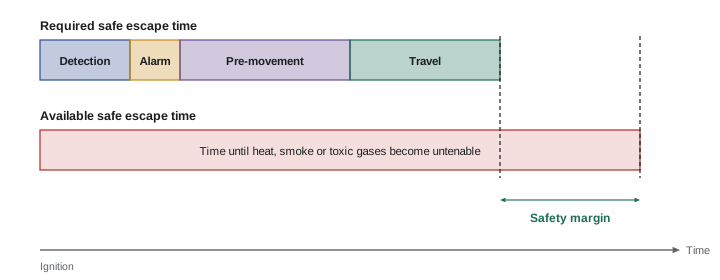
- Detection: the time from ignition until the fire is detected by a person or system.
- Alarm: the time from detection until occupants are warned.
- Pre-movement: the time from the warning until people start to move toward an exit, including recognition and response.
- Travel: the time to walk to and through exits to a place of safety, including time spent queuing at doors and stairs.
Fire engineers compare the required safe escape time, the sum of these stages, with the available safe escape time, the time until conditions become untenable because of heat, smoke or toxic gases. Evacuation is safe only when the required time is well below the available time, with a margin. Detection and alarm systems shorten the early stages, training shortens pre-movement, and building design (number and width of exits) shortens travel and queuing.
Estimating evacuation time
For simple buildings, a rough estimate of evacuation time can be made with a few rules of thumb, used in fire engineering and in planning drills. Walking speed on level floors is about 1.0 to 1.2 m/s for an unimpeded adult, slower in crowds and on stairs, and much slower for people with mobility impairments. The flow rate through a door is about 1.3 persons per meter of clear width per second. The time to pass through an exit is the number of people divided by the flow, and the overall time is roughly pre-movement plus the longer of travel time and queuing time.
where \( t_{pre} \) is the pre-movement time, \( d \) the travel distance to the exit, \( v \) the walking speed, \( N \) the number of people using the exit, \( F \) the specific flow (persons per meter per second) and \( W \) the clear exit width in meters. This is an approximation; complex buildings use computer models and are assessed by fire engineers.
Worked problem
Estimating evacuation time
A single-story workshop has 180 workers. They will evacuate through two exits, each 0.9 m wide, and divide evenly between them. The longest travel distance to an exit is 45 m, walking speed is 1.0 m/s, and drills show a pre-movement time of 90 s. Estimate the evacuation time. What happens if one exit is blocked?
Show solution
- People per exit: \( N = 180 / 2 = 90 \).
- Queuing time per exit: \( 90 / (1.3 \times 0.9) = 90 / 1.17 \approx 77 \) s.
- Travel time: \( 45 / 1.0 = 45 \) s; queuing is longer, so the exit flow controls.
- Total: \( 90 + 77 \approx 167 \) s, or a little under 3 minutes.
- One exit blocked: \( N = 180 \) at one exit, queuing time \( 180 / 1.17 \approx 154 \) s, total about \( 90 + 154 = 244 \) s, or about 4 minutes, and travel distances increase for many people.
- Reducing pre-movement time from 90 s to 30 s through training would save a full minute in either case.
Answer: About 2.8 minutes with both exits, about 4 minutes with one blocked; cutting pre-movement time is the quickest gain.
Evacuation procedures
A typical procedure for occupants when the alarm sounds:
- Stop work immediately, and make equipment safe only if it takes seconds and you are trained to do so.
- Leave by the nearest safe exit; if it is blocked by smoke or fire, use the alternative exit.
- Close doors behind you to slow fire and smoke, but do not lock them.
- Do not use elevators unless directed by firefighters or the building has designated evacuation elevators.
- Help visitors and people who need assistance, as assigned in the plan.
- In smoke, stay low, where the air is cooler and cleaner, and feel doors with the back of your hand before opening; if a door is hot, use another route.
- Go directly to the assembly point and report to your warden; do not leave the site or go to your car.
- Do not re-enter the building until the fire department or emergency coordinator says it is safe.
In high-rise buildings, many fire safety plans use phased evacuation: the fire floor and the floors immediately above and below evacuate first, while others wait for instructions, so stairs are not overloaded and firefighters can climb. Occupants must follow voice instructions.
| If you are... | Do this |
|---|---|
| Trapped in a room by smoke | Close the door, seal gaps with cloth, call 911 with your location, signal from a window |
| On fire (clothing) | Stop, drop and roll; cover your face |
| In thick smoke | Stay low, follow walls to the exit, count doors |
| Using a wheelchair | Go to the area of refuge or assigned point, notify your helper and 911 |
| A visitor | Follow your host or the nearest warden to the assembly point |
Assembly points and accounting
Assembly points should be far enough from the building to be safe from falling glass, smoke and collapse, commonly at least 15 to 30 m depending on building height; out of the way of fire department access and hydrants; away from traffic; large enough for everyone; and preferably with an alternative in case the first is unsafe or downwind of a release. Accounting confirms that everyone is out. Common methods include warden reports that their areas are clear, roll calls against sign-in sheets, visitor logs and shift lists, and electronic accounting using badge systems or phone check-ins. Missing people must be reported immediately to the emergency coordinator, who tells the fire department where they were last seen. Nobody should go back into the building to search.
Shelter-in-place
Sometimes going outside is more dangerous than staying in. Shelter-in-place means staying in a building, ideally in an interior room, during emergencies such as an outdoor hazardous material release, tornadoes and severe storms, or other external threats. Procedures for chemical releases typically include going indoors, closing windows and doors, shutting down ventilation systems that bring in outside air, moving to an interior room with few windows, sealing gaps if directed, and listening for instructions from authorities. Tornado and severe weather sheltering uses the lowest floor, interior rooms or corridors away from windows. Shelter-in-place is usually short; people should be ready to evacuate or move when the hazard passes or conditions change.
Lockdown and hold and secure
Lockdown is used when there is an immediate threat of violence inside or near the building, such as an active attacker. Occupants secure themselves in rooms, lock or barricade doors, turn off lights, silence phones and stay out of sight until police give the all clear. Many organizations train workers using a run, hide, fight model, promoted by public safety agencies in both countries: get out if you can do so safely (run), hide and secure yourself if you cannot (hide), and as a last resort act to defend yourself (fight). Hold and secure (also called secure the premises or lockout) is used when the threat is outside: exterior doors are locked and people stay inside, but normal activities continue. Fire alarms during a lockdown create a dilemma; plans should address how occupants will verify a fire before evacuating, for example through official instructions.
Calling 911
In both Canada and the United States, 911 is the emergency number. When calling, stay calm and give the address and nearest cross-street or site entrance, the nature of the emergency, the location within the site, the number of people affected, hazards such as chemicals, and a call-back number. Stay on the line until told to hang up. Workplaces should make sure that phones can dial 911 directly, that callers know the site's civic address, and that someone meets emergency crews at the entrance. Text-to-911 is available in many areas for people who are deaf, hard of hearing or speech-impaired.
Evacuating people who need assistance
People who need assistance require specific plans and practice. Options include horizontal evacuation through a fire separation into another compartment on the same floor, common in hospitals and care facilities; moving to an area of refuge or a protected stair landing to wait for firefighters, with two-way communication; using an evacuation chair to carry a person down stairs, which requires trained operators; and, in buildings with elevators designed and designated for occupant evacuation, using those elevators under controlled conditions. Each person's PEEP should specify which method is used, who helps and how the coordinator will be told where the person is waiting. Practice is essential: an evacuation chair that nobody has used before is unlikely to be operated safely in a real emergency.
Evacuation in industrial settings
Industrial sites raise additional evacuation issues. Workers may need to make processes safe before leaving, such as stopping machinery, closing valves or isolating energy, and the plan should define these tasks and limit them to a short time. Noise may make alarms hard to hear, so visual alarms, radios and wardens may be needed. Large outdoor sites may need several assembly points and a method for choosing among them based on wind direction for chemical releases; windsocks placed around the site help people see which way to move. Vehicles, cranes and mobile equipment should be parked safely so they do not block exits or emergency vehicle routes. Contractors on site may need to be counted separately.
When the evacuation is over
When an evacuation is complete and the emergency is under control, the fire department or emergency coordinator decides when people may re-enter. Do not reset alarms or re-enter until authorized. Some events, such as a significant fire or chemical release, may mean that the building cannot be re-entered for a long time; the plan should cover how people will be sent home, how they will get personal items such as keys and medications, and how they will be told when and where to report for work. Lesson 12 covers recovery and business continuity in more detail.
Smoke and visibility
Smoke is the main threat during evacuation. It reduces visibility, irritates the eyes and contains toxic gases. People generally turn back when visibility falls below a few meters, so even a smoke-logged corridor that is not hot can block escape. Exit signs placed low on walls, photoluminescent path markings on stairs, and closed doors that keep smoke out of exit stairs all help. Practice routes so that you could find the exit by touch if you had to.
Common mistakes
MistakeWaiting to see whether the alarm is real.
InsteadLeave as soon as the alarm sounds.
MistakeLeaving by the door you came in, past the fire.
InsteadUse the nearest safe exit.
MistakeGoing to your car or leaving the site.
InsteadGo to the assembly point and report.
MistakeRe-entering to search for a co-worker.
InsteadReport missing people to the coordinator and firefighters.
MistakeEvacuating into a toxic plume.
InsteadShelter in place when told the hazard is outside.
Summary and key terms
- People rarely panic; delay before moving is the main problem.
- Escape time is detection, alarm, pre-movement and travel.
- Required escape time must be well below available escape time.
- Estimate evacuation time from pre-movement, travel and exit flow.
- Leave by the nearest safe exit, close doors and report to the assembly point.
- Accounting confirms everyone is out; never re-enter.
- Shelter-in-place and lockdown are used when leaving is more dangerous.
- Evacuation
- Moving people out of a building to safety.
- Pre-movement time
- Time from warning to starting to move.
- Required safe escape time
- Time needed for everyone to reach safety.
- Available safe escape time
- Time until conditions become untenable.
- Specific flow
- People per meter of exit width per second.
- Phased evacuation
- Evacuating floors in a planned sequence.
- Accounting
- Confirming all occupants are out.
- Shelter-in-place
- Staying inside a protected area during an external hazard.
- Lockdown
- Securing occupants against an immediate violent threat.
- Hold and secure
- Locking exterior doors while normal activity continues inside.
Practice problems
Work each problem on paper first, then reveal the answer to check.
What is the biggest behavioral problem in evacuations?
Show answer
Delay before people start moving.
Name the four stages of escape time.
Show answer
Detection, alarm, pre-movement, travel.
What is a typical door flow rate?
Show answer
About 1.3 persons per meter per second.
How long for 60 people through a 1.0 m door?
Show answer
About 46 s.
Why close doors when leaving?
Show answer
To slow fire and smoke spread.
What should you do if a door is hot?
Show answer
Use another route.
Name two features of a good assembly point.
Show answer
Safe distance from the building, clear of fire department access.
When would you shelter in place?
Show answer
For an outdoor chemical release or tornado.
What does run, hide, fight mean?
Show answer
Escape if possible, hide if not, defend as a last resort.
What information should a 911 caller give?
Show answer
Address, emergency, location, people affected, hazards, call-back number.
Lesson quiz · 5 questions
Score 60% or more to complete this lesson.
Create a free account to save your progress, take quizzes and earn a certificate.