
HSE-105 · Lesson 2 of 12 · 25 min
Fire hazards at work
Every workplace has fire hazards, but they differ greatly between an office, a restaurant, a warehouse, a factory, a laboratory, a hospital and a construction site. Recognizing the specific fuels, ignition sources and conditions that could combine to start a fire in your own workplace is the foundation of prevention. Fire hazard recognition is part of the wider hazard assessment process covered in HSE-103; this lesson applies that process to fire. It covers flammable and combustible liquids and gases, combustible dusts, electrical fire hazards, hot work, heating and cooking equipment, lithium-ion batteries, oxidizers and reactive chemicals, arson and waste, and how to look at a workplace through the eyes of a fire inspector.
Leading causes of workplace fires
Fire statistics vary by country and by type of property, but the same causes appear again and again in investigations of workplace fires: cooking equipment in restaurants and staff kitchens; electrical distribution and lighting equipment; heating equipment; hot work; intentional fires set by arsonists, often in waste and storage areas; smoking materials; and process equipment such as dryers, ovens and dust collectors. In industrial settings, flammable liquids, combustible dusts and process upsets add serious explosion risks. Knowing which causes are most likely in your sector focuses prevention where it matters most.
| Workplace | Common fire hazards |
|---|---|
| Office | Overloaded power bars, space heaters, kitchen appliances, paper storage, battery chargers |
| Restaurant and kitchen | Deep fryers, grease in exhaust hoods and ducts, open flames, cleaning chemicals |
| Warehouse | High-piled storage, idle pallets, forklift charging, lithium batteries, vehicles |
| Manufacturing | Flammable liquids, combustible dusts, hot surfaces, hot work, conveyors, hydraulic oil |
| Laboratory | Solvents, reactive and oxidizing chemicals, gas cylinders, heating devices |
| Health care | Oxygen-enriched atmospheres, linen and waste, electrical equipment, patients who cannot self-evacuate |
| Construction | Hot work, temporary heaters, temporary wiring, combustible formwork and packaging, fuels |
Flammable and combustible liquids
Flammable and combustible liquids are among the most common serious fire hazards at work: fuels, solvents, paints, thinners, adhesives, cleaning products, alcohols and many process chemicals. Under the Globally Harmonized System used in WHMIS and HazCom (HSE-102), flammable liquids are classified into categories by flash point and boiling point, with Category 1 being the most hazardous. Fire codes also use older terms: flammable liquids, with flash points below about 37.8 °C (100 °F), and combustible liquids, with higher flash points. The main hazards are vapors that travel along floors to distant ignition sources, because most flammable vapors are heavier than air; spills that spread fire rapidly; containers that rupture when heated; and static electricity generated when liquids are transferred. Basic precautions include using the smallest practical quantity, keeping containers closed, storing liquids in approved safety cans and flammable storage cabinets, bonding and grounding containers when transferring liquids, ventilating work areas, and keeping ignition sources away. Lesson 3 covers storage in more detail.
Flammable gases and compressed gas cylinders
Flammable gases such as propane, natural gas, acetylene and hydrogen ignite easily and can form explosive mixtures in enclosed spaces. Leaks may be invisible and, for odorless gases, undetectable without instruments. Compressed gas cylinders also store large amounts of energy: a cylinder heated in a fire can rupture violently, and a cylinder whose valve is broken off can become a projectile. Cylinders must be secured upright, capped when not in use, stored away from heat and from incompatible gases (for example, oxygen cylinders separated from fuel gases), and checked for leaks with approved methods. Oxygen deserves special mention: oxygen itself does not burn, but an oxygen-enriched atmosphere makes ordinary materials such as clothing ignite easily and burn fiercely. Oxygen must never be used to blow dust off clothing or to "freshen" the air in a confined space.
Combustible dust
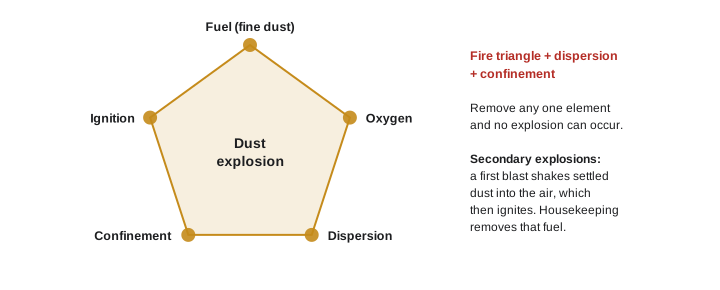
Many solid materials that are hard to ignite in bulk become explosive when they are ground into fine dust and dispersed in the air: wood, flour, sugar, grain, starch, plastics, pharmaceuticals, coal, and metals such as aluminum and magnesium. A dust explosion requires five conditions, sometimes called the dust explosion pentagon: fuel (the dust), oxygen, an ignition source, dispersion of the dust in air, and confinement. A small primary explosion, for example inside a dust collector, can shake loose dust that has accumulated on beams, ledges and ducts, creating a much larger secondary explosion that tears through a building. Major disasters, such as the 2008 sugar refinery explosion at Port Wentworth, Georgia, which killed 14 workers, and the 2012 sawmill explosions in British Columbia at Burns Lake and Prince George, which killed four workers in total, have shown how devastating dust explosions can be.
Controls for combustible dust include capturing dust at the source with properly designed dust collection; regular housekeeping that removes accumulations from all surfaces, including high and hidden ones, using methods that do not create clouds (such as approved vacuums rather than compressed air); controlling ignition sources, including static electricity and hot surfaces; and engineering protection such as explosion venting, isolation and suppression. Where combustible dust is present, a dust hazard analysis by a qualified person is the starting point, and specialized standards apply.
Electrical fire hazards
Electrical faults are a leading cause of fires in all kinds of buildings. Common hazards include overloaded circuits and power bars, especially when power bars are plugged into one another ("daisy-chained"); extension cords used as permanent wiring, run under carpets or through doorways where they are damaged; damaged cords and plugs; loose connections that overheat; equipment placed against combustibles or with blocked ventilation; and missing covers on electrical boxes and panels. Electrical rooms used as storage add fuel next to ignition sources, and blocked access to electrical panels delays shutting off power in an emergency. Simple controls go a long way: inspect cords and plugs before use, use equipment certified for the purpose, unplug appliances that are not in use, keep clearance in front of electrical panels, report warm outlets, flickering lights or burning smells, and leave electrical repairs to qualified electricians. HSE-213 and HSE-214 cover electrical safety in depth.
Lithium-ion batteries
Lithium-ion batteries power laptops, phones, tools, forklifts, scooters, e-bikes, energy storage systems and electric vehicles. When a cell is damaged, overcharged, manufactured with defects, exposed to heat or short-circuited, it can enter thermal runaway: an uncontrollable chain of heating that vents flammable and toxic gases and can spread from cell to cell. Battery fires burn intensely, can re-ignite hours or days later, and may produce explosive gas mixtures in enclosed spaces. Workplace precautions include buying certified batteries and chargers, using only the charger supplied for the device, charging in designated areas away from combustibles and exits, not charging unattended overnight where avoidable, inspecting for swelling, damage or heat, removing damaged batteries from service and storing them safely, and following site rules for e-bikes and scooters, which many workplaces now restrict indoors. Large battery energy storage systems require specialized fire protection and emergency planning.
Heating, cooking and process equipment
Portable space heaters are a frequent cause of fires when placed too close to paper, curtains or clothing, left running unattended, or knocked over. Many workplaces restrict their use or require models with tip-over and overheat protection and a minimum clearance, often about one meter, from combustibles. In commercial kitchens, grease accumulates in exhaust hoods, filters and ducts and can carry a fire from a fryer into the building structure; regular cleaning and inspected kitchen fire suppression systems (Lesson 5) are essential. Industrial ovens, dryers, furnaces and kilns need maintained safety controls, and process equipment such as hydraulic systems can spray oil mist onto hot surfaces if a hose fails. Maintenance programs that inspect and clean such equipment are part of fire prevention.
Hot work
Welding, cutting, brazing, soldering, grinding and torch-applied roofing cause many serious fires, often after the work has finished and workers have left. Sparks and slag can travel more than 10 m horizontally, fall through gaps in floors and walls, and smolder in hidden places for an hour or more before flaming. For this reason, hot work outside designated welding areas is controlled by a hot work permit system, which requires clearing or protecting combustibles within a defined radius, having extinguishers and a trained fire watch present during the work and for a period afterward, and inspecting the area before leaving. HSE-212 covers hot work and permits in depth.
Oxidizers, reactive chemicals and self-heating materials
Oxidizing chemicals, such as nitrates, chlorates, perchlorates, permanganates, peroxides and concentrated nitric acid, supply oxygen to fires and can cause organic materials to ignite on contact. Some chemicals react violently with water, air or each other, and some materials heat themselves: oily or solvent-soaked rags, linseed oil, certain metal powders and large piles of damp organic materials can heat spontaneously until they ignite. Segregating incompatible chemicals, following the storage and incompatibility information on safety data sheets, and disposing of oily rags in approved self-closing metal containers emptied daily are simple, effective controls.
Arson, waste and housekeeping
Deliberately set fires are a significant cause of fire damage to businesses, and they usually start where fuel is easy to reach: waste bins and dumpsters against buildings, pallets and packaging stored outside, and unlocked storage areas. Keeping waste containers away from walls and openings, keeping outdoor storage tidy and secured, controlling access, lighting the perimeter and investigating small fires promptly reduce the risk. Inside, accumulations of paper, cardboard and packaging give small fires the fuel to grow. Good housekeeping, discussed in Lesson 3, is one of the most effective fire prevention measures.
Looking at a workplace through an inspector's eyes
A fire hazard walk-through applies the fire tetrahedron systematically: where are the fuels, where are the ignition sources, and where could they meet? A structured approach looks at each area in turn and asks about storage of flammables and combustibles, condition of electrical equipment, heating and cooking appliances, hot work, waste and housekeeping, means of escape and fire doors, fire protection equipment and its access, and unusual hazards such as dust, batteries or oxygen. Findings are recorded, rated using the risk methods in HSE-103, and assigned for correction.
Worked problem
A fire hazard walk-through of a small workshop
During a walk-through of a maintenance workshop, a supervisor notes: a grinding bench next to a pile of cardboard boxes; an uncapped can of solvent on a shelf; a space heater under a desk with papers; three power bars plugged into one another feeding a battery charger; and oily rags in an open plastic bin. Identify the fuel and ignition source for each finding and a practical control.
Show solution
- Grinding next to cardboard: sparks (ignition) and cardboard (fuel). Move cardboard away or screen the bench; set up a designated grinding area with non-combustible surroundings.
- Uncapped solvent: vapor (fuel) that can reach any ignition source. Close the can, use an approved safety can and store in a flammable cabinet.
- Space heater under a desk: hot surface (ignition) and paper (fuel). Remove the heater or relocate it with at least the manufacturer's clearance, and choose a model with tip-over and overheat protection.
- Daisy-chained power bars: overheating connections (ignition) and nearby materials (fuel). Remove the chain, plug the charger directly into a wall outlet or have additional outlets installed.
- Oily rags in a plastic bin: self-heating material (fuel and heat). Use an approved self-closing metal oily waste can and empty it daily.
Answer: Each finding pairs a fuel with an ignition source; separating them (distance, storage, approved containers, proper wiring) removes the hazard.
Common mistakes
MistakeAssuming dust is only a housekeeping issue.
InsteadFine combustible dust can explode; control accumulation and ignition.
MistakeDaisy-chaining power bars.
InsteadPlug into wall outlets and install permanent wiring where needed.
MistakeCharging damaged batteries.
InsteadRemove swollen or damaged batteries from service immediately.
MistakeLeaving hot work areas as soon as the job ends.
InsteadKeep a fire watch and inspect afterward, as the permit requires.
MistakeUsing oxygen to blow off clothing.
InsteadNever use oxygen for ventilation or cleaning; it makes materials burn fiercely.
Summary and key terms
- Common workplace fire causes include cooking, electrical, heating, hot work, arson and smoking.
- Flammable liquids release heavier-than-air vapors that travel to ignition sources.
- Compressed gases and oxygen-enriched atmospheres create fire and explosion risks.
- Combustible dust explosions need fuel, oxygen, ignition, dispersion and confinement.
- Electrical misuse and lithium-ion battery failures are growing fire hazards.
- Hot work, heaters, kitchens, oxidizers and self-heating materials need specific controls.
- A fire hazard walk-through looks systematically for where fuels meet ignition sources.
- Flammable liquid
- Liquid that gives off ignitable vapor at low temperatures.
- Combustible liquid
- Liquid with a higher flash point that burns when heated.
- Bonding and grounding
- Connections that prevent static sparks during liquid transfer.
- Combustible dust
- Fine particles that can explode when dispersed and ignited.
- Secondary explosion
- Larger blast from dust shaken loose by a first explosion.
- Thermal runaway
- Uncontrolled self-heating of a battery cell.
- Oxidizer
- Chemical that supplies oxygen and intensifies fires.
- Self-heating material
- Material that can heat itself to ignition, such as oily rags.
- Fire watch
- Trained person watching for fires during and after hot work.
- Daisy-chaining
- Plugging power bars or extension cords into one another.
Practice problems
Work each problem on paper first, then reveal the answer to check.
Why do flammable vapors often travel along floors?
Show answer
Most are heavier than air.
Name two controls for transferring flammable liquids.
Show answer
Bonding and grounding, approved safety cans, ventilation, closed containers.
Why must oxygen cylinders be separated from fuel gases?
Show answer
Oxygen intensifies fires involving fuel gases.
List the five sides of the dust explosion pentagon.
Show answer
Fuel, oxygen, ignition, dispersion and confinement.
What makes secondary dust explosions so destructive?
Show answer
Accumulated dust is shaken into a large cloud and ignited.
Name two warning signs of an electrical problem.
Show answer
Warm outlets, flickering lights, burning smells, damaged cords.
What is thermal runaway?
Show answer
Uncontrolled heating of a battery cell that can spread.
How far can hot work sparks travel?
Show answer
More than 10 m.
How should oily rags be stored?
Show answer
In approved self-closing metal containers emptied daily.
Where do arson fires often start?
Show answer
Waste bins, dumpsters and outdoor storage against buildings.
Lesson quiz · 5 questions
Score 60% or more to complete this lesson.
Create a free account to save your progress, take quizzes and earn a certificate.