
HSE-105 · Lesson 5 of 12 · 26 min
Fire protection systems: alarms, sprinklers and suppression
Most workplace buildings contain fire protection systems that work around the clock without anyone noticing: smoke and heat detectors, manual pull stations, alarm bells and strobes, sprinklers, standpipes, special suppression systems, emergency lighting, exit signs and smoke control. These systems are designed to detect a fire early, warn occupants, control or extinguish the fire, and keep escape routes usable. They only work if they are designed for the hazard, kept in service and not defeated by changes to the building or its contents. This lesson explains how the main systems work, what workers and supervisors should know about them, and what inspection, testing and maintenance they require. It does not train you to service these systems; that work belongs to qualified technicians.
Active and passive fire protection
Fire protection is often divided into two families. Passive fire protection is built into the structure and works without activation: fire-rated walls, floors and doors, fire stopping, protected structural steel and compartmentation (Lesson 3). Active fire protection must detect the fire and respond: alarm systems, sprinklers, special extinguishing systems, smoke control and portable extinguishers. The two work together. Sprinklers control a fire, compartments limit how far it can spread if sprinklers fail, and alarms get people moving while both do their work.
Fire alarm systems
A fire alarm system has four main parts. Initiating devices detect a fire or allow people to report one: manual pull stations, smoke detectors, heat detectors, flame detectors, and sprinkler waterflow switches. The fire alarm control unit (panel) receives signals, decides what to do and supervises the wiring and devices for faults. Notification appliances warn occupants: horns, bells, speakers for voice messages and strobes for people who are deaf or hard of hearing. Many systems also send signals to a monitoring station or directly to the fire department and control building functions, such as releasing magnetic door holders, recalling elevators, shutting down air handlers and unlocking certain doors.
In the United States, fire alarm systems are installed, inspected, tested and maintained to NFPA 72, National Fire Alarm and Signaling Code (2025 edition current), as referenced by the IBC, IFC and NFPA 101. OSHA 1910.165 covers employee alarm systems, which must be distinctive, recognizable and perceivable above ambient noise, and supervised or tested regularly. Many large buildings use emergency voice/alarm communication systems that can give staged or targeted instructions.
- Smoke detectors respond early but can be fooled by dust, steam, cooking and aerosols; they are unsuitable in some industrial areas.
- Heat detectors respond to a fixed temperature, typically about 57 to 74 °C (135 to 165 °F), or to a rapid rise in temperature; they are slower but more reliable in dirty or humid areas.
- Flame detectors use infrared or ultraviolet sensors for fast detection of flaming fires in high-hazard areas such as fuel loading.
- Aspirating detectors draw air samples through pipes to a sensitive detector, for early warning in data centers and clean rooms.
Sprinkler systems
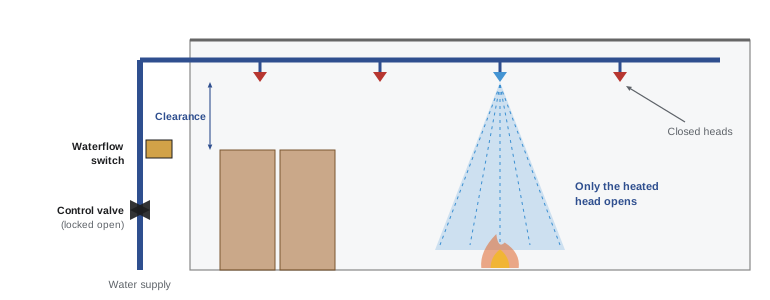
Automatic sprinklers are the most effective single fire protection measure. Each sprinkler head is held closed by a glass bulb filled with liquid or a fusible metal link; when the gases from a fire heat it to its rated temperature, commonly 68 °C (155 °F) for ordinary heads with a red bulb, the bulb breaks and that head alone opens. Only the heads near the fire open. Most fires in sprinklered buildings are controlled by one or two heads. The movie image of every sprinkler going off at once is wrong, except in a deluge system, where all heads are open and the whole system discharges on a signal.
| System type | How it works | Typical use |
|---|---|---|
| Wet pipe | Pipes always full of water; head opens and water flows immediately | Most heated buildings |
| Dry pipe | Pipes filled with pressurized air; water enters when a head opens and air escapes | Unheated warehouses, parking garages, loading docks |
| Pre-action | Water released into pipes only after a detection system operates; heads then open individually | Data centers, museums, freezers |
| Deluge | All heads open; water released on detection signal | Aircraft hangars, high-hazard processes |
| Antifreeze | Pipes filled with a listed antifreeze solution | Small unheated areas |
Sprinkler systems are designed for the hazard and storage arrangement present when they are installed. Changing the use of a space, such as converting an office area to a warehouse, storing plastics instead of paper, stacking higher, or adding racks, can overwhelm the design, even though the system looks the same. Any change in storage or occupancy should be reviewed by a fire protection professional before it happens.
Every sprinkler system has control valves that can shut off the water. Most catastrophic losses in sprinklered buildings involve a closed valve. Valves must be supervised electronically or locked open, and any impairment, when a system is shut off for any reason, must be managed through a formal impairment procedure.
Impairments
An impairment is any time a fire protection system is out of service, whether planned (maintenance, renovation) or emergency (a broken pipe, a failed pump). Impairments are dangerous because the building is unprotected while normal activities continue. A good impairment procedure includes notifying the fire department, monitoring company, insurer and building occupants; tagging the impaired equipment; limiting the duration and the area affected; stopping hazardous operations such as hot work; providing a fire watch, meaning trained people patrolling the affected area to detect fires and raise the alarm; having extra extinguishers available; and restoring the system and testing it before returning to normal. Fire codes in both countries require fire watch or other alternative measures during impairments.
Special suppression systems
Some hazards need systems other than water sprinklers:
- Commercial kitchen hood systems discharge a wet chemical agent onto cooking appliances and into the hood and duct, and shut off fuel and power to the appliances. They are installed to NFPA 17A and NFPA 96 and must be serviced every six months.
- Clean agent systems, such as inert gases or halocarbon agents, protect data centers, archives and control rooms. They leave no residue but may lower oxygen or produce decomposition products, so the protected space must be evacuated before discharge, and warning signs and pre-discharge alarms are required.
- Carbon dioxide total flooding systems protect unoccupied spaces such as printing presses, engine rooms and electrical vaults. CO2 at extinguishing concentrations is lethal; lockout of the system is required before anyone enters the protected space.
- Foam systems protect flammable liquid storage and processing areas, aircraft hangars and loading racks.
- Water mist systems use very fine droplets to cool and smother fires with little water.
- Dry chemical systems protect fuel dispensing, paint booths and some industrial processes.
Workers in areas with special systems must know what the pre-discharge alarm looks and sounds like, the evacuation route, the location of abort and manual release switches, and the lockout procedure for entry.
Standpipes and fire department connections
Standpipes are vertical pipes with hose connections on each floor of taller buildings, mainly for firefighters. Some buildings also have occupant hose stations, but most employers do not expect workers to use them, and untrained use of a fire hose can be dangerous. The fire department connection on the outside of the building lets firefighters pump water into the sprinkler or standpipe system; it must be visible and kept clear of snow, vehicles and landscaping.
Emergency lighting, exit signs and smoke control
Emergency lighting switches on automatically when normal power fails, providing enough light to evacuate; codes typically require it to last at least 30 minutes to 90 minutes depending on the building. Exit signs, increasingly the green running man pictogram in Canada and the red or green EXIT sign in the United States depending on local rules, mark exits and the route to them. Smoke control systems pressurize stairs, exhaust smoke from atriums or close dampers to keep escape routes tenable. All of these require monthly and annual testing.
Inspection, testing and maintenance
Fire codes require inspection, testing and maintenance (ITM) of fire protection systems to referenced standards, with records kept on site. Typical frequencies include weekly or monthly visual checks of valves and gauges, quarterly alarm and waterflow tests, annual testing of alarm systems and sprinkler systems by qualified technicians, and five-year internal pipe inspections. Workers can help by reporting trouble signals on the alarm panel, damaged or painted sprinkler heads, items hanging from sprinkler pipes, obstructed devices, and missing or unlit exit signs.
Worked problem
Assessing a change in storage
A warehouse sprinklered for cartoned paper goods stacked to 3.5 m plans to start storing expanded plastic foam packaging stacked to 6 m. What fire protection questions should be asked before the change?
Show solution
- Commodity: expanded plastics burn much faster and hotter than paper goods, so they are a higher commodity classification.
- Height: storage nearly twice as high produces a taller, faster-growing fire and less clearance below the sprinklers.
- Design: the existing sprinkler density and water supply were calculated for the original hazard; a fire protection engineer must check whether they are adequate.
- Likely outcome: upgrades such as higher-density sprinklers, in-rack sprinklers or limits on storage height may be required, and the change may need approval from the fire department and insurer.
Answer: Have a fire protection engineer review the commodity, height and sprinkler design before storing the plastics.
Water supplies and fire pumps
Sprinklers and standpipes are only as good as the water supply behind them. Most systems are fed from the municipal water main through a backflow preventer and a control valve, but large or high-hazard buildings may need a fire pump to boost pressure, a dedicated water storage tank or a private fire main with hydrants. Fire pumps are typically tested weekly or monthly by running them without flowing water, and annually with a full flow test, under NFPA 25 or the equivalent referenced standard. Water supply can change over time as municipal systems are modified or demand grows, so flow tests are used to confirm that the supply still meets the system's design. Freezing is a common cause of failure in cold climates: heated valve rooms, dry pipe systems in unheated areas and inspections during cold snaps help prevent frozen and burst pipes.
Alarm signals and what they mean
Fire alarm panels display three main kinds of signal. An alarm signal means that a fire has been detected or a pull station activated, and it starts evacuation or an alert sequence. A supervisory signal means that something affecting the fire protection system is off-normal, for example a sprinkler control valve partly closed, low air pressure in a dry pipe system, or a fire pump not running when it should. A trouble signal means that there is a fault in the alarm system itself, such as a broken wire, a failed battery or a disconnected device. Supervisory and trouble signals are not emergencies in themselves, but they mean that the system may not work when needed, so they must be investigated and corrected quickly. Staff who monitor the panel should know how to read it, whom to call and how to record events, and should never silence or reset an alarm without following the procedure in the fire safety plan.
Protecting systems from everyday damage
Fire protection systems are often damaged by normal work. Forklifts strike sprinkler pipes and risers in warehouses; contractors paint over sprinkler heads and detectors, which can stop them operating; decorations, signs and cables are hung from sprinkler pipes; detectors are covered with plastic bags during dusty work and not uncovered afterwards; and storage creeps up into the space below the sprinklers. Simple protections include guards on risers and low pipes, labeling sprinkler control valves and alarm panels, rules banning anything hung from pipes, covering detectors only under an impairment procedure and removing covers at the end of each shift, and regular walk-through checks by trained staff. Damaged, painted or corroded sprinkler heads must be replaced, not cleaned, because their operation can no longer be relied upon.
Integration with other building systems
Modern buildings link fire protection to many other systems. When the alarm operates, the building management system may shut down or reconfigure ventilation to limit smoke spread, recall elevators to a designated floor, release magnetic door holders so fire doors close, unlock access-controlled doors on exit routes, and send messages to security and monitoring stations. These interlocks are tested as part of the fire alarm system's annual inspection and whenever the systems are changed. A change to one system, such as a new access control system or a ventilation upgrade, can break these links if fire protection is not considered. Integrated testing, sometimes required for complex buildings, checks that all the linked systems work together as intended.
Common mistakes
MistakeBelieving all sprinklers open at once.
InsteadOnly heads heated by the fire open, except in deluge systems.
MistakeHanging things from sprinkler pipes or painting heads.
InsteadKeep sprinklers unobstructed and undamaged.
MistakeClosing a valve without an impairment procedure.
InsteadNotify, tag, fire watch and restore promptly.
MistakeIgnoring alarm panel trouble signals.
InsteadReport trouble signals for prompt service.
MistakeChanging storage without review.
InsteadHave changes reviewed against the sprinkler design.
Summary and key terms
- Passive protection is built in; active protection detects and responds.
- Alarm systems include initiating devices, a control unit and notification appliances.
- Sprinkler heads open individually when heated; most fires need one or two.
- Closed valves cause most failures; manage impairments with fire watch.
- Special systems protect kitchens, data centers and other special hazards.
- Emergency lighting and exit signs keep escape routes usable.
- Systems require scheduled inspection, testing and maintenance.
- Passive fire protection
- Built-in features that resist fire without activation.
- Active fire protection
- Systems that detect and respond to fire.
- Initiating device
- Device that sends a fire signal to the alarm panel.
- Notification appliance
- Horn, bell, speaker or strobe that warns occupants.
- Wet pipe system
- Sprinkler system with water always in the pipes.
- Dry pipe system
- Sprinkler system with pressurized air in the pipes.
- Deluge system
- System in which all heads are open and discharge together.
- Impairment
- Period when a fire protection system is out of service.
- Fire watch
- Trained people patrolling to detect fire during an impairment.
- Clean agent
- Gaseous extinguishing agent that leaves no residue.
Practice problems
Work each problem on paper first, then reveal the answer to check.
Give one example each of active and passive protection.
Show answer
Sprinklers (active); fire-rated walls (passive).
Name the four parts of a fire alarm system.
Show answer
Initiating devices, control unit, notification appliances, connections.
Why are heat detectors used in dirty areas?
Show answer
They are less prone to false alarms than smoke detectors.
What opens a sprinkler head?
Show answer
Heat breaking a glass bulb or melting a fusible link.
Where is a dry pipe system used?
Show answer
In unheated areas where pipes could freeze.
What causes most failures of sprinkler systems?
Show answer
Closed valves.
What is a fire watch?
Show answer
Trained people patrolling to detect fires during an impairment.
Why must CO2-protected spaces be locked out before entry?
Show answer
Discharge at extinguishing concentration is lethal.
How often are kitchen hood systems serviced?
Show answer
Every six months.
Name two things workers should report about sprinklers.
Show answer
Damaged or painted heads, items hanging from pipes.
Lesson quiz · 5 questions
Score 60% or more to complete this lesson.
Create a free account to save your progress, take quizzes and earn a certificate.