
HSE-105 · Lesson 3 of 12 · 27 min
Fire prevention and housekeeping
The cheapest and most effective way to deal with a fire is to prevent it. Fire prevention works on the same principle as every other control: keep fuel, oxygen and heat apart, and make sure that if a fire does start, it stays small and people can escape. In practice, prevention is a collection of everyday habits and simple rules: storing flammables properly, keeping workplaces tidy, controlling ignition sources, maintaining equipment, keeping exits and fire protection equipment clear, and checking regularly that nothing has slipped. This lesson covers housekeeping, storage of flammable and combustible materials, control of ignition sources, protecting means of escape and fire separations, fire prevention inspections, and the people and programs that keep prevention going. The legal requirements behind these practices are covered in Lesson 4.
The hierarchy of controls applied to fire
The hierarchy of controls (HSE-103) applies to fire as to any hazard. Elimination removes the fuel or ignition source altogether, for example by replacing a solvent-based cleaner with a water-based one or eliminating hot work by using mechanical joining. Substitution replaces a hazard with a lesser one, such as a high-flash-point fluid instead of a low-flash-point one. Engineering controls include ventilation, explosion-proof electrical equipment, flammable storage cabinets, spark arrestors, dust collection and automatic sprinklers. Administrative controls include hot work permits, housekeeping schedules, inspections, smoking policies and training. Personal protective equipment, such as flame-resistant clothing, protects people but does not prevent fires. Good fire prevention programs use every level, starting at the top.
Housekeeping
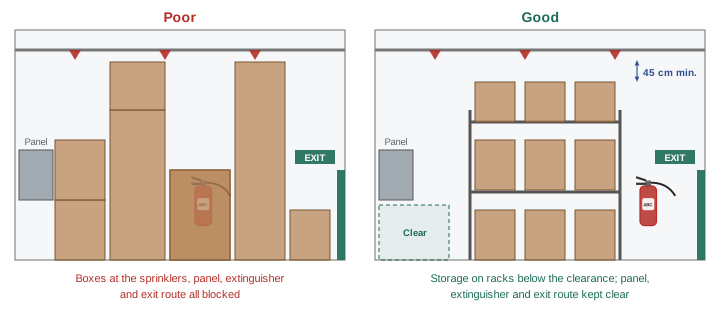
Poor housekeeping gives fires both a start and a path. Piles of cardboard, packaging, paper and waste provide fuel; clutter blocks access to extinguishers and exits; and dust and lint accumulations on equipment ignite easily. Good housekeeping practices include:
- Removing waste and packaging regularly, at least daily in most work areas, to designated containers and collection areas.
- Keeping combustible materials away from heat sources, lights, electrical panels and machinery.
- Cleaning up spills of flammable liquids promptly using appropriate absorbents and disposing of them safely.
- Removing dust and lint from equipment, lighting, ledges and ducts, using methods that do not create dust clouds.
- Keeping storage orderly, stable and below the clearance required from sprinkler heads, commonly at least 45 cm (18 inches) and more for some storage types.
- Keeping aisles, exits, stairways and access to fire equipment clear at all times.
- Storing idle pallets, which are a significant fire load, outside or in limited, well-arranged stacks indoors.
Housekeeping is everyone's job, but it needs ownership: assign areas, schedule tasks, and include housekeeping in inspections.
Storing flammable and combustible liquids
Fire codes in both Canada and the United States set detailed rules for storing flammable and combustible liquids, based on their hazard category, the type of container, the quantity and the occupancy. Common principles include:
- Keep only the quantity needed for the day or shift at the workstation; store the rest in approved storage.
- Use approved containers: original manufacturer containers, safety cans with self-closing lids and flame arrestors, or approved portable tanks.
- Store larger quantities in approved flammable liquid storage cabinets, which are designed to keep contents below ignition temperature for a period during a fire, or in dedicated storage rooms with ventilation, spill containment and explosion-proof equipment.
- Observe the maximum quantities permitted per cabinet and per area, and limits on the number of cabinets in a fire compartment, set by the applicable fire code.
- Keep containers closed when not in use, and never store flammables in exit stairs, corridors or near exits.
- Ground and bond metal containers when transferring liquids, and dispense only in well-ventilated areas away from ignition sources.
- Segregate incompatible materials, especially oxidizers and flammables, and follow safety data sheet storage information.
| Control | Purpose |
|---|---|
| Safety can with self-closing lid and flame arrestor | Limits vapor release and prevents flame entering the can |
| Flammable storage cabinet | Protects contents from external fire for a period and limits quantities |
| Spill containment | Prevents spills spreading and reaching drains |
| Ventilation | Keeps vapor concentrations below flammable limits |
| Bonding and grounding | Prevents static sparks during transfer |
| Segregation | Keeps incompatible materials apart |
Controlling ignition sources
Where fuels cannot be eliminated, ignition sources must be controlled. Key measures include:
- Smoking policies: prohibit smoking and vaping in buildings and near flammables, provide designated outdoor smoking areas with non-combustible receptacles, away from doors, air intakes and storage.
- Hot work control: use designated hot work areas where possible and a permit system elsewhere (HSE-212).
- Electrical safety: certified equipment, proper wiring, no daisy-chaining, inspections and maintenance, and electrical equipment rated for hazardous locations where flammable vapors or dusts may be present.
- Heating equipment: approved heaters with clearances, no improvised heaters, and controls on portable heaters.
- Static control: bonding and grounding, conductive flooring and footwear where required, and humidity control in some processes.
- Hot surfaces and friction: maintain machinery, lubricate bearings, guard belts and clean dust from motors.
- Battery charging: designated charging areas and approved chargers.
Protecting means of escape
Exits are designed for a building's occupant load and must remain usable at all times. Common failures include locked or chained exit doors, exits blocked by storage, exit signs that are unlit or missing, emergency lighting that does not work, and fire doors wedged open. Rules in fire codes and occupational safety regulations require that exits are kept clear and unlocked from the inside in the direction of travel during occupancy, that exit routes are marked and lit, and that fire doors close and latch. Many deadly fires, such as the 1911 Triangle Shirtwaist Factory fire in New York, in which 146 garment workers died partly because exit doors were locked, led directly to modern exit requirements.
Everyday practices protect escape routes: never store anything in exit stairs or corridors, report blocked exits immediately, never wedge fire doors open or disable door closers, check that exit signs and emergency lights work, and know at least two ways out of every area where you work.
Maintaining fire separations
Fire separations, fire walls, rated floors and ceilings, and the doors, dampers and seals within them divide buildings into compartments that hold fire and smoke back. These features are invisible to most occupants and easily damaged during renovations, cabling and maintenance. A contractor who cuts a hole through a fire-rated wall for a new cable and leaves it unsealed, or a tenant who removes ceiling tiles above a fire separation, can undo the protection. Organizations should control penetrations through a permit system, require fire stopping with listed systems, and inspect rated assemblies periodically. Fire dampers in ducts and smoke dampers must be tested on the schedule set by the applicable standards.
Measuring fire load
Fire load expresses how much combustible material is present, as the total heat energy it could release if it all burned, divided by the floor area. Fire load density is used by fire engineers to compare spaces and to judge how long a fire could burn and how severe it could become. It also shows clearly how housekeeping and storage limits reduce the fuel available.
where \( m_i \) is the mass of each combustible material in kilograms, \( \Delta H_{c,i} \) its heat of combustion in megajoules per kilogram, and \( A \) the floor area in square meters. Typical heats of combustion are about 18 MJ/kg for wood and cardboard, 16 MJ/kg for paper, 40 to 46 MJ/kg for many plastics such as polyethylene and polypropylene, and about 44 MJ/kg for diesel. Offices commonly have fire load densities of a few hundred MJ/m², while warehouses storing plastics can exceed several thousand.
Worked problem
Fire load of a storage room
A 40 m² storage room holds 600 kg of cardboard and wooden pallets (18 MJ/kg) and 150 kg of plastic packaging (40 MJ/kg). Calculate the fire load density. Then calculate it again after housekeeping removes 200 kg of unneeded cardboard and all the plastic is moved to a sprinklered warehouse.
Show solution
- Energy from cardboard and wood: \( 600 \times 18 = 10{,}800 \) MJ.
- Energy from plastics: \( 150 \times 40 = 6{,}000 \) MJ.
- Total: \( 10{,}800 + 6{,}000 = 16{,}800 \) MJ; fire load density \( q = 16{,}800 / 40 = 420 \) MJ/m².
- After housekeeping: \( 400 \times 18 = 7{,}200 \) MJ, so \( q = 7{,}200 / 40 = 180 \) MJ/m².
- Reduction: \( (420 - 180) / 420 \approx 57 \) percent.
Answer: The fire load drops from 420 MJ/m² to 180 MJ/m², a reduction of about 57 percent.
The plastic contributed more than a third of the energy despite being only a fifth of the mass, because plastics release more than twice as much heat per kilogram as wood and also burn faster and produce denser, more toxic smoke.
Fire prevention inspections
Regular inspections catch hazards before they cause fires. Workplace fire prevention inspections typically include daily checks by supervisors or workers (exits clear, housekeeping, flammables stored, no obvious hazards), monthly inspections by trained staff using a checklist (extinguishers, emergency lighting, fire doors, alarm panels free of trouble signals, storage clearances), and periodic inspections, testing and maintenance of fire protection systems by qualified contractors as required by the fire code and standards (Lesson 5). Fire departments in many municipalities also inspect workplaces, especially high-risk occupancies, and can issue orders to correct violations.
Worked problem
Prioritizing inspection findings
A monthly fire inspection of a distribution center finds: (1) an exit door chained shut at night to prevent theft; (2) a fire extinguisher with its inspection tag two months overdue; (3) pallets stacked within 30 cm of sprinkler heads in one aisle; (4) a missing ceiling tile in an office. Rank the findings by urgency and explain.
Show solution
- Chained exit door: immediate correction. A locked exit can trap people, and fire codes and OSHA or provincial regulations require exits to be openable from inside during occupancy, including night shifts. Remove the chain and find a security solution such as alarmed exit hardware.
- Pallets too close to sprinklers: urgent. Storage within the required clearance can prevent sprinklers from controlling a fire; lower the stack to maintain the required clearance (commonly at least 45 cm).
- Overdue extinguisher inspection: correct promptly; the extinguisher may still work, but inspect it now and fix the inspection schedule.
- Missing ceiling tile: correct soon; it may compromise smoke control or sprinkler performance, especially if the ceiling is part of a rated assembly.
Answer: Unlock the exit immediately, restore sprinkler clearance urgently, inspect the extinguisher promptly and replace the tile soon.
People and programs
Prevention lasts when it is part of how an organization works. Effective fire prevention programs assign responsibilities, often to a fire safety coordinator or the person responsible for the building's fire safety plan, with fire wardens for each area; train workers on fire hazards, prevention rules and emergency procedures at orientation and periodically; integrate fire risk into hazard assessments, management of change and contractor management (HSE-103); maintain records of inspections, maintenance and training; and review incidents, including small fires and near misses, to learn and improve. Workers contribute by following rules, keeping their areas tidy, reporting hazards and near misses, and speaking up when they see fire safety being compromised.
Seasonal and temporary hazards
Fire hazards change with the seasons and with temporary activities. Winter brings portable heaters, holiday decorations and snow blocking exits and hydrants; summer brings hot work for maintenance shutdowns, outdoor storage near buildings and dry vegetation in wildfire-prone areas. Renovations, inventory peaks, events and temporary structures all add fuel or ignition sources. Prevention programs should include seasonal checklists and require a fire safety review for temporary activities before they start.
Common mistakes
MistakeStoring materials up to the sprinkler heads.
InsteadKeep the required clearance below sprinklers.
MistakeLocking exits to prevent theft.
InsteadUse code-compliant security hardware that keeps exits openable from inside.
MistakeKeeping a week of solvent at the workstation.
InsteadKeep only what is needed for the shift; store the rest in approved cabinets.
MistakeLeaving cable holes in fire walls unsealed.
InsteadSeal penetrations with listed fire stopping and use a permit system.
MistakeTreating inspections as paperwork.
InsteadAct on findings by urgency and track corrections.
Summary and key terms
- Fire prevention separates fuel and ignition and keeps fires small and escape possible.
- The hierarchy of controls applies from elimination to PPE.
- Housekeeping removes fuel and keeps exits and equipment accessible.
- Flammable liquids need approved containers, cabinets, limits, ventilation and bonding.
- Control smoking, hot work, electrical, heating, static and battery ignition sources.
- Exits must stay clear and unlocked; fire separations must stay intact.
- Regular inspections and an organized program keep prevention working.
- Housekeeping
- Keeping work areas clean, orderly and free of excess combustibles.
- Fire load
- Amount of combustible material in an area.
- Safety can
- Approved container with self-closing lid and flame arrestor.
- Flammable storage cabinet
- Cabinet that protects flammable liquids from external fire.
- Sprinkler clearance
- Required space between storage and sprinkler heads.
- Means of escape
- Exits and routes that lead people to safety.
- Fire stopping
- Listed materials that seal openings in fire separations.
- Fire damper
- Device that closes a duct to stop fire spread.
- Fire safety coordinator
- Person responsible for organizing fire safety in a building.
- Near miss
- Event that could have caused harm but did not.
Practice problems
Work each problem on paper first, then reveal the answer to check.
Give an example of eliminating a fire hazard.
Show answer
Replacing a solvent cleaner with a water-based one.
How often should waste usually be removed from work areas?
Show answer
At least daily.
What is a common minimum storage clearance below sprinklers?
Show answer
About 45 cm (18 inches).
What does a flame arrestor in a safety can do?
Show answer
Prevents flame from entering the can.
Why limit flammables at the workstation?
Show answer
To reduce the fuel available if a fire starts.
Name three ignition source controls.
Show answer
Smoking policy, hot work permits, electrical safety, heater controls, static control.
What 1911 fire led to modern exit rules?
Show answer
The Triangle Shirtwaist Factory fire.
Why must fire doors never be wedged open?
Show answer
They keep smoke and fire out of escape routes.
Name three items on a monthly fire inspection.
Show answer
Extinguishers, emergency lighting, fire doors, alarm panel, storage clearances.
What should happen after a small fire or near miss?
Show answer
Report and review it to learn and improve.
Lesson quiz · 5 questions
Score 60% or more to complete this lesson.
Create a free account to save your progress, take quizzes and earn a certificate.