
HSE-105 · Lesson 12 of 12 · 27 min
Business continuity, recovery and capstone
When the fire is out and everyone is accounted for, the emergency is over, but the event is not. The organization must make the site safe, support affected workers, investigate, restore operations and learn. Many businesses that suffer a major fire never reopen, often because they had no plan for continuing their work while the site was rebuilt. This final lesson covers the transition from response to recovery, post-fire hazards and re-entry, supporting people, investigation and reporting, business continuity planning, and a capstone exercise that brings together the whole course.
From response to recovery
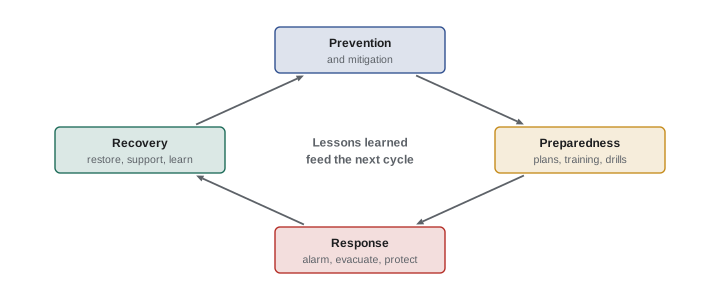
Emergency management is often described in four phases: prevention and mitigation, preparedness, response and recovery. Earlier lessons covered prevention (Lessons 2 and 3), preparedness (Lessons 4 to 8 and 11) and response (Lessons 7, 9 and 10). Recovery begins as soon as the immediate danger is controlled and can last weeks or months. The handover from the fire department back to the owner is a key moment: firefighters will release the scene once the fire is out and hazards are controlled, sometimes after the fire investigator has finished. Until then, no one should re-enter without permission.
Post-fire hazards and re-entry
A building after a fire is a hazardous workplace. Hazards include structural damage and collapse of floors, roofs and racking; hidden fire and smoldering material; electrical hazards from damaged wiring and wet equipment; toxic residues in soot and ash, including heavy metals, polycyclic aromatic hydrocarbons, dioxins and, in older buildings, asbestos; residues of extinguishing agents; contaminated water from firefighting; slippery and unstable floors; and damaged gas lines and pressure vessels. Before re-entry, the owner should obtain release from the fire department, have a qualified person assess structural safety, isolate utilities until checked by electricians and gas fitters, assess air quality and residues, and control access. Workers doing clean-up need training, respiratory protection and other PPE suited to the residues (HSE-104), and decontamination and hygiene facilities. Specialist restoration contractors are often used.
Supporting people
Fires and emergencies affect people beyond physical injury. Workers who witnessed injuries or deaths, were trapped or feared for their lives may experience acute stress, and some may develop post-traumatic stress. Organizations should provide practical information quickly (what happened, whether people are safe, pay and work arrangements), access to an employee assistance program and counseling, and time and space for people to talk. Supervisors should watch for signs that someone is struggling. Psychological first aid, a structured approach to supporting people in the hours and days after an event, is taught by many organizations.
Investigation and reporting
Fires are investigated by the fire department or fire marshal to determine origin and cause, by insurers, and by the organization itself. Serious injuries and fatalities must be reported to the occupational safety regulator, and the scene may need to be preserved until the regulator releases it.
In the United States, OSHA requires employers to report a work-related fatality within 8 hours and an in-patient hospitalization, amputation or loss of an eye within 24 hours (29 CFR 1904.39). State fire marshals and local fire investigators determine origin and cause, often following NFPA 921, Guide for Fire and Explosion Investigations. Significant chemical incidents may be investigated by the US Chemical Safety and Hazard Investigation Board, whose reports are public.
The organization's own investigation, using the methods from HSE-103, should look beyond the immediate cause to underlying causes: why the fuel and ignition source came together, why detection or suppression did or did not work, how the evacuation went, and what in the management system allowed the conditions to develop.
Business continuity planning
Business continuity planning prepares an organization to keep delivering its most important products and services during and after a disruption. It complements the emergency plan, which protects people and property. Standards such as ISO 22301, CSA Z1600 in Canada and NFPA 1600 (now consolidated into NFPA 1660) in the United States describe the process. The main steps are:
- Business impact analysis: identify critical activities, the resources they depend on (people, buildings, equipment, IT, suppliers), and how long the organization can tolerate their disruption, often expressed as a recovery time objective.
- Risk assessment: identify threats to those resources, including fire, and their likelihood and impact.
- Strategies: decide how to continue critical activities, such as alternate sites, remote work, backup equipment, mutual aid agreements, alternate suppliers, off-site data backups and insurance.
- Plans: document the strategies, roles, contact lists and step-by-step recovery procedures.
- Exercises and maintenance: test the plans and keep them up to date, using the drill and review methods from Lesson 11.
| Resource | Example continuity measure |
|---|---|
| Building | Alternate site agreement, remote work arrangements |
| Critical equipment | Spare units, rental agreements, alternate production lines |
| Data and IT | Off-site or cloud backups tested regularly |
| Records | Duplicate vital records stored off site |
| Suppliers | Second suppliers for critical inputs |
| People | Cross-training, succession for key roles |
| Finances | Property and business interruption insurance |
Worked problem
A quick business impact analysis
A small print shop has one building, two large presses, a design team of four, customer files on a single server in the office and one paper supplier. Its main customers expect delivery within five days. A fire closes the building for three months. Identify the most critical gaps and continuity measures.
Show solution
- Customer files on one on-site server: losing them would stop all work; back up off site or to the cloud and test restores.
- Presses: replacement takes weeks; arrange agreements with other printers to subcontract work during recovery.
- Building: the design team can work remotely if files and software are accessible.
- Supplier: one supplier is a single point of failure, also for normal disruptions; qualify a second supplier.
- Insurance: check that property and business interruption coverage match the three-month scenario.
Answer: Back up data off site, arrange subcontract printing, enable remote design work, add a second supplier and confirm insurance.
Capstone: putting it all together
The capstone exercise asks you to apply the whole course to one site. Consider a single-story food distribution warehouse of 6,000 m² with a sprinkler system designed for cartoned non-expanded plastics, a fire alarm system, a battery-charging area for 20 electric forklifts, an ammonia refrigeration plant room, a small office and a staff kitchen. It employs 80 people on two shifts, including two workers who use wheelchairs. Work through the following steps, using the lesson references:
- Hazards (Lessons 1 and 2): identify fuels, ignition sources and special hazards, including lithium-ion or lead-acid battery charging and the ammonia system.
- Prevention (Lesson 3): list housekeeping, storage, clearance and ignition control measures, and calculate the fire load of a representative storage bay.
- Legal framework (Lesson 4): list the codes, regulations and standards that apply where you work.
- Protection systems (Lesson 5): check that the sprinkler design matches the storage, and set up an impairment procedure.
- Extinguishers (Lessons 6 and 7): select extinguishers for each area, check travel distances and decide whether workers will use them or follow a total evacuation policy.
- Plans and roles (Lesson 8): draft the plan outline, assign roles for both shifts, and prepare PEEPs for the two wheelchair users.
- Evacuation and sheltering (Lesson 9): estimate evacuation time, choose assembly points, and decide when ammonia release would require shelter-in-place or evacuation upwind.
- Medical and other emergencies (Lesson 10): plan first aid coverage, AED placement and spill response.
- Drills and review (Lesson 11): plan a drill with objectives and an observer checklist.
- Recovery and continuity (Lesson 12): identify critical activities and continuity measures.
Worked problem
Capstone extract: extinguishers and evacuation
For the 6,000 m² warehouse (ordinary hazard, class A, roughly 100 m by 60 m), estimate the minimum number of 4-A extinguishers for class A coverage, and estimate the evacuation time for a shift of 40 people using four 0.9 m exits evenly, with a 60 s pre-movement time and a 50 m maximum travel distance at 1.0 m/s.
Show solution
- Area per 4-A extinguisher (ordinary hazard): up to about \( 4 \times 139 = 556 \) m², so \( 6{,}000 / 556 \approx 10.8 \), meaning at least 11 units on area alone.
- Travel distance: the 22.9 m limit, measured along aisles, usually requires more units, typically placed along main aisles and at exits and column lines; the count may rise to 14 or more after layout.
- Add class B units at the battery-charging area and the kitchen's class K unit, plus any specialized equipment for the plant room.
- Evacuation: 10 people per exit, queuing \( 10 / (1.3 \times 0.9) \approx 9 \) s; travel \( 50 / 1.0 = 50 \) s, so travel controls.
- Total: \( 60 + 50 = 110 \) s, about 2 minutes, before allowing for the wheelchair users, who need their PEEPs and possibly longer travel times.
Answer: At least 11, likely 14 or more, 4-A units after layout, plus special-hazard units; evacuation about 2 minutes for most occupants.
Where to go next
This course has built awareness of fire and emergency hazards, prevention, protection, response and recovery. To build further, consider hands-on extinguisher training on site; first aid, CPR and AED certification; warden and fire safety coordinator training offered by fire departments and safety associations; hot work safety (HSE-212); and courses on hazard assessment, incident investigation and safety management systems. Above all, learn your own site: walk your exit routes, find the extinguishers, pull stations, AEDs and first aid kits, read the emergency plan and take part in drills as if they were real.
Reminder: this course is awareness-level.
Restoring fire protection after an event
After a fire, the fire protection systems themselves need attention before the building is reoccupied. Sprinkler heads that operated must be replaced with heads of the same type, temperature rating and response, and the system refilled, tested and returned to service. Fire alarm devices exposed to heat, smoke or water may need replacement, and the whole system should be tested. Used extinguishers must be recharged or replaced. Fire doors and separations damaged by the fire or by firefighting must be repaired with listed components. Until the systems are restored, the building is impaired, and the impairment procedures from Lesson 5, including fire watch, apply. Insurers and the fire department will often want confirmation that systems have been restored before normal operations resume.
Communicating during recovery
Clear communication helps people and the business recover. Workers need to know what happened, whether they will be paid, when and where they will work, and what support is available. Customers and suppliers need to know how orders will be handled. Regulators, insurers and the fire department need reports and updates. Neighbors may be concerned about smoke, runoff or debris. Organizations should designate spokespeople, prepare messages in advance where possible as part of the continuity plan, and update people regularly even when there is little new to report. Honest, timely communication preserves trust; silence or inaccurate statements damage it.
Lessons for prevention
Recovery closes the loop back to prevention. The investigation findings, the after-action review of the response and the experience of continuing the business all feed into the next version of the fire prevention program, the emergency plan and the continuity plan. Questions to ask include: how did the fire start, and are similar conditions present elsewhere; did detection, alarms, sprinklers and extinguishers perform as expected; did the evacuation and accounting go as planned; and how long did it take to restore critical activities compared with the recovery time objectives? Sharing these lessons across the organization, and with the wider industry where appropriate, helps prevent the next fire.
Common mistakes
MistakeRe-entering a fire-damaged building to save equipment.
InsteadWait for release by the fire department and a safety assessment.
MistakeCleaning soot without protection.
InsteadAssess residues and use suitable respiratory protection and PPE.
MistakeIgnoring the emotional impact of an emergency.
InsteadProvide information, support and access to counseling.
MistakeAssuming insurance alone ensures recovery.
InsteadPlan how critical activities will continue.
MistakeKeeping all data on a single on-site server.
InsteadBack up off site and test restores.
Summary and key terms
- Emergency management cycles through prevention, preparedness, response and recovery.
- Re-enter only after release by the fire department and safety assessment.
- Post-fire sites have structural, electrical and toxic residue hazards.
- Support people with information, assistance and counseling.
- Report serious incidents and investigate underlying causes.
- Business continuity keeps critical activities going after a disruption.
- Apply the whole course to your own site and keep learning.
- Recovery
- Phase of restoring the site, people and operations after an emergency.
- Scene release
- Handover of the site from responders to the owner.
- Soot
- Fine carbon residue from fire that may contain toxic substances.
- Psychological first aid
- Structured support for people after a traumatic event.
- Origin and cause
- Where and why a fire started.
- Business continuity
- Ability to keep critical activities running during disruption.
- Business impact analysis
- Identifying critical activities and tolerable downtime.
- Recovery time objective
- Target time to restore an activity.
- Single point of failure
- One resource whose loss stops an activity.
- Business interruption insurance
- Coverage for lost income during recovery.
Practice problems
Work each problem on paper first, then reveal the answer to check.
Name the four phases of emergency management.
Show answer
Prevention and mitigation, preparedness, response, recovery.
When can a fire-damaged building be re-entered?
Show answer
After fire department release and a safety assessment.
Name three post-fire hazards.
Show answer
Structural collapse, electrical hazards, toxic residues.
What is psychological first aid?
Show answer
Structured support for people after a traumatic event.
Why preserve an incident scene?
Show answer
So regulators and investigators can examine it.
What is a business impact analysis?
Show answer
Identifying critical activities, dependencies and tolerable downtime.
What is a recovery time objective?
Show answer
Target time to restore an activity.
Give two continuity measures.
Show answer
Off-site backups, alternate site, second supplier.
What is a single point of failure?
Show answer
One resource whose loss stops an activity.
What should you learn about your own site?
Show answer
Exits, extinguishers, pull stations, AEDs, kits, the plan.
Lesson quiz · 5 questions
Score 60% or more to complete this lesson.
Create a free account to save your progress, take quizzes and earn a certificate.