
HSE-105 · Lesson 6 of 12 · 28 min
Portable fire extinguishers: classes, ratings and placement
Portable fire extinguishers are the first line of defense against small fires. Studies by fire protection organizations have found that most fires on which extinguishers are used are put out successfully, and that a correctly chosen extinguisher used promptly by a trained person can stop a fire before it grows beyond control. But extinguishers are only useful if they are the right type for the fire, have enough capacity, are located where people can reach them quickly, are in working order, and are used by someone who knows how and when to use them. This lesson covers the classes of fire, extinguishing agents, ratings and labels, selection, placement and travel distance, and inspection and maintenance. Lesson 7 covers using an extinguisher and deciding whether to fight a fire at all.
Classes of fire and the agents that fight them
Fires are grouped into classes by the fuel involved, because each class needs a different extinguishing approach. Using the wrong agent can be ineffective or dangerous, for example water on a grease fire or on energized electrical equipment.
| Class | Fuel | Suitable agents | Avoid |
|---|---|---|---|
| A | Ordinary combustibles: wood, paper, cloth, many plastics | Water, foam, multipurpose (ABC) dry chemical, wet chemical | CO2 alone (may not penetrate or cool deep-seated fires) |
| B | Flammable liquids and gases: gasoline, solvents, paints, propane | BC or ABC dry chemical, CO2, foam (AFFF or fluorine-free) | Water (spreads burning liquid) |
| C | Energized electrical equipment | CO2, dry chemical, clean agent | Water and foam while energized |
| D | Combustible metals: magnesium, titanium, sodium, lithium metal | Class D dry powder specific to the metal, dry sand | Water, CO2, ordinary dry chemical (violent reactions) |
| K | Cooking oils and fats in commercial cooking | Wet chemical (potassium acetate based) | Water (explosive steam and splatter) |
Class C means that the fire involves energized electrical equipment, where the extinguishing agent must not conduct electricity back to the user. Once the power is shut off, the fire becomes class A or B, depending on what is burning. Class D fires need a dry powder designed for the specific metal; a sodium chloride powder suits many metals, and copper-based powders are used for lithium. Lithium-ion battery fires are a special case: they are not a class D fire, because the batteries contain very little lithium metal, but they can reignite through thermal runaway and require large amounts of water for cooling. Specialized extinguishers and containment products are marketed for them, but evacuation and fire department response are usually needed for anything larger than a small device.
Extinguishing agents
- Water (pressurized water, water mist): cools class A fires; water mist models can be listed for class C because the fine droplets do not conduct.
- Foam (AFFF, AR-AFFF, fluorine-free foam): forms a film or blanket on flammable liquid fires and also cools class A fires; many jurisdictions are phasing out PFAS-containing AFFF.
- Multipurpose dry chemical (monoammonium phosphate, ABC): interrupts the chemical chain reaction and coats class A fuels; the most common workplace extinguisher, but leaves a corrosive residue.
- Ordinary dry chemical (sodium or potassium bicarbonate, BC): very effective on flammable liquids; potassium bicarbonate (Purple K) is used in fuel handling.
- Carbon dioxide (CO2): displaces oxygen and cools slightly; leaves no residue, suits electrical and electronic equipment; short range, and can be blown away outdoors.
- Clean agents (halocarbons such as halotron or FE-36): no residue, electrically non-conductive, suited to computer rooms and aircraft.
- Wet chemical: reacts with hot cooking oil to form a soapy layer (saponification) that seals the surface and cools it.
- Class D dry powder: smothers and absorbs heat from burning metal.
Ratings and labels
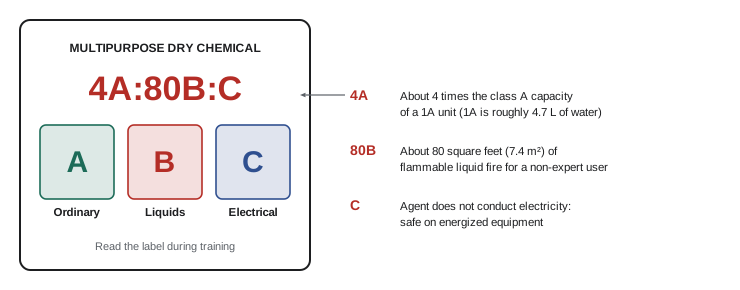
Extinguishers in Canada and the United States are tested and rated to harmonized standards, ULC-S508 in Canada and UL 711 in the United States, and labeled by an accredited certification body. The rating tells you both the class and the relative size of fire the extinguisher can handle. A typical label reads 3-A:40-B:C (UL style) or 3A-40BC (ULC style). The parts mean:
- The number before A shows the relative class A capacity: a 1-A rating is roughly equivalent to the extinguishing capacity of 1.25 gallons (about 4.7 liters) of water. A 4-A extinguisher has roughly four times the capacity of a 1-A unit.
- The number before B is the approximate area in square feet of a flammable liquid fire a non-expert user can extinguish in testing. A 40-B extinguisher can typically put out about 40 ft² (3.7 m²) of burning liquid. Experts can put out larger fires, but ratings assume ordinary users.
- C has no number: it simply means the agent is non-conductive and safe on energized equipment.
- D ratings do not have numbers either; the label lists the metals for which the extinguisher is effective.
- K shows suitability for commercial cooking fires.
Labels also show pictograms of the classes the extinguisher suits, with a red slash through those it must not be used on. Older extinguishers may use colored geometric symbols: a green triangle for A, a red square for B, a blue circle for C, a yellow star for D and a black hexagon for K.
Worked problem
Reading a rating
Two 4.5 kg (10 lb) dry chemical extinguishers are available. Extinguisher X is rated 4-A:80-B:C; extinguisher Y is rated 40-B:C. Which is suitable for a carpentry shop with wood dust and small quantities of finishing solvents?
Show solution
- The shop's main hazard is class A (wood, sawdust, rags), with a secondary class B hazard (solvents and finishes).
- Extinguisher X has a class A rating (4-A) and a large class B rating (80-B), and the C rating confirms it is safe on energized tools.
- Extinguisher Y has no class A rating, so it is not suitable for the main hazard; BC dry chemical may knock down flames on wood but does not prevent reignition of deep-seated embers.
Answer: Extinguisher X (4-A:80-B:C) suits the shop; Y lacks a class A rating.
Selection
Selection starts with a hazard assessment of each area: what can burn, how much, how quickly a fire could grow and who will use the extinguisher. Most workplaces need multipurpose ABC extinguishers for general class A and light class B hazards. Areas with flammable liquids need extinguishers with adequate B ratings; electrical rooms and server rooms may suit CO2 or clean agent units to avoid residue; commercial kitchens need class K wet chemical extinguishers near cooking appliances in addition to the hood system; and areas with combustible metals need the specific class D agent. The users matter too: heavy extinguishers may be unusable by some workers, and agents such as CO2 have short range and can cause frostbite at the horn. Fire codes and NFPA 10 require extinguishers to be selected for the hazard and the occupancy, and set minimum ratings and sizes.
| Area | Typical hazard | Typical extinguisher |
|---|---|---|
| Office | Light (low) hazard, class A | 2-A:10-B:C multipurpose |
| Workshop with some solvents | Ordinary (moderate) hazard, A and B | 4-A:40-B:C or larger multipurpose |
| Fuel dispensing or paint mixing | Extra (high) hazard, class B | 20-B or larger, plus foam or Purple K as needed |
| Server room | Electrical, sensitive equipment | CO2 or clean agent |
| Commercial kitchen | Cooking oils | Class K wet chemical within reach of appliances |
| Magnesium machining | Combustible metal | Class D powder listed for magnesium |
Placement and travel distance
An extinguisher is useless if it takes too long to reach. NFPA 10, which is referenced by the IFC, NFPA 101 and the NFC, sets maximum travel distances from any point in an area to the nearest suitable extinguisher, measured along the actual walking path around obstacles, not in a straight line.
| Hazard | Maximum travel distance |
|---|---|
| Class A (light, ordinary or extra hazard) | 22.9 m (75 ft) |
| Class B, low rating (for example 5-B to 10-B) | 9.15 m (30 ft) |
| Class B, higher rating (for example 10-B to 20-B or more) | 15.25 m (50 ft) |
| Class D | 22.9 m (75 ft) from the hazard |
| Class K | 9.15 m (30 ft) from cooking appliances |
| Class C | Based on the A or B hazard present |
Class A coverage also depends on the floor area each rating can protect. For ordinary hazard, NFPA 10 allows a maximum of about 139 m² (1,500 ft²) per unit of A rating, with a maximum of 1,045 m² (11,250 ft²) per extinguisher, subject to the travel distance limit. Other placement rules include mounting extinguishers so the top is no more than 1.53 m (5 ft) above the floor for units of 18 kg (40 lb) or less, and the bottom at least 10 cm (4 in) above the floor; locating them along normal paths of travel, near exits and entrances to hazard areas; keeping them visible and unobstructed, with signs where they are not visible; and protecting them from damage and freezing.
Worked problem
Checking travel distance
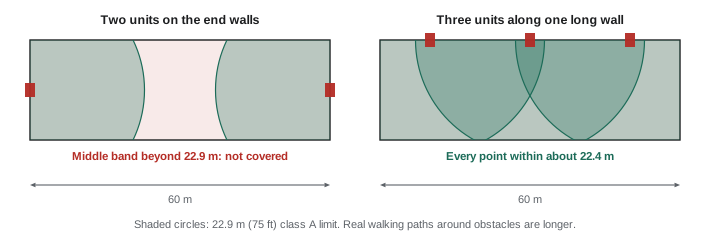
A rectangular workshop measures 60 m by 20 m and is classed as ordinary hazard, class A. Workers propose two 4-A extinguishers, one at each end wall, at the midpoint of each 20 m wall. Does this meet the 22.9 m maximum travel distance?
Show solution
- The farthest point from both extinguishers is at the center of the room, 30 m from each end wall.
- Travel distance from the center to either extinguisher is about 30 m, ignoring obstacles; the real walking path will be longer.
- 30 m exceeds the 22.9 m limit, so the arrangement fails even before obstacles are considered.
- Adding a third extinguisher at the center of one long wall reduces the maximum distance; for example, units spaced along a long wall at the 10 m, 30 m and 50 m marks give a worst case from a far corner of about \( \sqrt{10^2 + 20^2} \approx 22.4 \) m, which is just within the limit before obstacles. In practice, four units, or placement along the central aisle, give a safer margin.
- Area check: \( 60 \times 20 = 1{,}200 \) m²; with 4-A units, each can cover up to about \( 4 \times 139 = 556 \) m², so at least \( 1{,}200 / 556 \approx 2.2 \), meaning three units, are needed on area alone.
Answer: Two units fail the travel distance; at least three, better four, well-placed 4-A units are needed.
Inspection, maintenance and testing
In the United States, OSHA 1910.157 requires employers to visually inspect portable extinguishers monthly, have an annual maintenance check and record the date, perform hydrostatic tests at the intervals specified, and provide alternate protection while extinguishers are out of service. The IFC references NFPA 10 for the same activities.
The typical schedule under NFPA 10 includes:
- Monthly visual inspection by a trained person: the extinguisher is in its place, visible and accessible; the pressure gauge is in the operable (green) range; the safety pin and tamper seal are intact; there is no visible damage, corrosion, leakage or clogged nozzle; the label is legible; and the inspection tag is signed and dated.
- Annual maintenance by a certified technician: a thorough examination of mechanical parts, agent and expelling means, with a maintenance tag.
- Internal examination and recharging every six years for stored-pressure dry chemical extinguishers.
- Hydrostatic testing of the cylinder every five years for water, foam, wet chemical and CO2 extinguishers, and every twelve years for dry chemical and clean agent units.
- Recharging after any use, even partial; a partly used extinguisher may lose pressure or fail next time.
The 2026 edition of NFPA 10 introduces a performance-based option for inspection programs and adds procedures for condemning and disposing of extinguisher cylinders, but local codes may still reference earlier editions.
Wheeled and special extinguishers
Large hazards may need more extinguishing agent than a portable unit can provide. Wheeled extinguishers, with capacities of roughly 70 to 160 kg (150 to 350 lb) of agent, are used at fuel depots, chemical plants, airports and loading docks. They provide longer discharge times and greater range, but require more training and at least one person to move and operate them, often two. Special extinguishers include water mist units for areas with sensitive equipment and people, such as hospitals and clean rooms; non-magnetic extinguishers for MRI suites; and units designed for specific metal hazards. When selecting any special extinguisher, follow the manufacturer's listing and the requirements of NFPA 10 for the hazard.
Extinguishers in vehicles and outdoors
Vehicles, mobile equipment and remote work sites also need extinguishers. Many regulations and fleet policies require extinguishers in trucks carrying dangerous goods, in forklifts and heavy equipment, and on construction sites. Outdoor and vehicle extinguishers must be mounted in brackets designed for vibration, protected from weather and freezing, and inspected like other units. CO2 is less effective outdoors because wind disperses it, so dry chemical units are usually preferred. Workers in remote locations should know that help may take much longer to arrive, which affects decisions about fighting small fires and the importance of early evacuation.
Common mistakes
MistakeUsing a BC extinguisher as the main unit for class A hazards.
InsteadChoose an extinguisher with a class A rating for ordinary combustibles.
MistakeMeasuring travel distance as a straight line.
InsteadMeasure along the actual walking path.
MistakeTreating lithium-ion battery fires as class D.
InsteadTreat them as special hazards needing cooling and usually fire department response.
MistakeRehanging a partly used extinguisher.
InsteadRecharge after any use.
MistakeSkipping monthly checks because an annual service was done.
InsteadInspect monthly and service annually.
Summary and key terms
- Fires are classed A, B, C, D and K by fuel or condition.
- Each agent suits some classes and can be dangerous on others.
- Ratings show class and relative capacity, such as 4-A:80-B:C.
- Select extinguishers from a hazard assessment of each area.
- NFPA 10 sets maximum travel distances, such as 22.9 m for class A.
- Mount, sign and protect extinguishers along normal paths of travel.
- Inspect monthly, service annually and test cylinders at set intervals.
- Class A
- Fire in ordinary combustibles.
- Class B
- Fire in flammable liquids or gases.
- Class C
- Fire involving energized electrical equipment.
- Class D
- Fire in combustible metals.
- Class K
- Fire in commercial cooking oils and fats.
- Multipurpose dry chemical
- Monoammonium phosphate agent rated for A, B and C.
- Wet chemical
- Agent that saponifies hot cooking oil.
- Rating
- Label figures showing class and relative capacity.
- Travel distance
- Walking distance from any point to the nearest extinguisher.
- Hydrostatic test
- Pressure test of an extinguisher cylinder.
Practice problems
Work each problem on paper first, then reveal the answer to check.
What does the C in a rating mean?
Show answer
The agent is non-conductive and safe on energized equipment.
What does 40-B indicate?
Show answer
About 40 ft² of flammable liquid fire for a non-expert.
Why should water not be used on class K fires?
Show answer
It causes explosive steam and splattering of burning oil.
What agent is used on class K fires?
Show answer
Wet chemical.
What is the class A maximum travel distance?
Show answer
22.9 m (75 ft).
What is the class K maximum travel distance?
Show answer
9.15 m (30 ft).
How is travel distance measured?
Show answer
Along the actual walking path.
Why choose CO2 for a server room?
Show answer
It leaves no residue and is non-conductive.
How often are dry chemical cylinders hydrostatically tested?
Show answer
Every twelve years.
What should be done after partial use?
Show answer
Recharge the extinguisher.
Lesson quiz · 5 questions
Score 60% or more to complete this lesson.
Create a free account to save your progress, take quizzes and earn a certificate.