
HSE-105 · Lesson 7 of 12 · 26 min
Using an extinguisher safely and when not to
Knowing how to use a portable extinguisher is only half of the skill. The other half is knowing when not to use one. Every year, people are injured or killed trying to fight fires that were already too large, in rooms filling with smoke, with the wrong extinguisher or without an escape route. This lesson covers the decision to fight or leave, the steps of using an extinguisher (often remembered as PASS), technique for different classes of fire, what to do after the fire is out, and the training requirements that apply. Reading this lesson is not a substitute for hands-on training: you should discharge a real or training extinguisher on a controlled fire or simulator, under the supervision of a qualified instructor, before you are expected to use one at work.
Awareness only: this lesson does not qualify you to fight fires. OSHA 1910.157(g) requires hands-on or practical extinguisher training where employees are expected to use extinguishers, and you must follow your site's emergency action plan.
The decision: fight or leave
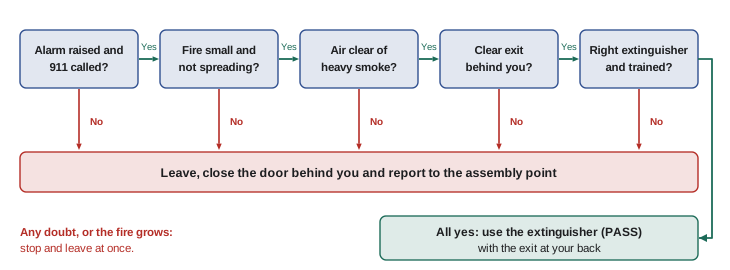
The first priority in any fire is people, not property. Before anyone picks up an extinguisher, three things must already be happening or done: the alarm has been raised so others can evacuate, the fire department is being called, and someone knows you are attempting to fight the fire. Then ask yourself a short series of questions. If the answer to any of them is no, leave immediately, closing doors behind you.
- Is the fire small and contained, for example no bigger than a wastebasket, and not spreading?
- Is the room free of heavy smoke, and is the air breathable at standing height?
- Do I have a clear exit behind me, so I can retreat without passing the fire?
- Do I know what is burning, and is the extinguisher the right type for it?
- Is the extinguisher large enough, and have I been trained to use it?
- Am I physically able to do this, and do I feel confident?
Many organizations simplify this to a rule: fight only fires that are no bigger than you, ideally smaller than a wastebasket, and only if you can keep the exit at your back. Many employers choose a total evacuation policy instead, in which no employee is expected to fight fires and everyone leaves when the alarm sounds. That is a legitimate choice, and it changes the training and equipment duties (Lesson 4).
Why fires outgrow extinguishers so quickly
Lesson 1 described how fires grow: a small fire can grow to fill a room within a few minutes, and flashover can occur in under five minutes in a modern furnished room. A typical 4.5 kg (10 lb) multipurpose extinguisher discharges for only 10 to 20 seconds, and a small 2.3 kg (5 lb) unit for 8 to 12 seconds. That is enough for a fire the size of a wastebasket or a small pan, but not for a burning sofa, a stack of pallets or a pool of fuel spreading across a floor. Smoke is also a fast-moving hazard: a few breaths of thick smoke can disorient you, and toxic gases such as carbon monoxide and hydrogen cyanide can cause collapse within minutes. The decision to fight must be made quickly, and abandoned quickly if things change.
PASS: using an extinguisher
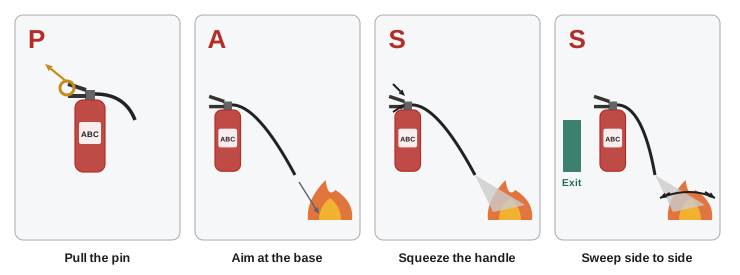
Most extinguishers are operated the same way, summarized by the acronym PASS: Pull, Aim, Squeeze, Sweep.
- Pull the pin. Hold the extinguisher upright and pull the safety pin, breaking the tamper seal. Some models have a different release mechanism; read the label during training, not during a fire.
- Aim low, at the base of the fire. Point the nozzle or hose at the fuel that is burning, not at the flames above it. Hitting the flames does little; the agent must reach the fuel surface.
- Squeeze the handle (lever) slowly and evenly to release the agent. Releasing the handle stops the discharge on most models.
- Sweep from side to side across the base of the fire, covering the whole burning area, until the fire appears to be out.
Start from a safe distance, typically 2 to 3 m (6 to 10 ft) for most dry chemical units and closer for CO2, and move forward as the fire diminishes. Keep low to stay below heat and smoke. Watch the area after the fire appears out, because it may reignite, and be ready to repeat the process or to leave.
Worked problem
PASS in practice
A worker sees a small fire in a wastebasket of paper beside a desk in an open office. The fire is about 40 cm high. A 2-A:10-B:C multipurpose extinguisher hangs by the exit 8 m away. A co-worker has pulled the alarm and is calling 911. Walk through the worker's actions.
Show solution
- Check the decision: the fire is small and contained, the air is clear, the worker is trained and the extinguisher is rated for class A, and the exit is reachable.
- Take the extinguisher from the exit and approach so the exit is behind the worker, stopping about 2 to 3 m from the fire.
- Pull the pin, aim the nozzle at the base of the burning paper, squeeze the handle and sweep side to side across the wastebasket.
- Stop when the flames are out, back away while watching for reignition, and do not turn your back on the fire.
- Report to the fire department or warden that the fire has been put out, and let them check for hidden burning; do not reuse or rehang the extinguisher, which must be recharged.
Answer: Confirm the decision, approach with the exit at your back, apply PASS, watch for reignition and report.
Technique by class of fire
- Class A: sweep the base of the burning material and soak or break apart smoldering material if it is safe; dry chemical leaves a coating that resists reignition, but deep-seated fires may need water from the fire department.
- Class B, spills: start at the near edge and sweep across the surface, pushing the fire away from you. Do not aim directly into a pool of liquid from close range, because the force of the discharge can splash burning liquid. Never use water.
- Class B, pressurized gas: a burning gas leak should usually not be extinguished unless the gas supply can be shut off; extinguishing the flame while the gas continues to flow can create an explosive vapor cloud. Shut off the gas if it is safe to do so and leave.
- Class C: shut off the power at the source if you can do so safely, then treat the fire as class A or B. Use only non-conductive agents while equipment may be energized.
- Class D: apply the class D agent gently to bury the burning metal, using the low-velocity applicator, without scattering it. Never use water or ordinary extinguishers.
- Class K: turn off the heat source if safe, activate the hood system if it has not operated, then use the class K extinguisher with a gentle, sweeping application to avoid splashing the oil. Never use water or carry a burning pan.
| Situation | Do | Do not |
|---|---|---|
| Wastebasket fire | PASS from 2 to 3 m with exit behind | Fight if smoke fills the room |
| Flammable liquid spill fire | Sweep from near edge across surface | Aim into the pool at close range or use water |
| Burning gas leak | Shut off the gas if safe, then leave | Put out the flame while gas still flows |
| Electrical panel fire | Cut power if safe, use CO2 or dry chemical | Use water or foam on live equipment |
| Deep fryer fire | Shut off heat, activate hood system, use class K | Use water or move the fryer |
| Magnesium chips burning | Gently cover with class D powder | Use water, CO2 or ABC |
Hazards of extinguishers themselves
Extinguishers are pressure vessels and their agents have hazards. Dry chemical discharges create a dense cloud that reduces visibility and irritates the eyes and lungs; in a small room, it can make escape harder. CO2 displaces oxygen and is dangerous in confined spaces, and the discharge horn becomes extremely cold, causing frostbite if held. Clean agents can decompose in fires to produce irritating gases. Damaged or corroded cylinders can rupture. Never use an extinguisher that looks damaged or has a gauge out of range, and report it.
After the fire
Even when a fire appears to be out, the fire department should be called to check for hidden fire in walls, ceilings and equipment. Leave the area, close doors and report to the warden or person in charge. The extinguisher must be removed from service and recharged or replaced, and a replacement installed. The incident should be reported and investigated, like any near miss or incident, to understand why the fire started and how to prevent a repeat (HSE-103). Clean-up of dry chemical residue should be done promptly, because monoammonium phosphate is corrosive to electronics and metals.
Training requirements
Under OSHA 1910.157(g), where an employer provides portable extinguishers for employee use, it must provide an educational program on the general principles of extinguisher use and the hazards of incipient-stage firefighting, upon initial employment and at least annually. Employees designated to use firefighting equipment as part of an EAP must receive hands-on training upon initial assignment and at least annually. An employer with a total evacuation policy, a written EAP and an FPP, and which does not expect employees to use extinguishers, may be exempt from parts of 1910.157.
Live-fire training is increasingly delivered with propane-fired simulators or laser-based trainers, which allow workers to practice PASS safely without the environmental impact of discharging dry chemical. Training should be documented, including the date, content, trainer and names of participants.
Fire blankets and other first-response tools
Fire blankets are sheets of fire-resistant material used to smother small fires, such as a burning pan on a domestic-style stove, a small wastebasket fire or burning clothing. To use one, pull the tabs to release it from its container, hold it in front of you with your hands protected by the folded edges, place it gently over the fire, turn off the heat source if possible, and leave it in place until the material has cooled completely. A fire blanket is not a substitute for a class K extinguisher in a commercial kitchen, but it is useful in staff kitchens, laboratories and workshops. Other tools sometimes found at work include sand buckets for small metal fires and spill containment, and emergency shut-off switches for fuel, gas and electrical supplies, which are often the most effective way to stop a fire from growing.
Human factors in firefighting decisions
People make poor decisions under stress. They underestimate how quickly a fire is growing, overestimate their ability to control it, focus narrowly on the flames and lose track of smoke and escape routes, and feel a strong sense of responsibility for equipment or property. Some keep trying after the extinguisher is empty. Training that includes realistic scenarios, clear decision rules and the explicit message that leaving is always an acceptable choice helps counter these tendencies. Supervisors must never pressure workers to fight fires, and workers who choose to leave rather than fight should be supported. The goal is not to save the building; it is to make sure everyone goes home.
Working in pairs
Where possible, two people should respond to a fire together: one fights the fire and the other watches the fire, the smoke and the exit, carries a second extinguisher and calls the attempt off if conditions worsen. If the first extinguisher fails to control the fire, the second person can make one more attempt, but if two extinguishers have not controlled a fire, it is beyond the incipient stage and both should leave, closing doors behind them. Responders should report what they did to the coordinator and firefighters, including what was burning, what agents were used and whether anyone may still be inside.
Common mistakes
MistakeFighting a fire before raising the alarm.
InsteadRaise the alarm and call the fire department first.
MistakeAiming at the flames.
InsteadAim at the base of the fire, where the fuel is burning.
MistakeLetting the fire get between you and the exit.
InsteadKeep the exit at your back.
MistakePutting out a gas flame while gas is still flowing.
InsteadShut off the gas if safe and leave.
MistakeTurning your back on a fire that seems out.
InsteadBack away watching for reignition and call the fire department to check.
Summary and key terms
- People come first: raise the alarm and call for help before fighting a fire.
- Fight only small, contained fires with clear air, an exit behind you and the right extinguisher.
- Extinguishers discharge in seconds; fires can grow in minutes.
- PASS: Pull, Aim at the base, Squeeze, Sweep.
- Adapt technique to the class, and never extinguish a burning gas leak while gas flows.
- After use, leave, report, recharge and investigate.
- Hands-on training is required where workers are expected to use extinguishers.
- PASS
- Pull, Aim, Squeeze, Sweep.
- Incipient fire
- Fire in its earliest stage, controllable with portable equipment.
- Total evacuation policy
- Policy that all occupants leave and none fight fires.
- Discharge time
- Time an extinguisher takes to empty.
- Reignition
- Fire starting again after appearing to be out.
- Base of the fire
- Where the fuel is burning, the point to aim at.
- Fire simulator
- Training device that safely mimics a fire.
- Tamper seal
- Seal that shows whether the pin has been pulled.
- Low-velocity applicator
- Nozzle that applies class D powder gently.
- Exit at your back
- Rule that your escape route stays behind you.
Practice problems
Work each problem on paper first, then reveal the answer to check.
What must happen before fighting a fire?
Show answer
Alarm raised, fire department called, others aware.
What size of fire is generally fightable?
Show answer
Small, contained, roughly wastebasket size.
How long does a 4.5 kg extinguisher discharge?
Show answer
About 10 to 20 seconds.
What does PASS stand for?
Show answer
Pull, Aim, Squeeze, Sweep.
Where should you aim?
Show answer
At the base of the fire.
What is a safe starting distance?
Show answer
About 2 to 3 m for dry chemical units.
Why not extinguish a burning gas leak while gas flows?
Show answer
It can create an explosive vapor cloud.
What hazard does a CO2 discharge horn present?
Show answer
Frostbite from extreme cold.
Why call the fire department after a fire is out?
Show answer
To check for hidden fire.
What is a total evacuation policy?
Show answer
Everyone leaves; no one fights fires.
Lesson quiz · 5 questions
Score 60% or more to complete this lesson.
Create a free account to save your progress, take quizzes and earn a certificate.