
HSE-102 · Lesson 6 of 12 · 25 min
Shipped container labels
The label on a shipped container is the first line of hazard communication. Chemical manufacturers, importers and distributors must ensure that each container of hazardous chemicals leaving their workplace is labeled with the essential hazard information and precautions in a standard format. Workers often see this label more than any other source of information, so understanding its content, knowing what to do if it is missing or damaged, and knowing the special rules for small containers and bulk shipments is essential. This lesson covers the required elements of shipped container labels, their layout, small containers, labeling of bulk shipments and containers released for shipment, label maintenance and updates when new information becomes available.
Required label elements
Under the HCS, a label on a shipped container must include:
- Product identifier: the name or code of the product, matching the product identifier on the SDS.
- Name, address and telephone number of the chemical manufacturer, importer or other responsible party.
- Pictograms for each applicable hazard, subject to precedence rules.
- Signal word: Danger or Warning, where applicable.
- Hazard statements for each hazard class and category.
- Precautionary statements for prevention, response, storage and disposal.
- Supplementary information where appropriate, such as the percentage of ingredients of unknown acute toxicity, and other information the manufacturer considers useful, as long as it does not contradict or detract from the required elements.
The pictograms, signal word and hazard statements must be located together on the label. Labels must be legible, in English, and prominently displayed. Employers may add other languages. OSHA does not prescribe a particular format beyond these requirements, though many manufacturers follow common layouts.
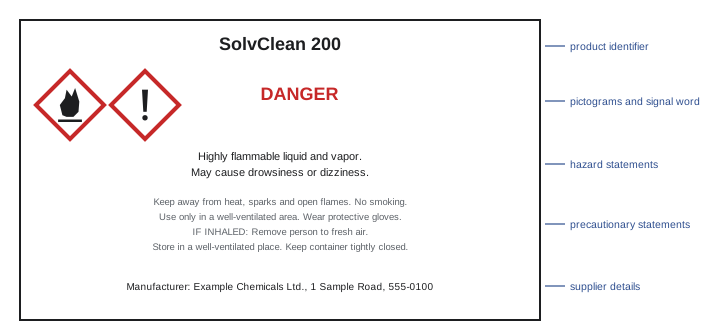
Reading a label in seconds
A practical habit when you pick up a container is to read the label in a consistent order: product identifier (is this the product I expect?), pictograms and signal word (what kinds of hazard, and how serious?), hazard statements (what exactly can it do?), and precautionary statements (what must I do to work safely and what should I do if something goes wrong?). For more detail, such as the type of gloves or the exposure limits, go to the SDS. If anything on the label is unclear, ask before using the product.
Worked problem
Reading a supplier label
A label shows the product name "Rapid Degreaser", the flame and health hazard pictograms, the signal word Danger, and the hazard statements "Highly flammable liquid and vapor", "May be fatal if swallowed and enters airways" and "May cause drowsiness or dizziness". What do these tell you, and what precautions follow?
Show solution
- Flame and "Highly flammable liquid and vapor": flammable liquid Category 2; keep away from ignition sources, keep containers closed, bond and ground during transfer.
- Health hazard and "May be fatal if swallowed and enters airways": aspiration hazard; do not induce vomiting if swallowed, get medical help immediately.
- "May cause drowsiness or dizziness": STOT SE Category 3 narcotic effects; use only with good ventilation and avoid breathing vapor.
- Check the SDS for gloves, respiratory protection if needed and storage requirements.
Answer: A highly flammable solvent with aspiration and narcotic hazards: control ignition, ventilate, avoid vapor, never induce vomiting, and consult the SDS for PPE.
Small containers
Some containers are too small for a full label. The 2024 update added specific provisions: for containers of 100 mL or less, the label must include at least the product identifier, pictograms, signal word, manufacturer's name and phone number and a statement that the full label information is on the immediate outer package; for containers of 3 mL or less, where a label would interfere with normal use, the container need only bear the product identifier, with the full label on the outer package. The full label must be on the immediate outer package in both cases. Before these provisions, OSHA allowed practical alternatives through enforcement guidance.
Bulk shipments and containers released for shipment
For bulk shipments, such as tank trucks and rail cars, the 2024 update clarifies that labels may be placed on the immediate container or transmitted with shipping papers, bills of lading or electronically, as long as the information is available to the receiving employer at the time of shipment. For packaged containers that are released for shipment but not immediately shipped, the update allows the label in effect at release to remain if a new hazard is identified, with updated information provided with the shipment. Containers shipped under DOT rules may carry both DOT and HCS labels, and the HCS allows certain DOT pictograms to substitute for HCS pictograms for the same hazard on shipped containers.
Label maintenance and replacement
Labels must stay legible and attached for as long as the product remains in the container. Chemicals, abrasion, weather, heat and age can damage labels. Workers should report damaged, illegible or missing labels immediately, and should never use a product from a container they cannot identify with certainty. Employers must replace damaged supplier labels with a new supplier label or, depending on the jurisdiction and situation, a workplace label. Removing, defacing or covering a supplier label is not permitted while the product is in the container. When a container is emptied and will be reused for something else, old labels must be removed or completely covered and the container properly cleaned.
Updating labels when new information appears
When chemical manufacturers, importers or distributors become aware of significant new information about the hazards of a chemical, they must revise the label within six months. Employers receiving updated labels and SDSs should update workplace labels, the written program and training as needed.
Supplier labels and other marks
Containers may carry other marks in addition to the hazard communication label: transport labels and placards, consumer product labels, pesticide labels, manufacturer instructions and logos. These do not replace the required label, but they can provide additional information. Transport placards on trucks and tanks identify hazards for emergency responders using UN numbers and classes, which differ from the workplace system: for example, a transport flammable liquid label uses a red diamond with a flame and the number 3. Workers should not confuse transport classes with workplace hazard categories.
| Feature | Workplace hazard label | Transport label |
|---|---|---|
| Purpose | Inform workers using the product | Inform handlers and emergency responders in transport |
| Format | Black symbol, white background, red diamond border | Colored diamond with class number |
| Numbering | Hazard categories (1 most severe) | Transport classes (e.g. Class 3 flammable liquids) |
| Required elements | Identifier, pictograms, signal word, statements, supplier | Class label, UN number, proper shipping name on documents |
Common label problems
Real labels are not always perfect. Problems you may encounter include labels that are faded, torn or soaked with product; labels in only one language where two are required; labels from another country that do not meet local requirements; labels that do not match the SDS, for example with different pictograms or product names; labels that have been partly covered by tape, price stickers or other labels; and old labels with outdated symbols. In each case, report the problem. Supervisors should contact the supplier for a correct label or SDS, and in the meantime ensure the product is identified with a workplace label as permitted and that workers know its hazards.
Imported and online purchases
Products bought online, imported directly from overseas or obtained from small suppliers are more likely to arrive without compliant labels and SDSs. Some may carry labels designed for another country, consumer labels when the product will be used at work, or no hazard information at all. Organizations should route all purchases of hazardous products through a process that checks for compliant labels and SDSs before the product is used. If a product cannot be supplied with proper hazard information, consider whether it should be used at all.
Labels and the receiving process
The receiving area is the first chance to catch labeling problems. When hazardous products arrive, receivers should check that containers are undamaged and not leaking, that each container carries a legible label, that the product matches the order and the SDS on file, and that a current SDS is available. Damaged or leaking containers should be isolated and handled according to the spill procedure. Records of receipt help maintain the chemical inventory. Simple checklists at receiving desks make these checks routine.
Label design for clarity
While suppliers must include the required elements, good label design makes the information easier to use: grouping pictograms, signal word and hazard statements together near the top; using clear, large type; keeping supplementary marketing text separate; and avoiding clutter. Employers who design workplace labels can apply the same principles, with large product names, clear pictograms and a few key precautions rather than long blocks of small text.
Practice: checking a label
Try this exercise with a real container at your workplace. Find the product identifier and check that it matches the SDS on file. Identify each pictogram and say what hazard it represents. Note the signal word. Read each hazard statement and put it in your own words. Read the precautionary statements and list what you should do before, during and after using the product, and in an emergency. Find the supplier's contact information. Finally, check whether the label is in good condition and in the required language. Doing this for the products you use most often turns label reading into a quick habit.
Labels on containers you receive from other workplaces
Products sometimes arrive from other company sites, contractors or customers, rather than from a supplier. These may carry workplace labels rather than supplier labels, or no label at all. Treat such products carefully: confirm their identity and obtain the SDS before use, and apply proper labels. The same applies to samples, returned products and products left behind by previous occupants of a building.
When labels conflict with experience
Experienced workers sometimes feel that a label overstates the hazard of a product they have used for years without problems. But many chemical effects, such as sensitization and chronic organ damage, appear only after long exposure, and incidents can happen the first time conditions change, such as higher temperatures, a confined space or mixing with another product. Labels reflect the best available evidence. If you believe a label is wrong, raise it, but follow it until it is reviewed.
Labels and people with limited literacy or vision
Some workers have limited literacy, read the label language as a second language, or have visual impairments. Pictograms help, but they are not enough on their own, since many people misinterpret some symbols. Employers can support these workers with training that uses real containers and demonstrations, translated summaries, larger-print workplace labels, color and position cues used consistently, and buddy systems for unfamiliar products. The goal is that every worker can identify the hazards of every product they use.
Labels and storage temperature
Labels and SDSs sometimes specify storage temperature limits, such as "Store below 30 °C" or "Protect from freezing". Exceeding these limits can change a product's behavior: some products degrade, separate or become more hazardous, and pressurized containers can rupture. Check labels when storing products in unheated buildings, vehicles or outdoor areas.
Labels and secondary hazards
A label lists all the classified hazards of a product, but users sometimes focus only on the first pictogram they see. A solvent may carry the flame pictogram most prominently while also carrying the health hazard pictogram for aspiration or organ toxicity. Read every pictogram and every hazard statement, not just the first.
Common mistakes
MistakeUsing a product with a missing label.
InsteadStop, isolate it and report it.
MistakeCovering supplier labels with tape or stickers.
InsteadKeep them visible and legible.
MistakeAssuming transport labels meet workplace requirements.
InsteadWorkplace labels are still required.
MistakeIgnoring precautionary statements because they are long.
InsteadRead them; they tell you what to do.
MistakeKeeping old labels after an update.
InsteadReplace them and update training.
Summary and key terms
- Labels give product identity, hazards and precautions at a glance.
- Shipped container labels include identifiers, pictograms, signal word, statements and the responsible party.
- Read labels in a consistent order and consult the SDS for detail.
- Small containers have reduced labeling options under specific conditions.
- Bulk shipments and released containers have specific rules.
- Labels must be maintained and replaced if damaged.
- Labels are updated when significant new information appears.
- Product identifier
- Name or code identifying the product.
- Initial supplier identifier
- Name and contact of the Canadian manufacturer or importer.
- Supplier label
- Label provided by the supplier on a hazardous product container.
- Shipped container label
- Label on chemicals leaving a manufacturer or distributor.
- Supplemental information
- Additional required or optional label information.
- Small container
- Container of 100 mL or less with reduced labeling options.
- Bulk shipment
- Large shipment such as tank trucks or rail cars.
- Significant new data
- Information changing classification or protection.
- Transport label
- Label for dangerous goods in transport.
- Legibility
- Ability to read the label clearly.
Practice problems
Work each problem on paper first, then reveal the answer to check.
List the main label elements.
Show answer
Product identifier, supplier details, pictograms, signal word, hazard and precautionary statements.
Why must the product identifier match the SDS?
Show answer
So users can find the correct SDS.
In what order should you read a label?
Show answer
Identifier, pictograms and signal word, hazard statements, precautions.
What size limit defines a small container?
Show answer
100 mL or less.
What should you do with a damaged label?
Show answer
Report it and have it replaced.
How long do manufacturers have to revise labels after significant new information?
Show answer
Six months.
Do transport labels replace workplace labels?
Show answer
No.
What number appears on a transport flammable liquid label?
Show answer
3.
What must be done before reusing an empty container?
Show answer
Clean it and remove or cover old labels.
Where do you find glove type?
Show answer
On the SDS (section 8).
Lesson quiz · 5 questions
Score 60% or more to complete this lesson.
Create a free account to save your progress, take quizzes and earn a certificate.