
HSE-102 · Lesson 8 of 12 · 25 min
Safety data sheets: the 16 sections
The safety data sheet is the most complete source of information about a hazardous product. Where a label gives the essentials, the SDS explains the hazards in detail, lists the ingredients, gives first aid and firefighting measures, describes safe handling, storage and personal protection, and provides the physical, chemical, toxicological and regulatory data behind the classification. SDSs are used by workers, supervisors, health and safety professionals, first aiders, emergency responders, doctors and anyone choosing controls or protective equipment. This lesson explains the standard 16-section format, what each section contains, who is responsible for SDSs, how SDSs must be kept up to date and made accessible, and the role of electronic SDS management.
From MSDS to SDS
Under the original HCS, the equivalent document was called a material safety data sheet (MSDS), with flexible formats. HCS 2012 adopted the GHS 16-section SDS format, with sections in a fixed order. Chemical manufacturers and importers must update the SDS within three months of becoming aware of significant new information about the hazards or ways to protect against them, and must provide SDSs to downstream users with the first shipment and after updates.
The 16 sections
| Section | Title | Main content |
|---|---|---|
| 1 | Identification | Product identifier, recommended use and restrictions, supplier details, emergency phone number |
| 2 | Hazard identification | Classification, label elements (pictograms, signal word, statements), other hazards |
| 3 | Composition/information on ingredients | Chemical names, CAS numbers, concentrations or ranges of hazardous ingredients |
| 4 | First-aid measures | First aid by route of exposure, symptoms, immediate medical attention needed |
| 5 | Fire-fighting measures | Suitable extinguishing media, specific hazards, protective equipment for firefighters |
| 6 | Accidental release measures | Personal precautions, protective equipment, emergency procedures, containment and cleanup |
| 7 | Handling and storage | Precautions for safe handling, conditions for safe storage, incompatibilities |
| 8 | Exposure controls/personal protection | Exposure limits, engineering controls, personal protective equipment |
| 9 | Physical and chemical properties | Appearance, odor, pH, flash point, boiling point, vapor pressure, solubility, and more |
| 10 | Stability and reactivity | Reactivity, stability, conditions to avoid, incompatible materials, decomposition products |
| 11 | Toxicological information | Routes of exposure, symptoms, acute and chronic effects, numerical toxicity data |
| 12 | Ecological information | Ecotoxicity, persistence, bioaccumulation, mobility in soil |
| 13 | Disposal considerations | Safe disposal methods for the product and contaminated packaging |
| 14 | Transport information | UN number, shipping name, transport hazard class, packing group |
| 15 | Regulatory information | Safety, health and environmental regulations specific to the product |
| 16 | Other information | Date of preparation or last revision, and other relevant information |
Under the HCS, all 16 sections must appear in order, but OSHA does not enforce the content of sections 12 to 15, which fall under other agencies' jurisdiction (EPA, DOT and others); manufacturers must still include the section headings. Section 16 must include the date of preparation or last revision. SDSs must be in English, and employers may keep copies in other languages as well.
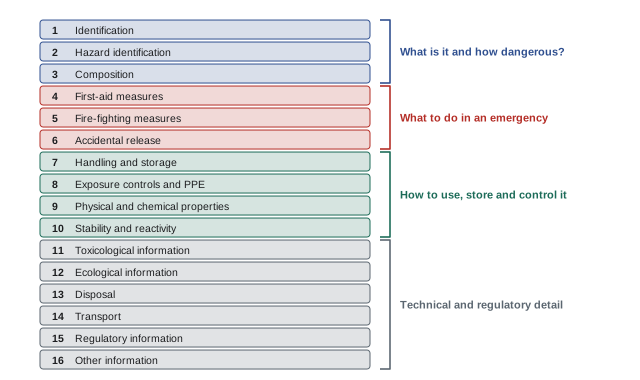
Sections 1 to 3: what is it, and how dangerous?
Section 1 identifies the product and the supplier, and gives an emergency telephone number, which may be a 24-hour service. It also lists recommended uses and restrictions: using a product for something it was not intended for may introduce hazards the SDS does not address. Section 2 gives the classification and the label elements, so it mirrors the label. Section 3 lists hazardous ingredients with their chemical names, Chemical Abstracts Service (CAS) registry numbers and concentrations, which can be exact percentages or, under current rules, prescribed ranges such as 10–30 %. Ingredient identities may be withheld as confidential business information or trade secrets, in which case the SDS must say so.
Sections 4 to 6: emergencies
Section 4 gives first-aid measures for each route of exposure: inhalation, skin contact, eye contact and ingestion, plus the most important symptoms and effects, whether immediate medical attention is needed, and notes for physicians. Section 5 describes suitable and unsuitable extinguishing media, such as "do not use water jet" for water-reactive materials, specific hazards during fire such as toxic combustion products, and protective equipment for firefighters. Section 6 covers spills and leaks: personal precautions and PPE, evacuation, environmental precautions such as preventing entry into drains, and methods for containment and cleanup. These three sections are often consulted under time pressure, so workers should become familiar with them for the products they use before an emergency happens.
Sections 7 to 10: handling, storage and control
Section 7 gives precautions for safe handling, such as avoiding contact, preventing static discharge or using only in well-ventilated areas, and conditions for safe storage, including temperature limits, incompatible materials and container requirements. Section 8 is particularly important for workplace protection: it lists occupational exposure limits for ingredients, appropriate engineering controls such as local exhaust ventilation, and personal protective equipment, including eye and face protection, skin protection with specific glove materials, and respiratory protection. Section 9 gives the physical and chemical properties used in classification and in planning controls: appearance, odor, odor threshold, pH, melting and boiling points, flash point, flammability limits, vapor pressure, vapor density, relative density, solubility, partition coefficient, autoignition and decomposition temperatures, and viscosity. Section 10 explains chemical stability, possible hazardous reactions, conditions to avoid such as heat or moisture, incompatible materials and hazardous decomposition products.
Sections 11 to 16: technical and regulatory detail
Section 11 gives toxicological information: likely routes of exposure, symptoms, acute and chronic effects, numerical measures such as LD50 and LC50 values, and whether ingredients are listed as carcinogens by bodies such as the International Agency for Research on Cancer (IARC). Section 12 covers ecological effects. Section 13 covers disposal. Section 14 gives transport information such as the UN number and transport hazard class. Section 15 lists other regulations that apply. Section 16 gives the revision date and other information, such as abbreviations and a summary of changes. Although sections 12 to 15 may not be enforced under workplace rules, they often contain useful information for environmental protection, waste handling and shipping.
Responsibilities for SDSs
Chemical manufacturers and importers must prepare SDSs and provide them to distributors and employers with the initial shipment and with the first shipment after an update. Distributors must pass SDSs on to their customers. Employers must keep copies of the required SDSs for each hazardous chemical and ensure that they are readily accessible during each work shift to employees in their work areas. Employers producing chemicals on site must prepare SDSs for them.
Accessibility
An SDS is useful only if workers can get it quickly when they need it. "Readily available" or "readily accessible" means available in the work area, during the shift, without barriers such as locked offices or a supervisor's password. Employers may keep SDSs in paper binders, electronically on computers, tablets or online services, or both. Electronic systems must work reliably, workers must be trained to use them, and there must be a backup, such as paper copies or a phone service, in case of power or network failure. In an emergency, a copy of the SDS should accompany an injured worker to medical care.
Worked problem
Is the SDS system accessible?
A warehouse keeps all SDSs in an online system that can be reached only from the office computer, which is locked at night when the night shift works. Does this meet the accessibility requirement, and how could it be fixed?
Show solution
- Night-shift workers cannot reach the SDSs during their shift, so the system is not readily accessible.
- Options: provide a terminal or tablet in the work area with access to the system, keep a paper binder of SDSs at the shift supervisor's desk, or use a phone-based SDS service.
- Train night-shift workers on how to find SDSs, and test the system periodically, including during a simulated outage.
Answer: No; provide in-area access during every shift, with a backup, and train workers to use it.
Electronic SDS management
Many organizations use electronic SDS management systems, which store current SDSs, track revisions, link products to locations and inventories, generate workplace labels and provide mobile access. They make it easier to keep SDSs current, to search by product, ingredient or location, and to produce reports such as chemical inventories. However, the system is only as good as its data: products brought in without going through purchasing or receiving, such as samples or products bought on a credit card, may never enter the system. A good chemical management program controls how products enter the workplace and checks that each has a current SDS.
Checking the quality of an SDS
Not all SDSs are equally good. When reviewing one, check that it is for the exact product and supplier, that it is current and in the required language and format, that all 16 sections are present, that the classification and label elements in section 2 match the label on the container, that section 8 gives specific advice rather than vague statements such as "wear suitable gloves", and that the emergency telephone number works. If an SDS seems incomplete, inconsistent or wrong, contact the supplier and inform your safety contact.
Who uses which sections
Different people rely on different parts of the SDS. Workers using a product need sections 2, 4, 7 and 8 most often: the hazards, first aid, safe handling and protection. Supervisors planning work also use sections 6, 9 and 10. Health and safety professionals and occupational hygienists use section 8 exposure limits, section 9 properties and section 11 toxicology to assess risks and choose controls. First aiders and medical staff use section 4 and section 11. Firefighters and emergency responders use sections 5, 6, 9 and 14. Environmental staff use sections 12 and 13. Purchasing staff compare sections 2 and 3 when choosing products. Knowing this helps each person find what they need quickly and makes SDS training more relevant.
SDSs for products from several suppliers
The same chemical, such as acetone or sodium hydroxide solution, may be bought from several suppliers, each with its own SDS. Although the hazards are the same, the SDSs may differ in wording, the concentrations stated, the PPE recommendations and the level of detail. The employer must keep an SDS for each product as supplied, matching the label on each container, rather than assuming one SDS covers all versions. Where SDSs differ significantly, such as in classification, it may be worth asking the suppliers why.
Language, readability and plain-language summaries
SDSs are technical documents, and some workers find them difficult to read, especially if they read the language of the SDS as a second language. Employers can help by explaining SDSs in training, by highlighting key sections, and by preparing plain-language summaries or task cards for common products, while keeping the full SDS available. Summaries must be accurate and kept up to date with SDS revisions. Workers should never feel embarrassed to ask for help understanding an SDS.
Keeping old SDSs
When an SDS is replaced by a newer version, or a product is no longer used, many organizations keep the old SDSs as records, because they document the hazards workers were exposed to in the past, which may matter for occupational disease claims years later. Some jurisdictions and other laws require exposure and medical records, including chemical identity information, to be kept for long periods, in some cases decades.
Common SDS mistakes by users
Common mistakes by people using SDSs include reading only section 2 and skipping section 8; using an SDS for a similar product instead of the exact product; relying on an SDS printed years ago; assuming a product is safe because section 11 says "no data available", which may simply mean testing has not been done; and ignoring section 1's restrictions on use. Avoiding these mistakes makes SDSs far more useful.
SDS updates and the employer
When suppliers send updated SDSs, employers should replace the old versions in every location where they are kept, including paper binders, electronic systems and emergency information boxes. They should review the changes, especially in sections 2, 4, 7, 8 and 10, and update workplace labels, procedures and training if the hazards or recommended protections have changed. Recording the date each SDS was received helps show that the SDS collection is current.
SDS access for everyone affected
SDS access is not only for workers who use a product directly. Workers nearby who may be exposed, such as those working next to a spray booth, maintenance staff who repair equipment, cleaners and first aiders, also need access to the SDS and an understanding of the hazards.
Common mistakes
MistakeRelying on an old MSDS.
InsteadObtain the current SDS from the supplier.
MistakeLocking SDSs away from workers.
InsteadKeep them readily accessible in the work area every shift.
MistakeSkipping section 8 when choosing PPE.
InsteadUse the specific controls and PPE listed.
MistakeUsing a product for an unlisted purpose without review.
InsteadCheck recommended uses and restrictions in section 1.
MistakeAssuming an electronic system never fails.
InsteadProvide a backup and train workers to use it.
Summary and key terms
- The SDS is the most complete source of product hazard information.
- All SDSs follow the same 16-section order.
- Sections 1–3 identify the product, hazards and ingredients.
- Sections 4–6 cover first aid, firefighting and spills.
- Sections 7–10 cover handling, storage, controls, PPE, properties and reactivity.
- Sections 11–16 give toxicology, ecology, disposal, transport, regulations and revision dates.
- SDSs must be current, readily accessible and checked for quality.
- SDS
- Safety data sheet in 16 sections.
- MSDS
- Material safety data sheet, the older format.
- CAS number
- Chemical Abstracts Service registry number.
- Emergency telephone number
- Contact for urgent product information.
- Exposure limit
- Airborne concentration not to be exceeded.
- Incompatible materials
- Substances that react dangerously with the product.
- Decomposition products
- Hazardous substances formed when the product breaks down.
- Revision date
- Date the SDS was last updated, in section 16.
- Readily accessible
- Available in the work area during every shift.
- SDS management system
- Electronic system for storing and tracking SDSs.
Practice problems
Work each problem on paper first, then reveal the answer to check.
How many sections does an SDS have?
Show answer
16.
Which section gives first aid?
Show answer
Section 4.
Which section gives exposure limits and PPE?
Show answer
Section 8.
Which section lists incompatible materials?
Show answer
Section 10 (also section 7 for storage).
Which section gives the revision date?
Show answer
Section 16.
What does section 3 contain?
Show answer
Hazardous ingredients, CAS numbers and concentrations.
How quickly must manufacturers update an SDS after significant new information?
Show answer
Within three months.
What does readily accessible mean?
Show answer
Available in the work area during each shift without barriers.
Name a weakness of electronic SDS systems.
Show answer
Outages and products that bypass purchasing.
What should you check on section 2?
Show answer
That it matches the container label.
Lesson quiz · 5 questions
Score 60% or more to complete this lesson.
Create a free account to save your progress, take quizzes and earn a certificate.