
HSE-102 · Lesson 10 of 12 · 25 min
Exposure, exposure limits and controls
Hazard classification tells you what a product can do; exposure determines whether it actually harms anyone. A highly toxic product in a sealed system with no contact poses little risk, while a moderately hazardous product sprayed in a confined space every day can cause serious harm. Controlling exposure is the purpose of everything else in hazard communication. This lesson explains how hazardous products enter the body, the relationship between dose and effect, occupational exposure limits and how they are set and used, how exposures are measured, the hierarchy of controls, ventilation, personal protective equipment for chemicals, and health monitoring.
Routes of entry
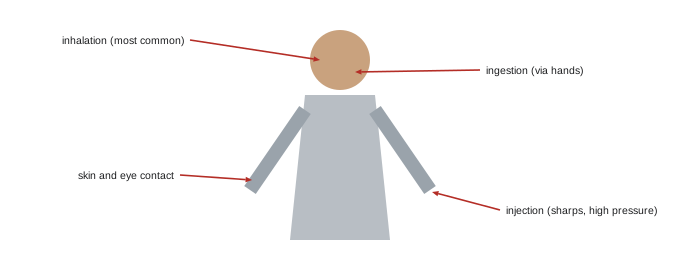
Hazardous products enter the body by four main routes:
- Inhalation: breathing gases, vapors, mists, fumes and dusts. This is the most common route in workplaces, because people breathe about 10 cubic meters of air during a working day, and the lungs absorb many substances quickly.
- Skin and eye contact: some chemicals burn or irritate on contact, and others pass through intact skin into the bloodstream, such as some solvents, pesticides and phenol. SDSs and exposure limit lists mark such substances with a "skin" notation.
- Ingestion: swallowing, usually through contaminated hands, food, drinks or cigarettes, or by mistake when chemicals are stored in food containers.
- Injection: through punctures or cuts from contaminated sharp objects, or high-pressure equipment such as hydraulic lines and spray guns, which can inject fluid through the skin and cause severe injury.
Understanding routes of entry helps choose controls: ventilation and respirators for inhalation, gloves and clothing for skin, hygiene for ingestion, and safe handling of sharps and high-pressure equipment for injection.
Dose and response
The effect of a hazardous substance depends on the dose, the amount that enters the body, and the duration and frequency of exposure. A principle often attributed to Paracelsus is that "the dose makes the poison": even water and oxygen are harmful in excess, while many hazardous substances cause no measurable effect below some level. Acute effects result from high exposures over short periods; chronic effects from lower exposures repeated over long periods. Individual factors such as age, health, pregnancy, genetics, and exposure to other substances, including smoking and alcohol, influence how people respond. For some effects, such as cancer caused by certain substances and sensitization, no exposure level can be shown to be completely safe, so exposures should be kept as low as reasonably achievable.
Occupational exposure limits
Occupational exposure limits set maximum airborne concentrations to which workers may be exposed. In the United States, OSHA's Permissible Exposure Limits (PELs) in 29 CFR 1910.1000 (the Z tables) and substance-specific standards are legally enforceable, but many PELs date from 1971 and are widely recognized as outdated. Other limits, which are not legally enforceable by federal OSHA but represent current scientific knowledge, include NIOSH Recommended Exposure Limits (RELs) and the ACGIH Threshold Limit Values (TLVs). Some state plans, such as Cal/OSHA, have more protective limits. OSHA encourages employers to consider the more current limits, and the general duty clause can apply to recognized hazards not covered by PELs.
Exposure limits are expressed as several types:
| Type | Meaning |
|---|---|
| Time-weighted average (TWA) | Average concentration over an 8-hour day and 40-hour week |
| Short-term exposure limit (STEL) | Average over 15 minutes, not to be exceeded during the day |
| Ceiling (C) | Concentration never to be exceeded, even briefly |
| Skin notation | Significant absorption through skin; air limits alone do not protect |
| Excursion limits | Limits on short peaks for substances without a STEL |
Limits are usually expressed in parts per million (ppm) for gases and vapors, and milligrams per cubic meter (mg/m³) for dusts, fumes and mists. For gases at 25 °C and normal pressure, the conversion is:
where \(M\) is the molecular weight in grams per mole. Exposure limits are not fine lines between safe and unsafe: they protect most, but not all, workers, and they are periodically lowered as evidence grows. Good practice keeps exposures well below limits.
Mixtures and unusual shifts
When workers are exposed to several substances that affect the same organ or system, such as several solvents with narcotic effects, their effects may add. Many jurisdictions require that the combined exposure be assessed with the additive formula:
where \(C\) is each measured concentration and \(L\) its limit. If the sum exceeds 1, the combined exposure exceeds the limit. Limits based on 8-hour days may need adjustment for longer shifts, such as 10- or 12-hour shifts, because longer exposure and shorter recovery increase the dose; several jurisdictions specify adjustment methods.
Worked problem
Combined solvent exposure
A painter is exposed to toluene at 10 ppm (limit 20 ppm) and xylene at 40 ppm (limit 100 ppm), both affecting the nervous system. Is the combined exposure acceptable?
Show solution
- Toluene fraction: \(10/20 = 0.5\).
- Xylene fraction: \(40/100 = 0.4\).
- Sum: \(0.5 + 0.4 = 0.9\), which is just below 1.
- Although within the limit, the margin is small; improve ventilation or substitution to reduce exposures further.
Answer: The sum is 0.9, just within the combined limit; further reduction is advisable.
Measuring exposure
Exposures are assessed by qualified people, such as occupational hygienists, using air sampling: personal sampling pumps with filters or sorbent tubes worn in the breathing zone, passive badges, and direct-reading instruments such as gas detectors and photoionization detectors. Results are compared with limits. Gas detectors also protect workers in real time from acute hazards, such as hydrogen sulfide, carbon monoxide, oxygen deficiency and flammable atmospheres, with alarms set at specified levels. Biological monitoring, measuring substances or their metabolites in blood, urine or breath, can assess total uptake from all routes for some substances, such as lead. Workers should be informed of monitoring results that relate to them.
The hierarchy of controls
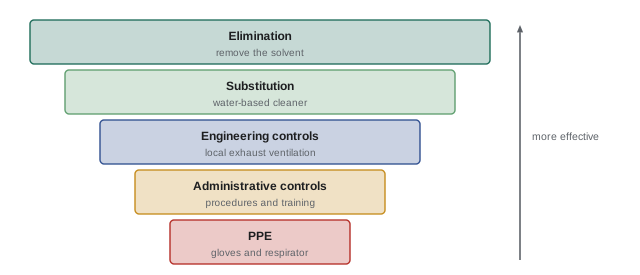
The hierarchy of controls ranks ways of reducing exposure from most to least effective:
- Elimination: remove the hazardous product or process entirely, for example by changing a process so that a solvent is no longer needed.
- Substitution: replace it with a less hazardous product, such as a water-based cleaner instead of a solvent, or a paste instead of a dusty powder.
- Engineering controls: isolate people from the hazard or remove contaminants at the source, through enclosure, local exhaust ventilation, general ventilation, closed transfer systems and automation.
- Administrative controls: change how people work, through safe work procedures, training, signs, limiting time and the number of people exposed, scheduling tasks when fewer people are present, and hygiene rules.
- Personal protective equipment: protect the individual with respirators, gloves, eye and face protection, and protective clothing.
Higher controls are more reliable because they do not depend on everyone doing the right thing every time. PPE is the last line of defense, used when other controls cannot reduce exposure enough, during emergencies and as a supplement.
Ventilation
Local exhaust ventilation (LEV) captures contaminants at or near the source, before they reach the worker's breathing zone, using hoods, slots, fume extraction arms, spray booths and laboratory fume hoods connected by ducts to fans and, where needed, air cleaners. LEV is the most effective engineering control for many chemical exposures, but it must be designed correctly, positioned close to the source, and maintained and tested periodically. General or dilution ventilation mixes contaminated air with fresh air to reduce concentrations, which is suitable only for low-toxicity contaminants released in small amounts, and it does not prevent high exposures close to the source. For flammable vapors, ventilation also keeps concentrations below the lower flammable limit.
Personal protective equipment for chemicals
When PPE is needed, it must be suitable for the specific chemical and task, fit the wearer, and be used, maintained and stored correctly. Key points include:
- Gloves: no glove material protects against all chemicals. Nitrile, neoprene, butyl rubber, Viton, laminate and natural rubber each resist some chemicals and fail with others. Glove manufacturers publish chemical resistance guides with breakthrough times and degradation ratings; select gloves using these and the SDS. Replace gloves when they are damaged or reach their breakthrough time, and remove them without touching the outside.
- Eye and face protection: safety glasses with side shields protect against impact but not splashes; chemical splash goggles seal around the eyes; face shields protect the face but must be worn with goggles for corrosives.
- Protective clothing: aprons, sleeves and chemical-resistant suits protect against splashes; contaminated clothing must be removed promptly and laundered or disposed of properly, never taken home.
- Respiratory protection: respirators must be NIOSH-approved, selected for the specific contaminant and concentration, and used within a written respiratory protection program meeting 29 CFR 1910.134, including medical evaluation, fit testing, training and maintenance. Filters and cartridges must match the hazard, such as particulate filters for dusts and organic vapor cartridges for solvents, and have limited service lives.
Hygiene and health monitoring
Good hygiene prevents ingestion and skin uptake: wash hands before eating, drinking, smoking or using the washroom; do not eat or drink in areas where hazardous products are used; keep work clothing separate from street clothing; and clean contaminated surfaces. For some hazards, health surveillance is required or recommended, such as lung function tests for workers exposed to respiratory sensitizers, blood lead testing, and skin checks for those using sensitizers. Early detection of effects allows action before permanent harm. Workers should report symptoms, such as rashes, coughing, headaches or dizziness, that might be related to work.
Ventilation checks workers can make
While ventilation design and testing are specialist tasks, workers can make simple checks. Make sure local exhaust hoods are switched on before starting work and positioned close to the source, typically within a distance about equal to the hood's diameter. Check airflow indicators or gauges on fume hoods and booths. Keep sashes on laboratory fume hoods at the marked working height. Do not block hood openings or supply air vents with equipment or materials. Report unusual odors, visible fumes escaping the hood, noisy or vibrating fans, and dust accumulations in ducts. Ventilation that is not working gives a false sense of security.
Controls in practice: an example
Consider a workshop where parts are cleaned with a flammable solvent in an open tray. Following the hierarchy, the first question is whether cleaning is necessary at all, or whether the process can be changed. If cleaning is needed, a water-based cleaner or an enclosed parts washer could replace the open tray. If a solvent must be used, a parts washer with a lid, local exhaust and a smaller quantity of solvent reduce exposure and fire risk. Administrative controls include written procedures, limiting time at the task and keeping lids closed. Finally, nitrile or other suitable gloves and splash goggles protect against skin and eye contact. This combination is far more effective than gloves alone.
Medical surveillance and exposure records
Where workers are exposed to certain substances, such as lead, silica, isocyanates or some solvents, regulations or good practice may require medical surveillance and the keeping of exposure monitoring records. These records help detect early health effects, demonstrate that controls are working and support workers' claims if occupational diseases develop later. Workers generally have the right to see their own exposure and medical records, and personal medical information must be kept confidential.
PPE limitations
Personal protective equipment has important limitations. It protects only the person wearing it, only if it is the right type, fits properly and is worn correctly throughout the task, and only until it fails, for example when a glove is punctured, a cartridge becomes saturated or a face shield is left raised. PPE can also be uncomfortable or hot, which may lead to people removing it. These limitations are why PPE comes last in the hierarchy of controls.
Common mistakes
MistakeAssuming exposure below a limit is perfectly safe.
InsteadKeep exposures as low as reasonably achievable.
MistakeIgnoring skin absorption.
InsteadCheck skin notations and protect skin.
MistakeChoosing gloves without checking resistance data.
InsteadUse manufacturer guides and the SDS.
MistakeRelying on PPE first.
InsteadApply elimination, substitution and engineering controls first.
MistakeUsing a respirator without fit testing.
InsteadFollow a respiratory protection program.
Summary and key terms
- Exposure, not just hazard, determines harm.
- Inhalation is the most common route; skin, ingestion and injection also matter.
- Dose, duration and individual factors affect response.
- OSHA PELs are enforceable but often outdated; NIOSH RELs and ACGIH TLVs are more current.
- TWA, STEL, ceiling and skin notations describe different limits; mixtures use the additive formula.
- The hierarchy of controls ranks elimination first and PPE last.
- LEV, suitable PPE, hygiene and health monitoring protect workers.
- Route of entry
- Way a substance enters the body.
- Dose
- Amount of a substance taken into the body.
- Occupational exposure limit
- Maximum airborne concentration permitted.
- TLV
- ACGIH Threshold Limit Value.
- PEL
- OSHA Permissible Exposure Limit.
- Ceiling limit
- Concentration never to be exceeded.
- Skin notation
- Mark indicating significant skin absorption.
- Hierarchy of controls
- Ranking of controls from most to least effective.
- Local exhaust ventilation
- Ventilation capturing contaminants at the source.
- Breakthrough time
- Time for a chemical to permeate a glove.
Practice problems
Work each problem on paper first, then reveal the answer to check.
Name the four routes of entry.
Show answer
Inhalation, skin and eye contact, ingestion, injection.
What is the most common route at work?
Show answer
Inhalation.
What does a ceiling limit mean?
Show answer
Never to be exceeded.
Convert 50 ppm of a gas with M = 92 g/mol to mg/m³.
Show answer
About 188 mg/m³.
Combined fraction for 30/50 and 20/100?
Show answer
0.8, within the limit.
List the hierarchy of controls.
Show answer
Elimination, substitution, engineering, administrative, PPE.
Why is LEV better than general ventilation?
Show answer
It captures contaminants at the source.
Do safety glasses protect against splashes?
Show answer
No; use splash goggles.
What must a respiratory program include?
Show answer
Selection, fit testing, training, medical assessment, maintenance.
Give an example of health surveillance.
Show answer
Blood lead testing, lung function tests.
Lesson quiz · 5 questions
Score 60% or more to complete this lesson.
Create a free account to save your progress, take quizzes and earn a certificate.