
HSE-102 · Lesson 9 of 12 · 25 min
Reading an SDS in practice
Knowing the 16 sections is the start; using an SDS to answer real questions quickly is the skill that protects people. In practice, workers and supervisors turn to SDSs with specific questions: Is this product dangerous to use in this way? What gloves do I need? Can I store it with that other product? What do I do if it splashes in my eye? Is this vapor concentration safe? This lesson works through practical SDS reading, using fictional but realistic examples, and covers how to find information fast, interpret technical data, compare products when choosing safer alternatives, and recognize SDSs that are incomplete or misleading.
A question-first approach
Rather than reading an SDS from start to finish every time, start with your question and go to the right section. The table below maps common questions to sections. Over time, you will learn where to look for the products you use most, and you will recognize which sections are most important for different roles: an operator may focus on sections 2, 7 and 8, a first aider on section 4, a storeroom attendant on sections 7 and 10, and an emergency responder on sections 5, 6 and 9.
| Question | Section(s) |
|---|---|
| What is it and who supplies it? | 1 |
| What are the main hazards? | 2 |
| What is in it? | 3 |
| What do I do if someone is exposed? | 4 |
| How do I fight a fire involving it? | 5 |
| How do I clean up a spill? | 6 |
| How should I handle and store it? | 7 and 10 |
| What PPE and ventilation do I need? | 8 |
| Will it give off flammable vapor at this temperature? | 9 (flash point) and 2 |
| Can I store or mix it with another product? | 10 and 7 |
| What are the long-term health effects? | 11 |
| How do I dispose of it? | 13 |
| Is the SDS current? | 16 |
Worked example 1: a two-part epoxy
Consider a fictional two-part epoxy floor coating. Part A, the resin, has an SDS showing skin irritation Category 2, eye irritation Category 2A and skin sensitization Category 1, with the exclamation mark and signal word Warning. Part B, the hardener, shows skin corrosion Category 1B, serious eye damage Category 1, skin sensitization Category 1 and acute oral toxicity Category 4, with the corrosion and exclamation mark pictograms and signal word Danger. Section 8 recommends nitrile gloves, with a note that breakthrough time should be confirmed with the glove manufacturer, chemical splash goggles, and coveralls; it recommends local exhaust ventilation or good general ventilation. Section 3 lists amines in the hardener at 30–60 %. Section 11 notes that repeated skin contact can cause allergic dermatitis.
Worked problem
Planning the epoxy job
A crew will apply the epoxy to a floor in a basement room with limited ventilation. Using the SDS information above, what precautions are needed?
Show solution
- Both parts are skin sensitizers: prevent all skin contact with nitrile gloves (confirm suitability), long sleeves or coveralls, and careful glove removal; once sensitized, a worker may have to stop working with epoxies.
- The hardener is corrosive and can cause serious eye damage: wear chemical splash goggles, and have an eyewash available.
- Ventilation: add mechanical ventilation to the basement, as recommended in section 8; check section 9 for vapor pressure and odor, and section 2 for any respiratory hazards.
- Mixing: follow the manufacturer's ratios and mix in a ventilated area; check section 10 for heat of reaction warnings when large batches are mixed.
- Cleanup and disposal: follow sections 6 and 13; cured epoxy is usually less hazardous than the liquid components.
Answer: Strict skin protection to prevent sensitization, splash goggles and eyewash for the corrosive hardener, added ventilation, and controlled mixing and disposal.
Worked example 2: is the vapor concentration acceptable?
Section 8 lists exposure limits, which can be compared with air monitoring results. Suppose an SDS for a degreaser lists the main ingredient with an 8-hour time-weighted average (TWA) limit of 50 ppm. Air sampling during a shift measures 80 ppm for 2 hours during tank cleaning, 30 ppm for 4 hours of general work, and 0 ppm for 2 hours of office work. The 8-hour TWA is:
The TWA of 35 ppm is below the 50 ppm limit, but the 80 ppm period exceeds the limit and may exceed a short-term exposure limit (STEL) if one is listed. Many organizations also use an action level, often half the limit, above which controls and monitoring are reviewed; 35 ppm exceeds a 25 ppm action level. The conclusion is that tank cleaning needs better controls, such as local exhaust ventilation or respiratory protection, even though the full-shift average meets the limit. Lesson 10 explains exposure limits in more detail.
Worked example 3: storage compatibility
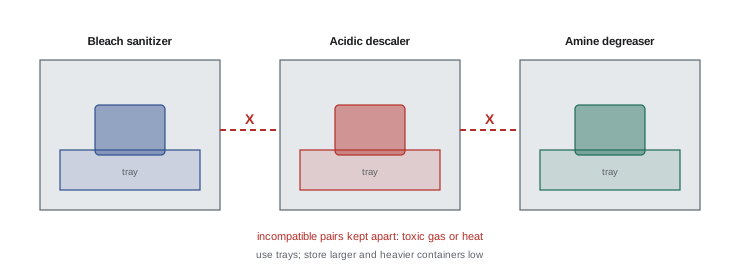
A storeroom holds a bleach-based sanitizer (sodium hypochlorite), a descaler containing hydrochloric acid, and a degreaser containing ethanolamine. The bleach SDS section 10 lists acids and ammonia or amines as incompatible, warning of toxic gas release. The descaler SDS lists bases, oxidizers and metals as incompatible. The degreaser SDS lists acids and oxidizers. The safe arrangement keeps the acid away from both the bleach and the amine-based degreaser, for example on separate shelves with secondary containment trays, with the bleach on a lower shelf than the acid so that a leak from above cannot run into it. Lesson 11 covers compatibility and segregation more fully.
Worked example 4: first aid for an eye splash
A worker gets a splash of a corrosive alkaline cleaner in the eye. Section 4 says: "IF IN EYES: Rinse cautiously with water for at least 15 minutes. Remove contact lenses, if present and easy to do. Continue rinsing. Immediately call a poison center or doctor." The right response is immediate flushing at an eyewash station, holding the eyelids open, for at least 15 minutes, which feels very long but is essential with alkalis, while someone calls for medical help and brings the SDS. Delaying even a minute to find the SDS or remove contact lenses can increase damage. This is why training should cover first aid for the products used before an incident occurs, and why eyewash stations must be located close to where corrosives are used and tested regularly.
Interpreting technical data in section 9
Section 9 contains values that help predict behavior. Vapor pressure indicates how readily a liquid evaporates: higher vapor pressure means more vapor in the air and greater inhalation and fire risk. Vapor density above 1 means vapor is heavier than air and collects low. Flash point, compared with working temperatures, indicates fire risk. pH indicates corrosivity. Solubility indicates whether water can dilute or wash the product away. Odor and odor threshold are informative but unreliable as warnings: some chemicals, such as hydrogen sulfide, deaden the sense of smell at dangerous concentrations, and others can be harmful below the level at which they can be smelled.
Comparing products and safer alternatives
SDSs allow products to be compared when choosing what to buy, which is one of the most effective ways to reduce hazards. Elimination and substitution, the top of the hierarchy of controls, often start with SDS comparisons: choosing a water-based degreaser with no flammability classification instead of a Category 2 flammable solvent; choosing a product without carcinogenic or sensitizing ingredients; choosing a ready-to-use dilution rather than a corrosive concentrate. When comparing, look at the classification in section 2, the ingredients in section 3, exposure limits in section 8, properties in section 9 and health effects in section 11. Consider performance too: a less hazardous product that does not work may lead to unsafe workarounds.
| Feature | Solvent degreaser | Water-based degreaser |
|---|---|---|
| Flammability | Category 2 (flash point 12 °C) | Not classified |
| Health hazards | STOT SE 3 (narcotic), aspiration hazard | Eye irritation Category 2 |
| Signal word | Danger | Warning |
| Ventilation needed | Local exhaust or good ventilation | General ventilation |
| Storage | Flammables cabinet | General storage |
Recognizing weak or misleading SDSs
Some SDSs are poorly prepared. Warning signs include: no revision date or a very old one; classifications that do not match the label; missing sections; section 8 with no specific glove material or with generic advice; ingredient lists that seem incomplete, or "proprietary" ingredients without an explanation; obvious translation errors; and claims such as "non-hazardous" or "environmentally friendly" that contradict the classification. When you find problems, request a corrected SDS from the supplier and alert your safety contact. Never assume that a product is safe because its SDS is short.
Using SDSs in risk assessment and procedures
SDSs feed into the workplace's risk assessments, safe work procedures, purchasing decisions, emergency plans and training. A supervisor preparing a job plan for a task involving hazardous products should list the products, review their SDSs, identify hazards and exposure routes, choose controls and PPE, and record emergency measures. Many organizations summarize key SDS information on a one-page task card or chemical safety summary posted at the point of use, which is helpful as long as the full SDS remains available and the summary is kept up to date.
Practice: a quick SDS scavenger hunt
A good way to become comfortable with SDSs is to practice finding information quickly. Take the SDS of a product you use and, within five minutes, find: the emergency telephone number; the signal word and pictograms; the main hazardous ingredient and its concentration; the first aid for skin contact; the recommended extinguishing media; how to clean up a small spill; the storage temperature or conditions; the recommended gloves and eye protection; the flash point; any incompatible materials; the main long-term health effect; and the date of the last revision. Repeat with a few different products, and you will soon know where to look without thinking.
When SDSs and procedures disagree
Sometimes the employer's procedure and the SDS seem to disagree: for example, the SDS recommends local exhaust ventilation, but the procedure relies on general ventilation; or the SDS recommends butyl gloves, but nitrile gloves are supplied. Such differences should be raised with the supervisor or safety contact. There may be a good reason, such as air monitoring showing that general ventilation keeps exposures low, or glove testing showing nitrile is suitable for the particular task, but the reason should be documented. If not, the procedure should be updated.
SDSs and emergency services
In an emergency, responders need SDS information quickly. Many workplaces keep a copy of the chemical inventory and key SDSs in an emergency information box near the main entrance, or share them with the local fire department in advance. When calling emergency services about a chemical incident, be ready to give the product name, the main hazards, the quantity involved and the location. If someone is taken to hospital after an exposure, send the SDS or label with them.
Using SDSs when planning a new task
When planning a task that is new to the team, a short SDS review meeting can prevent many problems. Gather the SDSs for every product the task will use, including any products that might be produced, such as fumes from heating or cutting. For each, note the main hazards, exposure routes, controls and PPE, incompatibilities with other products in the task, and emergency measures. Decide what controls will be used, what PPE will be worn, what emergency equipment is needed and who will check that everything is in place. Record the plan and brief the workers before starting.
From SDS to safe work procedure
A safe work procedure translates SDS information into steps for a specific task. For example, a procedure for refilling a parts washer might list: confirm the product and check the SDS; put on nitrile gloves and splash goggles; switch on local exhaust; bond and ground the drum and the washer; transfer using the drum pump; close containers; wipe up drips with absorbent pads and dispose of them in the flammables waste can; and wash hands. Procedures should be written with the workers who do the task, kept at the point of use and reviewed when the SDS or the task changes.
Common mistakes
MistakeReading the SDS only after an incident.
InsteadReview SDSs before starting work with a product.
MistakeComparing only TWA with the limit.
InsteadCheck peaks, STELs and action levels too.
MistakeRelying on smell to judge safety.
InsteadUse exposure limits and monitoring.
MistakeDelaying eye flushing to find the SDS.
InsteadFlush immediately; bring the SDS to medical care.
MistakeIgnoring safer alternatives.
InsteadCompare SDSs when purchasing.
Summary and key terms
- Start with your question and go to the right SDS section.
- Sensitizers and corrosives call for strict skin and eye protection.
- TWA = Σ(C × t) / 8 h; compare with limits, STELs and action levels.
- Section 10 identifies incompatibilities for safe storage.
- First aid in section 4 should be known before an incident.
- Section 9 data predict evaporation, fire and corrosivity.
- Compare SDSs to choose safer products, and question weak SDSs.
- Time-weighted average
- Average exposure over a work shift.
- Short-term exposure limit
- Limit for a short period, usually 15 minutes.
- Action level
- Exposure at which controls and monitoring are reviewed.
- Breakthrough time
- Time for a chemical to pass through a glove material.
- Vapor pressure
- Tendency of a liquid to evaporate.
- Odor threshold
- Lowest concentration that can be smelled.
- Substitution
- Replacing a hazardous product with a safer one.
- Task card
- Point-of-use summary of key safety information.
- Proprietary ingredient
- Ingredient whose identity is withheld.
- Secondary containment
- Tray or bund that catches leaks.
Practice problems
Work each problem on paper first, then reveal the answer to check.
Which sections does an emergency responder use most?
Show answer
5, 6 and 9.
Why must epoxy users avoid all skin contact?
Show answer
Components are skin sensitizers.
TWA for 100 ppm for 1 h and 20 ppm for 7 h?
Show answer
30 ppm.
What is a common action level?
Show answer
Half the exposure limit.
Which section lists incompatibilities?
Show answer
Section 10.
How long should eyes be flushed for corrosives?
Show answer
At least 15 minutes, per the SDS.
What does a vapor density above 1 mean?
Show answer
Vapor is heavier than air and collects low.
Why is odor unreliable?
Show answer
Some chemicals deaden smell or are harmful below the odor threshold.
Name a sign of a weak SDS.
Show answer
No revision date, mismatched classification, vague PPE advice.
Which control does SDS comparison support?
Show answer
Substitution.
Lesson quiz · 5 questions
Score 60% or more to complete this lesson.
Create a free account to save your progress, take quizzes and earn a certificate.