
HSE-102 · Lesson 7 of 12 · 25 min
Workplace labels and other forms of warning
Hazardous products rarely stay in their original containers. They are poured into spray bottles, decanted into smaller jugs, mixed in tanks, piped through systems and produced inside processes. Every time a product moves out of its supplier-labeled container, hazard information has to move with it. Workplace labels and other identifiers make sure that workers can identify what is in every container and how to handle it safely. This lesson explains when workplace labels are needed, what they must contain, the exemptions for portable containers used immediately, identification of piping and process vessels, products produced in the workplace, laboratory labels, alternative rating systems such as NFPA 704 and HMIS, and practical labeling programs.
When a workplace label is needed
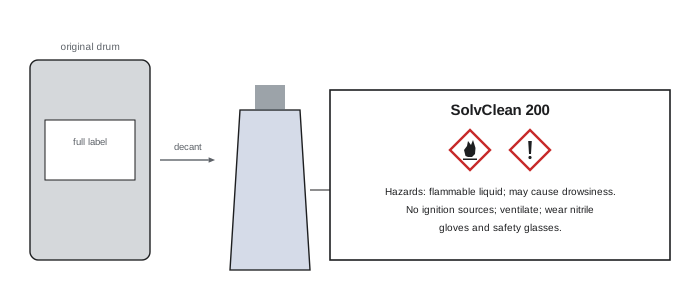
Under the HCS, employers must ensure that each container of hazardous chemicals in the workplace is labeled, tagged or marked with either the label from the shipped container or a workplace label containing the product identifier and words, pictures, symbols or a combination that provide at least general information about the hazards, which, together with other information immediately available to employees under the hazard communication program, gives specific information about the physical and health hazards. Workplace labels are typically needed when chemicals are transferred to secondary containers, produced in the workplace, or received in bulk.
Content of a workplace label
An HCS workplace label must include at least:
- The product identifier, matching the SDS.
- Words, pictures, symbols or a combination giving at least general information about the hazards of the chemicals.
Employers can choose to use the full GHS label elements, an in-house system, or a rating system such as NFPA 704 or HMIS, as long as employees are trained on the system and have immediate access to the specific hazard information on the SDS.
Workplace labels must be legible, in English (other languages may be added), and prominently displayed. Many employers use pre-printed secondary container labels with spaces for the product name, pictograms and key precautions.
Portable containers used immediately
The HCS exempts portable containers into which hazardous chemicals are transferred from labeled containers and which are intended only for the immediate use of the employee who performs the transfer. If the container is left unattended, used by others or kept beyond the immediate task, it must be labeled. Because the exemption is narrow, many employers label every portable container to avoid confusion.
Worked problem
Decanting a solvent
A maintenance worker fills a small safety can with degreaser from a labeled drum at the start of a shift, uses some of it, then leaves the can in the shop overnight for the next shift. Is a label needed?
Show solution
- Filling and using the can immediately, under the worker's control, may be exempt from labeling.
- Leaving it overnight for others to use ends that exemption: the next person cannot know what is inside.
- The can needs a workplace label with the product identifier and hazard and handling information before it is left.
- Good practice: label portable containers every time they are filled.
Answer: Yes; once the can is left for others or kept beyond immediate use, it must carry a workplace label.
Piping, vessels and process equipment
The HCS allows employers to use signs, placards, process sheets, batch tickets, operating procedures or other written materials instead of labels on individual stationary process containers, as long as the alternative identifies the containers and conveys the required information, and is readily accessible to employees in their work area throughout each shift. Pipes are not covered by HCS labeling, but many employers mark them following ASME A13.1, which specifies colors and text for pipe contents and flow direction, and other OSHA standards may require identification.
Products produced in the workplace
When an employer produces a hazardous chemical in the workplace, such as a mixture made on site or an intermediate in a process, the employer becomes a chemical manufacturer for that chemical and must classify it and provide labels and SDSs as required. Hazardous waste is labeled under EPA rules, and by-products and emissions such as welding fume must be addressed through the hazard communication program and training.
Laboratory labels
Laboratories that meet the definition in the OSHA laboratory standard (29 CFR 1910.1450) follow a chemical hygiene plan and must ensure that labels on incoming containers are not removed or defaced; the HCS labeling requirements for in-house containers are limited in laboratories, but good practice is to label every container with the chemical name, hazards and date.
Alternative rating systems: NFPA 704 and HMIS
Many workplaces also use rating systems that predate the GHS, especially in the United States. The NFPA 704 "fire diamond", published by the National Fire Protection Association, uses a diamond divided into four colored sections: blue for health, red for flammability, yellow for instability and white for special hazards such as reactivity with water (W with a line through it) or oxidizers (OX). Each colored section carries a number from 0 to 4, where 4 is the most severe. NFPA 704 is designed for emergency responders, giving a quick view of hazards on buildings, tanks and storage areas. The Hazardous Materials Identification System (HMIS), developed by the American Coatings Association, uses colored bars with similar numbers plus a letter code for PPE.
The crucial point is that these systems number hazards in the opposite direction to the GHS: in NFPA 704 and HMIS, 4 is the most severe and 0 the least, while in the GHS Category 1 is the most severe. A product rated 4 for flammability in NFPA terms might be GHS Category 1 flammable liquid. Confusing the two can lead to dangerous misjudgements. NFPA ratings are also based on emergency conditions, such as fire, rather than routine workplace exposure.
| Feature | GHS classification | NFPA 704 / HMIS |
|---|---|---|
| Most severe | Category 1 | 4 |
| Least severe (classified) | Category 4 or higher number | 0 (minimal hazard) |
| Purpose | Worker information for normal use and emergencies | Emergency response (NFPA); workplace shorthand (HMIS) |
| Format | Pictograms, signal words, statements | Colored diamond or bars with numbers |
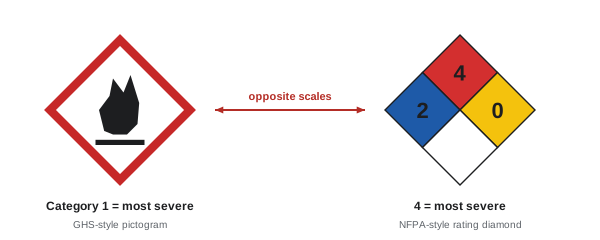
Under the HCS, NFPA and HMIS ratings may be used on workplace labels, provided employees are trained and the numerical ratings are not inconsistent with the hazard classification; OSHA has noted that the numbering difference must be addressed in training. NFPA 704 placards are often required on buildings and storage areas by fire codes.
Building a labeling program
An effective labeling program includes a written procedure explaining when and how containers are labeled; a stock of pre-printed workplace labels near decanting points; a rule that no unlabeled container may be used; regular inspections of storage areas and work areas for missing or damaged labels; identification of pipes, tanks and process equipment; procedures for labeling products produced in the workplace and waste; and training so that everyone understands the labels used, including any rating systems. Color coding of containers, such as a specific color for each cleaning product, can help but should not replace written identification, because colors alone are easily misunderstood.
Labeling in specific situations
Some situations need extra thought. In cleaning services, many dilutions are prepared from concentrates using dispensing systems, so pre-printed labels for each diluted product, applied every time a bottle is filled, are essential. In laboratories, many small containers of reagents, solutions and samples need labels with the chemical name, concentration, hazards, date and preparer's initials. In food service, chemicals must be kept separate from food and never stored in food containers. In maintenance and construction, products are often moved between sites in smaller containers, which need labels that survive outdoor conditions. In schools, products used by students in science classes and workshops need clear labels and supervision. In each case, the principle is the same: anyone who picks up the container should be able to tell what it contains and how to handle it safely.
Waste containers
Containers of hazardous waste also need identification. Waste is often a mixture of products with uncertain composition, which can be more hazardous than the original products. Waste containers should be labeled with their contents as accurately as possible, the hazards, and the date accumulation started, following environmental and workplace rules. Never add waste to a container without knowing what is already in it, because incompatible wastes can react.
Signs and placards for storage areas
Signs at the entrances to storage rooms, flammables cabinets, gas cylinder cages and process areas warn workers and emergency responders of the hazards inside. Signs should be clear, visible and accurate: a "Flammable liquids — no smoking or open flames" sign on a storeroom door, a "Corrosives" sign near acid storage, or a "Compressed gases" sign at a cylinder cage. Outdated signs, such as signs for products no longer stored, should be removed so that warnings remain credible.
Keeping identification up to date
Identification systems drift over time as products change, containers are reused and staff turn over. Periodic walk-throughs of the workplace, checking every container, pipe and storage area against the inventory, catch problems early. Involving workers in these walk-throughs builds awareness and often reveals containers that would otherwise be missed, such as bottles stored in personal lockers or products brought from home.
Practice: decide what each container needs
Consider these situations and decide what identification each needs. A drum of hydraulic oil delivered with a supplier label: keep the supplier label legible. A mop bucket filled with diluted floor cleaner and used immediately by the cleaner who filled it: may be exempt while in use, but a label is good practice. A spray bottle of disinfectant left on a cart for the next shift: needs a workplace label. A pipe carrying caustic solution through a plant: needs pipe identification such as labels with contents and flow direction. A batch of adhesive mixed on site for use over several days: needs classification and a workplace label, with an SDS where required. A bucket of waste solvent: needs a waste label. Working through such cases helps make labeling rules practical.
Workplace labels and language
Workplace labels should be written for the people who use them. If workers speak different languages, consider bilingual or multilingual labels, or symbols supported by training, so that everyone can understand them. Keep wording short and direct, such as "Corrosive — wear goggles and gloves", and make product names large enough to read at a distance. Test new label designs with the workers who will use them and adjust them based on feedback.
Electronic and coded labels
Some workplaces use barcodes or QR codes on containers that link to electronic SDS systems, making it easy to retrieve the SDS on a phone or tablet. These are helpful additions, but they do not replace the required label elements, because labels must be readable without a device, during power outages and in emergencies.
Who is responsible for workplace labels
Employers are responsible for making sure workplace labels are applied, but in practice the person who fills or creates a container is usually the one who labels it. Make it a personal rule: if you fill it, you label it. Supervisors should check that labels are applied correctly and that a supply of blank workplace labels is always available where products are decanted.
Common mistakes
MistakeLeaving decanted products unlabeled.
InsteadLabel portable containers unless they are used immediately by the filler.
MistakeUsing drink bottles for chemicals.
InsteadNever use food or drink containers for hazardous products.
MistakeConfusing NFPA 4 with GHS Category 4.
InsteadRemember the scales run in opposite directions.
MistakeRelying on color coding alone.
InsteadInclude written product identification.
MistakeForgetting pipes and process vessels.
InsteadIdentify them by signs, stencils or other means.
Summary and key terms
- Workplace labels follow hazardous products into new containers.
- HCS workplace labels need the product identifier and general hazard information.
- Portable containers used immediately by the filler may be exempt.
- Pipes, tanks and process vessels must be identified by other means.
- Products produced in the workplace must be classified and labeled.
- NFPA 704 and HMIS number hazards 0–4 with 4 most severe, opposite to the GHS.
- A labeling program, inspections and training keep identification reliable.
- Workplace label
- Label applied by the employer to a container in the workplace.
- Decanting
- Transferring a product into another container.
- Portable container
- Small container filled from a larger one.
- Secondary container
- Container other than the original shipped container.
- Process vessel
- Tank or reactor in a process system.
- Pipe marking
- Labels and colors identifying pipe contents and flow.
- NFPA 704
- Fire diamond rating system for emergency responders.
- HMIS
- Hazardous Materials Identification System using colored bars.
- Product produced in the workplace
- Hazardous product made and used on site.
- Labeling program
- Procedures ensuring all containers are identified.
Practice problems
Work each problem on paper first, then reveal the answer to check.
When is a workplace label typically needed?
Show answer
After decanting, for products made on site, for bulk deliveries, or to replace damaged labels.
What must an HCS workplace label include at minimum?
Show answer
Product identifier and general hazard information.
When does the portable container exemption end?
Show answer
When the container is left, used by others or kept beyond immediate use.
How are pipes identified?
Show answer
With labels, colors, stencils or signs, often following ASME A13.1.
In NFPA 704, which number is most severe?
Show answer
4.
In the GHS, which category is most severe?
Show answer
Category 1.
What does the blue section of NFPA 704 represent?
Show answer
Health.
What does W with a line mean in NFPA 704?
Show answer
Reacts with water.
Why not use color coding alone?
Show answer
Colors are easily misunderstood.
Can drink bottles be used for chemicals?
Show answer
Never.
Lesson quiz · 5 questions
Score 60% or more to complete this lesson.
Create a free account to save your progress, take quizzes and earn a certificate.