
GCP-222 · Lesson 1 of 12 · 20 min
Pipeline orchestration concepts
▶ Video coming soon A video version of this lesson is on the way.
On Monday, October 26, 2026, Mateo Alvarez starts three weeks of morning sessions with Aisha Daniels, the data engineer who keeps Birchline's pipelines running. Ravi Menon set the arrangement up after the last two courses: Mateo can now prepare data and analyze it, but he has never been the person whose phone buzzes at 05:40 when the sales numbers are not ready. Each morning, after Aisha's on-call handover, they spend half an hour on one part of running data reliably. The first session starts with a question Aisha asks every new team member: what has to happen, in what order, before a store manager in Columbus opens the morning dashboard?
What a pipeline is, and what orchestration adds
A data pipeline is a series of steps that moves data from where it is created to where it is used, changing it along the way. Birchline's nightly sales pipeline collects the till files from 40 stores, loads them into the raw dataset, combines them with web orders, builds the curated sales table and refreshes the views that the dashboards read. Each step on its own is something Mateo already knows how to do from GCP-220 and GCP-221. What he has not done is make them happen every night, in the right order, without anyone pressing a button.
Orchestration is that missing part. An orchestrator decides when each step starts, waits for the steps it depends on, retries the ones that fail for temporary reasons, records what happened, and tells someone when it cannot recover. Aisha puts it simply: the steps do the work, and the orchestrator makes sure the work happens in the right order and that somebody knows when it did not.
Orchestration is different from transformation. A transformation tool changes data: BigQuery SQL, Dataform, Dataflow, Dataproc and Cloud Data Fusion all transform. An orchestration tool coordinates steps: BigQuery scheduled queries, Workflows, Eventarc and managed Apache Airflow all orchestrate. Some products do a little of both. Dataform, for example, runs SQL transformations and also works out their order from the dependencies between them. The exam often asks you to pick the right tool for a requirement, and the first question to ask is whether the requirement is about changing data or about coordinating steps.
Thinking in DAGs
Aisha draws the nightly pipeline on the whiteboard as boxes and arrows. Each box is a task, and each arrow means 'this task needs that one to finish first'. Because the arrows all point forward and no task can depend on itself, even indirectly, the drawing is a directed acyclic graph, or DAG. Almost every orchestrator, from Airflow to Dataform, represents a pipeline this way.
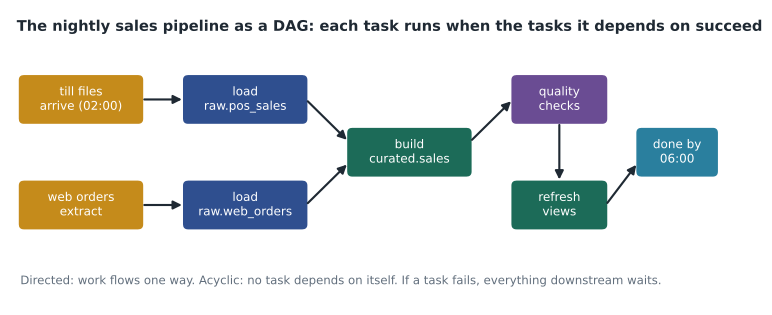
The DAG answers practical questions. Which tasks can run at the same time? The two loads, because neither depends on the other. What happens if the web orders extract fails? The curated build waits, and so does everything after it, while the till-file load can still finish. What is the critical path, the longest chain of dependent tasks that decides when the whole pipeline ends? Here it runs from the till files through the load, the curated build, the checks and the view refresh. Speeding up a task that is not on the critical path does not make the pipeline finish sooner.
An orchestrator works out a valid running order from the dependencies, a process called a topological sort. Mateo tries it on the nightly pipeline using Python's standard library, which includes a module made for exactly this.
from graphlib import TopologicalSorter

# each task: the set of tasks it depends on
dag = {
    "load_pos": {"till_files"},
    "load_web": {"web_extract"},
    "build_curated": {"load_pos", "load_web"},
    "quality_checks": {"build_curated"},
    "refresh_views": {"quality_checks"},
}
ts = TopologicalSorter(dag)
ts.prepare()
wave = 1
while ts.is_active():
    ready = sorted(ts.get_ready())
    print(f"wave {wave}: run together ->", ", ".join(ready))
    ts.done(*ready)
wave += 1wave 1: run together -> till_files, web_extract wave 2: run together -> load_pos, load_web wave 3: run together -> build_curated wave 4: run together -> quality_checks wave 5: run together -> refresh_views
What this code does
The tool takes a list of tasks and, for each one, the tasks it must wait for. It then groups the tasks into waves: everything in a wave can run at the same time because its inputs are already finished. The printout shows that the two inputs and then the two loads can run side by side, while the curated build, the checks and the view refresh must run one after another. That chain is the critical path that decides when the pipeline finishes.
Five waves for seven tasks: the first two waves each hold two tasks that can run in parallel, and the last three hold one each. If each task took 20 minutes, the pipeline would take about 100 minutes even with unlimited workers, because the five waves must follow one another.
ETL or ELT
Pipelines differ in where the transformation happens. In ETL, extract, transform, load, data is changed before it reaches the warehouse, often by a separate engine such as Dataflow or Cloud Data Fusion. In ELT, extract, load, transform, raw data is loaded first and transformed inside the warehouse with SQL. BigQuery makes ELT attractive: loading is free, storage is cheap, and SQL transformations scale without servers to manage. Birchline's till files follow ELT: they land in raw.pos_sales unchanged, and SQL builds everything else.
ETL still has its place. When data must be cleaned of something before it is stored, such as card numbers or personal details that must never reach the warehouse, the change has to happen first. When data arrives as a stream and must be aggregated as it flows, Dataflow transforms it on the way in. GCP-220 described the returns portal pipeline as ETLT: a small Cloud Run service drops the customer's phone number before loading, and SQL does the rest. The test is simple: if anything must not be stored, transform before loading.
| Question | Points to ETL | Points to ELT |
|---|---|---|
| Must some fields never be stored? | Yes: remove them before loading | No |
| Is the data a continuous stream needing aggregation in flight? | Yes: Dataflow | No: batches are fine |
| Do analysts need the raw data to rerun or correct logic later? | Less important | Yes: keep raw, rebuild with SQL |
| Is the transformation easy to express in SQL? | No: complex parsing or code | Yes |
| Who maintains the pipeline? | Engineers comfortable with code | Analysts and engineers who know SQL |
Triggers: time, dependency or event
Every pipeline run starts with a trigger. A time-based trigger, such as 'every day at 03:30', is the simplest, and BigQuery scheduled queries and Cloud Scheduler both work this way. A dependency trigger starts a task when the tasks before it succeed, which is what a DAG provides. An event-based trigger starts work when something happens, such as a file arriving in a bucket or a message arriving on a Pub/Sub topic, and Eventarc is Google Cloud's service for routing those events.
Each has a weakness. A time trigger assumes the input is ready, and a late file leaves the job processing yesterday's data or nothing at all. A dependency trigger needs an orchestrator that understands the dependencies. An event trigger can fire twice for the same event, or fire for a half-finished upload if the pipeline is not careful about which events it listens to. Birchline uses all three: the Google Ads transfer runs at a fixed time, the curated build depends on the loads, and the till-file load starts when each store's file arrives.
Choosing an orchestration tool
Google Cloud offers several orchestration options, and Aisha's rule is to use the simplest one that meets the need. A single SQL statement that must run every night needs nothing more than a scheduled query. A set of related SQL transformations with dependencies and tests belongs in Dataform. A few calls to Google Cloud APIs in sequence, with retries and simple branching, suit Workflows. A pipeline that spans many systems, needs sensors that wait for external conditions, or must be backfilled over months of history may justify managed Airflow, which Google now offers as Managed Service for Apache Airflow, the service long known as Cloud Composer. Spark and Hadoop jobs in a fixed sequence can use Dataproc workflow templates.
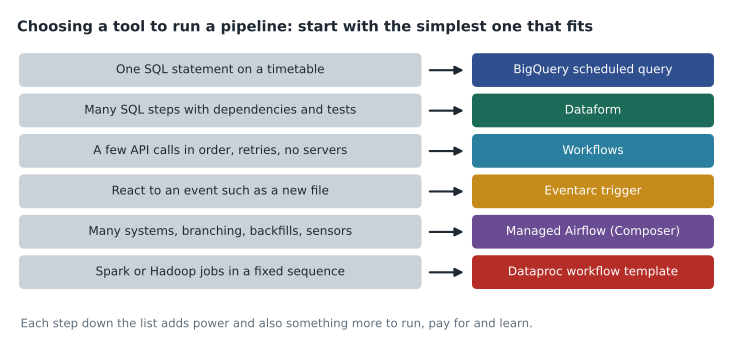
The guide is a starting point, not a rule. Tools combine: an Eventarc trigger can start a Workflows execution that runs a Dataform workflow. The question to ask of any choice is what it costs to run and maintain. Managed Airflow is powerful, but an environment runs and is billed around the clock, needs upgrades and needs people who can write Python DAGs. A scheduled query costs nothing beyond the query itself.
Properties of a reliable pipeline
Aisha ends the session with the four properties she checks in every pipeline review. A pipeline should be idempotent: running the same step twice for the same day gives the same result, with no duplicated rows. It should be observable: every run leaves logs and metrics that show what it did. It should be recoverable: after a failure, someone can rerun one day or one step without rebuilding everything. And it should be owned: a named team is responsible for it, and the alert goes to them. The rest of this course works through how Google Cloud's tools support each property.
Backfills, reruns and the logical date
Two words come up in every pipeline discussion. A rerun repeats a run that failed or produced wrong results, usually for one day. A backfill runs the pipeline for a range of past dates, for example to load two years of history into a new table or to rebuild a table after a logic change. Both are only safe if each run knows which day it is processing, and that day is not simply 'today'.
Orchestrators handle this with a logical date, sometimes called the run date or data interval. The run that starts at 03:30 on October 27 processes the sales of October 26, and if it is rerun on October 30 it must still process October 26. Aisha shows Mateo the difference in one line of SQL: a query that filters on CURRENT_DATE() minus one gives a different answer every day it is rerun, while a query that filters on a run-date parameter always processes the day it was asked to process. Writing every step against a run date, and replacing that day's partition rather than appending to the table, is what makes reruns and backfills boring, which is exactly what Aisha wants them to be.
Backfills also need limits. Running 700 days of history at once can exhaust slots or quotas and crowd out the nightly work. Most orchestrators let you cap how many runs proceed at the same time, so a backfill of two years might run five days at a time over a weekend.
Worked problem
Finding the critical path
The nightly pipeline has these durations: till files arrive at 02:00; load_pos takes 25 minutes; web_extract takes 40 minutes and starts at 02:00; load_web takes 15 minutes; build_curated takes 35 minutes; quality_checks takes 10 minutes; refresh_views takes 5 minutes. When does the pipeline finish, and which branch is critical?
Show solution
- Till branch: 02:00 + 25 minutes for load_pos = 02:25.
- Web branch: 02:00 + 40 minutes for web_extract + 15 minutes for load_web = 02:55.
- build_curated must wait for both, so it starts at 02:55, the later of the two, and ends at 03:30.
- quality_checks ends at 03:40 and refresh_views ends at 03:45.
- Speeding up load_pos would change nothing, because the web branch finishes 30 minutes later.
Answer: The pipeline finishes at 03:45. The web branch is on the critical path, so it is the one worth speeding up, and the 06:00 deadline leaves 2 hours and 15 minutes of slack.
Common mistakes
MistakeTreating orchestration and transformation as the same thing.
InsteadAsk first whether the need is to change data or to coordinate steps, then choose a tool for that job.
MistakeChoosing the most powerful orchestrator by default.
InsteadStart with the simplest tool that meets the requirement; every extra component must be run, paid for and maintained.
MistakeRelying only on a fixed start time for work that depends on a file.
InsteadUse a dependency or an event, or at least check that the input has arrived before processing it.
MistakeWriting steps that add duplicate rows when rerun.
InsteadMake each step idempotent, for example by replacing one day's partition rather than appending to it.
Summary and key terms
- A pipeline is a series of steps that moves and changes data; orchestration decides when each step runs, waits for dependencies, retries temporary failures, records results and raises alerts.
- Pipelines are drawn as directed acyclic graphs, and the critical path decides when a run finishes.
- ETL transforms before loading and suits data that must not be stored or streams that must be processed in flight; ELT loads raw data first and transforms it with SQL in BigQuery.
- Runs are started by time, by dependencies or by events.
- Google Cloud's orchestration options range from scheduled queries through Dataform, Workflows and Eventarc to managed Airflow, and the simplest suitable tool is usually best.
- Reliable pipelines are idempotent, observable, recoverable and owned.
- Data pipeline
- A series of steps that moves data from its source to where it is used, changing it on the way.
- Orchestration
- Coordinating when pipeline steps run, in what order, and what happens when they fail.
- DAG
- A directed acyclic graph: tasks joined by one-way dependencies with no loops.
- Critical path
- The longest chain of dependent tasks, which decides when the pipeline finishes.
- ETL
- Extract, transform, load: data is changed before it reaches the warehouse.
- ELT
- Extract, load, transform: raw data is loaded first and transformed inside the warehouse.
- Idempotent
- Safe to repeat: running a step again gives the same result without duplicates.
- Trigger
- The event, time or dependency that starts a pipeline run.
Practice problems
Work each problem on paper first, then reveal the answer to check.
Why does speeding up a task that is not on the critical path not shorten the pipeline?
Show answer
Because the pipeline still has to wait for the longer chain of tasks to finish.
Give one reason Birchline transforms the returns data before loading it.
Show answer
The customer phone number must never be stored in the warehouse, so it is removed first.
What is the weakness of a purely time-based trigger?
Show answer
It assumes the input is ready; a late file leads to processing old or missing data.
Name the four properties Aisha checks in a pipeline review.
Show answer
Idempotent, observable, recoverable and owned.
Lesson quiz · 5 questions
Score 60% or more to complete this lesson.
Create a free account to save your progress, take quizzes and earn a certificate.