
GAS-310 · Lesson 10 of 12 · 21 min
Codes for large equipment: NFPA 85, NFPA 86 and approvals
▶ Video coming soon A video version of this lesson is on the way.
Vitale Foods, a family company that makes frozen pizza in a plant on Fisher Road on the west side of Columbus, had bought a used spiral oven from a closed bakery in Italy. It arrived in October in four crates: a stainless steel enclosure, a conveyor, and a gas burner system rated 2,400,000 Btu/h with a gas train, a control panel full of European components, and a CE mark. On Monday, November 2, the plant engineer, Carlo Vitale, met Maureen and Luis on the plant floor. "Our electrician says it's a plug-and-play machine," he said. "How soon can you hook up the gas?" Maureen opened the control panel, looked at the valves and the flame relay, and shook her head. "Not until it's been evaluated and accepted for use here," she said. "Let me explain what that takes."
This lesson explains which codes and standards govern large gas equipment in Ohio and the City of Columbus, what certification or listing means, what happens when a piece of equipment is not certified, how the pressure-vessel side of a boiler is regulated, and what a gas technician's responsibilities are under each. It describes the codes in general terms; on a real job, the current edition of each code and the authority's own adoption documents are the reference.
Certified equipment and the installation code
Almost all gas equipment you install is certified or listed: an accredited certification body has tested a sample design against a product standard and authorized the maker to apply its mark to every unit built to that design. The mark tells the installer and the inspector that the equipment, as built and installed by its instructions, meets the standard. Common product standards include those for gas-fired boilers up to 12,500,000 Btu/h (ANSI Z21.13 · CSA 4.9), for commercial and industrial gas heating equipment (UL 795), and for direct-fired makeup air heaters (ANSI Z83.4 · CSA 3.7). The 2021 International Fuel Gas Code, adopted through the Ohio Mechanical Code 2024 for commercial buildings, requires gas appliances to be listed and labeled and installed according to the listing and the maker's instructions, and sets out piping, venting, air supply, clearances and testing. NFPA 54-2024 covers the same ground and is the reference behind much of the IFGC. For certified equipment, the technician's job is to install, start and service it by the code and the instructions, and not to modify it.
When equipment is not listed: approval and field evaluation
Large industrial equipment is often built to order, assembled on site, modified, or imported from markets that use different standards, so it may carry no North American certification. In Columbus, unlisted equipment may be installed only if the code official approves it, which in practice means a field evaluation by a nationally recognized testing laboratory or another evaluation body the city accepts. The evaluator inspects the installed equipment against the applicable product standard and the relevant NFPA standard, witnesses safety tests, and applies a field evaluation label when it complies. For ovens, dryers, furnaces and other industrial process heating, the standard is NFPA 86, Standard for Ovens and Furnaces; its current edition is 2027, and many jurisdictions and insurers still enforce the 2023 edition until they adopt the new one. NFPA 86 sets requirements for purge, safety shutoff valves and their annual seat leakage tests, flame supervision, combustion air and fuel interlocks, and the training and testing of the people who run and maintain the equipment.
Boilers: the burner side and the pressure side
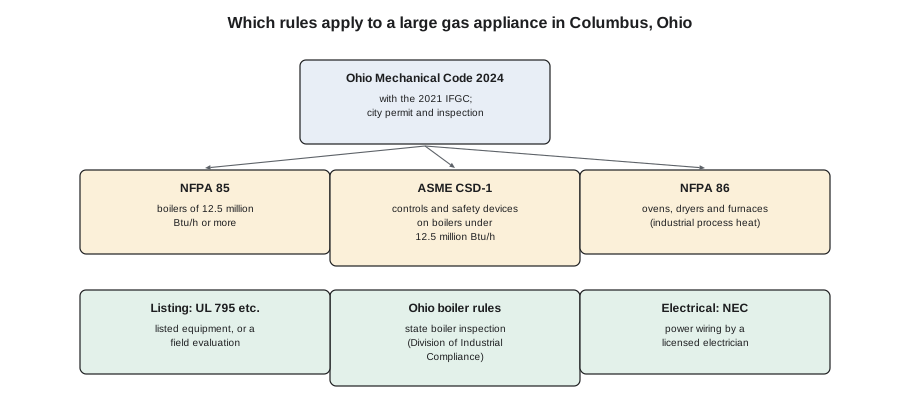
A boiler is two things at once: a gas appliance and a pressure vessel. In Ohio, the state boiler rules in Ohio Administrative Code chapter 4101:4, in their current form since July 1, 2024, govern the pressure side and much of the burner side of boilers. They incorporate the ASME Boiler and Pressure Vessel Code, the National Board Inspection Code, ASME CSD-1 (2021 edition) for controls and safety devices on automatically fired boilers, and NFPA 85 (2021 edition), the Boiler and Combustion Systems Hazards Code. A state or authorized inspector inspects the boiler, and the state issues a certificate of operation. The current editions of the national documents are CSD-1 2024 and NFPA 85 2023, which the state may adopt later. The gas technician's work on a boiler must satisfy both sides; a perfect gas train on a boiler with a missing low-water cutoff is still an unsafe boiler.
The split between CSD-1 and NFPA 85 is by input: CSD-1 covers automatically fired boilers with inputs under 12,500,000 Btu/h, and NFPA 85 covers single-burner boilers of 12,500,000 Btu/h and more, as well as multiple-burner boilers and other large combustion systems. Both set requirements for safety shutoff valves, proof of closure, gas pressure interlocks, flame safeguards, purge, trial times, low-water cutoffs and periodic testing, with NFPA 85 adding more for larger and more complex units.
| Rule | What it covers | Who enforces it |
|---|---|---|
| Ohio Mechanical Code 2024 with the 2021 IFGC | Installation of gas appliances, piping, venting, air supply | City of Columbus Building and Zoning Services |
| ASME CSD-1 | Controls and safety devices, boilers under 12,500,000 Btu/h | Ohio boiler rules and inspectors |
| NFPA 85 | Boilers of 12,500,000 Btu/h and more; large combustion systems | Ohio boiler rules and inspectors |
| NFPA 86 | Ovens, dryers, furnaces and process heating | The code official, the insurer and the owner |
| National Electrical Code | Power wiring to equipment | City electrical inspectors |
Worked problem
Which rules apply?
Vitale's oven is rated 2,400,000 Btu/h and is not listed for the United States. The same plant has a listed 15,000,000 Btu/h steam boiler. For each, find the input in kilowatts and state which NFPA standard or ASME document applies to its burner safety controls and whether a field evaluation is needed.
Show solution
- Oven:
- \[\frac{2{,}400{,}000}{3{,}412} = 703 \text{ kW}\]
- It is an oven, so NFPA 86 applies; it is not listed, so a field evaluation is needed before the city will accept it.
- Boiler:
- \[\frac{15{,}000{,}000}{3{,}412} = 4{,}396 \text{ kW}\]
- At 12,500,000 Btu/h or more, NFPA 85 applies, through the Ohio boiler rules; it is listed, so no field evaluation, but it needs its state certificate of operation.
Answer: The oven falls under NFPA 86 and needs a field evaluation; the boiler is large enough for NFPA 85 rather than CSD-1. Neither may be connected without the city's permit.
What the approval needed at Vitale
Maureen walked Carlo through what she had seen. The gas train used valves certified to European standards but not listed for the United States, with a single valve-proving device in place of the proof of closure switches the evaluator would expect, and its pressure switches had no markings the evaluator would recognize. The flame relay was a European model with no North American listing. The panel's wiring and terminal blocks were sized and marked to European rules. None of that made the oven unsafe in Italy. It meant the oven had to be brought into line with the rules here, and documented, before anyone could approve it.
She listed what Bayline would need from Vitale and the oven's maker: the burner and gas train drawings, the control wiring diagram, the sequence of operation with its timings, the maker's purge calculation, data sheets for every safety component, and the oven's rated input and gas pressure. With those, she would propose replacing the gas train with listed North American components, including two safety shutoff valves with proof of closure, listed low and high gas pressure switches, and a listed burner management system with a self-checking flame detector suitable for the oven's continuous runs. Vitale's electrician would rewire the panel to the National Electrical Code under his own permit. Then the evaluator would inspect, review the documents and witness the tests: purge timing, trial times, flame failure response, each interlock, and the valve leak tests. Maureen suggested the plant also call its insurer, whose own engineers often have requirements for process ovens.
| Document or test | Why it is needed |
|---|---|
| Burner and gas train drawings | Show every component, its rating and its order |
| Control wiring diagram and sequence of operation | Show how interlocks and timings work |
| Purge calculation | Shows the purge clears the oven and its ducts |
| Component data sheets and certifications | Prove each safety component is suitable |
| Gas piping test record | Shows the piping to the oven is tight |
| Witnessed safety tests | Prove the system does what the documents say |
The gas technician's responsibilities
Whatever the equipment, the technician who connects, starts or services it carries legal and professional responsibilities. Work only within your certificate or the limits your employer and the burner makers set. Never connect or light equipment that requires an approval it does not have. Never modify certified equipment, which voids its certification; a change to a certified burner's gas train or controls may turn it into equipment that needs a field approval. Replace safety components only with parts the maker or the approval allows. Test every safety control you disturb. Keep records: the codes and the inspectors expect service records, test results and safety-control tests to be written down, and in a dispute or an investigation those records protect everyone who did the work properly. And report unsafe conditions by shutting off the gas, tagging the equipment and notifying the owner in writing, and the utility or the city where required.
Carlo asked how long it would all take. Maureen said that with the drawings in hand, Bayline could have a revised gas train designed and quoted within two weeks, and the oven's maker could probably supply North American components through its export division. The field evaluation could be booked for mid-December if the parts arrived, with the oven in production in January, written into Bayline's plan as targets. "It's slower than plug and play," she told him. "But you'll have an oven that the next technician, the inspector and your insurer can all understand, and that your night shift can run without wondering what happens when the flame goes out."
Hydrogen blends and gas the equipment was not certified for
Some North American utilities have begun pilot projects that blend small amounts of hydrogen into the natural gas supply, and the Canadian codes now address it. Hydrogen burns faster and hotter than methane, has a lower heating value per cubic foot, and can affect some metals and seals, so equipment must be suitable for the gas it receives. In Columbus, the gas you work with is ordinary natural gas, but you may meet the topic on new equipment data plates and in industry news. The general rule is the same for any fuel: equipment is certified or approved for particular gases, and converting it to another gas, whether propane, a hydrogen blend or biogas, is done only with the maker's conversion kit and instructions, or through an approval.
Inspections and records over the equipment's life
Approval and commissioning are only the beginning. Over a large burner's life, the state boiler program inspects boilers periodically and renews their certificates of operation; ASME CSD-1 includes testing and maintenance checklists that owners are expected to follow at set intervals; and NFPA 86 requires the safety interlocks and safety shutoff valves of ovens and furnaces to be tested at least once a year, with the results documented. Insurers often add their own requirements and inspections. Bayline's service reports are written with these in mind: each annual service on a commercial burner records the safety tests performed and their results, the valve leak tests, the switch trip points, the flame signals and the combustion readings, so that the owner can show any inspector what was done and when.
Owners and operators also have daily and weekly duties that a technician should explain at handover: watching the boiler's pressure and temperature, checking for lockouts and alarms, testing the low-water cutoff on steam boilers by the maker's method, and keeping a log. On a large plant, operating engineers do this as their job. In a school or apartment building, it may be a caretaker with little training, and the technician's explanation may be all the training they get.
| Who | Typical duties |
|---|---|
| Owner or operator | Daily and weekly checks, log, calling for service, keeping the room clear |
| Service technician | Annual and seasonal service, safety tests, valve tests, tuning, records |
| State boiler inspectors | Periodic pressure-vessel inspection and certificates |
| Insurer's engineers | Their own inspections and requirements |
Common mistakes
MistakeConnecting uncertified equipment because it carries a foreign mark.
InsteadA foreign mark is not North American certification; obtain the approval the authority requires first.
MistakeModifying a certified burner's train or controls.
InsteadChanges void the certification and may require a field approval or evaluation.
MistakeTreating a boiler only as a gas appliance.
InsteadThe pressure side has its own rules, registration and inspections.
MistakeAssuming the newest edition of a code is the one enforced.
InsteadCheck which edition the authority has adopted, and any amendments.
MistakeFailing to record safety tests.
InsteadWrite down every safety test and result; inspectors and investigators will ask.
Summary and key terms
- Most gas equipment is certified to a product standard and installed under the 2021 IFGC through the Ohio Mechanical Code 2024, with NFPA 54 as its reference, following the maker's instructions without modification.
- Unlisted equipment in Columbus needs the code official's approval, usually through a field evaluation; ovens and furnaces fall under NFPA 86.
- Ohio's boiler rules incorporate ASME CSD-1 for boilers under 12,500,000 Btu/h and NFPA 85 for larger boilers, with state inspection and a certificate of operation.
- Technicians must work within their limits, never connect unapproved equipment, never modify certified equipment, test and record every safety control, and report unsafe conditions.
- Certification
- Testing of a design to a product standard and authorization to mark units built to it.
- Pressure vessel
- A vessel that holds fluid under pressure, such as a boiler, regulated for its construction and inspection.
- Field evaluation
- Inspection of an individual unlisted product on site against the applicable standard.
- ASME CSD-1
- The standard for controls and safety devices on automatically fired boilers under 12,500,000 Btu/h.
- NFPA 85
- The code for boilers of 12,500,000 Btu/h and more and other large combustion systems.
- NFPA 86
- The standard for ovens, dryers, furnaces and other industrial process heating.
Practice problems
Work each problem on paper first, then reveal the answer to check.
What NFPA standard covers industrial ovens and furnaces?
Show answer
NFPA 86.
Why can't a technician modify a certified burner's gas train?
Show answer
It voids the certification and may make the equipment need a field approval or evaluation.
Which ASME document covers controls on boilers under 12,500,000 Btu/h?
Show answer
ASME CSD-1.
What did Vitale's oven need before it could be lit?
Show answer
A field evaluation accepted by the city, with a North American gas train and controls.
Name three documents an approval typically needs.
Show answer
Gas train drawings, the wiring diagram and sequence of operation, and the purge calculation; also component data sheets.
Lesson quiz · 5 questions
Score 60% or more to complete this lesson.
Create a free account to save your progress, take quizzes and earn a certificate.