
GAS-310 · Lesson 1 of 12 · 24 min
Commercial and industrial gas equipment
▶ Video coming soon A video version of this lesson is on the way.
On Friday, September 11, Hank Morrow sent Jonah to spend the day with Maureen Fitch, who runs Bayline's commercial service. Maureen had come to Bayline six years earlier from a burner service company, where she had spent eighteen years on boilers, ovens and process heaters; she holds a journey-level gas fitter card and the burner makers' factory training. Luis Ferreira rode along too. Luis had held his journey-level card for four years and was now logging commercial hours with Maureen so that he could take over some of her accounts. Their first stop was the mechanical room of the Eastmount Community Center on the east side of Columbus. Jonah stopped in the doorway. Two boilers the size of delivery vans stood side by side, each with a burner bolted to its front that was bigger than the furnace he had helped install the week before, and a row of red and yellow valves ran along a pipe as thick as his arm. "Same gas, same physics," Maureen said. "Just more of it, faster, and with more ways to go wrong if you skip a step."
This course moves from the appliances in houses to the equipment in commercial buildings and industrial plants. This first lesson describes the kinds of equipment you will meet, how they are rated, what makes them different from residential appliances, and who is allowed to work on them. The rest of the course looks at burners, air and fuel ratios, gas trains, safety shutoff valves, flame safeguards, light-off sequences, firing-rate control, combustion tuning, the codes and approvals for large equipment and commissioning, and it ends with a boiler that would not light.
What counts as commercial and industrial
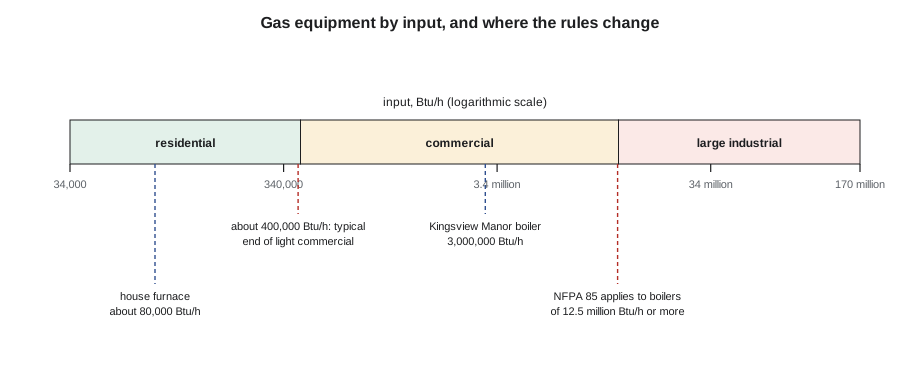
There is no single dividing line, but in practice the trade sorts gas equipment into three broad groups. Residential appliances, such as furnaces, water heaters, ranges and fireplaces, usually have inputs from a few kilowatts up to about 200,000 Btu/h and are certified as complete units that you install and adjust by the maker's instructions. Commercial equipment, in schools, offices, apartment buildings, hospitals, restaurants and shops, runs from about 400,000 Btu/h up to a few megawatts: boilers, large water heaters, rooftop units, makeup air units, unit heaters, cooking equipment and pool heaters. Industrial equipment, in factories and process plants, includes large boilers, ovens, dryers, kilns, furnaces, thermal oxidizers and process heaters, sometimes far larger than anything in a commercial building, and often built to order.
The groups overlap. A greenhouse grower may have a boiler bigger than a hospital's. A bakery's tunnel oven is industrial process equipment in a building that looks like a store. What changes as equipment grows is less the physics than the consequences: a larger burner can fill a combustion chamber with an explosive mixture in seconds if its gas valves open without a flame, so larger equipment carries more layers of protection, and the technician who works on it needs to understand each layer.
Ratings and units
Commercial equipment is rated by its input, the rate at which it burns fuel, and often also by its output, the heat delivered to water, steam or air. In the United States, input is given in Btu per hour, often written MBH for thousands of Btu per hour or MMBtu/h for millions. Some imported equipment and many engineering documents give kilowatts, so a commercial technician should be able to convert. One kilowatt is 3,412 Btu/h. Steam boilers are also rated in boiler horsepower, an old unit equal to about 9.81 kW or 33,475 Btu/h of output. A boiler's turndown ratio is the ratio of its maximum to its minimum firing rate; a burner with a 5:1 turndown can fire as low as one-fifth of full input.
Worked problem
Converting ratings at Eastmount
The Eastmount boilers' rating plates read 5,000,000 Btu/h input, 4,100,000 Btu/h output. The pool heater is rated 586 kW on its imported data sheet, and the makeup air unit 2,000,000 Btu/h. Express the pool heater in Btu/h, the boiler input in kilowatts, and the boiler's output as a fraction of its input.
Show solution
- Pool heater in Btu/h:
- \[586 \times 3{,}412 = 1{,}999{,}432 \approx 2{,}000{,}000 \text{ Btu/h}\]
- Boiler input in kilowatts:
- \[\frac{5{,}000{,}000}{3{,}412} = 1{,}465 \text{ kW}\]
- Output as a fraction of input:
- \[\frac{4{,}100{,}000}{5{,}000{,}000} = 0.82\]
Answer: Each boiler fires about 5,000,000 Btu/h (1,465 kW) and delivers about 82 parts in 100 of that to the water. Two of them together are nearly sixty times the size of a typical house furnace.
The equipment you will meet
The rest of the morning, Maureen walked Jonah and Luis through the room and then the roof, naming each piece and what made it different from its residential cousin.
| Equipment | Typical sizes | What is different from residential work |
|---|---|---|
| Hot water and steam boilers | 500,000 Btu/h to many MMBtu/h | Power burners, gas trains with two safety shutoff valves, flame safeguards, water-side limits, pressure-vessel rules |
| Rooftop units and makeup air units | 200,000 Btu/h to 3 MMBtu/h | Direct-fired makeup air burns in the airstream, with air-flow and temperature safeties |
| Unit and infrared heaters | 30,000 to 400,000 Btu/h each | Many units on one system; ceiling-mounted; clearance to stored goods |
| Commercial water heaters and pool heaters | 200,000 Btu/h to 2 MMBtu/h | High recovery; often power burners; storage tanks and circulators |
| Commercial cooking | 30,000 to 350,000 Btu/h per appliance | Hood interlocks, makeup air and fire suppression shutoffs |
| Process ovens, dryers and furnaces | from small to very large | Purge of the work chamber, solvent and atmosphere hazards, custom gas trains |
| Thermal oxidizers and process heaters | large | Built to order; often field approved; complex burner management |
The biggest change from residential work is that most commercial and nearly all industrial equipment uses power burners, which push all of the combustion air in with a fan, instead of the atmospheric burners of most older residential appliances. Lesson 2 explains the difference. Power burners allow high inputs in compact fireboxes and close control of air and fuel, but they also need a gas train of valves and switches (lesson 4), safety shutoff valves that are proven to close (lesson 5), a flame safeguard or burner management system that runs the light-off sequence and watches the flame (lessons 6 and 7), and a way to vary the firing rate (lesson 8).
Why larger equipment is more dangerous
The worst thing that can happen at a gas burner is a furnace explosion: gas enters a combustion chamber without burning, mixes with air, and finds an ignition source. In a house furnace the chamber is small and the gas flow modest, so a delayed ignition usually means a loud bang and a damaged panel. In a large boiler the chamber may hold several cubic meters, and a burner firing at full rate can admit enough gas in a few seconds to make an explosive mixture throughout it. The force of a large boiler explosion can blow out walls. Almost every rule in this course exists to prevent that event: purging the chamber with air before ignition, limiting how long gas may flow before a flame is proven, closing the gas within seconds if the flame goes out, and proving that the valves really close.
Worked problem
How long to make an explosive mixture?
Suppose a boiler's combustion chamber and flue passages hold 210 ft³ of air, and its burner admits natural gas at 5,000 ft³/h at full input. Natural gas will burn when it makes up roughly 5 to 15 parts in 100 of a mixture with air. If the main valves opened at full rate with no flame and none of the gas escaped, about how many seconds would it take for the gas to reach 5 parts in 100 of the chamber volume?
Show solution
- Gas needed for 5 parts in 100 (treating the mixture volume as the chamber volume):
- \[0.05 \times 210 = 10.5 \text{ ft}^3\]
- Gas flow per second:
- \[\frac{5{,}000}{3600} = 1.39 \text{ ft}^3/\text{s}\]
- Time:
- \[\frac{10.5}{1.39} = 7.6 \text{ s}\]
Answer: In under eight seconds the chamber could hold a mixture that will burn. That is why main-flame trial times on equipment like this are kept to seconds, and why the chamber must be purged with air before every ignition attempt. The real situation is more complicated, since gas mixes unevenly and some flows out, but the order of magnitude is the point.
Who may work on it
Ohio has no separate state license for gas fitters. Commercial burner work in Columbus is done by licensed HVAC contractors under the city's permits, and the boilers themselves are registered and inspected under the state boiler rules. Bayline therefore sets its own rule: only technicians with the burner makers' training and Maureen's sign-off work alone on equipment over 400,000 Btu/h. Jonah may assist under direct supervision, and Luis does the work under Maureen's supervision while he logs the hours and training she requires. Many burner makers also require factory training before a technician may adjust or warranty their controls.
Commercial equipment also brings other trades and other rules. Boilers are pressure vessels, registered and inspected under the state boiler rules, Ohio Administrative Code chapter 4101:4, which issue a certificate of operation after inspection. Power wiring belongs to an electrician. Building owners often have their own operating engineers or maintenance staff, and large plants have permit-to-work systems, lockout procedures and hot-work rules that a visiting technician must follow.
Gas supply to commercial equipment
Large equipment needs a lot of gas, and the supply arrangements reflect that. A house is usually fed at about 7 in. w.c. from its meter. A commercial building is often fed at an elevated pressure, commonly 2 psig or 5 psig, and sometimes much higher in industrial plants, so that the piping to distant equipment can be a reasonable size. Each appliance's gas train then has its own regulator that reduces the supply to the pressure its burner needs. At Eastmount, the utility meter set delivered 2 psig into the building, and each boiler's train regulator reduced it to about 14 in. w.c. ahead of the safety shutoff valves. GAS-330 covers elevated-pressure piping, meters and regulators in depth; for now, remember that the pressure at the inlet of a commercial gas train may be several times what you are used to, so your gauges and test methods must suit it.
Maureen showed them the room's main shutoff, a lubricated plug valve on the header with a wrench chained beside it, and the labels on each branch. "In an emergency, I want to shut one valve and know the room is dead," she said. "And when I work on one boiler, I want to shut one valve and know the other is still feeding the building." The drawings for the room, the gas train diagrams for each burner and the last two service reports hung in a plastic sleeve on the wall. She expects that on every account she looks after.
| Supply arrangement | Typical pressure | Where you meet it |
|---|---|---|
| Low-pressure house service | about 7 in. w.c. | Houses and small shops |
| Elevated-pressure commercial service | 2 to 5 psig | Schools, apartment buildings, offices, hospitals |
| Industrial service | often 10 psig and higher | Plants with large burners and long runs |
| Burner manifold pressure | a few in. w.c. to about 1 psig | Downstream of the train regulator and valves, set by the burner maker |
Working in a commercial mechanical room
Maureen ended the tour with her rules for the room. Sign in with the building's contact, and find out what else is running. Read the boiler log if there is one. Look before you touch: the gas train, the vent connections, the condition of the burner, any jumper wires or taped-over switches, and any sign that someone has been there before you. Never bypass a safety control to get a burner running, and never leave one bypassed. Know where the emergency shutoff switch is, usually a red button or switch at the exit door, and where the main gas valve for the room is. Wear hearing protection near running burners. Keep the analyzer, the manometers and the meter calibrated. And write everything down, because commercial equipment has a history, and the next technician needs to read it.
| Before you start | Why |
|---|---|
| Sign in; ask what has changed and what the complaint is | Owners often know about a recent repair or a new appliance on the same gas line |
| Read the log and the last service report | Settings, readings and faults over time show trends |
| Locate the emergency stop and the room's main gas valve | You must be able to stop everything quickly |
| Check for bypassed safeties, jumpers and open covers | A bypass is a red flag and must be removed, reported and made safe |
| Confirm lockout and permit requirements | Plants and large buildings have procedures you must follow |
Common mistakes
MistakeTreating a commercial boiler like a big furnace.
InsteadLearn the gas train, the flame safeguard and the sequence before you touch anything.
MistakeWorking on equipment above your certificate or training.
InsteadCheck the input on the rating plate and work within your limits, under supervision where required.
MistakeLeaving a jumper or a bypassed safety in place to keep heat on.
InsteadNever bypass a safety. If it can't be repaired, shut the equipment down and report it.
MistakeIgnoring the building's own procedures.
InsteadFollow the owner's lockout, permit and sign-in rules as well as your own.
Summary and key terms
- Commercial and industrial equipment runs from about 400,000 Btu/h to many megawatts and includes boilers, makeup air units, unit heaters, water and pool heaters, cooking equipment, ovens, dryers, furnaces and process heaters.
- It is rated by input and sometimes output, in kilowatts, Btu/h, MBH or boiler horsepower, and its turndown ratio is the ratio of maximum to minimum firing rate.
- Most of it uses power burners with gas trains, safety shutoff valves and flame safeguards.
- The central hazard is a furnace explosion from unburned gas in a large chamber, which can form in seconds, so purge, trial times, flame supervision and valve proving all aim to prevent it.
- In Ohio, there is no state gas fitter license; Bayline restricts work over 400,000 Btu/h to trained technicians, and apprentices work under direct supervision. Boilers are also pressure vessels, inspected under separate rules.
- Input
- The rate at which an appliance burns fuel, in kilowatts or Btu per hour.
- MBH
- Thousands of Btu per hour.
- Boiler horsepower
- An old unit of boiler output equal to about 9.81 kW or 33,475 Btu/h.
- Turndown ratio
- The ratio of a burner's maximum firing rate to its minimum.
- Power burner
- A burner whose combustion air is supplied by a fan.
- Furnace explosion
- The ignition of an accumulated mixture of unburned fuel and air inside a combustion chamber.
- Emergency shutoff switch
- A switch, usually at the boiler room exit, that stops the burners.
Practice problems
Work each problem on paper first, then reveal the answer to check.
Convert 2,500,000 Btu/h to kilowatts.
Show answer
2,500,000 ÷ 3,412 = 733 kW.
What does a turndown ratio of 10:1 mean for a burner rated 3,400,000 Btu/h?
Show answer
It can fire as low as one-tenth of full input, 340,000 Btu/h.
Why do larger burners need more layers of protection?
Show answer
Because a large burner can fill a large chamber with an explosive mixture within seconds if gas flows without a flame.
Who may work alone on a 1,000,000 Btu/h boiler at Bayline?
Show answer
Only a technician with the burner makers' training and Maureen's sign-off.
Name two things to locate when you first enter a commercial mechanical room.
Show answer
The emergency shutoff switch and the main gas valve for the room.
Lesson quiz · 5 questions
Score 60% or more to complete this lesson.
Create a free account to save your progress, take quizzes and earn a certificate.