
GAS-310 · Lesson 7 of 12 · 23 min
Purge, ignition trials and run sequences
▶ Video coming soon A video version of this lesson is on the way.
The superintendent at Lakeview Apartments, an eleven-story building on East Livingston Avenue in Columbus, had asked Bayline to look at the heating boiler because, as he put it, "it takes forever to light, and twice last week it banged." On Tuesday, October 27, Maureen and Luis found the boiler, 4,000,000 Btu/h with a modulating power burner, cycling normally. Luis pulled out his phone's stopwatch. "Before we touch anything," Maureen said, "we're going to time every step of a start and compare it with what the burner maker says it should be. A burner's sequence is its safety. If the timing is wrong, nothing else matters."
This lesson follows a burner management system through a complete start, run and stop: the checks before the start, the purge that clears the combustion chamber, the trials for ignition of the pilot and the main flame, the run, and the post-purge. It explains why each step exists, what typical times look like, what happens when a step fails, and how to time and verify a sequence in the field.
Before the start: standby and pre-ignition checks
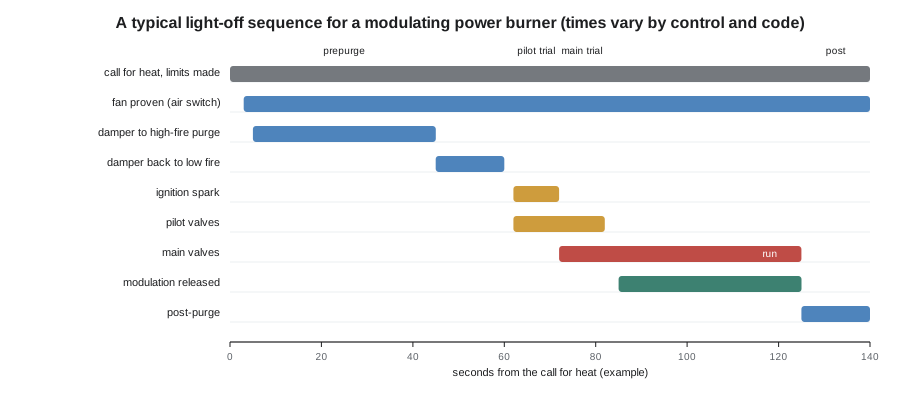
In standby, the burner is off, the safety shutoff valves are closed and the burner management system is powered, watching its inputs. When the operating control calls for heat, the system checks that the limit string is closed, so that no high-temperature limit, low water cutoff or other limit is open, and then checks its pre-ignition interlocks: the proof of closure switches must show the safety shutoff valves closed; there must be no flame signal (the safe-start check of lesson 6); and the combustion air proving switch must be open, since the fan is not yet running. That last check catches an air switch that is stuck closed or jumpered, which would otherwise prove air flow that is not there. If any check fails, the system holds or locks out, depending on the fault and the control.
Purge
With the checks passed, the system starts the combustion air fan. The air proving switch must now close, proving that air is moving. On a modulating burner, the system then drives the air damper to its high-fire position, proven by a high-fire purge switch on the actuator or linkage, and begins timing the prepurge. The purpose of the purge is to sweep out any gas that may have entered the combustion chamber and flue passages since the last run, for example from a leaking valve, and to fill them with clean air, so that the ignition spark cannot find a burnable mixture. The codes and the burner makers set the purge in terms of how many times the volume of the combustion chamber and flue passages must be replaced with air, at a minimum air flow. NFPA 86, for ovens and furnaces, requires at least four volume changes; ASME CSD-1, NFPA 85 and the burner makers set similar rules for boilers, and the burner maker converts them into a purge time for each burner and boiler combination. The air flow during the purge must be proven throughout; if the air switch opens, the purge timer starts again from zero, or the system locks out.
Worked problem
How long a purge is needed?
Lakeview's boiler has a combustion chamber, tube passes and breeching up to the stack damper with a total volume of 300 ft³. At high fire the burner fan moves about 44,000 cfh of air. How long does it take to move four times the volume through the boiler?
Show solution
- Air needed:
- \[4 \times 300 = 1{,}200 \text{ ft}^3\]
- Air flow per minute:
- \[\frac{44{,}000}{60} = 733 \text{ cfm}\]
- Time:
- \[\frac{1{,}200}{733} = 1.64 \text{ min} = 98 \text{ s}\]
Answer: Four volume changes take about a minute and forty seconds at high-fire air flow. The burner maker's label on this boiler calls for a two-minute purge, which gives a margin. At low-fire air flow the same purge would take several times as long, which is why modulating burners purge at high fire.
Back to low fire
When the purge time is complete, the system drives the air damper and the firing-rate valve back to the low-fire position, proven by a low-fire start switch. Lighting at low fire is essential: the burner lights with the smallest possible gas flow and the most stable flame, and if ignition is delayed, the least gas is in the chamber. The system will not proceed to ignition until the low-fire switch is made; most controls hold here and lock out if it is not made within a set time.
Trials for ignition
The pilot trial for ignition begins: the system energizes the ignition transformer and the pilot valves together. The pilot must light and the flame detector must prove it within the pilot trial time, typically 10 seconds or less on commercial burners, as set by the control's listing, the code and the burner maker. On many controls the spark stops a few seconds before the end of the pilot trial, so that the detector must prove the pilot flame alone, not a flame held up by the spark; this is called early spark termination. If the pilot is not proven by the end of the trial, the system closes the pilot valves, post-purges and locks out.
With the pilot proven, the main trial for ignition begins: the system opens the main safety shutoff valves, with the pilot still burning, and the main flame must be proven within the main trial time, typically about 10 seconds for gas burners of this size, again as the listing, code and maker set. At the end of the main trial, on a burner with an interrupted pilot, the pilot valves close, and the detector must now see the main flame alone. If the flame is lost at that moment or at any time afterward, the system closes all valves within its flame failure response time and goes to safety shutdown.
Run and stop
Once the main flame is proven, the system holds the burner at low fire for a short time, and then releases the firing-rate control, lesson 8, which modulates the burner to suit the load. Throughout the run, the running interlocks must stay made: the limits, the gas pressure switches, the air proving switch and the flame signal. When the operating control is satisfied, the system closes the safety shutoff valves, the flame goes out, and the fan runs a post-purge, typically 15 seconds or more, to clear the products of combustion and any gas left in the head before returning to standby. Some burners add a valve proving test, lesson 5, after the stop or before the next start.
| Step | What must be true to proceed | Typical time | If it fails |
|---|---|---|---|
| Standby checks | Limits closed; valves proven closed; no flame; air switch open | — | Hold or lockout |
| Fan start | Air switch closes | a few seconds | Lockout on most controls |
| Prepurge | High-fire switch made; air flow proven throughout | set for four or more volume changes | Timer restarts or lockout |
| Low-fire return | Low-fire start switch made | set by actuator speed | Hold, then lockout |
| Pilot trial | Pilot flame proven | about 10 s or less | Lockout |
| Main trial | Main flame proven | about 10 s for gas | Lockout |
| Run | Running interlocks made; flame present | — | Safety shutdown |
| Post-purge | Fan running | about 15 s or more | — |
Timing a sequence
A technician verifies a sequence by watching it and timing each step against the control's specification and the burner maker's instructions. Most modern controls display the step and a countdown, which helps, but a stopwatch and the control's own data sheet are still the reference. The technician also confirms that each proving switch actually controls its step: that the purge timer does not start until the high-fire switch is made, that ignition waits for the low-fire switch, that removing the pilot flame during the pilot trial produces a lockout at the right time, and that the main valves never open before the pilot is proven. Lesson 11 describes these tests as part of commissioning.
Worked problem
Timing the Lakeview start
Luis timed a start from the call for heat. The fan started at 0 s and the air switch made at 3 s. The damper reached high fire at 18 s and the purge began. At 48 s the damper started back to low fire, and the low-fire switch made at 63 s. The spark and pilot came on at 64 s, the spark stopped at 69 s, the main valves opened at 74 s and the pilot closed at 84 s. The maker's label calls for a 120 s prepurge, a pilot trial of 10 s maximum and a main trial of 10 s maximum. Which step is wrong?
Show solution
- Prepurge from high fire proven to the start of the return:
- \[48 - 18 = 30 \text{ s}\]
- Pilot trial from pilot on to main valves open:
- \[74 - 64 = 10 \text{ s}\]
- Main trial from main valves open to pilot off:
- \[84 - 74 = 10 \text{ s}\]
- The prepurge is 30 s, a quarter of the 120 s the maker requires.
Answer: The trial times are correct, but the purge is far too short. With a 30 s purge, the boiler gets only about one volume change of air, not the four or more needed to clear it, so any gas left from a leaking valve could still be there when the spark comes on.
What had happened at Lakeview
Maureen opened the control's front and pulled the purge timer card, a small plug-in module that sets the prepurge time on that model of control. It was marked 30 seconds. The burner maker's label inside the panel door called for a 2 minute card, and the original commissioning report in the boiler room file listed one. The superintendent admitted that the building's maintenance man, after tenants complained that the heat was slow, had swapped the card with one from a spare control he found in a drawer, to make the boiler light faster. Nobody had connected that change to the two bangs the week before.
"Those bangs were small delayed ignitions," Maureen explained to the superintendent. "With a short purge, if there's any gas in the chamber from a valve that weeps a little, the spark finds it. You were lucky it was small." She installed a 2 minute card from her stock, and Luis bubble tested both safety shutoff valves, finding the first valve sound and the second weeping slightly, within the maker's allowance but worth watching. They timed three more starts, all with a 120 s purge, and checked the valve seats again at the end of the day. Maureen wrote the change on the service report, put a label on the control reading "purge card must be 2 minutes, see maker's label", and booked a valve replacement for the second valve at the next service, since its leakage had increased since the last report. She also explained to the superintendent that the slow light-off was the burner doing its job, and that what the tenants really needed, a quicker response on cold mornings, could come from adjusting the building's outdoor reset and setback schedule, not from the burner's safety timing.
Holds, recycles and what the display tells you
Modern burner controls display the step they are in, a countdown, and a message when they stop. Not every stop is a lockout. A hold means the control is waiting for a condition, such as the low-fire switch or the air switch, before it moves on; it will continue by itself when the condition is met, though most controls lock out if a hold lasts too long. A recycle means the control has shut the burner down and will try again from the beginning, with a full purge, when the condition returns, as after a brief power failure or the operating control opening. A lockout needs a manual reset. Reading the display tells the technician which step failed and how, which is far more useful than knowing only that the burner is off. At Lakeview, the display had shown the 30 s purge clearly every time; nobody had compared it with the label.
Building staff also need to know what they may and may not do. Most burner makers allow a trained operator to reset a lockout once, after checking for obvious causes such as a closed gas valve or a tripped breaker, and require a service call if it locks out again. Changing timings, settings or plug-in cards is never the operator's job.
Common mistakes
MistakeShortening a purge to make a burner light faster.
InsteadNever change safety timings; the purge must meet the maker's and the code's requirements.
MistakeLighting at high fire to make ignition easier.
InsteadIgnition must take place at proven low fire.
MistakeAssuming the timings are right because the control is the right model.
InsteadCheck plug-in cards, settings and displays against the maker's label.
MistakeJumpering an air switch that won't prove.
InsteadFind out why the air flow is not proven: fan, inlet, switch, tubing or setting.
MistakeRepeating ignition attempts without a full purge between them.
InsteadEach new attempt must begin with a complete purge.
Summary and key terms
- Before a start, the burner management system checks that the limits are closed, the valves are proven closed, there is no flame and the air switch is open.
- It starts the fan, proves air flow, drives to high fire and purges the combustion chamber and flue passages, commonly with at least four volume changes, restarting the timer if air flow is lost.
- It returns to proven low fire, runs a pilot trial of typically 10 seconds or less with early spark termination, then a main trial of typically about 10 seconds, after which an interrupted pilot shuts off.
- It releases modulation, supervises the running interlocks and flame, and on stopping closes the valves and post-purges.
- Timings come from the control, the code and the maker and must be verified and never shortened.
- Prepurge
- The flow of air through the combustion chamber and flue passages before ignition to remove any fuel.
- High-fire purge switch
- A switch that proves the air damper is at its purge position.
- Low-fire start switch
- A switch that proves the burner is at low fire before ignition.
- Pilot trial for ignition
- The limited time in which the pilot must be lit and proven.
- Main trial for ignition
- The limited time in which the main flame must be proven after the main valves open.
- Early spark termination
- Stopping the spark before the end of the pilot trial so the pilot flame is proven alone.
- Post-purge
- The fan run after the burner stops, to clear the combustion chamber.
Practice problems
Work each problem on paper first, then reveal the answer to check.
Why must the air proving switch be open before the fan starts?
Show answer
To show the switch is not stuck closed or jumpered.
Why do modulating burners purge at high fire?
Show answer
High-fire air flow replaces the chamber volume quickly enough to purge in a reasonable time.
Why must ignition take place at low fire?
Show answer
The flame is most stable and the least gas is in the chamber if ignition is delayed.
What is the purpose of early spark termination?
Show answer
So the detector must prove the pilot flame on its own, not one held up by the spark.
What was wrong at Lakeview?
Show answer
A 30 s purge card had been installed where the maker required 2 minutes.
Lesson quiz · 5 questions
Score 60% or more to complete this lesson.
Create a free account to save your progress, take quizzes and earn a certificate.