
GAS-310 · Lesson 4 of 12 · 24 min
Gas trains and their components
▶ Video coming soon A video version of this lesson is on the way.
On Saturday morning, September 26, Hank held a shop class for Bayline's apprentices and service technicians, and Maureen ran it. Bolted to a sheet of plywood on two sawhorses was a complete gas train from a boiler Bayline had replaced the year before: a manual valve, a strainer, a regulator, two big yellow safety shutoff valves, two pressure switches, a row of little test cocks and a butterfly valve with a linkage arm, all on 2 in. pipe. Maureen had connected it to a cylinder of compressed air through a regulator, wired the valves to a switch box and fitted gauges at every test point. "This is the part of the boiler you'll spend most of your time on," she said, "and the part people understand least. By lunch, every one of you is going to be able to trace a train, tell me what each piece does, and tell me what happens when it fails."
This lesson walks along a typical gas train, the assembly of valves, regulators and switches between the building's gas piping and a power burner, explaining what each part does, where it goes and why, how the pilot train differs, how train components are vented and rated, and how to check that a train can deliver the burner's full input. Lesson 5 looks more closely at the safety shutoff valves and how they are proven to close.
What a gas train does
A gas train has four jobs. It must isolate the burner from the gas supply when someone needs to work on it. It must regulate the pressure to a steady value the burner can use. It must shut off the gas automatically and quickly whenever the burner management system calls for it, or whenever the power fails, with enough redundancy that one failed valve cannot leave gas flowing. And it must meter the gas to the burner at the firing rate called for. Codes and the burner makers specify which components a train must have for a given input and type of equipment; the larger the input, the more components it needs. A residential furnace's combination gas valve does all four jobs in one small body. A commercial train does them with separate, larger, testable parts.
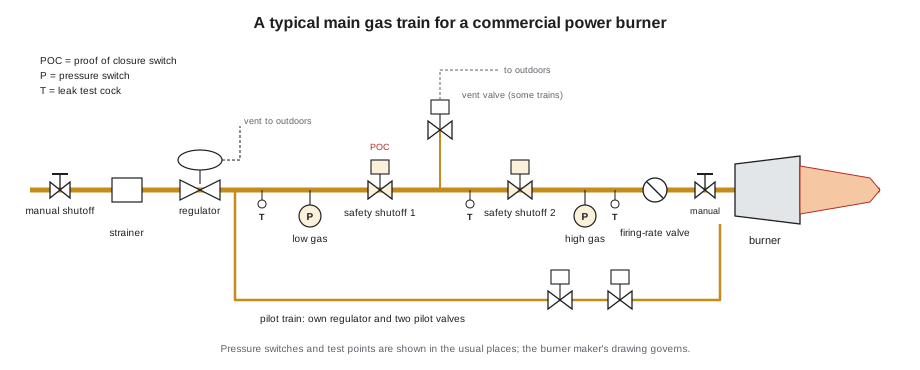
Along the train, from the supply
Manual shutoff valve. The first component is a listed, quarter-turn manual valve, commonly a lubricated plug valve or a ball valve, that shuts off the whole train. It must be accessible, it must not be inside a locked cabinet away from the burner, and its handle position must show clearly whether it is open or closed. Upstream of it, or just downstream, there is a sediment trap or drip leg to catch scale and moisture, as on any appliance.
Strainer or filter. Commercial trains usually have a strainer or filter to protect the regulator and valve seats from pipe scale, sealant and dirt, which are the most common reason a safety shutoff valve fails to seal. A new train or a train on a new piping system catches a surprising amount in its first weeks, so the strainer is checked at start-up and at the first service.
Regulator. The train regulator reduces the building supply pressure to the steady pressure the burner needs at its inlet. On small commercial trains it is a spring-loaded diaphragm regulator like those of GAS-240; on larger trains it may be a pilot-operated regulator, which uses a small pilot regulator to load a large main diaphragm and holds pressure more closely over a wide flow range. The regulator must be rated for the supply pressure, sized for the full-input flow with its pressure drop, and its outlet set to the pressure on the burner maker's data. Its vent must be piped to the outdoors with a protected termination unless the regulator has a listed vent limiter and the code permits one in that location.
Low gas pressure switch. Downstream of the regulator and upstream of the safety shutoff valves sits a pressure switch that opens on falling pressure. If the gas pressure falls below its setting, because the supply has failed or a regulator is failing, it opens the safety circuit and shuts the burner down before it can run with a weak, unstable flame or a fuel-lean mixture that could go out and relight explosively. Most are manual reset, so someone has to find the cause before the burner will start again.
Safety shutoff valves. Two automatic safety shutoff valves in series, often called SSOVs, open only when the burner management system powers them and close by spring force within about a second when the power is removed. Two are used so that a valve held open by dirt or a failed part still leaves the other to stop the gas. On larger equipment one or both carry a proof of closure switch, and some trains add a normally open vent valve between them or a valve proving system. Lesson 5 is about these valves.
High gas pressure switch. Downstream of the safety shutoff valves, and upstream of the firing-rate valve, sits a pressure switch that opens on rising pressure. If the regulator fails open and the pressure climbs above its setting, it shuts the burner down before overfiring can damage the boiler or make carbon monoxide. It too is usually manual reset.
Leak test cocks. Small manual valves, usually 1/4 in. plugged cocks, are fitted just downstream of each safety shutoff valve, and sometimes upstream of the first, so that each valve's seat can be leak tested, as lesson 5 shows. They must be kept plugged when not in use.
Firing-rate valve. On a modulating or high-low burner, a butterfly valve linked to the air damper, or driven by its own servo, sets the gas flow for the firing rate. On a single-stage burner there may be only a fixed limiting orifice or an adjustable cock.
Burner manual valve. Many trains end with a second manual valve just before the burner, sometimes called the firing valve, used during leak tests and to isolate the burner head.
| Component | Normal state with burner off | What it protects against |
|---|---|---|
| Manual shutoff valve | Open (closed for service) | Lets the train be isolated for work |
| Strainer or filter | — | Dirt reaching regulator and valve seats |
| Regulator | Locked up | Supply pressure changes and over-pressure at the burner |
| Low gas pressure switch | Closed if pressure is normal | Running on low or failed supply pressure |
| Safety shutoff valves | Closed | Gas flowing without a flame or a call |
| Vent valve (where used) | Open | Gas leaking past the first valve reaching the second |
| High gas pressure switch | Closed | Overfiring from a failed regulator |
| Firing-rate valve | At low fire | Starting at too high a rate |
The pilot train
Most commercial power burners light from a gas pilot, a small burner with its own spark igniter that lights first and is proven before the main valves open. The pilot is fed by a pilot train, a branch taken from the main train, usually downstream of the main manual valve and upstream of the main safety shutoff valves, with its own manual valve, its own small regulator and its own automatic pilot valve or valves. Some smaller burners use direct spark ignition of the main flame at low fire instead, with no pilot, where the burner's listing and the code allow. A pilot may be intermittent, burning throughout the run, or interrupted, shut off once the main flame is proven, which is required on many burners so the flame detector sees only the main flame. Lesson 7 covers how the sequence uses the pilot.
Venting train components
Regulators and pressure switches with diaphragms have vents, and valves with proof of closure or valve proving may have bleed lines. In normal operation they release little or no gas, but a ruptured diaphragm can release a lot. Codes require these vents to be piped to the outdoors with pipe of adequate size, ending in a protected termination away from openings, air intakes and ignition sources, unless the device has a listed vent limiter and the code permits it there. Vent lines from different devices are not combined unless the code and the device makers allow it, and then only with a common line sized for the purpose, because a combined line can let gas from one device's failure back-pressure another. A vent line also needs to be free of water and insects, which is a recurring theme in lesson 12.
Ratings and sizing
Every train component has a maximum inlet pressure that must not be exceeded, so a component downstream of the regulator may be rated far lower than one upstream. A common error when a building's supply is raised, for example from 7 in. w.c. to 2 psig, is to forget that a train designed for low pressure may have switches and valves not rated for the new inlet pressure. Every component also has a pressure drop at a given flow, read from the maker's capacity chart. The train must deliver the burner's full-input flow with enough pressure left at the burner manifold; if the drops add up to more than the regulator outlet can supply, the burner cannot reach full input, however the linkage is set.
Worked problem
Will the shop train reach full input?
Maureen's board train is set up for a burner that needs 8.0 in. w.c. at its manifold at a full-input flow of 5,000 cfh. The regulator outlet is set to 14.0 in. w.c. At that flow the maker's charts give these SAMPLE pressure drops: each safety shutoff valve 2.2 in. w.c., the firing-rate valve fully open 1.0 in. w.c., and the manual valve and fittings 0.6 in. w.c. What pressure is left at the manifold, and is it enough?
Show solution
- Total drop:
- \[2 \times 2.2 + 1.0 + 0.6 = 6.0 \text{ in. w.c.}\]
- Pressure at the manifold:
- \[14.0 - 6.0 = 8.0 \text{ in. w.c.}\]
- Compare with the burner's need of 8.0 in. w.c.: just enough, with no margin.
Answer: The train just reaches full input. If the supply sagged, or the strainer partly clogged, the burner would fall short. A train with no margin is a train that will cause a call some cold morning; one size larger in valves, or a higher regulator setting within the burner's allowed range, would give margin. These values are SAMPLE figures for practice; real drops come from the makers' charts.
Setting the pressure switches
The burner maker's start-up instructions give the settings for the pressure switches, and those govern. As a general pattern, the low gas pressure switch is set somewhat below the lowest pressure the train sees at full flow in normal service, so that normal sag does not trip it but a failing supply does; the high gas pressure switch is set somewhat above the highest pressure the train sees, so that normal lock-up does not trip it but a failed regulator does. A switch set too close to the running pressure causes nuisance lockouts that tempt someone to bypass it; a switch set too far away gives no protection. Each switch is tested by actually changing the pressure at its sensing point, not by trusting the dial.
Worked problem
Testing the low gas switch on the board
On the board, the regulator holds 14.0 in. w.c. with the valves closed and 13.2 in. w.c. with full flow. The low gas switch is set at 10.0 in. w.c. Jonah slowly closes the manual valve upstream of the regulator while watching the gauge at the switch. At what reading should the switch open, and what fraction of the full-flow pressure is that?
Show solution
- The switch should open as the gauge falls through its setting of 10.0 in. w.c.
- Fraction of the full-flow pressure:
- \[\frac{10.0}{13.2} = 0.76\]
Answer: The switch opened at a reading within the switch's stated tolerance of its setting, about three-quarters of the normal full-flow pressure, and the board's lockout light came on. It stayed out until Jonah pressed the reset button, which is the point of a manual-reset switch.
By lunch, each apprentice had traced the board from end to end, set and tested both switches, timed how fast the safety shutoff valves closed when power was cut, and found the fault Maureen had planted: a strainer packed with pipe dope that limited the flow. Luis noticed that the second safety shutoff valve's actuator was a different model from the first, with a slow-opening hydraulic action. "Good eye," Maureen said. "Slow open, fast close. It lets the main flame light gently. Lesson for next time."
Common mistakes
MistakeInstalling a regulator or switch rated below the supply pressure.
InsteadCheck every component's maximum inlet pressure against the pressure it will see.
MistakeLeaving a regulator vent open indoors without a listed vent limiter.
InsteadPipe vents outdoors with a protected termination unless a vent limiter is listed and permitted.
MistakeSetting pressure switches by the dial alone.
InsteadTest each switch by changing the actual pressure at its sensing point.
MistakeLeaving a test cock unplugged.
InsteadPlug every test cock after use; an open cock is a leak waiting to happen.
MistakeAssuming a train will reach full input because the burner is rated for it.
InsteadAdd up the pressure drops at full flow and check the manifold pressure.
Summary and key terms
- A gas train isolates, regulates, shuts off and meters gas to a power burner.
- Along the train come a manual shutoff valve, a sediment trap and strainer, a regulator vented outdoors, a low gas pressure switch that opens on falling pressure, two safety shutoff valves in series that close by spring force, sometimes a vent valve or valve proving system, a high gas pressure switch that opens on rising pressure, leak test cocks, a firing-rate valve and a burner manual valve.
- A pilot train branches off with its own valve, regulator and pilot valves.
- Components must be rated for the pressure they see and sized so the pressure drops leave enough manifold pressure at full input.
- Switches are set by the maker's instructions and tested by changing the real pressure.
- Gas train
- The assembly of valves, regulators and switches that supplies gas to a burner.
- Safety shutoff valve
- An automatic valve that opens only when powered by the flame safeguard and closes by spring force.
- Low gas pressure switch
- A switch that opens the safety circuit when gas pressure falls below its setting.
- High gas pressure switch
- A switch that opens the safety circuit when gas pressure rises above its setting.
- Leak test cock
- A small manual valve downstream of a safety shutoff valve used to test its seat.
- Firing-rate valve
- A valve, usually a butterfly, that varies the gas flow with the firing rate.
- Vent limiter
- A listed device that limits the escape of gas from a regulator or switch vent.
- Pilot train
- The branch of valves and regulator that supplies a burner's pilot.
Practice problems
Work each problem on paper first, then reveal the answer to check.
Which pressure switch opens on rising pressure, and where is it?
Show answer
The high gas pressure switch, downstream of the safety shutoff valves and upstream of the firing-rate valve.
Why are there two safety shutoff valves?
Show answer
So that if one is held open by dirt or a failed part, the other still stops the gas.
What is the most common reason a safety shutoff valve fails to seal?
Show answer
Dirt, scale or sealant on its seat.
Why must every train component's maximum inlet pressure be checked?
Show answer
Components downstream of the regulator may be rated much lower than the supply pressure.
What is an interrupted pilot?
Show answer
A pilot that shuts off once the main flame is proven.
Lesson quiz · 5 questions
Score 60% or more to complete this lesson.
Create a free account to save your progress, take quizzes and earn a certificate.