
GAS-310 · Lesson 3 of 12 · 27 min
Burner air and fuel ratios
▶ Video coming soon A video version of this lesson is on the way.
On Tuesday, September 29, the plant manager at Crown Linen, a commercial laundry on Joyce Avenue on the north side of Columbus, called Bayline because the boiler room's carbon monoxide alarm had sounded twice that week, both times in the early afternoon. Maureen and Luis found the steam boiler, 5,000,000 Btu/h with a modulating power burner, running smoothly at mid-morning, with flue gas readings of 3.6 parts in 100 oxygen and 22 ppm carbon monoxide air-free. At one o'clock, when the laundry's four big tumble dryers were all running, Luis took the readings again: oxygen 1.1, carbon monoxide 410 ppm air-free and climbing. "Same burner, same settings," Maureen said. "So what changed?" Luis looked at the door between the boiler room and the dryer floor, which was being sucked shut, and then at the makeup air unit on the dryer floor wall, which was silent.
This lesson explains the chemistry of burning natural gas and propane, how much air a burner needs, what excess air is and how to calculate it from a flue gas reading, why a burner's air and fuel ratio can drift with the weather and the building, and how much air a boiler room must supply. Lesson 9 uses these ideas to tune burners.
The chemistry of combustion
Natural gas is mostly methane, CH₄, with small amounts of ethane, propane, nitrogen and carbon dioxide. When methane burns completely, each molecule combines with two molecules of oxygen to make one molecule of carbon dioxide and two of water vapor, and releases heat:
Because gases at the same temperature and pressure occupy volumes in proportion to the number of molecules, one volume of methane needs two volumes of oxygen. Air is about 20.9 parts in 100 oxygen by volume, the rest being mostly nitrogen, which passes through the flame and carries heat out of the stack. So one volume of methane needs about 2 ÷ 0.209 volumes of air. This exact amount, with no oxygen left over and no fuel unburned, is the stoichiometric or theoretical air. Propane, C₃H₈, needs five volumes of oxygen per volume of gas, so it needs about 24 volumes of air.
Worked problem
Theoretical air for methane and propane
Using air at 20.9 parts in 100 oxygen by volume, find the volumes of air needed to burn one volume of methane (2 volumes of oxygen) and one volume of propane (5 volumes of oxygen).
Show solution
- Methane:
- \[\frac{2}{0.209} = 9.57 \text{ volumes of air}\]
- Propane:
- \[\frac{5}{0.209} = 23.9 \text{ volumes of air}\]
Answer: Natural gas needs close to 10 volumes of air per volume of gas, and propane close to 24. These are the numbers to remember when you think about how much air a burner room must supply.
In real burners, perfect mixing is impossible, so a burner fed with exactly the theoretical air would leave some fuel partly burned, producing carbon monoxide, CO, and sometimes soot. Burners are therefore set to run with excess air, more than the theoretical amount, so that every bit of fuel finds the oxygen it needs. The excess is expressed in parts in 100 of the theoretical air: 20 parts in 100 of excess air means 1.20 times the theoretical air. Too little excess air risks carbon monoxide and soot; too much carries extra heat out of the stack and can make the flame unstable, lift off the head, or also produce carbon monoxide when the flame is chilled. The right amount depends on the burner design and is set by the maker.
Reading excess air from the flue gas
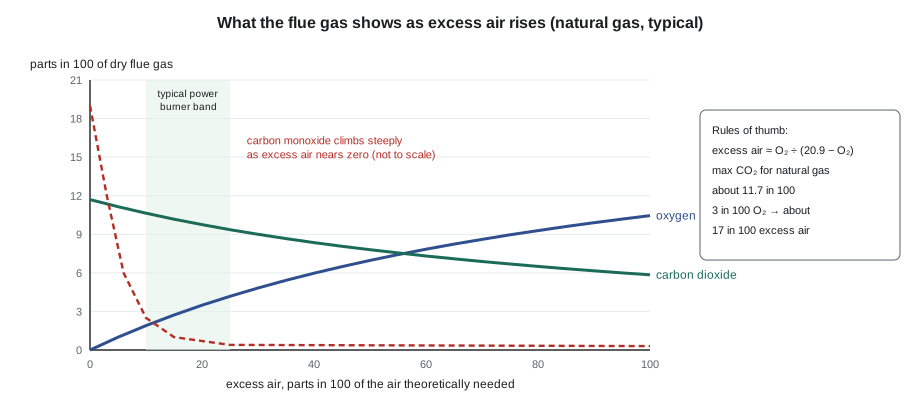
A combustion analyzer measures the oxygen left in the flue gas, and from that it calculates the excess air and the carbon dioxide. For natural gas, a simple approximation, good enough for field work, relates the oxygen reading in the dry flue gas to the excess air:
Carbon dioxide falls as oxygen rises. With no excess air, natural gas makes the maximum carbon dioxide, about 11.7 parts in 100 of the dry flue gas; propane's maximum is about 13.7. With excess air, the carbon dioxide reading is about the maximum times (20.9 − O₂) ÷ 20.9. Most technicians read oxygen, because it changes clearly with excess air and does not depend on knowing the fuel's exact maximum.
Worked problem
What the Crown Linen readings mean
In the morning the boiler's flue gas had 3.6 parts in 100 oxygen. In the afternoon it had 1.1. Find the excess air and the approximate carbon dioxide for each reading.
Show solution
- Morning excess air:
- \[\frac{3.6}{20.9 - 3.6} \times 100 = \frac{3.6}{17.3} \times 100 = 20.8\]
- Morning carbon dioxide:
- \[11.7 \times \frac{20.9 - 3.6}{20.9} = 9.7\]
- Afternoon excess air:
- \[\frac{1.1}{20.9 - 1.1} \times 100 = \frac{1.1}{19.8} \times 100 = 5.6\]
- Afternoon carbon dioxide:
- \[11.7 \times \frac{20.9 - 1.1}{20.9} = 11.1\]
Answer: In the morning the burner had about 21 parts in 100 of excess air, a normal setting. In the afternoon it had less than 6, so close to the theoretical air that the carbon monoxide soared. The gas flow had not changed; the air flow had fallen.
| Burner type | Typical oxygen at high fire (parts in 100) | Typical excess air (parts in 100) |
|---|---|---|
| Atmospheric commercial boiler | 6 to 9 | 40 to 75 |
| Nozzle-mix power burner, single-point linkage | 3 to 4.5 | 17 to 27 |
| Power burner with linkageless control and oxygen trim | 2 to 3.5 | 10 to 20 |
| Premix condensing boiler | as the maker states, often 4 to 6 | about 25 to 40 |
Why the ratio drifts
A power burner meters air by volume: the fan moves roughly the same volume of air at a given damper position. But what the flame needs is a certain mass of oxygen, and the mass of oxygen in a cubic meter of air depends on the air's density, which changes with temperature and barometric pressure. Cold air is denser than warm air, so a burner that takes its air from outdoors or from a cold room will get more oxygen in winter than in summer at the same damper setting, running leaner. A burner tuned on a cold day may run short of air on a hot day. Barometric pressure changes with the weather, and humidity displaces a little oxygen. The gas side changes too: gas density and heating value vary a little with the supply, and the gas temperature affects the mass flow through the valves. All of these are reasons to tune burners with a margin, to tune them in conditions close to how they will run, and to check them each season.
Worked problem
Summer tuning, winter air
A makeup air burner was tuned in August with outdoor combustion air at 86 °F, leaving it with 15 parts in 100 of excess air. In January, with the damper settings unchanged, the combustion air is at 41 °F. Assuming the fan moves the same volume of air and the gas mass flow is unchanged, about how much excess air does the burner now have? Air density is proportional to 1 ÷ absolute temperature, where absolute temperature in degrees Rankine is the Fahrenheit temperature plus 460.
Show solution
- Ratio of air densities:
- \[\frac{86 + 460}{41 + 460} = \frac{546}{501} = 1.090\]
- Total air in January as a multiple of theoretical:
- \[1.15 \times 1.090 = 1.25\]
- Excess air in January: about 25 parts in 100.
Answer: The burner has gone from 15 to about 25 parts in 100 of excess air, which costs some efficiency but is safe. Reverse the case, tuning in January and running in August, and a burner set at 15 could fall to about 5, close to the carbon monoxide knee. That is why burners on outdoor air are tuned with care about the season.
Air supply to the boiler room
Every cubic meter of gas burned needs nearly ten cubic meters of air, plus the excess, and that air must come into the room from somewhere. The codes require openings or ducts to the outdoors for combustion and ventilation air in rooms with large appliances, or a mechanical air supply interlocked with the burners, sized by the total input and the way the air arrives. The IFGC and NFPA 54 set the method; the details are in the code and you must use them for a real job. Bayline's rule, which Maureen repeats on every call, is that a power burner can only be as good as the air in the room. A room under negative pressure, because exhaust fans, dryers or kitchen hoods pull air out faster than it comes in, starves the burner of air, can pull flue gas back through the vent, and makes the burner's fuel-air ratio change every time those fans start.
Worked problem
How much air does the Crown Linen boiler need?
The boiler fires 5,000,000 Btu/h with 20 parts in 100 of excess air. Using a heating value of 1,000 Btu/ft³ and 9.57 ft³ of air per cubic foot of gas, find the gas flow and the combustion air flow in cubic feet per hour and per minute.
Show solution
- Gas flow:
- \[\frac{5{,}000{,}000}{1{,}000} = 5{,}000 \text{ ft}^3/\text{h}\]
- Theoretical air:
- \[9.57 \times 5{,}000 = 47{,}850 \text{ ft}^3/\text{h}\]
- With 20 parts in 100 of excess air:
- \[1.20 \times 47{,}850 = 57{,}420 \text{ ft}^3/\text{h} \;\to\; \frac{57{,}420}{60} = 957 \text{ ft}^3/\text{min}\]
Answer: The burner alone needs nearly 1,000 cubic feet of air every minute, which is more than a large house exhaust fan moves. If the dryers next door exhaust several times that and the makeup air unit is off, the room cannot supply it.
At Crown Linen, the cause was simple once they looked. The four dryers each exhausted about 1,000 cfm, and the makeup air unit that replaced that air had stopped when its fan belt broke the previous week. With the dryers running, the boiler room, which shared a louvered door with the dryer floor, went to −0.07 in. w.c. against outdoors. The burner fan, trying to draw from a room under suction, delivered less air, the oxygen fell, and the carbon monoxide rose. Some of the flue gas was also being drawn back into the room past the barometric damper, which is what set off the alarm.
Maureen shut the boiler down to low fire, and the plant manager stopped two of the dryers while Luis replaced the makeup air unit's belt. With the unit running, the room went back to −0.01 in. w.c., and the boiler's readings returned to 3.5 oxygen and 24 ppm air-free with all four dryers on. Maureen then recommended two changes in writing: an interlock so that the dryers could not run without the makeup air unit proving air flow, and a pressure switch in the boiler room to alarm on negative pressure. "The boiler wasn't broken," she told Luis. "It was doing exactly what a burner does when you take its air away."
| Symptom | Air or fuel cause to check |
|---|---|
| Oxygen falls and CO rises when other equipment starts | Room depressurization by exhaust fans, dryers or hoods |
| Readings change with the seasons | Air density change with temperature; burner tuned in the wrong conditions |
| High oxygen and high CO together | Flame chilled or lifted by too much air, or poor mixing at the head |
| Low oxygen and soot | Too little air: blocked fan inlet, dirty fan wheel, slipped damper linkage |
| Readings drift over weeks | Linkage wear, a regulator that has drifted, or a dirty air filter or inlet |
Gas quality and interchangeability
Natural gas is not identical from day to day or region to region. Its heating value and its density vary slightly with its composition, and a burner tuned for one gas behaves a little differently on another. The Wobbe index, the heating value divided by the square root of the gas's specific gravity, is the number engineers use to judge whether two gases will give the same heat input through the same orifice at the same pressure. Two gases with the same Wobbe index are said to be interchangeable: a burner adjusted for one will run correctly on the other. Utilities keep the Wobbe index of the gas they deliver within a set range for this reason. For a field technician, the practical points are to use the utility's actual heating value when checking input, as lesson 9 does, to be aware that a burner tuned with very little margin may be pushed out of adjustment by normal variations in gas quality, and to know that propane, with a very different Wobbe index, cannot be burned in natural gas equipment without the maker's conversion.
Common mistakes
MistakeAssuming a burner that read well in the morning is fine all day.
InsteadTest with the building's other equipment running, especially exhaust fans and dryers.
MistakeTuning on a hot day with no margin.
InsteadLeave enough excess air for the coldest and hottest conditions the burner will see.
MistakeReading carbon dioxide without knowing the fuel.
InsteadRead oxygen, which relates to excess air the same way for any common gas fuel.
MistakeBlocking boiler room air openings to keep the room warm.
InsteadCombustion and ventilation air openings must stay open and clear.
Summary and key terms
- Methane burns with two volumes of oxygen per volume, so natural gas needs about 9.57 volumes of air per volume and propane about 24.
- Real burners need excess air to burn completely; too little causes carbon monoxide and soot, and too much wastes heat or chills the flame.
- Excess air is about O₂ ÷ (20.9 − O₂) × 100, and natural gas's maximum carbon dioxide is about 11.7 parts in 100.
- A power burner meters air by volume, so the ratio drifts with air density, barometric pressure and gas properties, and burners are tuned with margin and checked by season.
- The boiler room must supply the burner's air; depressurization by other equipment starves the burner and can spill flue gas.
- Stoichiometric air
- The exact amount of air needed to burn a fuel completely with no oxygen left over.
- Excess air
- Air supplied beyond the stoichiometric amount, in parts in 100 of it.
- Maximum carbon dioxide
- The carbon dioxide in dry flue gas when a fuel burns with no excess air.
- Air density
- The mass of air in a given volume, which falls as temperature rises.
- Combustion and ventilation air
- The air supplied to an appliance room for burning and for cooling and ventilation.
- Depressurization
- A drop in room pressure below outdoors caused by exhaust exceeding supply.
Practice problems
Work each problem on paper first, then reveal the answer to check.
How many volumes of air does one volume of methane need?
Show answer
About 9.57.
A flue gas reads 4.0 parts in 100 oxygen. About how much excess air is that?
Show answer
4.0 ÷ 16.9 × 100 = about 24 parts in 100.
Why does a burner on outdoor air run leaner in winter?
Show answer
Cold air is denser, so the same volume carries more oxygen.
What two changes did Maureen recommend at Crown Linen?
Show answer
A dryer interlock with the makeup air unit's air flow, and a boiler room negative-pressure alarm.
Name two causes of low oxygen and soot on a power burner.
Show answer
A blocked fan inlet or dirty fan wheel, and a slipped air damper linkage.
Lesson quiz · 5 questions
Score 60% or more to complete this lesson.
Create a free account to save your progress, take quizzes and earn a certificate.