
GAS-310 · Lesson 5 of 12 · 21 min
Safety shutoff valves and valve proving
▶ Video coming soon A video version of this lesson is on the way.
Hearthstone Bakery in the Linden neighborhood of Columbus bakes bread in a long tunnel oven with three gas-fired zones. For a week in early October, the zone 2 burner had refused to start each morning, its control showing the same message: valve proving fault, downstream valve. The night baker had been resetting it, and on the third or fourth try it would usually pass and light. On Wednesday, October 7, the owner, Grace Antonelli, called Bayline. "I don't understand why it passes sometimes," she told Maureen on the phone. "Isn't it either leaking or not?" Maureen asked her to stop resetting it and leave the zone off until they arrived. "If it's telling you the second valve leaks," she said, "believe it until we prove otherwise."
This lesson looks closely at the two safety shutoff valves at the heart of every commercial gas train: how they are built, how fast they must close, how a proof of closure switch shows that a valve has closed, what double block and bleed and valve proving systems do, and how a technician leak tests a valve seat. These valves are the last barrier between the gas supply and the combustion chamber, so their condition matters more than any other part of the train.
What makes a valve a safety shutoff valve
A safety shutoff valve is an automatic valve listed for safety shutoff service. It is normally closed: with no power, a spring holds its disc firmly against its seat. When the burner management system energizes it, an actuator lifts the disc against the spring and holds it open. When the power is removed, for any reason, including a flame failure, an open limit or a power cut, the spring closes the valve. A listed safety shutoff valve must close quickly, typically within about one second, and must seal to within a very small leakage set by its listing standard. It must not depend on gas pressure, a pilot supply or anything other than its own spring to close.
Safety shutoff valves come in two main kinds. Solenoid valves use an electromagnet to lift the disc directly or through a small pilot; they open and close quickly and are common on smaller trains. Motorized valves use an electric or hydraulic actuator to open the valve, often slowly over several seconds to give a soft main-flame light-off, and a strong spring to close it quickly. Many motorized valves carry a valve position indicator and the switches described below. Both kinds must be installed with the flow arrow in the right direction, upstream of nothing that can push dirt back into them, and with their actuators clear of heat and water.
Proof of closure
A safety shutoff valve that sticks open is dangerous, and one that sticks partly open is worse, because it may let gas through while looking closed. A proof of closure switch, also called a valve seal overtravel or closed-position switch, is a switch inside the actuator that is made only when the valve disc has traveled fully onto its seat and slightly beyond. It is wired into the burner management system's pre-ignition interlock, so that the burner cannot start its purge, or cannot proceed to ignition, unless the switch proves the valve closed. If a valve fails to close at the end of a run, the next start-up is blocked. Codes require proof of closure on at least one of the safety shutoff valves on larger inputs, and on both, or a valve proving system instead, on larger inputs still; the exact thresholds depend on the code, the type of equipment and its input, and the burner maker's design follows them.
Double block and bleed
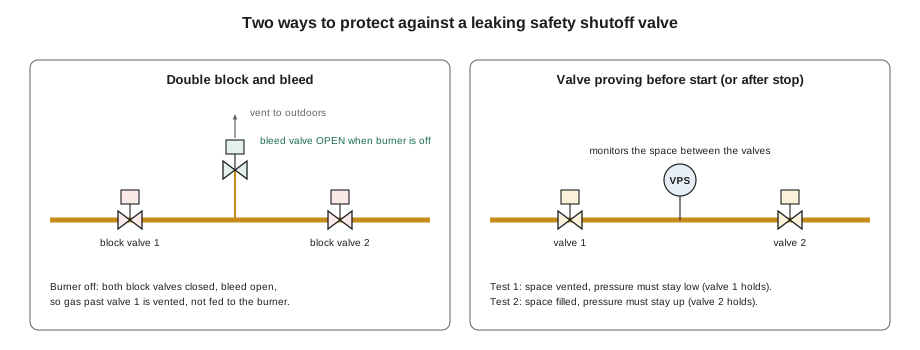
Even a closed valve may leak a little, and a seat with a speck of scale under it may leak a lot. A double block and bleed arrangement handles that by adding a normally open vent valve between the two safety shutoff valves, piped to a safe place outdoors. When the burner is off, both block valves are closed and the vent valve is open, so any gas leaking past the first valve escapes to the vent instead of building up pressure against the second valve and leaking into the burner. When the burner lights, the vent valve closes and the block valves open. Double block and bleed is used on many larger burners, particularly industrial equipment and burners with high supply pressures. It wastes a little gas each cycle and its vent must be properly terminated.
Valve proving systems
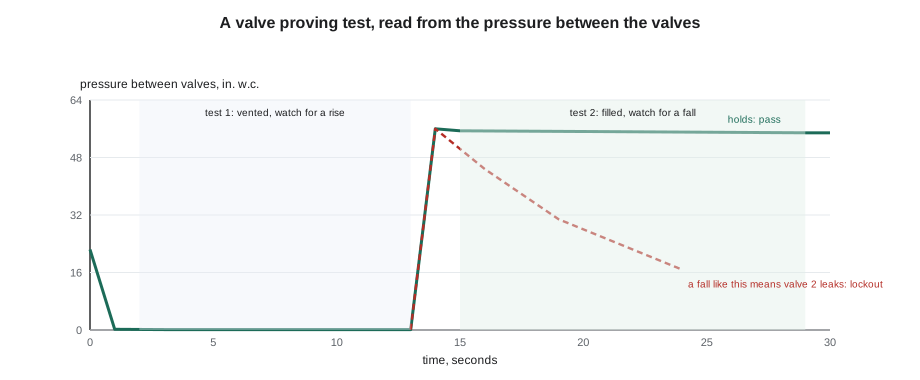
A valve proving system, often called a VPS, uses a pressure sensor connected to the space between the two safety shutoff valves to test both valves for leaks automatically, either just before each start, usually during the purge, or just after each shutdown, depending on the system and the code. A typical test has two steps. First, the space between the valves is emptied, by opening the downstream valve briefly into the purging combustion chamber or by venting it. Both valves are then closed, and the sensor watches the pressure for a set time. If the pressure rises, gas is leaking past the upstream valve. Second, the space is filled, by opening the upstream valve briefly, and both valves are closed again. If the pressure falls during the test time, gas is leaking past the downstream valve into the burner. If either test fails, the system locks out and shows which valve failed. Some systems also prove the valves' closure switches at the same time.
The test time is set when the system is commissioned, from the volume of the space between the valves, the gas pressure and the largest leak the code or the maker allows. A larger space or a smaller allowed leak needs a longer test. If someone later changes the piping between the valves, or the supply pressure, the test time may no longer catch the leak it was set to catch, which is one reason the test settings are recorded on the start-up report.
Worked problem
How long must the test run?
The space between Hearthstone's zone 2 valves holds 0.0706 ft³ of gas at 14 in. w.c. gauge. The valve proving system trips if the pressure in test 2 falls by half, 7 in. w.c. The maker's allowed leak rate for the valve size is 1.77 cfh, measured at atmospheric pressure. Treating the gas as an ideal gas at constant temperature, with atmospheric pressure 407 in. w.c., how long does a leak of exactly 1.77 cfh take to drop the pressure by 7 in. w.c.?
Show solution
- Volume of gas at atmospheric pressure that must leak out to drop the pressure by 7 in. w.c.:
- \[\frac{7}{407} \times 0.0706 = 0.00121 \text{ ft}^3\]
- Time at 1.77 cfh:
- \[\frac{0.00121}{1.77} = 0.000686 \text{ h} = 2.5 \text{ s}\]
Answer: A leak at the allowed rate would trip the system in about two and a half seconds, so a test time longer than that, with a margin, will catch it. A slower leak than the allowed rate may pass, which is intended. These are SAMPLE figures for practice; the system maker's procedure sets the real test time.
Testing a valve seat by hand
Valve proving systems test automatically, but most trains do not have one, and even those that do need periodic manual leak tests of each valve seat. ASME CSD-1 and NFPA 86 call for periodic seat leakage tests of safety shutoff valves, NFPA 86 at least once a year, and the burner makers' instructions give the procedure. The usual method is a bubble test through the leak test cock downstream of each valve, following the burner maker's procedure, which tells you how to pressurize the space ahead of each valve safely. In outline, with the burner shut down and the downstream burner manual valve closed so no gas can reach the combustion chamber:
- Confirm the valve under test is closed and de-energized, and that the space upstream of it is at normal gas pressure.
- Connect a length of 1/4 in. tubing to the test cock just downstream of the valve, open the cock briefly to vent the gas trapped downstream, then place the tube's open end about 1 in. below the surface in a clear container of water.
- Wait for the trapped gas to stop bubbling, then count the bubbles over a set period, usually one minute after the flow has settled.
- Compare the count with the maximum the valve maker allows for that valve size. More bubbles than allowed means the seat leaks; the valve must be cleaned or replaced and the burner kept off until it is.
- Close and plug the test cock, repeat for the other valve as the procedure directs, then open the burner manual valve and restore the burner.
A bubble test only means something if nothing else is leaking into or out of the test space, so the test cock connections themselves must be tight and the procedure followed exactly. Some technicians use a small electronic leak meter in place of the water jar; the principle is the same.
What Maureen and Luis found
At Hearthstone, Maureen first read the valve proving system's history: eleven downstream-valve failures in seven days, all at the first start of the morning, none during the day's restarts. That pattern, failing when cold, passing when warm, pointed to something on the second valve's seat that sealed better once the valve body warmed up. With the zone off and the burner manual valve closed, Luis bubble tested both valves. The first valve gave no bubbles in a minute. The second gave a steady stream, about thirty bubbles a minute, far more than the maker's allowance. They isolated the train, removed the second valve's bonnet and found a crescent of black, gritty material on the seat and disc, and the same grit in the strainer upstream, which looked as if it had not been opened since the oven was installed.
"That's pipe scale and old thread sealant," Maureen said. "Somebody's been working on the gas line upstream." Grace confirmed that a contractor had added a gas line for a new fryer in September. The new line had been tied into the same header, and the work had shaken loose scale that the strainer had mostly caught, but enough had reached the second valve. The maker did not permit field rebuilding of that valve, so they replaced it, cleaned the strainer basket and the first valve's inlet screen, and repeated the bubble tests: no bubbles on either valve. They then ran the valve proving system through three cold starts, after cooling the train with the zone off for an hour, and it passed each time.
| Valve proving result | Likely meaning | First action |
|---|---|---|
| Upstream valve fails (pressure rises in test 1) | Gas leaking past the first valve | Bubble test valve 1; check for dirt on the seat |
| Downstream valve fails (pressure falls in test 2) | Gas leaking past the second valve into the burner | Bubble test valve 2; never keep resetting |
| Fails only when cold | Debris or a seat that seals only when warm | Treat as a real leak; inspect the seat |
| Fails after piping work upstream | Scale or sealant reached the seats | Clean strainer, inspect seats, flush the line |
| Closure switch fault | Valve not fully closed, or switch failed | Do not bypass; inspect the actuator and valve |
Maureen's report to Grace was short. The second valve had been leaking into the burner every night, which is exactly what the valve proving system exists to catch, and resetting it until it passed had meant lighting a burner whose second valve was known to leak. She recommended that the fryer contractor's new line be blown clear and its strainer fitted properly, and that the bakery's staff be told that a valve proving fault is a reason to call, not to reset. For the oven's file, she recorded the bubble test results, the new valve's serial number, and the valve proving test times, which had not changed.
Common mistakes
MistakeResetting a valve proving lockout until it passes.
InsteadTreat each failure as a real leak and test the valve before relighting.
MistakeBubble testing with the burner manual valve open.
InsteadClose the downstream manual valve so no gas can reach the combustion chamber during the test.
MistakeRebuilding a safety shutoff valve the maker says must be replaced.
InsteadFollow the maker's instructions; many safety valves are not field-repairable.
MistakeChanging the piping between the valves without reviewing the valve proving test time.
InsteadA changed volume or pressure changes the test; recommission it.
MistakeIgnoring the strainer.
InsteadCheck and clean the strainer, especially after any upstream piping work.
Summary and key terms
- Safety shutoff valves are listed, normally closed valves that open only when powered and close by spring force, typically within about a second, sealing to a small allowed leakage.
- Solenoid valves open fast; motorized valves often open slowly and close fast.
- A proof of closure switch proves a valve is fully closed before the burner may start.
- Double block and bleed vents the space between the valves when the burner is off, and a valve proving system tests each valve automatically by watching the pressure in that space, rising if the upstream valve leaks and falling if the downstream valve leaks.
- Valve seats are also leak tested by hand, usually with a bubble test at the test cocks, following the maker's procedure, with the burner manual valve closed.
- Proof of closure switch
- A switch made only when a safety shutoff valve is fully closed, wired into the pre-ignition interlock.
- Double block and bleed
- Two block valves with a normally open vent valve between them.
- Valve proving system
- A device that tests safety shutoff valves for leaks by monitoring the pressure between them.
- Bubble test
- A seat leakage test that counts gas bubbles from a test cock through water.
- Motorized valve
- A safety shutoff valve opened by an electric or hydraulic actuator and closed by a spring.
- Pre-ignition interlock
- A condition the burner management system must prove before it will begin a start sequence.
Practice problems
Work each problem on paper first, then reveal the answer to check.
What closes a safety shutoff valve when power is removed?
Show answer
Its own spring.
In a valve proving test, what does a pressure rise in the vented space mean?
Show answer
The upstream valve is leaking.
What is the vent valve's position in double block and bleed when the burner is off?
Show answer
Open, venting the space between the block valves.
Why must the burner manual valve be closed during a bubble test?
Show answer
So no gas can reach the combustion chamber while the safety valves are being tested.
What caused the Hearthstone valve to leak?
Show answer
Pipe scale and old thread sealant shaken loose by new piping work upstream.
Lesson quiz · 5 questions
Score 60% or more to complete this lesson.
Create a free account to save your progress, take quizzes and earn a certificate.