
GAS-130 · Lesson 10 of 12 · 23 min
Grounding, bonding and polarity
▶ Video coming soon A video version of this lesson is on the way.
At the rural propane customer's farmhouse outside Grove City, where Bayline was planning a new tank and a standby generator, Luis was measuring the old furnace's gas line for a new regulator in early November when he felt a tingle in his wrist where it rested on the pipe. He stepped back, put on his gloves and took out his meter. Between the gas pipe and the concrete floor, with a probe pressed on a damp patch, the meter read 38 volts AC. Luis switched off the furnace at its switch and the reading fell to zero. "Something in this furnace is leaking voltage onto the cabinet," he told Jonah, "and nothing is taking it away to trip the breaker. That's a grounding problem, and it's the kind that kills people."
This lesson explains grounding and bonding, the difference between the neutral and the grounding conductor, why a proper fault path makes a breaker trip, how gas piping is bonded, what polarity is and why it matters to gas appliances, and how ground-fault circuit interrupters protect people. It finishes with the readings that show whether an appliance supply is correctly wired.
Three conductors with three jobs
A 120-volt appliance circuit has three conductors. The hot conductor carries current from the panel to the load. The neutral carries it back. Under normal conditions, the current in the hot and in the neutral is the same. The neutral is connected to earth at the service, which is why the codes call it the grounded conductor, but it is a current-carrying conductor and must be treated as one: on a running circuit, it can carry the full load current, and if it is opened it can be at full voltage.
The third conductor, green or bare, is the equipment grounding conductor, also called the bonding conductor in Canadian usage. It connects the metal cabinet of the appliance, the metal boxes and the metal raceways back to the panel's ground bar. It carries no current in normal operation. Its job is to carry fault current if a hot conductor touches metal that should not be live, and to keep that metal at earth potential so that a person touching it is not shocked.
Grounding and bonding
Grounding means connecting the electrical system to the earth, through a grounding electrode such as a buried rod, a metal underground water pipe or a concrete-encased electrode. It limits the voltage that lightning, a utility fault or an accidental contact with a higher-voltage line can impose on the system, and it gives the system a stable reference.
Bonding means connecting metal parts together, with conductors of adequate size, so that they are all at the same potential and form a continuous, low-resistance path. Bonding is what makes a breaker trip on a fault. It is a common mistake to think that a fault current simply "goes to ground" and is dealt with. Fault current wants to return to its source, the utility transformer, and the earth itself is a poor conductor. What clears a fault is the bonded path back to the panel, where the neutral and ground are tied together, giving fault current a low-resistance route to the transformer. Through that route, the current rises high enough to trip the breaker in a fraction of a second.
For that reason, the neutral and the equipment grounding conductor are connected together at one place only: the main service, where the neutral bar and ground bar are bonded and connected to the grounding electrode. Everywhere downstream, including at a furnace junction box, neutral and ground are kept separate. Joining them at the appliance would put normal neutral current onto the cabinet, the ducts and the gas pipe.
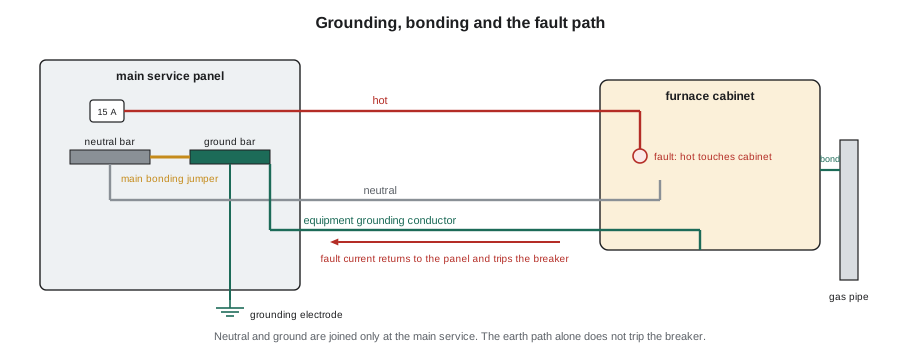
Worked problem
Why a bonded path trips the breaker
A hot conductor in a furnace chafes through and touches the cabinet. Case 1: the cabinet is properly bonded, and the total resistance of the fault path, hot conductor out and equipment grounding conductor back, is 0.5 Ω. Case 2: the grounding conductor is missing, and the only return is through the gas pipe, the soil and the utility's ground, totaling 25 Ω. How much fault current flows in each case on a 120-V circuit with a 15-A breaker?
Show solution
- Case 1, properly bonded:
- \[I = \frac{120}{0.5} = 240 \text{ A}\]
- Case 2, no grounding conductor:
- \[I = \frac{120}{25} = 4.8 \text{ A}\]
- Compare with the breaker:
- \[240 \text{ A} \gg 15 \text{ A} \qquad 4.8 \text{ A} < 15 \text{ A}\]
Answer: With a proper bonded path, about 240 A flows and the breaker trips almost instantly. Without it, only about 4.8 A flows, the breaker never trips, and the cabinet and the gas pipe stay energized at a dangerous voltage until someone becomes part of the circuit. That was the situation at the farmhouse.
Bonding gas piping
Gas piping is metal that runs throughout a building and connects to appliances whose wiring could fault to it, so the NEC requires it to be bonded. Section 250.104(B) requires metal gas piping that is likely to become energized to be bonded to the service equipment enclosure, the grounded conductor at the service, the grounding electrode conductor or a grounding electrode, and allows the equipment grounding conductor of the circuit that is likely to energize the piping to serve as the bonding means. In practice, a furnace whose cabinet is connected to the gas pipe and whose circuit has a proper equipment grounding conductor bonds that pipe. Corrugated stainless steel tubing has its own bonding requirements in the IFGC, the Residential Code of Ohio and its manufacturer's instructions, which the gas codes course covered.
Two rules follow for the gas technician. First, metal gas piping is not a grounding electrode. Underground metal gas piping must not be used to ground the electrical system, and nobody should attach a grounding conductor to the gas service in place of the proper electrode. Second, because gas piping can carry current from a fault elsewhere in the building, from a nearby lightning strike or from the electrical system itself, install a temporary bonding jumper across any gap before separating gas piping, such as before removing a meter, a regulator or a section of pipe. Clamp a heavy jumper to the pipe on each side of the joint first, then break the joint. If current was flowing, it continues through the jumper instead of arcing at the joint in the presence of gas, or through the person holding the wrench.
Polarity
Polarity in an AC circuit means that the hot and neutral conductors are connected to the right places: the hot to the switch, fuse and hot terminal of the load, the neutral to the neutral terminal. A polarized plug, with one blade wider than the other, keeps plug-in appliances connected the right way. On hard-wired appliances, it depends on the installer.
Reversed polarity matters in three ways. First, switches and fuses belong in the hot conductor. With the polarity reversed, a switch in the line opens the neutral instead, and the appliance's internal wiring stays live even when it is switched off, a hazard for the next person who works on it. Second, a fault in a reversed appliance can energize parts that are normally at neutral potential. Third, and specific to gas appliances, many furnace control boards sense flame by passing a tiny current through the flame to the grounded burner, and they rely on the neutral and ground being at nearly the same potential and the hot being where they expect it. On many furnaces, reversed polarity or a poor ground produces a flame-sensing failure: the burner lights, then shuts down after a few seconds, and the board flashes a polarity or flame code. The later course on appliance controls explains flame sensing; here the point is that a polarity check belongs in every no-heat call.
Testing an appliance supply
Three voltage readings at an appliance's junction box, or at a receptacle, show whether the supply is correctly wired. With power on and the cover removed carefully, measure hot to neutral, hot to ground and neutral to ground. A correctly wired 120-volt supply reads about 120 volts hot to neutral, about 120 volts hot to ground, and close to zero neutral to ground, usually less than about 2 volts, rising a little under load because of the neutral's voltage drop.
| Hot to neutral | Hot to ground | Neutral to ground | Likely meaning |
|---|---|---|---|
| About 120 V | About 120 V | Close to 0 V | Correctly wired |
| About 120 V | Close to 0 V | About 120 V | Hot and neutral reversed |
| About 120 V | Close to 0 V | Close to 0 V or unstable | Equipment ground missing or open |
| Close to 0 V | About 120 V | About 120 V | Neutral open |
| Below about 110 V or unstable | Varies | Several volts | Loose neutral or supply problem |
A plug-in receptacle tester, with three lights, gives a quick check of a receptacle, but it can be fooled, for example by a neutral and ground bonded at the wrong place, and it cannot test a hard-wired supply. The meter readings are the real test.
Ground-fault circuit interrupters
A breaker protects wire, not people. The device that protects people from shock is the ground-fault circuit interrupter (GFCI), often shortened to GFI. It compares the current leaving on the hot conductor with the current returning on the neutral. If they differ by more than about 5 milliamps, meaning some current is returning by another path, possibly through a person, it opens the circuit within a fraction of a second. That is fast enough, and sensitive enough, to prevent a fatal shock in most cases.
The codes require GFCI protection in places where water and electricity meet: bathrooms, kitchens near sinks, outdoors, garages and, in some locations, unfinished basements and near laundry and utility sinks. The NEC as adopted in Ohio sets out exactly where, and the rules have expanded over recent editions. A furnace or a condensate pump connected through a GFCI can trip it on a small leakage current that is not dangerous, so the electrical code also addresses which appliance circuits need GFCI protection and how; the electrician installs it, and the gas technician's part is to recognize a tripped GFCI as a possible cause of no heat and to look for the leakage, often a wet condensate pump or a failing igniter, rather than simply resetting it.
Worked problem
How far apart are hot and neutral currents?
A GFCI-protected receptacle feeds a condensate pump. A clamp meter around the hot conductor alone reads 1.200 A, and around the neutral alone 1.194 A. How much current is leaking to ground, and should the GFCI trip?
Show solution
- Subtract the neutral current from the hot current:
- \[1.200 - 1.194 = 0.006 \text{ A}\]
- Convert to milliamps:
- \[0.006 \times 1000 = 6 \text{ mA}\]
Answer: About 6 mA is returning by another path, enough for a GFCI to trip. A water-damaged pump motor is a likely culprit. Clamping both the hot and neutral together through the jaws gives the difference directly, which is a quick leakage test.
Back at the farmhouse
With the furnace switched off and locked out and the supply proved dead, Luis and Jonah opened the junction box. The furnace was fed with an old two-conductor cable with no grounding conductor at all, and the cable's black conductor had chafed through its insulation where it entered the cabinet without a connector. Every time the furnace ran, that bare spot touched the cabinet. With no grounding conductor, nothing tripped. The cabinet, the burner and the propane piping attached to them sat at a fraction of line voltage, limited only by the poor path through the soil. Luis tagged the furnace out of service, explained the danger to the owner and called Bayline's electrical partner, who replaced the cable with a properly grounded one the next morning and checked the bonding of the gas piping. Jonah measured the new supply before the furnace was restarted: 121 volts hot to neutral, 121 volts hot to ground, 0.3 volts neutral to ground. The pipe-to-floor reading was zero.
Common mistakes
MistakeThinking fault current "goes to ground" and disappears.
InsteadFault current returns to its source; the bonded path to the panel is what trips the breaker.
MistakeJoining neutral and ground at a furnace junction box.
InsteadNeutral and ground are bonded only at the main service.
MistakeUsing gas piping as a grounding electrode.
InsteadGas piping is bonded, never used as the electrode.
MistakeSeparating a gas pipe joint without a bonding jumper.
InsteadClamp a temporary jumper across the gap first.
MistakeResetting a tripped GFCI on a condensate pump and leaving.
InsteadFind the leakage; a GFCI trips because current is escaping.
Summary and key terms
- The hot carries current to the load and the neutral carries it back; the equipment grounding conductor carries no current normally and provides a fault path.
- Grounding connects the system to earth; bonding connects metal parts together so that a fault current can return to the source through a low-resistance path and trip the breaker.
- Neutral and ground are joined only at the main service.
- Metal gas piping must be bonded but never used as a grounding electrode, and a temporary jumper goes across any joint before it is separated.
- Polarity puts switches and fuses in the hot; reversed polarity or a poor ground can cause flame-sensing faults.
- Measure hot to neutral, hot to ground and neutral to ground.
- A GFCI trips at about 5 mA of leakage to protect people.
- Grounded conductor
- The neutral, a current-carrying conductor connected to earth at the service.
- Equipment grounding conductor
- The green or bare conductor that bonds metal parts and carries fault current.
- Grounding electrode
- A rod, plate, pipe or other electrode that connects the system to earth.
- Bonding
- Connecting metal parts together so they are at the same potential and form a continuous fault path.
- Main bonding jumper
- The connection between the neutral and ground at the main service.
- Polarity
- The correct connection of the hot and neutral conductors.
- GFCI
- A device that opens a circuit when the hot and neutral currents differ by about 5 mA.
Practice problems
Work each problem on paper first, then reveal the answer to check.
Where are neutral and ground connected together?
Show answer
At the main service only.
Why does a missing grounding conductor leave a fault live?
Show answer
Without a low-resistance path, fault current is too small to trip the breaker.
What should be done before separating gas piping?
Show answer
Install a temporary bonding jumper across the joint.
A supply reads 120 V hot to neutral, 0 V hot to ground and 120 V neutral to ground. What is wrong?
Show answer
Hot and neutral are reversed.
About what leakage current trips a GFCI?
Show answer
About 5 mA.
Lesson quiz · 5 questions
Score 60% or more to complete this lesson.
Create a free account to save your progress, take quizzes and earn a certificate.