
FAT-120 · Lesson 9 of 12 · 19 min
Audible notification: horns, speakers and audibility
Ravi hands Sasha a sound level meter and a floor plan of Willowbank School's new addition. 'Before we finish the layout, I want the ambient noise in every space we're covering,' he says. 'The gym during a basketball game, the music room during band practice, the shop with the dust collector running, the library at its quietest. I can't decide how many horns we need, or how loud, until I know what they have to be heard over.' Audible notification is the part of the fire alarm system that most people experience. If it is too quiet, people in a noisy room don't hear it. If it is far too loud, it is painful, it drowns out instructions, and people cover their ears instead of moving. This lesson covers the appliances, the signals they make, and the rules for how loud they must be.
Audible appliances
Horns are the most common audible appliances: an electronic or electromechanical sounder that produces a harsh, broadband tone that cuts through noise. Many are multi-tone and multi-candela combination horn-strobes, with the tone and volume set by switches or jumpers at installation. Bells were the classic appliance in older systems and still appear in some buildings. Chimes are quieter, used in hospitals and other places where a loud signal would disturb patients and staff are trained to respond. Speakers are used in voice systems, where a pre-recorded or live message follows the alarm tone; they play the tone and the message, and each speaker has taps for different power settings. Voice systems and intelligibility are covered in FAT-310.
Audible appliances are listed to UL 464 for horns and bells and UL 1480 for speakers. Installed appliances must be compatible with the panel and its notification circuits, and their tone and pattern settings must match the building's system.
The evacuation signal
The evacuation signal in North America is the temporal-three pattern: three half-second tones, each followed by a half-second pause, then a one-and-a-half-second pause, repeated. It is standardized internationally so that the same sound means the same thing in every building. Every audible appliance on the system must produce it in synchrony, so that horns in the same space don't overlap into a confusing jumble; the panel or a sync module keeps them together. Older systems that ring a continuous bell or use a slow whoop may stay until they are replaced, but new and altered systems use the temporal pattern.
Where a building uses an alert tone to notify staff before a general evacuation, it is distinct from the evacuation signal, and the building's fire safety and evacuation plan explains what each sounds like. NFPA 72 sets the evacuation pattern and the rules for any other signals.
Measuring sound in decibels
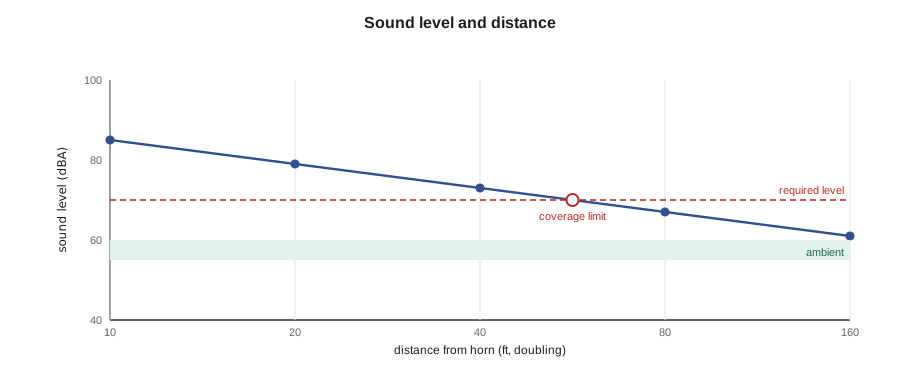
Sound level is measured in decibels, a logarithmic scale, so that each increase of 10 decibels is a tenfold increase in sound power and is heard as roughly twice as loud. The A-weighted scale, written dBA, adjusts the measurement to match the ear's sensitivity, which is lower for very low and very high frequencies. Quiet library: 35 to 45 dBA. Normal conversation at one meter: about 60 dBA. Busy school corridor: 65 to 75 dBA. Gym during a game: 80 to 90 dBA. Workshop with machinery: 85 dBA or more. Because decibels are logarithmic, two horns of equal level together are only 3 dB louder than one, not twice as loud, and doubling the distance from a horn in open space reduces its level by about 6 dB.
# Decibel arithmetic for horns (open space, illustrative)
import math
def combine(*levels):
    return 10 * math.log10(sum(10 ** (L / 10) for L in levels))
def at_distance(L_ref, d_ref, d):
    return L_ref - 20 * math.log10(d / d_ref)
print(f"two horns of 85 dBA together: {combine(85, 85):.1f} dBA")
print(f"one horn of 85 dBA with one of 75 dBA: {combine(85, 75):.1f} dBA")
for d in [10, 20, 40, 80]:
print(f"horn rated 85 dBA at 10 ft, at {d:3d} ft: {at_distance(85, 10, d):5.1f} dBA")two horns of 85 dBA together: 88.0 dBA one horn of 85 dBA with one of 75 dBA: 85.4 dBA horn rated 85 dBA at 10 ft, at 10 ft: 85.0 dBA horn rated 85 dBA at 10 ft, at 20 ft: 79.0 dBA horn rated 85 dBA at 10 ft, at 40 ft: 73.0 dBA horn rated 85 dBA at 10 ft, at 80 ft: 66.9 dBA
The second line shows something technicians find surprising: adding a horn 10 dB quieter than the first barely changes the total. Coverage comes from placing horns where each space needs them, not from adding more horns in one place.
How loud is loud enough
NFPA 72 sets the audibility requirement for public mode, the mode used to alert everyone in a space: a level at least 15 dB above the average ambient sound level, or 5 dB above the maximum sound level that lasts 60 seconds or more, whichever is greater, measured about 5 ft above the floor. The level must not exceed 110 dBA at the minimum hearing distance. Private mode, used where only trained staff need to hear, such as nurses' stations, needs 10 dB above ambient. In sleeping areas, the signal must reach at least 75 dBA at the pillow, or the ambient-based level if higher, and new systems in sleeping areas use a low-frequency tone of about 520 Hz. Levels are measured with a sound level meter at acceptance testing.
Ambient noise is the normal background level when the space is in use, and it has to be measured or estimated with care. A gym measured empty at 45 dBA might reach 85 during a basketball game. A shop with the dust collector off is very different from one with it running. Designers use measured values where they can, published typical values otherwise, and choose the busiest normal condition, not the loudest freak event. Where the ambient is so high that the required level would exceed the maximum, such as above about 95 to 105 dBA, the standards allow visual signals to be used instead of or as well as audible ones, and some machines can be shut down on alarm.
# Required alarm level for each space (NFPA 72 public mode: the greater of average + 15 and max + 5)
spaces = [  # name, average ambient (dBA), maximum lasting 60 s or more (dBA)
    ("Library", 42, 50),
    ("Classroom", 55, 62),
    ("Corridor at class change", 72, 78),
    ("Gym during a game", 84, 92),
    ("Shop, dust collector on", 88, 91),
]
limit = 110
for name, avg, peak in spaces:
    need = max(avg + 15, peak + 5)
    note = "(high: plan visual signals as well)" if need >= 95 else ""
print(f"{name:26s} ambient {avg} dBA -> alarm at least {need:.0f} dBA {note}")Library ambient 42 dBA -> alarm at least 57 dBA Classroom ambient 55 dBA -> alarm at least 70 dBA Corridor at class change ambient 72 dBA -> alarm at least 87 dBA Gym during a game ambient 84 dBA -> alarm at least 99 dBA (high: plan visual signals as well) Shop, dust collector on ambient 88 dBA -> alarm at least 103 dBA (high: plan visual signals as well)
Low-frequency signals for sleeping areas
Research on waking people has found that a low-frequency, square-wave tone around 520 Hz wakes sleeping people far more reliably than the high-pitched tones of traditional horns and smoke alarms, particularly for older adults, people with mild hearing loss, children and people who have been drinking. The 3,000 Hz tones of many older smoke alarms are near the top of the range where hearing declines first with age. As a result, codes and standards increasingly require low-frequency sounders in sleeping rooms: in hotel rooms, dormitories and, depending on the code, apartment suites. Low-frequency sounder bases can be fitted under some addressable smoke detectors, so that the detector and the sounder occupy one ceiling location.
NFPA 72 has required the 520 Hz low-frequency signal for sleeping areas in new installations since its 2010 edition, with the 2025 edition simplifying the requirements. Where it applies depends on the edition the state or local jurisdiction has adopted. At Riverlight Tower, new suite sounders installed during the corridor renovation are low-frequency types, as the design specified.
Placing audible appliances
NFPA 72 requires wall-mounted audible appliances to have their tops at least 90 in above the floor and at least 6 in below the ceiling, so that the sound spreads over people and furniture rather than being blocked. Appliances are spread through a space rather than grouped, so that the level is even and nobody stands next to a painfully loud horn while the far end is too quiet. Closed doors cut sound sharply, so rooms that are normally closed, such as offices and classrooms, often need their own appliances rather than relying on the corridor.
Horn settings matter. Many horns have high and low volume settings, often several decibels apart, and each choice changes the current the appliance draws, which affects the power supply and battery calculations covered in FAT-130. Speakers have taps for different powers, such as 1/4, 1/2, 1 and 2 watts, where each doubling of power adds about 3 dB. The settings chosen in design must be the settings installed, recorded on the drawings and checked at verification.
Worked problem
Gym horns at Willowbank
The gym's ambient during a game is 84 dBA average, with sustained peaks of 92. The chosen horn gives 90 dBA at 10 ft on its high setting. How loud must the alarm be, and is one horn at each end of the 100 ft gym enough?
Show solution
- The NFPA 72 requirement is the greater of 84 + 15 = 99 and 92 + 5 = 97: 99 dBA throughout the gym.
- One horn at each end leaves the middle 50 ft from the nearest horn; there, one horn gives about 90 - 20 log10(5) = 76 dBA, and the two together about 79 dBA.
- That is far short of the requirement, and placing horns close enough to reach it would make spots near them painfully loud.
- The answer is more horns spread around the walls, and visual signals throughout, because the ambient is high and spectators may not hear a signal over a game.
Answer: Ravi designs six horn-strobes around the gym walls and a relay that mutes the gym's sound system when the alarm sounds, which removes one of the loudest sources of ambient noise. Sasha's sound measurements at verification will show whether the levels are met.
Measuring audibility in the field
Audibility is designed on paper but proven with a meter. During verification, the technician sounds all the appliances in the area, with doors in their normal positions and normal equipment running, and measures the level at representative points: the far corners of rooms, the middle of large spaces, the pillow position in sleeping rooms with the doors closed. The meter is set to A-weighting and to a response that captures the alarm's pulses fairly, as the standard specifies, and the readings are recorded on the floor plans. Where a reading falls short, the fix is usually to add or move an appliance, raise a tap setting, or reduce a noise source; turning every horn up to its highest setting can push spaces near the horns over the limit. Rooms that change use, such as a classroom converted to a music room, need new measurements, because their ambient noise has changed.
Sasha's meter readings at Riverlight Tower's renovated floors become part of the building's record. A year later, when a tenant complains that the alarm is too quiet in a corner suite, the record shows that the level met the requirement at verification, and the inspection finds that the tenant has installed a solid-core door with heavy weatherstripping between the living room and the bedroom. The fix is a sounder base under the bedroom's smoke alarm, tied to the building's alarm, and the record is updated.
Speakers in voice systems have their own audibility rules, because a message that is loud but garbled fails as surely as one that is too quiet. FAT-310 covers intelligibility. For tone signals, the audibility rules in this lesson apply to the tone that the speakers play before and between messages.
Common mistakes
MistakeMeasuring ambient noise only when the space is empty.
InsteadUse the busiest normal condition.
MistakeAdding horns in one place to make a space louder.
InsteadSpread appliances through the space; two equal horns add only 3 dB.
MistakeRelying on corridor horns for rooms behind closed doors.
InsteadClosed doors cut sound sharply; add appliances inside.
MistakeUsing high-pitched sounders in sleeping areas where low-frequency signals are required.
InsteadUse 520 Hz low-frequency sounders.
MistakeChanging horn volume settings after design without updating calculations.
InsteadSettings affect current draw and battery calculations.
Summary and key terms
- Horns, bells, chimes and speakers produce audible signals; speakers also carry voice messages.
- The temporal-three pattern is the evacuation signal, synchronized on all appliances.
- Decibels are logarithmic: two equal sources add 3 dB, and doubling distance loses about 6 dB.
- NFPA 72 public mode requires 15 dB above average ambient or 5 dB above the 60-second maximum, up to 110 dBA.
- Low-frequency 520 Hz tones wake sleeping people more reliably.
- Spread appliances, add them in closed rooms and record their settings.
- Audibility
- The ability of an alarm signal to be heard over the ambient noise of a space.
- Ambient noise
- The normal background sound level of a space in use.
- dBA
- Sound level in decibels, A-weighted to match human hearing.
- Temporal-three
- The standard evacuation pattern of three pulses and a pause.
- Low-frequency signal
- A tone around 520 Hz used to wake sleeping people.
- Tap setting
- A selectable power setting on a speaker.
Practice problems
Work each problem on paper first, then reveal the answer to check.
Average ambient in a classroom is 58 dBA, with sustained peaks of 64. What public-mode level does NFPA 72 require?
Show answer
73 dBA (58 + 15, which is more than 64 + 5).
Two horns each give 82 dBA at a point. What is the combined level?
Show answer
About 85 dBA.
A horn gives 88 dBA at 10 ft. About what is its level at 40 ft in open space?
Show answer
88 - 12 = about 76 dBA.
What level must reach the pillow in a sleeping area?
Show answer
At least 75 dBA, or the ambient-based level if higher.
Lesson quiz · 5 questions
Score 60% or more to complete this lesson.
Create a free account to save your progress, take quizzes and earn a certificate.