
FAT-120 · Lesson 2 of 12 · 20 min
Photoelectric and ionization smoke detectors
The call from Riverlight Tower comes in on a Monday morning: the third nuisance alarm in a month from the same corridor smoke detector, outside the garbage room on the twelfth floor. Donna Achebe sends Sasha and Gerry. On the way, Gerry asks Sasha what kind of detector it is. She checks the as-built list: an ionization detector, original to the building. 'That might be your whole answer,' he says. 'Ionization detectors love fast, hot fires and the small particles they make. They also love burnt toast, and anything else that makes lots of tiny particles. Let's see what's next to it.' Spot smoke detectors are the most common automatic initiating devices in buildings, and the two classic sensing methods, photoelectric and ionization, respond to smoke in very different ways. Choosing the right one, and placing it well, decides whether a detector catches the fire early or cries wolf.
What smoke is, to a detector
FAT-110 described smoke as a mix of gases and particles. To a smoke detector, the particles are what matter. A flaming fire makes huge numbers of very small particles, many smaller than a micrometer, which are hard to see but easy to charge electrically. A smoldering fire, such as a cigarette in upholstery or an overheated cable, makes fewer, larger, lighter-colored particles that scatter light well, and produces a lot of carbon monoxide. As smoke travels and ages, small particles stick together into larger ones. So the same detector can see a fire's smoke very differently depending on what is burning, how far away it is and how long the smoke has been traveling.
Detector sensitivity is expressed as the smoke density that triggers an alarm, measured as percent obscuration per unit length: the percentage of light that a foot of the smoke would block. A detector might be listed with a sensitivity range of about 0.5 to 3.5 percent per foot, and each detector has a nominal setting printed on its label. Because the detector's response depends on the type of smoke, the listing test uses several standard test fires, and the detector must alarm within the allowed range for all of them.
Photoelectric detectors
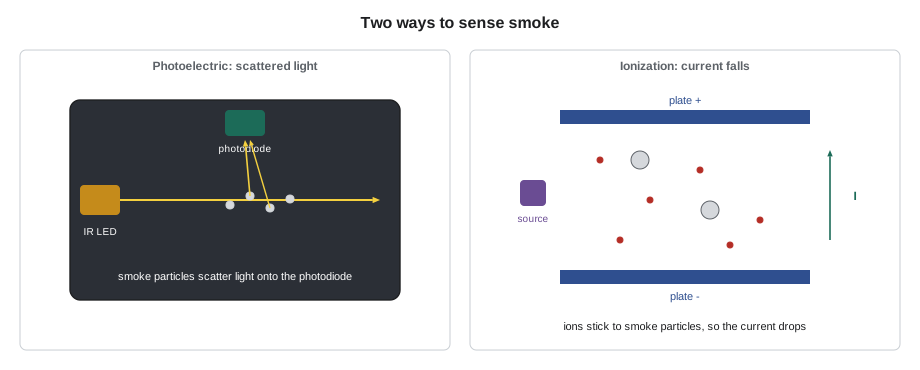
A photoelectric detector looks for light scattered by smoke particles. Inside its chamber, an infrared light-emitting diode sends a beam across a dark labyrinth, and a photodiode sits off to one side, out of the direct beam. In clean air, almost no light reaches the photodiode. When smoke enters the chamber, particles scatter some of the light onto it, the signal rises, and once it passes the alarm threshold, the detector alarms or, for an analog detector, the panel decides it has. The labyrinth's walls keep out ambient light and insects while letting smoke drift in.
Because larger particles scatter light much better than very small ones, photoelectric detectors respond best to smoldering fires and to smoke that has aged and traveled. They respond more slowly to clean-burning, fast flaming fires that make small dark particles. Modern furnishings made largely of synthetic foam produce a lot of visible, light-scattering smoke in both smoldering and flaming phases, which is one reason photoelectric and multi-criteria detectors now dominate new installations.
Ionization detectors
An ionization detector contains a very small radioactive source, usually americium-241, that ionizes the air between two charged plates, so a tiny current flows across the gap. When smoke particles enter, ions attach to them and move much more slowly, so the current drops. When the drop passes the threshold, the detector alarms. A second, partly sealed reference chamber compensates for changes in air pressure, temperature and humidity. Ionization detectors respond quickly to the very small particles of hot flaming fires, and more slowly to the larger particles of smoldering fires.
That same sensitivity to small particles makes them prone to nuisance alarms from cooking, toasters, combustion engines and even very humid air or steam. The radioactive source is tiny and sealed, but it does mean ionization detectors must be handled, returned and disposed of under the rules for radioactive materials, and most manufacturers have moved their product lines to photoelectric and multi-criteria sensing. In many buildings they are now replaced when they reach the end of their service life rather than one for one.
Ionization detectors and smoke alarms contain a sealed source distributed under a general license from the US Nuclear Regulatory Commission, which allows the public to own them but sets out how distributors and installers handle used ones. Bramwell returns removed ionization detectors to the manufacturer's take-back program rather than putting them in the trash.
| Fire or source | Photoelectric | Ionization |
|---|---|---|
| Smoldering upholstery or cable | Fast response | Slow response |
| Fast flaming paper or wood | Moderate response | Fast response |
| Flaming synthetic foam | Good response (dense smoke) | Good response |
| Cooking fumes, toast | Fewer nuisance alarms | Prone to nuisance alarms |
| Steam, high humidity | Can alarm in heavy steam | Can alarm |
| Dust and insects | Can alarm as the chamber gets dirty | Less affected by light-colored dust |
Cooking nuisance and the new listing tests
Cooking is the biggest cause of nuisance alarms in homes and apartments, and many people respond by removing smoke alarms. In response, UL 217 (8th edition) and UL 268 (7th edition) added new tests: a smoldering and a flaming polyurethane foam fire, and a cooking nuisance test in which hamburger patties are broiled and the device must not alarm before the smoke reaches a set level. NFPA 72-2025 requires smoke alarms and detectors to meet those editions, and sets placement rules near cooking: generally no smoke alarm or detector within about 10 ft of a fixed cooking appliance, and only devices listed for nuisance resistance from about 6 to 20 ft along the path smoke would travel. Devices made before the new editions can still be installed until stock runs out, but replacements are now the new type.
Where detectors misbehave
Every spot smoke detector has places where it will cause trouble. Near supply air diffusers, moving air keeps smoke away from the chamber and blows dust in; installation standards keep detectors 3 ft from supply diffusers. In kitchens, laundry rooms and bathrooms, steam and cooking fumes cause nuisance alarms. In garages, loading docks and boiler rooms, exhaust and dust do the same; heat detectors usually belong there. In very cold or hot spaces, detectors may be outside their listed temperature range. Near fluorescent fixtures and some LED drivers, electrical noise can cause false readings in older detectors. And in new construction, drywall dust can contaminate every detector in a building, which is why detectors are often installed after the dusty work is done or protected with dust covers that are removed before the system is commissioned.
Dirt and drift are the long-term problem. As dust settles in a photoelectric chamber, more light reaches the photodiode even in clean air, so the detector creeps closer to its alarm threshold. Analog addressable systems track each detector's clean-air reading and adjust the threshold, called drift compensation, until the detector runs out of adjustment and the panel reports it as dirty. Conventional detectors have no such help and simply become more sensitive until they cause nuisance alarms. Periodic sensitivity testing, covered in FAT-230, catches detectors drifting out of their listed range in either direction.
# Drift compensation on an analog photoelectric detector (illustrative units)
clean = [20, 26, 33, 41, 52, 64, 75]            # clean-air chamber reading at each annual check
alarm_above_clean = 30   # alarm when the reading is this far above the clean-air value
limit = 70               # the panel can adjust the clean-air value up to this point
for year, base in enumerate(clean, start=1):
    if base > limit:
        print(f"year {year}: clean reading {base} -> past the limit: DIRTY trouble, clean or replace")
        break
    threshold = base + alarm_above_clean
    margin = threshold - base
print(f"year {year}: clean reading {base:3d}, alarm threshold {threshold:3d}, margin {margin}")year 1: clean reading 20, alarm threshold 50, margin 30 year 2: clean reading 26, alarm threshold 56, margin 30 year 3: clean reading 33, alarm threshold 63, margin 30 year 4: clean reading 41, alarm threshold 71, margin 30 year 5: clean reading 52, alarm threshold 82, margin 30 year 6: clean reading 64, alarm threshold 94, margin 30 year 7: clean reading 75 -> past the limit: DIRTY trouble, clean or replace
The script shows the panel holding the margin steady by raising the threshold with the clean-air reading. The detector stays at the same effective sensitivity until year 7, when it runs out of compensation and the panel calls for service. A conventional detector in the same dust would have been alarming on nothing by about year 5.
Mounting and orientation
Spot smoke detectors are normally mounted on the ceiling, where smoke collects first. When they must be mounted on a wall, the installation standard limits how far below the ceiling they go: the top of the detector between 4 and 12 in below the ceiling. The corner where the wall meets the ceiling has dead air, and smoke may not reach it early, so ceiling detectors are kept out of that corner too. Detectors are installed on their listed bases, with the head locked in place where the manufacturer provides a tamper lock. In spaces with ceiling fans, detectors are kept clear of the blades' air movement. In cold spaces below a warm floor, or in atriums with glass roofs, smoke may stratify, stopping below a hot layer of air under the ceiling; Lesson 3 covers beam and aspirating systems that deal with it.
Worked problem
Choosing a replacement at Riverlight Tower
The twelfth-floor corridor detector outside the garbage room is an ionization detector. The garbage room's door is often propped open, and the alarm log shows the nuisance alarms at 7 a.m. and 6 p.m., when residents take out garbage and cook. What should Sasha recommend?
Show solution
- The times and location point to fumes and particles, not a fire, and ionization sensing is the most prone to them.
- The detector should be replaced with a type listed for the panel: a photoelectric or multi-criteria detector, which resists cooking-type particles better.
- The garbage room door should be kept closed, which is also a fire separation requirement.
- Moving the detector is not the answer if the drawings place it there for corridor coverage; the spacing must still be met.
Answer: Gerry agrees. Donna quotes a multi-criteria replacement for the building's remaining ionization corridor detectors, and the building manager installs a closer on the garbage room door. The nuisance alarms stop.
Smoke detectors in special environments
Some spaces push spot smoke detectors to the edge of their listings. Very cold spaces, such as freezers and unheated vestibules, can be below a detector's lowest listed temperature, and condensation forms in the chamber when warm air enters. Very humid spaces, such as pool enclosures and showers, cause readings to rise as fine water droplets scatter light. Spaces with high airflow, such as computer rooms, dilute smoke and need closer spacing. Each manufacturer lists the temperature, humidity and air velocity ranges its detectors are designed for, and a detector installed outside them is not considered compliant even if it seems to work. Where a space is outside every spot detector's range, the designer chooses a different method: heat detection, air-sampling with conditioned sample air, or protection from adjoining spaces. Sasha learns to check those three limits on the data sheet before she checks anything else.
Replacement is another place where mistakes happen. When a detector fails or reaches the end of its service life, the replacement must be compatible with the panel and the base, listed for the same use, and set to the same sensitivity and mode as the original design. Swapping an ionization detector for a photoelectric one is usually a good change, but it is still a change: the record of the device type is updated on the drawings and device list, and the panel's device type is changed if the panel treats the two differently. Most manufacturers recommend replacing smoke detectors at about ten years, and many owners plan replacements by floor or by building so that the whole system doesn't age at once.
Common mistakes
MistakeInstalling smoke detectors in kitchens, garages or boiler rooms.
InsteadUse heat detectors or another listed type suited to the space.
MistakeMounting a detector right beside a supply diffuser.
InsteadKeep the distance the installation standard requires.
MistakeLeaving dust covers on after commissioning, or removing them during drywall work.
InsteadRemove covers only when dusty work is done, and before the system is verified.
MistakeThrowing removed ionization detectors in the garbage.
InsteadReturn them through a take-back program.
MistakeAssuming a newer detector is more sensitive and so better.
InsteadThe right sensing method for the fire and the space matters more.
Summary and key terms
- Photoelectric detectors see light scattered by smoke and respond best to smoldering and aged smoke.
- Ionization detectors see a drop in ion current and respond best to fast flaming fires, but are prone to nuisance alarms.
- Sensitivity is expressed as percent obscuration per foot and must stay within the listed range.
- UL 217 (8th) and UL 268 (7th) added foam fire tests and a cooking nuisance test, required by NFPA 72-2025.
- Keep detectors away from supply diffusers, cooking, steam, dust and exhaust.
- Analog systems compensate for drift until a detector is reported dirty.
- Photoelectric detector
- A smoke detector that senses light scattered by smoke particles.
- Ionization detector
- A smoke detector that senses a drop in current through ionized air.
- Obscuration
- The percentage of light blocked by smoke over a set distance.
- Drift compensation
- Adjustment of a detector's alarm threshold as its clean-air reading rises with dirt.
- Labyrinth
- The dark baffled chamber of a photoelectric detector that admits smoke but not light.
- Nuisance alarm
- An alarm caused by something other than a fire, such as cooking or dust.
Practice problems
Work each problem on paper first, then reveal the answer to check.
Which detector type would you choose for a hotel corridor next to guest rooms with kitchenettes?
Show answer
Photoelectric or multi-criteria, which resist cooking particles better.
An analog detector's clean-air reading rises from 20 to 41 over four years. What does the panel do with the alarm threshold?
Show answer
Raises it by the same amount, keeping the margin, until compensation runs out.
Why are smoke detectors kept out of the corner where wall meets ceiling?
Show answer
Dead air there can keep smoke from reaching them early.
What radioactive source do most ionization detectors use?
Show answer
Americium-241.
Lesson quiz · 5 questions
Score 60% or more to complete this lesson.
Create a free account to save your progress, take quizzes and earn a certificate.