
FAT-120 · Lesson 4 of 12 · 19 min
Multi-criteria, CO and video-based detection
Donna's quote for Riverlight Tower's corridors specified multi-criteria detectors, and the building manager wants to know what he is paying for. Sasha is asked to write a one-page explanation, and she starts by asking Gerry what is actually inside the new detector. He opens one on the bench: a photoelectric chamber, a thermistor that measures temperature, and a small electrochemical carbon monoxide cell, all feeding a microprocessor. 'One sensor can be fooled,' he says. 'Three sensors that disagree usually means it isn't a fire. Three that agree usually means it is.' The same idea, combining several signals to decide faster and more reliably, runs through the newer detection technologies in this lesson: multi-criteria detectors, carbon monoxide detection, and detection that uses cameras and thermal imaging.
Why combine sensors
A single-sensor detector has to choose one threshold. Set it low and it alarms early on real fires, but also on dust, steam and cooking. Set it high and the nuisance alarms stop, but real fires take longer to detect. A multi-criteria detector measures two or more effects of fire and combines them in an algorithm. Smoke rising together with temperature, or with carbon monoxide, is very likely a fire, so the detector can respond at a lower smoke level. Smoke without any heat or carbon monoxide, such as steam or dust, can be held until it reaches a higher level or ignored if it behaves like a known nuisance. The result is earlier detection of real fires and fewer nuisance alarms, which is the reason they are replacing single-sensor detectors in many buildings.
The sensors commonly combined are a photoelectric smoke chamber, sometimes with two wavelengths or two scattering angles to tell particle sizes apart; one or more thermistors for temperature and rate of rise; a carbon monoxide cell; and sometimes an infrared sensor for flame flicker. Each manufacturer's algorithm is its own, and its listing says how the detector is used and spaced. A multi-criteria detector that includes smoke sensing is usually listed and spaced as a smoke detector. Some can be programmed to act as a pure heat detector during working hours in a dusty shop and as a full multi-criteria detector at night, if the listing and the authority allow it.
A simple model of the decision
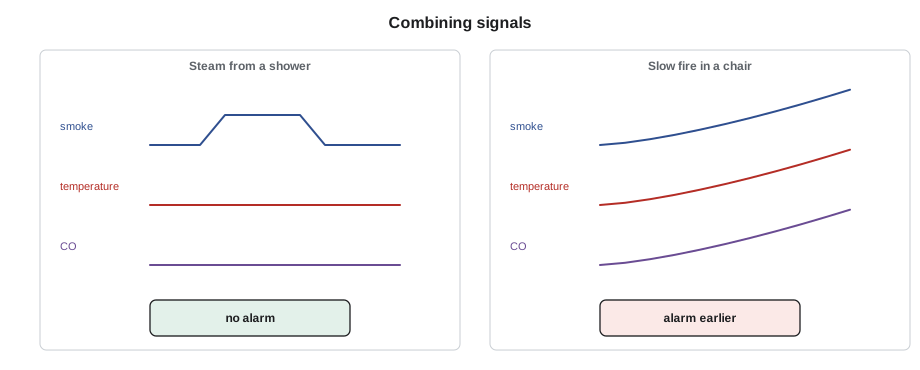
Real algorithms are proprietary and far more detailed, but a simple scoring model shows the principle. Each sensor contributes a score in proportion to how far its reading is above normal, and the detector alarms when the combined score passes a threshold. A strong smoke signal alone can still alarm, so a fire with little heat or carbon monoxide is not missed, but smoke with supporting signals alarms sooner.
# A simple multi-criteria scoring model (illustrative only; real algorithms differ)
def score(smoke, temp_rise, co):
    s = smoke / 2.5          # smoke obscuration as a fraction of the single-sensor alarm level
    t = temp_rise / 27.0      # temperature rise (deg F) as a fraction of a heat alarm rise
    c = co / 50.0             # CO (ppm) as a fraction of 50 ppm
    return s + 0.6 * t + 0.6 * c
cases = [  # name, smoke (%/ft), temperature rise (deg F), CO (ppm)
    ("Steam from a shower", 2.2, 0, 0),
    ("Toast in a kitchenette", 1.9, 2, 4),
    ("Slow fire in a chair", 1.4, 4, 35),
    ("Flaming wastebasket", 1.6, 22, 20),
]
for name, sm, tr, co in cases:
    total = score(sm, tr, co)
print(f"{name:24s} score {total:4.2f} -> {'ALARM' if total >= 1.0 else 'no alarm'}")Steam from a shower score 0.88 -> no alarm Toast in a kitchenette score 0.85 -> no alarm Slow fire in a chair score 1.07 -> ALARM Flaming wastebasket score 1.37 -> ALARM
In this model, the steam reaches almost the single-sensor alarm level but has no heat or carbon monoxide, so it doesn't alarm. The slow fire in the chair, a smoldering fire, has less smoke but plenty of carbon monoxide and alarms. The flaming wastebasket alarms on the combination of smoke and heat. A single-sensor photoelectric detector set at the same smoke level would have alarmed on the steam and missed, for a while, the fire in the chair.
Carbon monoxide: fire signature and life safety
Carbon monoxide shows up in detection for two different reasons, and keeping them apart avoids confusion on the job. First, CO is a product of incomplete combustion, produced in large amounts by smoldering fires, so a CO sensor in a multi-criteria detector helps detect fires early. Second, CO from fuel-burning appliances, vehicles and generators is a poison, and CO detection protects people from it even when there is no fire. The life-safety use has its own rules: where CO alarms or detectors are required, how they sound, and what happens when they operate. A CO signal for life safety is not a fire alarm signal. Its sound pattern is different: four short beeps repeated, in place of the fire alarm's three, so people can tell them apart.
In the US, the International Building Code and International Fire Code require carbon monoxide detection in occupancies such as dwelling units, hotels, schools and care facilities where there is a fuel-burning appliance, fireplace or attached garage. Since the 2022 edition, NFPA 72 has included the requirements for CO detection and warning equipment that used to be in NFPA 720, and CO alarms are listed to UL 2034 and CO detectors to UL 2075. A CO signal at a fire alarm panel is processed as its own signal, not a fire alarm.
Electrochemical CO sensors have a limited life, typically seven to ten years, after which the device reports an end-of-life trouble and must be replaced. They are also affected by some cleaning chemicals and by very humid or very cold conditions, so the location rules in the manufacturer's instructions matter. A multi-criteria detector whose CO cell has reached its end of life may continue to work as a smoke and heat detector, reporting a trouble for the CO part, depending on the model.
| Signal | Typical pattern | What it means |
|---|---|---|
| Fire alarm | Temporal three: three pulses, pause, repeat | Evacuate or follow the fire safety plan |
| Carbon monoxide | Temporal four: four short pulses, pause, repeat | Move to fresh air; call emergency services |
| Supervisory | Panel and remote annunciation only | Check the protection feature |
| Trouble | Panel sounder and display | Call for service |
Video and thermal image detection
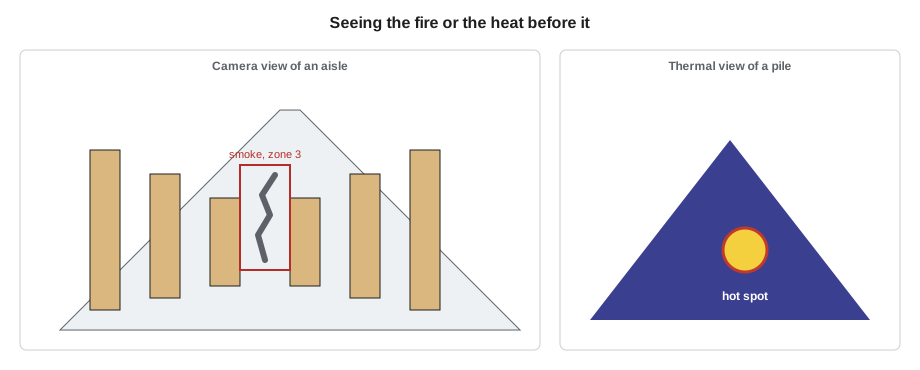
Video image smoke and flame detection uses cameras and image analysis software to recognize the shape, movement and color of smoke plumes and flames in a camera's view. It suits very large spaces where smoke may take a long time to reach a ceiling or a beam: aircraft hangars, tunnels, large warehouses, atriums and outdoor storage yards. Because the camera sees the fire's location, the operator can confirm the alarm on screen. The equipment must be listed for fire detection, installed as its listing requires, and supervised like any other initiating device, which is a different thing from a security camera with smoke analytics added.
NFPA 72-2025 also added thermal image detection, which uses infrared cameras to see heat from developing fires, including hot spots in stored materials before they burst into flame. Typical uses are waste and recycling facilities, coal piles and storage of lithium-ion batteries, where early heat is the first sign of trouble. Acoustic leak detection, which listens for the sound of escaping gas such as that from a failing battery or a pressurized line, was added at the same time. These technologies are still specialized, and a technician meets them mainly in industrial buildings, but the principle is the same as for every initiating device: listed equipment, installed according to its listing, reporting to a supervised system.
Lithium-ion batteries
Battery storage rooms, electric vehicle charging areas and stores of scooters and e-bikes have brought a new detection problem. A lithium-ion cell that fails can enter thermal runaway, releasing flammable and toxic gas, sometimes for minutes before any visible flame. Off-gas detectors that sense the electrolyte vapor, and the CO and hydrogen sensors in some multi-criteria detectors, can give earlier warning than smoke detection alone. The codes for energy storage systems set what detection is required, and the battery system's own management electronics often report to the fire alarm system too. At Cartwright Distribution Center, the new e-bike storage cage has a multi-criteria detector with a CO cell and an off-gas sensor wired through an input module, in addition to the sprinklers.
Programming and testing
Multi-criteria and advanced detectors often have several modes or sensitivity settings, chosen at the panel. The setting used must be one the detector is listed for in that application, recorded in the sequence of operation, and kept the same after service unless the change is approved. Testing also needs care. A multi-criteria detector may need a combination aerosol, heat and CO, or a manufacturer's test tool that stimulates all its sensors, and some detectors will not alarm on aerosol alone if the algorithm sees no heat or CO, by design. The manufacturer's test instructions say how each type is tested, and FAT-230 covers testing in detail.
Worked problem
Explaining multi-criteria detectors to an owner
The Riverlight building manager asks why he should pay more for multi-criteria detectors when photoelectric ones meet the code. What are the main points of Sasha's answer?
Show solution
- Both types meet the code where they are listed for the space, so either can be used.
- Multi-criteria detectors compare smoke with heat and CO, so steam and cooking fumes that would fool a photoelectric detector are less likely to cause alarms.
- Real fires that make heat or CO are detected at a lower smoke level, so the warning comes earlier.
- Fewer nuisance alarms mean fewer fire department responses, fewer residents tampering with devices and fewer false alarm fees, which offset the higher price.
Answer: Sasha's page goes to the board with Donna's quote. The board approves the multi-criteria replacement for the corridors and asks for a price for the garbage chute rooms too.
Who decides which technology to use
Advanced detection technologies are usually chosen by the designer and the owner for a reason the code doesn't require: fewer nuisance alarms, earlier warning for valuable contents, or a space where conventional devices don't work. That is a good reason, but it brings responsibilities. The technology must be listed for the use, the authority must accept it where it replaces or modifies required detection, and the owner must understand its maintenance needs, such as the replacement interval of CO cells or the cleaning of camera windows. A technician who services a building with multi-criteria detectors, video detection or off-gas sensors needs the manufacturer's training for each, because the test methods and the meaning of their trouble signals differ from one product to the next.
Records matter here too. The device list for Riverlight Tower now shows three detector types on the same loop: the remaining photoelectric detectors in stairs, the new multi-criteria detectors in corridors, and heat detectors in the garbage rooms. Each type's mode setting, CO end-of-life date and test method is listed, so the technician who does next year's inspection doesn't test a multi-criteria detector with aerosol alone, see no alarm and write it up as failed. Gerry calls the device list the building's memory: if it isn't written down, the next person will have to guess.
Choosing among these technologies follows the same questions as choosing any detector. What fire is expected, and what does it produce first? What nuisance sources are in the space, and how often? Who will respond to an early warning, and how fast? How will the device be reached for testing and service? A multi-criteria detector answers the nuisance question in a residential corridor. Air-sampling answers the early-warning question in a data room. Thermal imaging answers the hidden-heat question in a recycling plant. None of them is the right answer everywhere, and the cheapest device that meets the code is sometimes the most expensive one over the life of the building, once false alarm fees and service calls are counted.
Common mistakes
MistakeTreating a carbon monoxide signal as a fire alarm signal.
InsteadCO signals are separate, with their own pattern and response.
MistakeTesting a multi-criteria detector with smoke aerosol alone.
InsteadFollow the manufacturer's test method; some need combined stimuli.
MistakeLeaving CO sensors in service past their end of life.
InsteadReplace them when the end-of-life trouble appears or the date passes.
MistakeUsing a security camera with smoke analytics as a listed fire detector.
InsteadOnly equipment listed for fire detection counts.
MistakeChanging a detector's mode after service without approval.
InsteadKeep the programmed mode as recorded in the sequence of operation.
Summary and key terms
- Multi-criteria detectors combine smoke, heat, CO and sometimes flame sensing to decide faster and with fewer nuisance alarms.
- CO is both a fire signature and a life-safety hazard; life-safety CO signals are separate from fire alarms.
- The building and fire codes require CO detection in many occupancies; NFPA 72 now covers CO equipment, listed to UL 2034 and UL 2075.
- Temporal-three means fire; temporal-four means carbon monoxide.
- Video and thermal image detection see fires or hot spots in large or special spaces.
- Lithium-ion storage can need off-gas, CO or other early detection in addition to sprinklers.
- Multi-criteria detector
- A detector that combines two or more sensing methods in one decision.
- Electrochemical CO sensor
- A cell that produces a current in proportion to carbon monoxide concentration.
- Temporal-four pattern
- The four-pulse pattern used for carbon monoxide signals.
- Video image detection
- Fire detection by analysis of camera images of smoke or flame.
- Thermal image detection
- Detection of hot spots and developing fires using infrared cameras.
- Thermal runaway
- A self-heating failure of a battery cell that can release gas and lead to fire.
Practice problems
Work each problem on paper first, then reveal the answer to check.
In the scoring model, why did the steam not alarm?
Show answer
It had smoke but no heat or CO, so the combined score stayed below the threshold.
Which pattern should a person hear for a CO emergency?
Show answer
Temporal-four: four short pulses, then a pause.
About how long do electrochemical CO sensors usually last?
Show answer
About seven to ten years.
Name two spaces where thermal image detection is useful.
Show answer
Recycling or waste facilities and lithium-ion battery storage (also coal piles).
Lesson quiz · 5 questions
Score 60% or more to complete this lesson.
Create a free account to save your progress, take quizzes and earn a certificate.