
FAT-120 · Lesson 3 of 12 · 19 min
Duct, beam and aspirating smoke detection
Three jobs land on Ravi Menon's desk in the same week, and he takes Sasha through each one. At Tamarind House, the mechanical contractor is replacing air handler AHU-2 and the duct smoke detectors have to move to the new ductwork. At Willowbank School, the new gymnasium in the summer addition has a ceiling 26 ft high, under a sloped steel roof, and spot detectors would be hard to reach and slow to respond. And at Eastview General Hospital, the new data room for the medical records system needs very early warning, long before a spot detector would see smoke. 'Three spaces, three different detectors,' Ravi says. 'A duct detector, a beam detector and an air-sampling system. Each one solves a problem spot detectors can't.'
Duct smoke detectors: what they are for
An air handling system can carry smoke from a fire in one area to every room it serves, and the fans keep running unless something stops them. A duct smoke detector samples the air moving through a duct and, when it sees smoke, shuts down the fan or operates smoke dampers so the system stops spreading smoke. It is a control device for the air handling system, not a replacement for area smoke detection. Air moving in a large duct dilutes smoke so much that a duct detector may not see a small fire in one room at all, and the installation standards say clearly that duct detectors do not take the place of area detectors.
The International Mechanical Code and NFPA 90A require duct smoke detectors on air handling systems above set sizes: commonly in the supply side of systems over 2,000 cfm, and in the return side of larger systems or those serving more than one story, with exceptions where area detection covers the whole space served. NFPA 72 covers installation, and where a building has a fire alarm system, duct detectors are connected to it, typically sending a supervisory signal and shutting down the fan, as the sequence of operation records.
Installing duct detectors
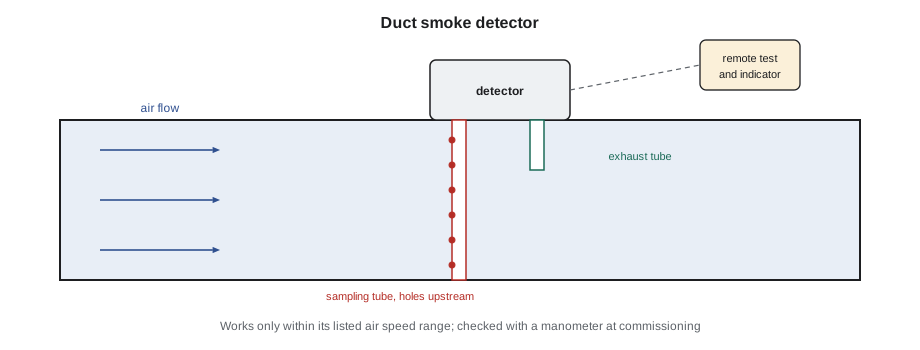
A duct detector is mounted on the outside of the duct, with a sampling tube that crosses the full width of the duct and has holes facing into the airflow. Air enters the tube, passes through the detector's chamber, and returns to the duct through a shorter exhaust tube. The pressure difference between the two tubes drives the sample, so the detector only works within its listed range of air speeds, typically about 100 to 4,000 ft/min, and the installer checks the pressure difference with a manometer during commissioning. The tube must be cut to the duct width and sealed at the far end if the instructions say so. Most manufacturers ask for the detector to be placed several duct widths downstream of bends, dampers or fans, where the air flow is smooth.
Location in the system matters. A supply-side detector goes downstream of the fan and filters, so it sees smoke from the unit itself and from a fire drawn in through the return. A return-side detector goes before the return air is mixed with outside air, so it sees smoke from the spaces served. The detector also needs a place where a technician can reach it, because duct detectors are tested and cleaned regularly, and the sampling tubes clog with dust. When the detector is hidden above a ceiling, a remote test station with an indicator light is mounted on a wall below so that alarms can be seen and tests started without a ladder.
# Duct detector check: duct air speed against the detector's listed range
ducts = [  # (name, airflow, duct width, duct height) in cfm and ft
    ("AHU-2 supply", 8900, 4.0, 2.0),
    ("AHU-2 return", 8000, 4.5, 2.5),
    ("Exhaust EF-4", 320, 3.25, 2.0),
]
vmin, vmax = 100, 4000      # listed air speed range (ft/min)
for name, q, w, h in ducts:
    area = w * h
    v = q / area
    ok = "within range" if vmin <= v <= vmax else "OUTSIDE range: choose another detector or location"
print(f"{name:20s} area {area:6.2f} ft2 speed {v:6.1f} ft/min -> {ok}")AHU-2 supply area 8.00 ft2 speed 1112.5 ft/min -> within range AHU-2 return area 11.25 ft2 speed 711.1 ft/min -> within range Exhaust EF-4 area 6.50 ft2 speed 49.2 ft/min -> OUTSIDE range: choose another detector or location
The exhaust fan's duct is so large for its airflow that the air is moving too slowly for a standard duct detector to draw a sample. The options are a detector listed for low velocity, a different location in a smaller section of duct, or area detection in the spaces the fan serves, which the designer chooses.
Projected beam detectors
A projected beam smoke detector sends an infrared beam across a large open space to a receiver on the far side, or to a reflector that sends it back to a combined transmitter-receiver. Smoke anywhere along the beam reduces the light that arrives, and when the loss passes the alarm threshold for long enough, the detector alarms. If the beam is blocked completely and suddenly, as by a ladder or a bird, the detector reports a trouble instead, because smoke doesn't cut a beam to zero in an instant. Beam detectors cover large spaces such as gymnasiums, atriums, warehouses and auditoriums, where spot detectors would be numerous, hard to service and possibly too high to respond in time.
Beams are installed and spaced according to their listing: typically a maximum distance between parallel beams, a maximum distance from a beam to a side wall of half that, and a range of beam lengths. They are mounted below the ceiling at a depth set by the listing and the standard, often lower in spaces where the ceiling is hot in summer, so smoke that stratifies below the hot layer still crosses the beam. Mounting has to be rigid: a beam on a steel roof structure that flexes with wind and temperature can drift out of alignment, and many modern units have automatic alignment motors for that reason. Each beam's sensitivity is set for its length, and the detector is tested with a filter of known obscuration, not with aerosol.
Air-sampling smoke detection
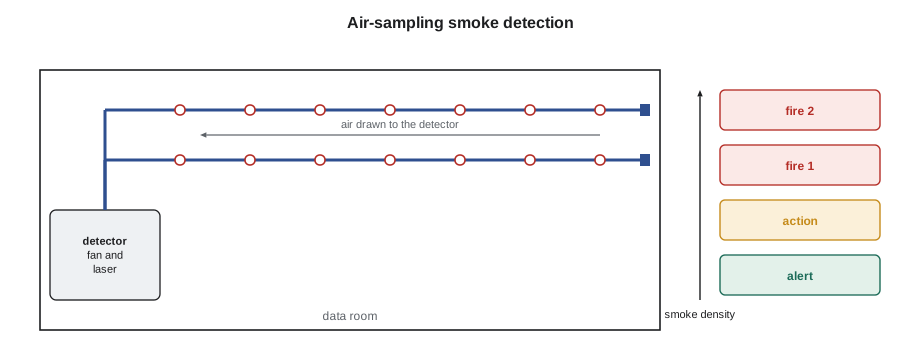
An aspirating, or air-sampling, smoke detection system uses a fan to draw air continuously through a network of small pipes with sampling holes, and passes it through a very sensitive detector, often using a laser to count particles. Because the detector is in one accessible place and the pipes go into the protected space, air-sampling suits places where very early warning is needed, such as data rooms and clean rooms, and places where spot detectors would be hard to reach, damaged or vandalized, such as high warehouses, prison cells, elevator shafts and heritage ceilings. A single detector can have several alarm levels, such as alert, action, fire 1 and fire 2, each set to a smoke density, so staff can investigate a tiny overheating cable long before it becomes a fire.
Each sampling hole is treated like a spot smoke detector for spacing, so the pipe network is laid out so that the holes are where spot detectors would be. The system's design is checked with the manufacturer's calculation software, which predicts the transport time, the time for smoke at the farthest hole to reach the detector, and the sensitivity at each hole. The installation standard limits the transport time from the farthest hole, to 120 seconds under NFPA 72, and the commissioning test confirms it by introducing smoke at the end of each pipe and timing the response. Pipe joints are glued, not just pushed together, and end caps and holes are labeled, because a loose joint changes the airflow and the sensitivity.
# Air-sampling transport time: a rough check of the farthest hole (illustrative model)
pipe_len = 200         # length from the detector to the farthest hole (ft)
pipe_id = 0.83           # pipe inside diameter (in)
holes = 12          # sampling holes on the pipe
fan_flow = 1.4        # fan flow into this pipe (cfm)
area = 3.1416 * (pipe_id / 12) ** 2 / 4
speed_start = fan_flow / 60 / area           # air speed near the detector (ft/s)
speed_end = speed_start / holes               # air speed beyond the last hole but one
avg = (speed_start + speed_end) / 2
t = pipe_len / avg + 5                        # plus about 5 s inside the detector
print(f"average air speed about {avg:.2f} ft/s, transport time about {t:.0f} s")
print("within 120 s" if t <= 120 else "too slow: shorten the pipe, add a pipe or raise the fan speed")average air speed about 3.36 ft/s, transport time about 64 s within 120 s
This simple model treats the air as slowing evenly along the pipe as each hole adds air; real design software accounts for every hole, fitting and the fan curve. It still shows why long single pipes are a problem, and why designers split large areas into several shorter pipes.
Choosing among them
| Space | Likely choice | Why |
|---|---|---|
| Air handler supply or return | Duct smoke detector | Shuts down the fan to stop smoke spread |
| Gymnasium or atrium | Projected beam detectors | Large open area, high ceiling, few devices |
| Data room | Air-sampling, very early warning | Detects overheating long before visible smoke |
| High-bay warehouse | Beam or air-sampling | Spot detectors hard to reach and slow |
| Cells, heritage ceilings | Air-sampling | Holes are small and tamper-resistant |
| Elevator shaft top | Air-sampling or spot, as the design allows | Access is difficult and dangerous |
Worked problem
Placing the gym beams at Willowbank
The new gym is 100 ft by 66 ft, with the roof rising from 23 ft to 26 ft across its width. The beam detectors Ravi has chosen are listed for beam lengths of 16 to 330 ft, spaced no more than 60 ft apart and no more than 30 ft from a side wall. How many beams does the gym need, and which way should they run?
Show solution
- Run the beams along the long dimension, 100 ft, well within the listed length, so fewer beams are needed.
- Across the 66 ft width, a beam within 30 ft of each side wall would be enough on its own only if the two were no more than 60 ft apart.
- Two beams, each about 16 ft from a side wall and about 34 ft apart, cover the width within both limits.
- Mount them below the high side of the sloped roof at the depth the listing gives, and on rigid supports, with the reflectors on the far wall.
Answer: Two beams running the length of the gym satisfy the listing. Ravi adds a note to mount the transmitters on the masonry end wall, not on the steel roof joists, so they don't drift with the roof.
Commissioning the three systems
Each of these systems has its own commissioning checks beyond those of a spot detector. A duct detector's sampling tube is checked for the right length and orientation, the pressure difference across the detector is measured with the air handler running at its normal speed and confirmed within the manufacturer's range, and the detector is then tested with the method its instructions give, often a test port that lets aerosol or smoke into the chamber. The fan shutdown is confirmed by watching the air handler stop. A beam detector's alignment is checked at full signal strength, its sensitivity is set for the beam length, and it is tested with the calibrated filter. An air-sampling system's flow rates are recorded for each pipe as the baseline, so a later change of flow, from a blocked hole or a cracked pipe, is reported as a fault, and the transport time from the end of each pipe is measured. These results become part of the verification record and the baseline for every later inspection.
Beam and air-sampling systems also need access planning. A beam transmitter 26 ft up a gym wall needs a lift for every inspection, so the owner's maintenance plan includes one, and the beams' remote test stations are mounted at floor level so they can be tested between lift visits where the listing allows.
Common mistakes
MistakeUsing duct detectors in place of area smoke detection.
InsteadDuct detectors control the air system; they don't protect the spaces.
MistakeInstalling a duct detector where the air is outside its listed speed range.
InsteadCheck the duct speed and the pressure difference at commissioning.
MistakeTesting a beam detector with aerosol.
InsteadUse a calibrated filter of known obscuration, as the manufacturer specifies.
MistakePushing air-sampling pipe joints together without glue.
InsteadGlue joints and label holes; leaks change sensitivity.
MistakeMounting beams on flexible roof steel.
InsteadUse rigid walls or columns, or units with automatic alignment.
Summary and key terms
- Duct smoke detectors shut down fans or close dampers; they do not replace area detection.
- The mechanical code and NFPA 90A set where duct detectors are required; NFPA 72 covers installation.
- Duct detectors work only within their listed air speed range, with a tube spanning the duct.
- Projected beam detectors cover large open spaces; a sudden total blockage is a trouble, not an alarm.
- Air-sampling systems draw air through pipe holes to one sensitive detector with several alarm levels.
- Each sampling hole is spaced like a spot detector, and transport time from the farthest hole is limited.
- Duct smoke detector
- A detector that samples the air in a duct to shut down fans or close dampers.
- Sampling tube
- The perforated tube that carries duct air through a duct detector.
- Projected beam detector
- A detector that measures smoke obscuration along an infrared beam across a space.
- Air-sampling detector
- A detector that draws air through a pipe network to a sensitive central chamber.
- Transport time
- The time for smoke at the farthest sampling hole to reach the detector.
- Stratification
- Smoke stopping below a layer of hotter air under a ceiling.
Practice problems
Work each problem on paper first, then reveal the answer to check.
A duct carries 7,200 cfm through a 4 ft by 1.5 ft section. What is the air speed?
Show answer
7,200 / 6 = 1,200 ft/min.
Two beams cover a 66 ft wide room. What is the largest spacing between them if the listing allows 60 ft?
Show answer
60 ft, with each no more than 30 ft from its side wall.
Why does a beam detector report a trouble, not an alarm, when the beam is cut off instantly?
Show answer
Smoke does not block a beam completely and suddenly; an object does.
What limits the length of an air-sampling pipe?
Show answer
The transport time from the farthest hole and the sensitivity at each hole.
Lesson quiz · 5 questions
Score 60% or more to complete this lesson.
Create a free account to save your progress, take quizzes and earn a certificate.