
FAT-120 · Lesson 6 of 12 · 19 min
Flame and special hazard detectors
Cartwright Distribution Center has added a fuel dispensing station inside the building for its propane forklifts, and a small flammable liquids storage room for the maintenance shop. Neither space will be well served by smoke or heat detectors: a propane or solvent fire grows in seconds, makes intense radiation before much smoke reaches the high roof, and has to be caught fast enough to shut off the fuel and, in the storage room, release a suppression system. Ravi's design uses flame detectors, and Sasha goes with Gerry to install them. 'These are the fastest detectors we sell,' Gerry tells her, 'and the easiest to fool if you aim them wrong. A flame detector doesn't care where the ceiling is. It cares what it can see.'
What a flame detector senses
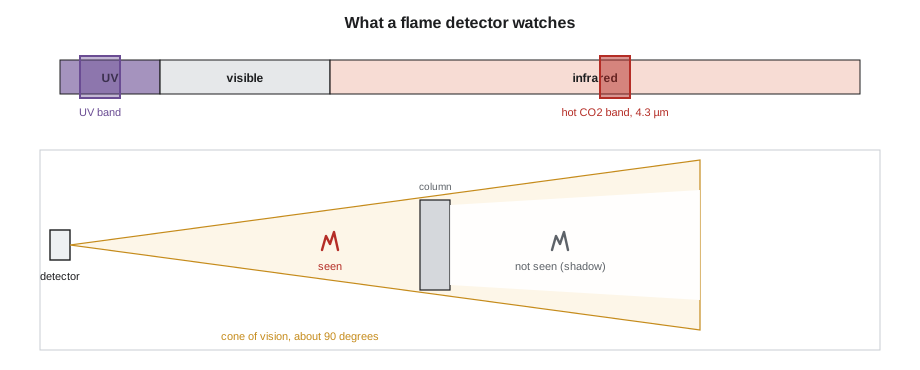
Flames give off radiation across a wide band: ultraviolet at short wavelengths, visible light, and infrared at longer wavelengths. A flame detector looks at one or more narrow bands where flames radiate strongly and the background usually doesn't. Ultraviolet detectors respond to the short-wavelength radiation that almost all flames produce. Infrared detectors look for the band near 4.3 micrometers, where hot carbon dioxide from burning hydrocarbons radiates strongly, and also look for flicker, the irregular variation of a flame's brightness, typically a few to about ten pulses per second. Because they respond to radiation traveling in a straight line, flame detectors react within seconds, but only to fires they can see.
| Type | Senses | Strengths | Weaknesses |
|---|---|---|---|
| Ultraviolet (UV) | Short-wavelength UV radiation | Very fast; sees most flames | Fooled by arc welding, lightning, some lamps; blocked by smoke and oil films |
| Single infrared (IR) | IR at about 4.3 µm, with flicker | Sees through light smoke | Can be fooled by hot flickering objects and sunlight reflections |
| UV/IR | Both bands must agree | Fewer false alarms than either alone | Both channels can be blinded by contamination |
| Multi-spectrum IR | Three or more IR bands compared | Long range, high false-alarm immunity | Higher cost; set-up matters |
| Visible or video flame | Flame shape and color in a camera view | Shows the fire's location | Needs lighting and a clear view |
Hydrogen and some alcohols burn with flames that make little carbon dioxide or visible light, so detectors for those fuels are chosen specially, often UV or multi-spectrum types tuned for them. The fuel to be detected is part of the specification: the detector's listing or approval states which fuels it was tested on, at what fire size and at what distance.
Cone of vision and the inverse square law
Every flame detector has a cone of vision, the angle within which it can see a fire, typically around 90 degrees, and a sensitivity that falls off toward the edges of the cone. The manufacturer's data gives the distance at which a standard test fire, such as a 1 ft2 pan of heptane or gasoline, is detected on the axis and at the edges. The radiation a detector receives falls with the square of the distance, so doubling the distance requires a fire four times as large to give the same signal. A detector that sees a 1 ft2 fire at 100 ft will see a 4 ft2 fire at 200 ft. That relationship lets a designer check whether a detector placed at one end of a room will see the smallest fire the owner wants to catch at the far end.
# Flame detector coverage: smallest fire seen at each distance (inverse square law)
import math
d_ref = 100            # on-axis distance at which the test fire is detected (ft)
a_ref = 1.0            # test fire size (ft2)
edge_factor = 0.5         # sensitivity at the edge of the cone, as a fraction of on-axis (from data sheet)
for d in [30, 60, 100, 150, 200]:
    a_axis = a_ref * (d / d_ref) ** 2
    a_edge = a_axis / edge_factor
print(f"at {d:3d} ft: smallest fire seen on axis {a_axis:5.2f} ft2, at the cone edge {a_edge:5.2f} ft2")at 30 ft: smallest fire seen on axis 0.09 ft2, at the cone edge 0.18 ft2 at 60 ft: smallest fire seen on axis 0.36 ft2, at the cone edge 0.72 ft2 at 100 ft: smallest fire seen on axis 1.00 ft2, at the cone edge 2.00 ft2 at 150 ft: smallest fire seen on axis 2.25 ft2, at the cone edge 4.50 ft2 at 200 ft: smallest fire seen on axis 4.00 ft2, at the cone edge 8.00 ft2
At Cartwright's dispensing station, the owner wants to detect a fire the size of a small spill, about 1 ft2, anywhere in the area. The table shows that a single detector at one corner sees it on axis up to about 100 ft, but near the cone's edge only to about 70 ft. Ravi uses two detectors at opposite corners, aimed at each other's blind spots, so every point is within range of at least one.
Placement and false alarm sources
Because flame detectors see rather than wait for smoke to reach them, they can be mounted on walls or columns at a height and angle that gives a clear view of the hazard, tilted down so the cone covers the floor area. Obstructions such as racks, columns, vehicles and equipment create shadows, and the layout must cover the hazard from more than one direction if shadows are likely. Glass and plastic windows block ultraviolet and much infrared, so a detector cannot see through a window unless it is designed and approved for that. Detectors must be kept clean: an oil film or dust on the window can blind a UV detector, and many units have an automatic self-test that checks the optics and reports a trouble if the window is dirty.
False alarm sources depend on the type. UV detectors respond to arc welding, which produces intense ultraviolet, so they must be bypassed during welding with a proper impairment procedure. Lightning, X-ray inspection equipment and some lamps can also trigger them. IR detectors can be fooled by hot, flickering objects such as rotating machinery near a heater, or by sunlight reflecting off rippling water. UV/IR and multi-spectrum IR detectors reduce false alarms by requiring agreement between bands. A technician who installs a flame detector also walks the space looking for these sources and records them.
Special hazard releasing systems
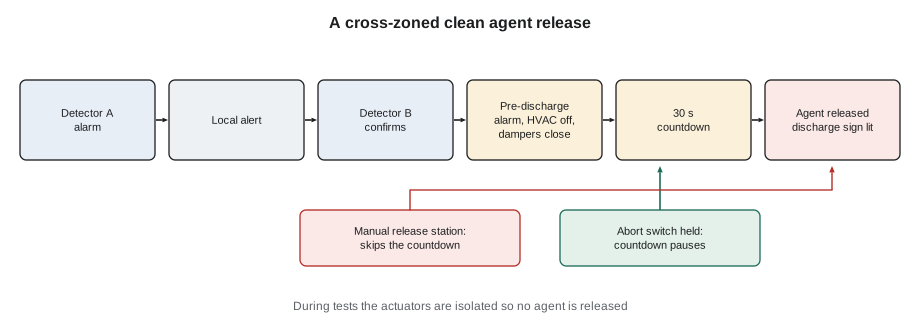
In special hazard areas, detection often does more than sound an alarm: it releases a suppression system. A releasing system has its own listed releasing panel, or a releasing function in the main panel, that operates a solenoid or actuator on a gaseous agent cylinder, a pre-action or deluge sprinkler valve, a foam system or a water mist system. Clean agent systems flood a room with a gas, either a halocarbon agent or an inert gas such as nitrogen or argon blends, to put the fire out without water damage, and are used for data rooms, archives and control rooms. Because a discharge is expensive and, for some agents, dangerous to people in the room, releasing sequences use cross-zoning or counting: two detectors, or two different detector types, must agree before the release starts.
A typical clean agent sequence is: first detector in alarm sounds a local alert and notifies the building; second detector confirms and starts a pre-discharge alarm with distinct horns and strobes, shuts down the room's ventilation, closes dampers and starts a countdown, often 30 seconds; at the end of the countdown, the agent is released and a discharge signal lights at the door. An abort switch, held by a person who has checked the room, pauses the countdown, and a manual release station lets staff discharge at once. Signs at the doors explain what each signal means. The fire alarm technician installs and tests the detection and releasing circuits; a suppression technician handles the agent cylinders, and during testing the actuators are disconnected or replaced with test devices so no agent is released.
NFPA 72 covers releasing service fire alarm systems and their supervision; the suppression systems follow their own standards, such as NFPA 2001 for clean agents, NFPA 13 for pre-action and deluge sprinklers and NFPA 750 for water mist. The authority having jurisdiction approves the releasing sequence as part of acceptance.
Spark and ember detection
In woodworking, grain handling and recycling plants, a spark carried along a dust collection duct can ignite a fire or an explosion in the collector. Spark detectors are infrared sensors that look into the duct, in darkness, and detect a single glowing particle passing by. Each detection operates an extinguishing system, usually a fine water spray downstream of the detector, within a fraction of a second, without stopping production. The system logs every spark so that its source, such as a worn blade or tramp metal, can be found. These are specialized systems installed under their own standards, but they connect to the building fire alarm system for supervisory and trouble reporting.
Testing flame and special hazard detection
Flame detectors are tested with a test lamp made for the model, which produces the right radiation and flicker at a set distance. A cigarette lighter or a torch isn't a reliable test and may not represent the detector's alarm level. Some detectors run a built-in test continuously, reporting trouble if their optics are blocked. Releasing systems are tested with the actuators isolated, and the test proves each step of the sequence in turn: each detector, the cross-zone logic, the countdown, the abort, the manual release, the HVAC and damper interlocks, and the signals at the doors. The suppression contractor and the fire alarm contractor coordinate so that one doesn't reconnect a cylinder while the other is testing.
Worked problem
Avoiding a discharge during maintenance
The maintenance shop at Cartwright is about to do arc welding on a steel bench in the flammable liquids room, which has a UV/IR flame detector and a cross-zoned clean agent release. What must Sasha and the shop arrange before the welding starts?
Show solution
- Arc welding produces intense UV and could trip the UV channel; with the IR channel seeing the hot weld, the detector could alarm.
- An impairment must be arranged: notify the owner's representative, the monitoring station and, if required, the fire department.
- The suppression system's actuators are disabled by the suppression contractor or the releasing circuit is placed in a listed disable mode, and a fire watch is posted.
- After the welding, the system is restored, the detector's window is checked for spatter, and the restoration is logged.
Answer: Sasha writes the impairment, the suppression technician locks out the release, and the welding goes ahead with a fire watch and extinguishers on hand. Afterward, the system is restored and the log is closed before the shop reopens the room.
Documents for special hazard systems
Because a special hazard system can do something irreversible, its documents are more detailed than those for ordinary detection. The design package includes the hazard description and the fuels involved, the detector selection and its approval data, a coverage drawing that shows each detector's cone of vision and any shadows, the releasing sequence with every delay and interlock, the abort and manual release locations, the signs and their wording, and the shutdowns of ventilation, fuel valves and power. The owner's staff are trained on what each signal means and what to do. Sasha keeps a copy of the releasing sequence in her hand during every test at Cartwright, ticking each step as it happens, because a missed interlock, such as a damper that didn't close, would let the agent leak away and leave the room unprotected during a real release.
Flame detectors also need a maintenance routine that suits their environment. In a fuel dispensing area, vehicle exhaust and fuel vapor leave films on the windows, so Cartwright's detectors are cleaned with the manufacturer's recommended cleaner every quarter, and their self-test results are checked at the panel each month. A detector whose self-test fails is a trouble that leaves the hazard unprotected, so the impairment procedure applies until it is cleaned or replaced.
Common mistakes
MistakeAiming a flame detector through a glass window.
InsteadMost can't see through glass; mount it inside the protected space.
MistakeTesting with a lighter or torch.
InsteadUse the manufacturer's test lamp at the stated distance.
MistakeAllowing arc welding near a UV detector without an impairment.
InsteadBypass properly, disable releases and post a fire watch.
MistakeTesting a releasing system with the actuators connected.
InsteadIsolate or replace actuators with test devices first.
MistakeLeaving shadows behind racks and columns uncovered.
InsteadCover the hazard from more than one direction.
Summary and key terms
- Flame detectors sense UV, IR or both, react within seconds, and see only what is in their line of sight.
- Sensitivity falls with the square of distance: twice as far needs a fire four times as large.
- Placement considers the cone of vision, shadows, windows and false alarm sources such as welding.
- Releasing systems use listed panels, cross-zoning, pre-discharge alarms, countdowns, abort and manual release.
- Spark detectors in dust ducts trigger fast water extinguishing without stopping production.
- Test flame detectors with the correct test lamp and releasing systems with actuators isolated.
- Flame detector
- A detector that senses radiation from flames in ultraviolet or infrared bands.
- Cone of vision
- The angle within which a flame detector can see a fire.
- Flicker
- The irregular variation in a flame's brightness that IR detectors look for.
- Releasing panel
- A listed control unit that operates a suppression system release.
- Cross-zoning
- Requiring two separate detectors to agree before an action such as a release.
- Abort switch
- A switch held by a person to pause a suppression release countdown.
Practice problems
Work each problem on paper first, then reveal the answer to check.
A detector sees a 1 ft2 fire at 100 ft. What size of fire does it see at 50 ft?
Show answer
1 x (50/100)^2 = 0.25 ft2.
Why does a cross-zoned clean agent system need two detectors?
Show answer
To avoid an expensive, possibly dangerous release on a single false alarm.
What should happen to a UV detector during nearby arc welding?
Show answer
It should be bypassed under an impairment procedure, with releases disabled and a fire watch.
What is a spark detector's usual extinguishing method?
Show answer
A fine water spray downstream in the duct.
Lesson quiz · 5 questions
Score 60% or more to complete this lesson.
Create a free account to save your progress, take quizzes and earn a certificate.