
FAT-120 · Lesson 5 of 12 · 19 min
Heat detectors: fixed temperature and rate of rise
The Willowbank School family studies room has a heat detector over the cooking ranges, and in the spring a student's pan of oil caught fire. Nobody was hurt; the teacher put a lid on it. But the heat detector didn't alarm, and the principal wants to know why. Gerry and Sasha look at the device. It is a fixed-temperature heat detector rated at 190 °F, mounted on the ceiling about 6 ft to the side of the ranges, and the flames were out within a minute. 'It did what it was built to do,' Gerry says. 'A heat detector waits for the ceiling to get hot. A small fire that's over in a minute never gets it there. That's not a fault in the detector; it's what heat detection is.' Heat detectors are the right choice for many spaces, but understanding what they respond to, and how slowly, is the key to using them well.
Where heat detectors belong
Heat detectors suit spaces where smoke detectors would cause nuisance alarms or fail: kitchens, garages and parking areas, boiler and furnace rooms, laundries, dusty storage, unheated attics and sheds, and some industrial spaces with steam or fumes. They are also used where the goal is property protection rather than early life-safety warning, and as the trigger for some special functions such as elevator shunt trip, which cuts power to an elevator before sprinklers in its machine room or hoistway discharge water. Heat detectors respond later than smoke detectors to most fires, because a fire has to grow large enough to heat the ceiling. They are not a substitute for smoke detection where the code requires smoke detection for life safety.
Fixed-temperature detectors
A fixed-temperature detector alarms when its sensing element reaches its rated temperature. The traditional element is a fusible alloy, a solder that melts at a precise temperature and releases a spring-loaded contact; such detectors are non-restorable and must be replaced after they operate. Bimetallic elements, two metals bonded together that bend as they heat, close a contact and reset when they cool, so they are restorable. Electronic heat detectors use a thermistor and electronics to decide, and analog addressable heat detectors send the actual temperature to the panel.
Because the element has to heat up from the air around it, it lags behind the air temperature. By the time a fixed detector rated at 135 °F operates in a fast fire, the ceiling air may be well above that. This thermal lag is why heat detectors are given listed spacings from fire tests, rather than just a temperature rating. A detector's response time index, the same idea used for sprinklers, describes how quickly its element responds; a low response time index means a fast detector.
| Classification | Rating range | Typical use |
|---|---|---|
| Ordinary | 135 to 174 °F | Most occupied rooms and offices |
| Intermediate | 175 to 249 °F | Attics, boiler rooms, near heaters |
| High | 250 to 324 °F | Very hot process areas |
| Extra high and above | 325 °F and up | Ovens, special industrial uses |
The rule for choosing a rating is that the detector's rating should be well above the highest temperature the ceiling normally reaches, commonly at least 20 °F above it, so that summer heat or a nearby heater doesn't set it off. In an unheated attic that can reach 122 °F in summer, an ordinary-rated detector at 135 °F is too close, and an intermediate rating is needed. Detectors are often color-coded by classification, so an inspector can see at a glance whether the right rating is installed.
Rate-of-rise and rate-compensated detectors
A rate-of-rise detector alarms when the temperature climbs faster than a set rate, typically about 15 °F per minute, regardless of the actual temperature. It catches a fast fire before the ceiling gets hot enough to operate a fixed element. Pneumatic rate-of-rise detectors have a small air chamber with a calibrated vent; slow temperature changes, such as a heating system starting in the morning, let the air expand out through the vent, but a fast rise expands it faster than the vent can relieve, and the pressure closes a contact. Most rate-of-rise detectors are combination units with a fixed-temperature element as well, so a slow-growing fire that never rises fast enough still operates the detector when it reaches the fixed rating.
Rate-of-rise sensing is a poor choice where the temperature naturally jumps quickly: near ovens and dishwashers when their doors open, by overhead doors that let in hot or cold air, near heating units that blow warm air, and in rooms heated rapidly from cold. In those spaces, a fixed-temperature or rate-compensated detector is used. A rate-compensated detector alarms when the air reaches its set temperature, whatever the rate of rise, by sensing the air rather than waiting for its own element to heat; it avoids both nuisance alarms from fast swings and the lag of a simple fixed element.
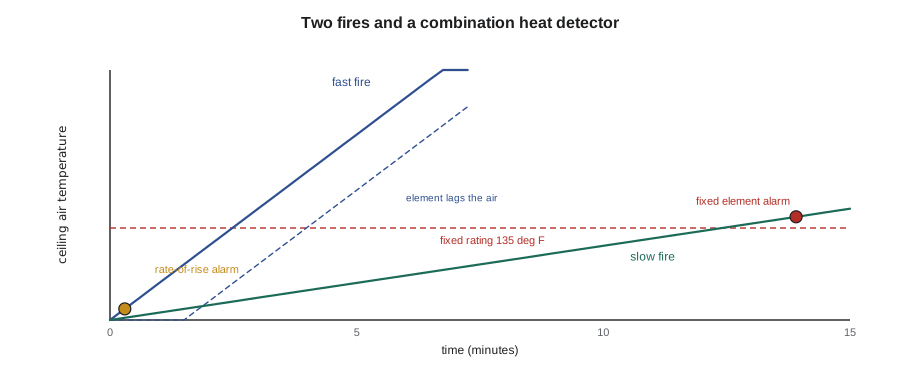
# When does each element of a combination heat detector operate? (simple model)
rating = 135          # fixed element rating (deg F)
ror = 15.0                # rate-of-rise setting (deg F per minute)
tau = 1.5                  # element lag (minutes): it closes the gap to the air temperature over time
def run(name, rate, start=68):
    air, elem, t = start, start, 0.0
    ror_t = fix_t = None
    while t < 30 and fix_t is None:
        t += 0.1
        air += rate * 0.1
        elem += (air - elem) * 0.1 / tau
        if ror_t is None and rate >= ror:
            ror_t = t
        if elem >= rating:
            fix_t = t
    ror_s = f"{ror_t:4.1f} min" if ror_t else "never"
    fix_s = f"{fix_t:4.1f} min" if fix_t else "over 30 min"
    print(f"{name:12s} rate {rate:4.1f} deg F/min: rate-of-rise {ror_s}, fixed element {fix_s}")
run("Fast fire", 27.0)
run("Slow fire", 5.4)
run("Heater on", 1.8)Fast fire rate 27.0 deg F/min: rate-of-rise 0.1 min, fixed element 3.8 min Slow fire rate 5.4 deg F/min: rate-of-rise never, fixed element 13.9 min Heater on rate 1.8 deg F/min: rate-of-rise never, fixed element over 30 min
The model is simple: the air heats at a steady rate and the element follows it with a lag. The fast fire trips the rate-of-rise element almost at once and the fixed element a few minutes later. The slow fire never rises fast enough for the rate-of-rise element and is caught by the fixed element only after many minutes. The heater warms the room so slowly that neither element operates, which is what should happen.
Listed spacing and what it means
A heat detector's listed spacing comes from a fire test in which detectors are placed at various distances from a test fire, and the spacing is the largest at which the detector operated at least as fast as a reference sprinkler head. A detector listed for 30 ft spacing can be placed up to that far apart on a smooth, flat ceiling up to 10 ft high, with none farther than half that from a wall. NFPA 72 then reduces the spacing for ceilings above 10 ft using a table of multipliers, and for beams, joists and sloped ceilings, because hot gases cool and spread out as they rise and travel.
Listed spacings commonly fall between 15 ft and 50 ft, and the spacing is printed in the instructions and on the device. The higher the rating and the slower the element, the smaller the listed spacing tends to be, because a slow, high-temperature element needs to be closer to the fire to operate in time. Lesson 11 shows how the reductions for ceiling height are applied.
Linear heat detection
Linear heat detection is a cable that detects heat anywhere along its length. The common type has two conductors insulated by a heat-sensitive polymer and twisted together; when any point reaches the cable's rated temperature, the polymer melts and the conductors touch, and the panel or a dedicated interface sees an alarm. That type is non-restorable, and the damaged length must be cut out and spliced. Other types sense a change in resistance or use optical fiber and laser measurement to report both that heat was detected and where along the cable it is, to within a few meters. Linear heat detection protects conveyors, cable trays, tunnels, parking structures, cold storage, escalators and floating-roof tanks, where spot detectors would be impractical.
Installation details
Heat detectors are mounted on the ceiling, or on the sidewall close to the ceiling where the standard allows, within their listed spacing and away from obstructions that would block hot gases. They are kept away from heat sources that would cause nuisance operation, such as unit heaters and steam lines. In elevator machine rooms and at the top of hoistways, a heat detector is often placed within 2 ft of each sprinkler, rated lower than the sprinkler, so that it trips the elevator's shunt trip before the sprinkler discharges water. A heat detector used for that purpose is normally not connected to start a general evacuation alone; the sequence of operation says what it does.
Worked problem
Choosing a heat detector for an attic and a kitchen
Willowbank's 1968 wing has an unheated attic that reaches 118 °F on summer afternoons, and the family studies room has ranges with ovens that release a puff of hot air each time a door opens. Which heat detectors fit each space?
Show solution
- Attic: the ceiling reaches 118 °F, so the rating should be at least 20 °F higher, at 138 °F or more.
- An ordinary rating at 135 °F is too close; an intermediate rating, such as 190 °F, gives a safe margin.
- Kitchen: oven doors cause quick swings, so a rate-of-rise element would cause nuisance alarms.
- A fixed-temperature or rate-compensated detector suits the kitchen, rated well above the normal hot-air puffs near the ceiling.
Answer: Ravi specifies an intermediate fixed-temperature detector for the attic and a rate-compensated detector for the kitchen. The principal's question gets an honest answer: a heat detector is there to catch a fire that grows, and the staff's quick action with a lid is what handled the small one.
Heat detectors and sprinklers
In a fully sprinklered building, a heat detector and a sprinkler head do much the same job: both respond to hot gases at the ceiling. That is why many codes allow heat detectors to be omitted where sprinklers are installed and their waterflow is monitored, because the waterflow switch reports the fire as soon as a sprinkler opens. Heat detectors are still used in sprinklered buildings where an earlier signal than the sprinkler's is needed, as for the elevator shunt trip, or where the fire alarm must start a function before water flows, such as closing doors or releasing a special system. Where both are installed in the same room, the heat detector is usually rated below the sprinkler, so it responds first.
Testing heat detectors depends on the type. Restorable detectors are tested with a listed heat source, such as a heat gun with a shroud, that warms the element without overheating it; the panel should show the alarm and the detector should reset as it cools. Rate-of-rise elements are tested with the same heat source applied quickly. Non-restorable fusible detectors can't be tested by heating, so they are tested mechanically or electrically as the manufacturer allows, and samples are replaced and laboratory tested after a set number of years, as the inspection standard requires. Linear heat cable is tested at its end-of-line device and by measuring its loop resistance, and sections are replaced after any operation.
The color coding of heat detectors helps during inspections. Many manufacturers mark ordinary-rated detectors with a natural or uncolored frame and higher ratings with colored frames or dots, following the same convention used for sprinkler heads. An inspector who sees an ordinary-rated detector in a boiler room or attic, where the ceiling normally runs hot, can flag it at a glance, before it becomes a nuisance alarm on the first hot afternoon.
Common mistakes
MistakeUsing a rate-of-rise detector near ovens or by an overhead door.
InsteadChoose fixed-temperature or rate-compensated detection there.
MistakeChoosing an ordinary rating in a hot attic.
InsteadKeep the rating well above the highest normal ceiling temperature.
MistakeUsing heat detectors where smoke detection is required for life safety.
InsteadHeat detection responds later and does not replace required smoke detection.
MistakeTesting a fusible-element detector with a heat gun.
InsteadThat destroys it; non-restorable detectors are tested by other means.
MistakeIgnoring ceiling height when spacing heat detectors.
InsteadApply the standard's reductions for higher ceilings.
Summary and key terms
- Heat detectors suit spaces where smoke detectors would cause nuisance alarms or fail, and respond later than smoke detectors.
- Fixed-temperature elements alarm at a rating; fusible ones are non-restorable, bimetallic and electronic ones restorable.
- Rate-of-rise elements alarm on a fast climb, about 15 °F per minute, and most are combined with a fixed element.
- Rate-compensated detectors alarm at their set air temperature without lag or nuisance from fast swings.
- Listed spacing comes from fire tests and is reduced for higher ceilings, beams and slopes.
- Linear heat cable detects heat anywhere along its length.
- Fixed-temperature detector
- A heat detector that alarms when its element reaches a set temperature.
- Rate-of-rise detector
- A heat detector that alarms when temperature rises faster than a set rate.
- Rate-compensated detector
- A heat detector that alarms at a set air temperature regardless of the rate of rise.
- Thermal lag
- The delay between the air reaching a temperature and the detector element reaching it.
- Listed spacing
- The maximum detector spacing found by the listing fire test.
- Linear heat detection
- A cable that detects heat at any point along its length.
Practice problems
Work each problem on paper first, then reveal the answer to check.
A boiler room ceiling reaches 113 deg F normally. What minimum rating keeps a 20 deg F margin?
Show answer
133 deg F or more; an intermediate rating gives more margin.
Why might a combination detector not alarm on a slow fire's rate-of-rise element?
Show answer
The temperature never rises faster than the rate setting; the fixed element must catch it.
Which heat detector type must be replaced after it operates?
Show answer
A fusible-element (non-restorable) detector.
Name two places linear heat detection is used.
Show answer
Conveyors and cable trays (also tunnels, parking structures, cold storage).
Lesson quiz · 5 questions
Score 60% or more to complete this lesson.
Create a free account to save your progress, take quizzes and earn a certificate.