
FAT-110 · Lesson 7 of 12 · 19 min
Building codes, NFPA 72 and the authority having jurisdiction
Captain Helen Strand of the Charlotte Fire Department's fire marshal's office visits Bramwell's office once a year to talk to the technicians about what her inspectors are finding. This year, Sasha is in the room. Helen starts with a question: when Gerry tests a system at Riverlight Tower, which document says how often he has to test each smoke detector? Someone says the fire code. Someone else says NFPA 72. Helen says both are right, and explains why. This lesson explains how fire alarm requirements are set in the United States: who writes the model codes, how a state or city turns them into law, how the building code, the fire code and NFPA 72 divide the work, and who the authority having jurisdiction is.
Who makes the rules
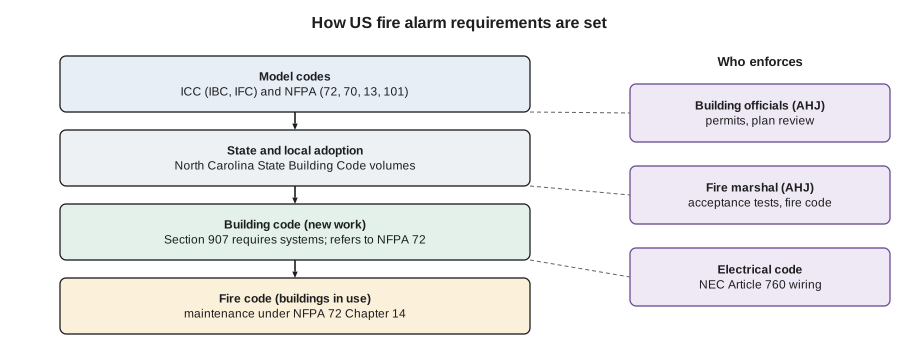
The United States has no national building code. Building and fire regulation belongs to the states, and many states share it with counties and cities. Almost every state builds its rules on model codes written by private organizations. The International Code Council publishes the International Building Code, the International Fire Code and related codes on a three-year cycle. The National Fire Protection Association publishes NFPA 72, the National Fire Alarm and Signaling Code; NFPA 70, the National Electrical Code; NFPA 13 for sprinklers; NFPA 101, the Life Safety Code; and hundreds of other documents. A model code has no force on its own; it becomes law when a state or local government adopts it, often with amendments.
North Carolina adopts its own state building code, a set of volumes based on the International Codes and amended by the state's Building Code Council, with the Office of State Fire Marshal handling much of the administration. The 2018 North Carolina State Building Code, based on the 2015 International Codes, governed for several years. The 2024 edition was published, but state legislation in 2025 postponed its start until twelve months after the State Fire Marshal certified that it was ready; the edition that applies to a project depends on when its permit was applied for. Each volume of the state code names the editions of NFPA 72 and other standards it references, and those are the editions that apply.
The building code, the fire code and NFPA 72
The International Building Code applies when a building is built, added to, altered or changes occupancy. Its Section 907 decides whether a fire alarm system is required, whether it needs automatic detection, and where notification appliances must go. The International Fire Code contains the same Section 907, so the requirements match, and adds the rules for buildings in use: owners must keep systems in service, inspect, test and maintain them, keep records, handle impairments and false alarms, and, in some occupancies, add systems to existing buildings that lack them. Neither code says in detail how to install or test a fire alarm. For that, both refer to NFPA 72.
NFPA 72 is a single document that covers how fire alarm and signaling systems are designed, installed, tested and maintained. Its chapters include fundamentals, circuits and pathways, inspection, testing and maintenance, initiating devices, notification appliances, emergency control functions, protected premises systems, emergency communications systems, supervising stations, and household signaling. The 2025 edition added a chapter on cybersecurity, a restricted audible mode for occupants sensitive to sound, and new detector types. NFPA 72 is a 'how' document; whether a building needs a system is answered by the building and fire codes.
When a fire alarm is required
Section 907.2 of the building and fire codes lists, occupancy by occupancy, when a fire alarm system and automatic detection are required. Buildings are classified into occupancy groups: A for assembly, B for business, which includes offices, E for educational, F for factory, H for high hazard, I for institutional, which includes hospitals, M for mercantile, R for residential, S for storage and U for utility. Examples of the thresholds in recent editions include Group A occupancies with an occupant load of 300 or more; Group B with a combined occupant load of 500 or more, or more than 100 above or below the lowest level of exit discharge; Group E with an occupant load of 50 or more; all Group I occupancies; Group M above similar thresholds to Group B; and Group R-2 apartment buildings with dwelling units three or more stories above the lowest level of exit discharge, or with more than 16 dwelling units. There are exceptions, many of them for buildings with sprinklers. The script below is a teaching aid that classifies a few buildings and screens them against simplified thresholds; a real decision always comes from the adopted code itself.
# Teaching aid: rough occupancy classification and fire alarm screening (simplified, not the full code)
groups = {"assembly": "A", "school": "E", "restaurant": "A-2", "hospital": "I-2", "apartment": "R-2",
          "hotel": "R-1", "office": "B", "store": "M", "warehouse": "S-1"}
def needs_alarm(use, stories, load, above_below_exit, units):
    reasons = []
    if use in ("assembly", "restaurant") and load >= 300: reasons.append("Group A occupant load 300 or more")
    if use in ("office", "store") and (load >= 500 or above_below_exit > 100):
        reasons.append("occupant load 500 or more, or over 100 above or below exit discharge")
    if use == "school" and load >= 50: reasons.append("Group E occupant load 50 or more")
    if use == "hospital": reasons.append("Group I occupancy")
    if use == "hotel": reasons.append("Group R-1")
    if use == "apartment" and (stories >= 4 or units > 16): reasons.append("R-2 with units 3+ stories above exit discharge, or over 16 units")
    return reasons
buildings = [("Willowbank School", "school", 2, 420, 180, 0), ("Tamarind House", "office", 6, 650, 540, 0),
             ("Riverlight Tower", "apartment", 18, 380, 360, 162), ("Corner bakery", "store", 1, 30, 0, 0)]
for name, use, st, load, ab, u in buildings:
    r = needs_alarm(use, st, load, ab, u)
print(f"{name:18s} group {groups[use]:4s} -> " + ("alarm required: " + "; ".join(r) if r else "no trigger in this screen"))Willowbank School group E -> alarm required: Group E occupant load 50 or more Tamarind House group B -> alarm required: occupant load 500 or more, or over 100 above or below exit discharge Riverlight Tower group R-2 -> alarm required: R-2 with units 3+ stories above exit discharge, or over 16 units Corner bakery group M -> no trigger in this screen
The authority having jurisdiction
NFPA documents use a phrase that Sasha hears every day: the authority having jurisdiction, or AHJ. It means the organization, office or individual responsible for enforcing the requirements of a code or standard, or for approving equipment, materials, an installation or a procedure. On a new building in Charlotte, the AHJ for the building permit is the county's code enforcement department, which reviews plans and inspects construction; the fire marshal's office takes part in plan review and acceptance testing of fire protection systems and enforces the fire code once the building is occupied. An insurance company can also act as an AHJ for the property it insures, and a federal agency such as the Centers for Medicare and Medicaid Services, which requires hospitals that receive its funding to meet NFPA 101 and the standards it references, is an AHJ for those hospitals.
The AHJ approves things the codes leave to judgment: whether an alternative design is acceptable, whether a newer edition of a standard can be used, which documents must be submitted, and how acceptance tests are witnessed. When codes disagree or are unclear, the AHJ's interpretation governs on that project. Technicians who build good working relationships with their local AHJs, by submitting complete documents, keeping appointments and fixing what the inspector finds, have smoother projects.
| Document | What it does | Applies to |
|---|---|---|
| Building code (IBC as adopted) | When an alarm is required, detection, notification locations | New buildings, additions, alterations, change of occupancy |
| Fire code (IFC as adopted) | Owners' duties: maintain, inspect, test, handle impairments | Existing buildings in use |
| NFPA 72 (edition referenced) | How systems are installed, tested and maintained | New and existing systems |
| NFPA 70, Article 760 | Wiring of fire alarm systems | All fire alarm wiring |
| NFPA 101 (where adopted or required) | Life safety requirements, notably for health care | Hospitals and other occupancies under it |
Inspection, testing and maintenance
The fire code puts the duty on the owner: the owner must make sure the fire alarm system is inspected, tested and maintained according to NFPA 72 and must keep the records. Chapter 14 of NFPA 72 sets the frequencies and methods: which devices are tested annually, such as smoke detectors, heat detectors and manual stations; which items are checked semiannually, quarterly or more often; how batteries are tested; and what the records must contain. Smoke detectors also need a sensitivity check within one year of installation and then on a regular cycle. Helen's answer is therefore that the fire code requires the testing, and NFPA 72 says how and how often.
When a system is impaired, out of service for any reason, the fire code requires the owner to notify the fire department and take steps to protect occupants, such as a fire watch or evacuation, until the system is restored. Lesson 11 describes impairment procedures.
The electrical code and product listings
Fire alarm wiring is governed by the National Electrical Code, Article 760, Fire Alarm Systems, in the edition the state adopts. It sets the types of cable for power-limited and non-power-limited fire alarm circuits, separation from other wiring, and how the panel's branch circuit is connected and marked. In North Carolina, fire alarm and low-voltage contracting falls under a limited license from the state's electrical contractors' board.
Equipment must be listed, meaning tested and certified by a nationally recognized testing laboratory, for its fire alarm use. Control units are listed to UL 864, smoke detectors to UL 268, notification appliances to UL 464 and UL 1971, among others. Using an unlisted device, or a listed device outside its listing, such as connecting a detector to a panel it isn't listed as compatible with, is a violation, even if it seems to work.
Documents the AHJ expects
Before a fire alarm system is installed in a new building, the contractor submits shop drawings to the AHJ for review. NFPA 72 lists what they contain: floor plans showing every device and appliance, a riser diagram showing how the panels, circuits and floors connect, the sequence of operation, equipment data sheets showing each product's listing, battery calculations proving the secondary supply is large enough, voltage drop calculations for notification circuits, and, for voice systems, information on intelligibility. Many AHJs, including the plan reviewers who handle Charlotte projects, also want the designer's credentials, such as a NICET certification level or a professional engineer's seal, as the local rules require.
At the end of the job, the installer tests the whole system, the AHJ witnesses an acceptance test, and the contractor completes a record of completion, a standard form in NFPA 72 that describes the system, its devices, its power supplies and its monitoring. The owner keeps that record, the as-built drawings and the sequence of operation for the life of the system, and every later inspection report refers back to them. When Gerry arrives for an annual test, the first thing he asks the building manager for is this documentation box. A system without records is harder to test, harder to repair, and harder to defend after a fire, and the fire code expects the owner to keep them available for the AHJ.
Worked problem
Which document applies?
Sasha is asked three questions in a NICET study group: (1) How far apart can smoke detectors be on a flat ceiling in a new office? (2) How often must the smoke detectors at Riverlight Tower be tested? (3) Who decides whether Willowbank School needs a fire alarm at all? Which document answers each?
Show solution
- (1) Spacing on installation is set by NFPA 72, Chapter 17, in the edition referenced by the adopted building code.
- (2) The testing frequency for an existing system is set by NFPA 72, Chapter 14, required by the adopted fire code.
- (3) Whether a fire alarm system is required is set by Section 907.2 of the adopted building code, for the school's occupancy group and occupant load.
Answer: Each question has a different source document, and each applies in the edition the state or local adoption names, as interpreted by the AHJ.
Common mistakes
MistakeQuoting the latest edition of NFPA 72 as if it were automatically the law.
InsteadThe edition referenced by the adopted code applies unless the AHJ accepts another.
MistakeThinking NFPA 72 decides whether a building needs a system.
InsteadThe building and fire codes decide; NFPA 72 says how.
MistakeIgnoring the AHJ's interpretation.
InsteadOn a given project, the AHJ's interpretation governs.
MistakeUsing devices outside their listing.
InsteadDevices must be listed for the use and compatible with the panel.
MistakeForgetting the electrical code.
InsteadNEC Article 760 governs fire alarm wiring.
Summary and key terms
- Building and fire codes in the US are adopted by states and local governments from model codes by the ICC and NFPA.
- North Carolina adopts a state building code based on the International Codes; the 2024 edition's start was delayed by 2025 legislation.
- Section 907 of the building and fire codes sets when fire alarm systems and detection are required.
- NFPA 72 sets how systems are installed, tested and maintained; the 2025 edition added cybersecurity and restricted audible mode.
- The authority having jurisdiction enforces requirements and approves equipment and procedures.
- NEC Article 760 governs wiring; equipment must be listed for its use.
- Model code
- A code written by a private organization for adoption by governments, such as the IBC or NFPA 72.
- Authority having jurisdiction (AHJ)
- The organization, office or individual that enforces a code or approves installations.
- Occupancy group
- The classification of a building by use, such as Group B business.
- NFPA 72
- The National Fire Alarm and Signaling Code.
- Listed
- Tested and certified by a recognized laboratory for a specific use.
- Article 760
- The part of the National Electrical Code covering fire alarm wiring.
- Impairment
- A condition in which a fire protection system is out of service.
Practice problems
Work each problem on paper first, then reveal the answer to check.
Which document decides whether a new office building needs a fire alarm system?
Show answer
The adopted building code, Section 907.2.
Which chapter of NFPA 72 covers inspection, testing and maintenance?
Show answer
Chapter 14.
Give two examples of an authority having jurisdiction.
Show answer
The local building official and the fire marshal; an insurer or a federal agency can also be one.
Which article of the NEC covers fire alarm wiring?
Show answer
Article 760.
Lesson quiz · 5 questions
Score 60% or more to complete this lesson.
Create a free account to save your progress, take quizzes and earn a certificate.