
FAT-110 · Lesson 6 of 12 · 20 min
Initiating, notification and control functions
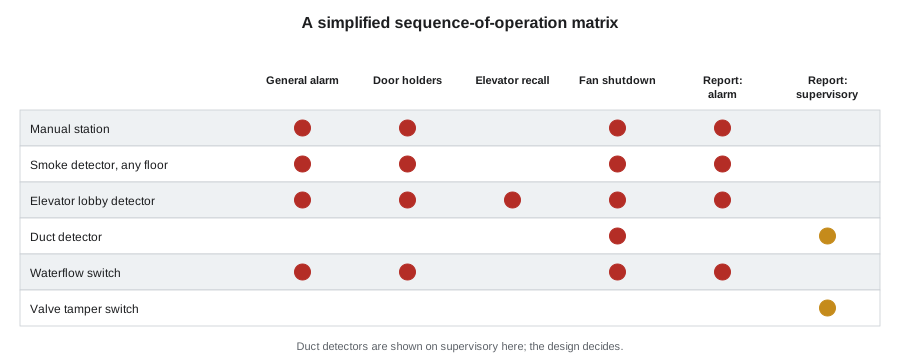
Ravi lays a document on the table in front of Sasha: the sequence of operation for Tamarind House, a grid with every type of input down the left side and every output across the top, and dots where they meet. A smoke detector on the third floor sounds the alarm everywhere, releases the third-floor door holders, recalls the elevators to the ground floor and shuts down the air handler that serves the third floor. A waterflow switch does most of the same things. A smoke detector in an elevator lobby does something extra: it chooses which floor the elevators go to. A valve tamper switch does none of these; it sends only a supervisory signal. This lesson is an overview of the three families of functions in that grid: initiating devices that tell the panel something has happened, notification appliances that tell people, and control functions that tell other systems. Later courses take each family in depth.
Manual stations
The manual station, or pull station, is the oldest and simplest initiating device: a person who sees a fire pulls a handle or pushes a lever, and a switch inside sends an alarm. Single-action stations operate with one motion; dual-action stations need two, such as lifting a cover and then pulling, which reduces accidental and malicious operation. Stations are mounted near exits, where people pass on their way out, at a height that a person in a wheelchair can reach. Some are keyed so that only staff can operate them, in places such as psychiatric wards; and in two-stage systems a key switch on the station sends the second-stage signal. Clear plastic covers that sound a local horn when lifted are used where false pulls are a problem, such as at Willowbank School.
Automatic detectors
Lesson 2 described how smoke detectors work. Spot smoke detectors, photoelectric or multi-criteria, are the most common automatic devices in offices, corridors, apartments and hospitals. Duct smoke detectors sample the air inside a ventilation duct through a tube that crosses the duct, and detect smoke being carried by the air handler, so the system can shut the fan down before it spreads smoke through the building. Beam detectors cover large open spaces such as atriums and gymnasiums. Air-sampling systems draw air through pipes to a very sensitive detector, for spaces where early warning matters or detectors are hard to reach.
Heat detectors suit places where smoke detectors would cause nuisance alarms or would not survive: kitchens, garages, boiler rooms, dusty storage areas, attics. A fixed-temperature detector alarms when its element reaches a set temperature, commonly 135 °F for ordinary spaces and higher for warm ones. A rate-of-rise detector alarms when the temperature climbs faster than a set rate, typically about 15 °F per minute, which catches a fast fire before the room gets hot; most combine both functions. A rate-compensated detector alarms at its set temperature regardless of how slowly the air heats, without the lag of a simple fixed element. Linear heat detection, a cable that alarms along any part of its length, protects conveyors, cable trays and tunnels.
Flame detectors sense infrared or ultraviolet radiation from flames and respond within seconds, in places such as fuel storage, aircraft hangars and industrial plants. Carbon monoxide detectors sense the gas that smoldering fires produce and are also used to protect against CO from fuel-burning appliances, although that use is governed by its own rules. Sprinkler waterflow switches, which detect water moving in a sprinkler pipe, are initiating devices too, and in many buildings they are among the most important ones; Lesson 8 covers them.
| Device | Senses | Typical places |
|---|---|---|
| Spot smoke detector (photoelectric or multi-criteria) | Smoke particles, sometimes heat and CO | Corridors, offices, apartments, patient rooms |
| Duct smoke detector | Smoke in the air stream of a duct | Air handlers and return ducts |
| Heat detector (fixed or rate-of-rise) | Temperature or rate of temperature rise | Kitchens, garages, boiler rooms, attics |
| Beam or air-sampling detector | Smoke across a large space or in sampled air | Atriums, gyms, warehouses, data rooms |
| Flame detector | Infrared or ultraviolet flame radiation | Fuel storage, hangars, industrial plants |
| Manual station | A person's action | Exits on every floor |
| Waterflow switch | Water flowing in sprinkler pipes | Sprinkler risers and floor control valves |
Supervisory devices
Supervisory initiating devices watch fire protection equipment rather than looking for fire. A valve tamper switch on a sprinkler control valve signals when the valve is moved from fully open; a closed valve would leave the sprinklers it feeds without water. Low-air switches on dry-pipe sprinkler systems, low-temperature switches in rooms where sprinkler pipes could freeze, and switches that report a fire pump running or failing all send supervisory signals. In many buildings, duct detectors are also set to give a supervisory signal rather than a general alarm, so the fan stops but the building doesn't evacuate for smoke that may be from a burnt belt in the air handler; which arrangement is used depends on the code and the design.
Notification appliances
Notification appliances turn the panel's decision into something people perceive. Audible appliances include horns, bells, chimes and speakers; visual appliances are strobes. Combination horn-strobes and speaker-strobes are common. Low-frequency sounders, with a tone around 520 hertz, are much better at waking sleeping people, especially older people and people who have been drinking, than the higher-pitched tones of traditional horns. Tactile appliances, such as bed shakers, serve people who are deaf.
The evacuation signal uses a standard rhythm called the temporal pattern, or temporal-three: three half-second pulses, each followed by a half-second pause, then a one-and-a-half-second pause, repeated. Its purpose is recognition: the same pattern in every building means people know it is a fire alarm and not a car alarm or a forklift reversing. Speakers play the pattern as a tone before and between voice messages.
How loud is loud enough
Audible signals have to be heard over the normal background noise in every part of the building. For public-mode signals, NFPA 72 requires a level at least 15 dB above the average ambient sound level, or 5 dB above the maximum sound level that lasts 60 seconds or more, whichever is greater, measured about 5 ft (1.5 m) above the floor, and no more than 110 dBA at the minimum hearing distance. Private-mode signals, meant for trained staff, need only be 10 dB above ambient. In sleeping areas, the signal must reach about 75 dBA at the pillow, or the higher of the ambient-based levels, and new installations use the 520 Hz low-frequency tone.
Sound level falls with distance from the appliance. In open space, it drops by about 6 dB each time the distance doubles, which follows from the inverse square law.
Walls and doors cut the level much more. A closed solid-core door can reduce a horn's sound by 20 dB or more, and a closed apartment door between a corridor horn and a bedroom can reduce it by 30 dB or more once the bedroom door is also closed. That is why codes now require appliances inside sleeping rooms or suites rather than relying on a horn in the corridor. The script below estimates the level at a few places at Riverlight Tower from a horn rated at 85 dBA at 10 ft.
# Estimated sound level from one horn at several locations (illustrative losses)
import math
L_ref, d_ref = 85.0, 10                  # horn rating: dBA at reference distance (ft)
spots = [  # place, distance (ft), loss through doors or walls (dB), ambient (dBA)
    ("Corridor, near the horn", 10, 0, 45),
    ("Corridor, far end", 60, 0, 45),
    ("Suite living room, door closed", 30, 22, 40),
    ("Bedroom, both doors closed", 40, 34, 35),
]
need_above = 15
for place, d, loss, amb in spots:
    level = L_ref - 20 * math.log10(d / d_ref) - loss
    target = amb + need_above if "Bedroom" not in place else 75
    ok = "meets" if level >= target else "falls short of"
print(f"{place:32s} {level:5.1f} dBA ({ok} {target:.0f} dBA)")Corridor, near the horn 85.0 dBA (meets 60 dBA) Corridor, far end 69.4 dBA (meets 60 dBA) Suite living room, door closed 53.5 dBA (falls short of 55 dBA) Bedroom, both doors closed 39.0 dBA (falls short of 75 dBA)
The corridor is well covered, but the horn in the corridor cannot reach the bedroom at the level needed to wake people. Appliances inside the suites, sounding when the building's alarm sounds, are the answer that modern codes require in new residential buildings.
Strobes and visual signals
Strobes flash a bright white light about once a second. Their brightness is rated in candela, and the rating needed depends on the size of the room and where the strobe is mounted, from 15 candela for a small office to 75, 110, 135 or 185 candela for larger rooms. Wall strobes are mounted high, with the whole lens between 80 and 96 in above the floor, so that people see the flash over furniture and other people. In sleeping rooms, strobes must be bright enough to wake people, typically 110 candela or more, and higher still if mounted close to the ceiling. Where more than one strobe is visible from one place, they must flash together, which the panel or a sync module controls.
Control functions
Control functions are where the fire alarm system acts on the building. Door holders are electromagnets that hold fire doors open during normal use; on alarm, the system cuts their power and the doors close, keeping smoke and fire out of stairs and corridors. Elevator recall sends elevators to a safe floor, usually the main entrance level or an alternate floor if the fire is there, so that nobody is trapped in a car that opens onto a fire floor, and so firefighters can take control of them. Fan shutdown stops air handlers that would spread smoke, while smoke control systems run some fans on purpose to pressurize stairs or exhaust smoke. Electrically locked doors on exit routes unlock so that people can get out. Some systems release suppression agents such as clean-agent or pre-action sprinkler systems.
Control functions are usually performed through relays or control modules wired to the other system's controls, and the connection point, often called the interface, is where the fire alarm trade's work meets another trade's. The fire alarm technician tests that the output operates; the elevator mechanic, the HVAC technician or the door hardware installer confirms that their equipment responds correctly. Lesson 9 describes these interfaces, and FAT-320 covers them in depth.
The sequence of operation
The sequence of operation, sometimes called an input-output matrix, is the master document for programming and testing. It lists every type of input, every output, and what each input does. It also shows timing: a pre-signal delay, a supervisory delay, an alarm verification feature that waits a short time and checks whether a smoke detector still sees smoke before sounding the general alarm. Every one of those choices must be allowed by the code and recorded. During verification or acceptance testing, a technician operates each input and confirms that every output in its row responds, and nothing else does.
Worked problem
Reading a row of the matrix
At Tamarind House, the draft matrix row for 'Smoke detector, 4th floor elevator lobby' has dots under: general alarm, release 4th floor door holders, elevator recall to the alternate floor, shut down AHU-2, and notify monitoring station as alarm. Sasha thinks one dot is wrong. Which, and why?
Show solution
- Elevator lobby detectors are there to keep people from riding elevators to a floor where there is a fire.
- Elevators are normally recalled to the designated floor, usually the main entrance level.
- They go to the alternate floor only when the detector that operated is on the designated floor itself, because that is where the fire is.
- A 4th floor lobby detector should therefore recall the cars to the designated floor, not the alternate floor; the dot is probably copied from the ground floor row.
Answer: Sasha raises it with Ravi, who confirms the error and corrects the matrix before programming starts. Catching it on paper is far cheaper than catching it during the acceptance test.
Common mistakes
MistakeUsing a heat detector where early life-safety warning is needed.
InsteadHeat detectors suit spaces where smoke detectors won't work; they respond later.
MistakeRelying on a corridor horn to wake people behind two closed doors.
InsteadPut appliances inside suites and sleeping rooms.
MistakeLeaving strobes unsynchronized in a large room.
InsteadSynchronize strobes visible from one place.
MistakeTesting only the alarm signal when an input operates.
InsteadCheck every output in the input's row of the matrix, and that nothing else operates.
MistakeTreating valve tamper switches as alarm devices.
InsteadThey send supervisory signals so someone checks the valve.
Summary and key terms
- Initiating devices include manual stations, smoke, heat, beam, air-sampling, flame and CO detectors, and waterflow switches.
- Supervisory devices watch fire protection equipment, such as valves, pumps and dry-pipe air pressure.
- Notification appliances include horns, speakers, strobes and low-frequency sounders, using the temporal pattern.
- NFPA 72 requires public-mode signals 15 dB above average ambient or 5 dB above the 60-second maximum, and 75 dBA in sleeping areas.
- Sound falls about 6 dB per doubling of distance in open space and much more through doors.
- Control functions release doors, recall elevators, shut down or run fans, unlock exits and release suppression.
- The sequence of operation matrix defines what every input does and guides programming and testing.
- Manual station
- A device a person operates to send an alarm.
- Rate-of-rise detector
- A heat detector that alarms when temperature rises faster than a set rate.
- Duct smoke detector
- A detector that samples the air in a ventilation duct.
- Valve tamper switch
- A switch that sends a supervisory signal when a sprinkler valve is moved from open.
- Candela
- The unit of luminous intensity used to rate strobes.
- Door holder
- An electromagnet that holds a fire door open until the alarm releases it.
- Elevator recall
- Sending elevators to a designated safe floor when a fire is detected.
- Sequence of operation
- The document that defines what each input does to each output.
Practice problems
Work each problem on paper first, then reveal the answer to check.
A horn gives 85 dBA at 10 ft. About how loud is it at 40 ft in open space?
Show answer
85 - 20 log10(4) = about 73 dBA.
Average ambient noise in a workshop is 70 dBA, with no long louder periods. What minimum public-mode level does NFPA 72 require?
Show answer
85 dBA.
Which detector type would you expect in a commercial kitchen?
Show answer
A heat detector.
What does a door holder do when the alarm operates?
Show answer
It releases the door so it closes.
Lesson quiz · 5 questions
Score 60% or more to complete this lesson.
Create a free account to save your progress, take quizzes and earn a certificate.