
FAT-110 · Lesson 1 of 12 · 21 min
The fire alarm trade
At seven on a Monday morning, Sasha Vukovic signs in at the service counter of Bramwell Fire Protection in Charlotte, picks up a tablet with the day's work orders and climbs into a van beside Gerry Tremaine. Gerry has worked on fire alarm systems for twenty-two years and is certified at NICET Level III in fire alarm systems; Sasha is in her first month. Their first stop is Tamarind House, a six-story office building where a smoke detector in a mechanical room has been causing trouble signals. The second is Willowbank School, where the principal wants to know why the alarm sounded during a cooking class last Thursday. The afternoon is set aside for the annual test of the alarm system at Riverlight Tower, an eighteen-story apartment building. None of these jobs involves fighting a fire, and most days in this trade never do. The work is about making sure that, on the one day a fire does start, the system finds it early, warns everyone in the building, calls for help and sets the building up to keep people safe.
This course is the first in the Fire Alarm Technician program. It explains what fire alarm systems are for, how fire behaves, which kinds of systems exist, which codes and standards govern them, how they connect to sprinklers and other building systems, and how a technician works safely alongside other trades and the fire department. Later courses go deeper into devices, electrical theory, control panels, installation, inspection and testing, voice systems, integration and commissioning. Here the goal is the big picture, so that every later detail has a place to fit.
What a fire alarm system does
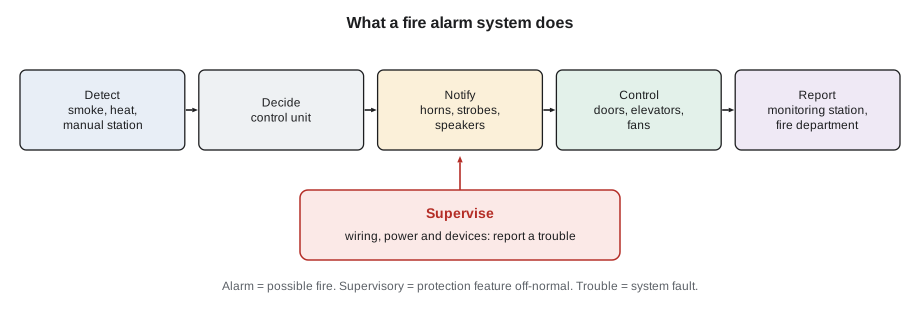
A fire alarm system is a set of devices connected to a control unit that detects a fire or receives a manual alarm, warns the people in a building, and starts the actions the building needs in a fire. Codes describe the same job in different words, but every system does four things. It detects, through automatic detectors that sense smoke, heat or flame, and through manual stations that a person pulls. It notifies, through horns, bells, speakers and strobes that tell occupants to leave or to follow instructions. It controls, by switching other building systems: releasing doors held open by magnets, recalling elevators, shutting down air handlers and starting smoke control. And it reports, by sending a signal to a monitoring station or to the fire department so that help is on the way even if nobody in the building calls.
The control unit sits at the center of all of this. It watches every circuit, decides what each input means, and turns on the right outputs. It also watches itself. A fire alarm system is unusual among building systems because it spends almost all of its life waiting, and a fault that appears while it waits could go unnoticed until the day it matters. To prevent that, the system supervises its own wiring, power supplies and devices, and reports a trouble signal when something is wrong, so that a broken wire is found on a Tuesday afternoon rather than during a fire.
Three kinds of signals
Technicians talk about three kinds of signals, and Sasha hears the words on her first morning. An alarm signal means a fire may be present: a detector has operated or someone has pulled a manual station. A supervisory signal means a fire protection feature is not in its normal condition: for example, a sprinkler control valve has been partly closed, or a fire pump is not running when it should be. A trouble signal means the alarm system itself has a fault: an open circuit, a ground fault, a failed battery or a device that has stopped answering. Each has its own sound and light at the control unit and its own meaning for the people who respond. An alarm sends people out of the building and the fire department in; a supervisory signal sends someone to look at the sprinkler system; a trouble signal sends a technician like Gerry.
The trouble at Tamarind House turns out to be a dusty detector. The mechanical room's air handler was running without filters during a renovation, and the photoelectric smoke detector at the top of the room has collected enough dust that its chamber reads higher than normal. The addressable system has flagged it as dirty before it gets close to an alarm. Gerry shows Sasha the reading on the panel, takes the detector out of service with the building manager's agreement, replaces it with a new one and confirms that the reading returns to normal. He writes up the work order, notes that the filters must go back in, and leaves a copy with the building manager.
Who works on fire alarm systems
Fire alarm work sits between the electrical trade and the fire protection trade, and the people in it come from both. Installers run conduit and cable, mount boxes and devices, and terminate wiring, often as part of an electrical contractor's crew. Technicians program control units, test and inspect systems, find and fix faults, and verify new installations. Designers lay out devices and circuits and produce drawings and calculations. Service managers schedule work, keep records and deal with building owners. Fire inspectors and plan examiners from the fire marshal's office and the building department review plans and confirm that systems meet the code. Monitoring station operators receive signals and call the fire department.
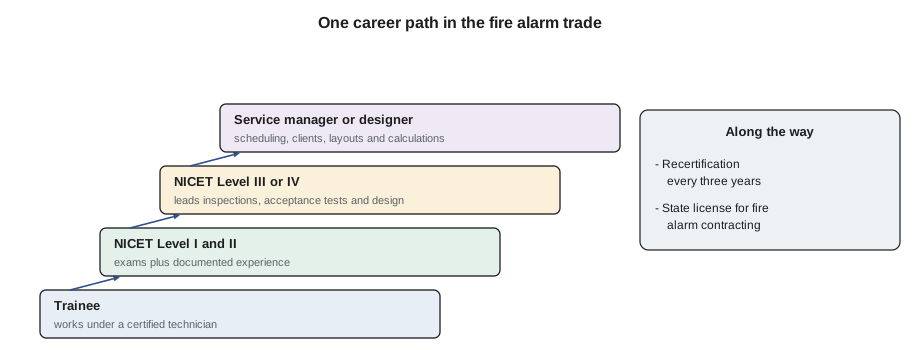
Sasha's path at Bramwell starts as a trainee working under Gerry's direct supervision. She will learn to install and test devices, read drawings, use a multimeter and a laptop with programming software, and write reports. The route to working on her own is set by the industry and the state, as later sections of this lesson describe. For now, her rule is simple: she does not work on a live system without Gerry, and she never silences, bypasses or disables anything without the building's permission and a record of it.
Becoming qualified
In the United States, the most widely recognized credential is NICET certification in fire alarm systems, offered at four levels. Level I is an entry level with an exam that can be taken online; Levels II, III and IV need longer exams, more years of documented experience, and at the upper levels personal recommendations and, for Level IV, a major project. Certification is renewed every three years with continuing professional development. NICET's exams are based on a specific edition of NFPA 72, and NICET announces when they move to a newer one. On top of that, states license contractors and sometimes individuals: in North Carolina, fire alarm and low-voltage work falls under a limited electrical license from the state board of electrical contractors, which requires documented experience and an exam. Many cities, building owners and insurers expect NICET-certified technicians for design, inspection and testing work, and some local rules require it.
Whatever the credential, three habits carry through a career. A good technician reads the code and the standard, not just the panel manual, because the code is what the work is judged against. A good technician writes things down: every test, every fault, every change to the program, every time a part of the system was out of service. And a good technician stays current, because codes change every few years, products change faster, and the system installed this year will be inspected under next decade's rules.
A day's work and the tools it needs
Gerry's van carries what a fire alarm technician uses every day. A digital multimeter with an insulation resistance function measures voltage, current, resistance and ground faults. A laptop with the manufacturer's programming software and cables talks to the control unit. A smoke detector tester, a long pole with a cup that delivers a measured puff of aerosol, tests detectors on high ceilings without a ladder; a heat detector tester does the same with hot air. A sound level meter checks that horns and speakers are loud enough. A light meter, magnet tools and a test key for manual stations, spare detectors and bases, batteries, a label maker, and a supply of tags and report forms complete the kit. Ladders and, in the warehouse, a scissor lift are part of the job too, and Lesson 11 covers using them safely.
The afternoon test at Riverlight Tower uses most of these tools. Before anything starts, Gerry calls the monitoring station and tells them the system will be in test for the next three hours, so that alarms are not sent on to the fire department. He tells the building manager, who has already posted notices in the lobby and elevators. Sasha walks each floor with a test pole and a radio, operating detectors and manual stations one by one, while Gerry watches the panel and confirms that each device reports with the right address and description. At the end, Gerry restores everything to normal, calls the monitoring station to put the system back on line, confirms they receive a test signal, and records the results in the inspection report.
How the work is measured
A fire alarm system protects people only if every part of it works. That is why the trade measures its work in counts and percentages: how many devices were tested, how many passed, how many were found faulty and corrected. The code and the inspection standard set what must be tested and how often; the owner keeps the records; and the fire inspector can ask to see them. Sasha's first job each afternoon is to tally the day's results so Gerry can sign the report. The short script below does the same tally for the Riverlight Tower test, floor by floor.
# Tally an annual test: devices tested, faults found and the pass rate per floor
results = {  # floor: (devices tested, devices with a fault)
    "Ground": (24, 1), "2": (14, 0), "3": (14, 0), "4": (14, 1), "5": (14, 0), "6": (14, 0),
    "7": (14, 0), "8": (14, 2), "9": (14, 0), "10": (14, 0), "11": (14, 0), "12": (14, 0),
    "13": (14, 1), "14": (14, 0), "15": (14, 0), "16": (14, 0), "17": (14, 0), "18": (16, 0),
}
total = sum(t for t, f in results.values())
faults = sum(f for t, f in results.values())
for floor, (t, f) in results.items():
    if f:
        print(f"Floor {floor:6s}: {t} tested, {f} fault(s)")
print(f"Total: {total} devices tested, {faults} faults, pass rate {100 * (total - faults) / total:.1f} %")
print("Every fault must be corrected and retested before the report is closed.")Floor Ground: 24 tested, 1 fault(s) Floor 4 : 14 tested, 1 fault(s) Floor 8 : 14 tested, 2 fault(s) Floor 13 : 14 tested, 1 fault(s) Total: 264 devices tested, 5 faults, pass rate 98.1 % Every fault must be corrected and retested before the report is closed.
A pass rate of over ninety-eight percent sounds good, but the last line of the output is the one that matters. A fire alarm system is not graded on a curve. Each of the five faulty devices could be the one nearest to a fire, and each must be repaired and retested, with the repair recorded, before the system is described as fully working.
The people the system protects
Behind every work order is a building full of people who will never think about the alarm until the day it sounds. At Riverlight Tower, some residents are elderly and some use wheelchairs. At Eastview General Hospital, patients may be unable to move at all, so the building is designed to protect them in place. At Willowbank School, children follow a fire drill they practice every month. At the Cartwright Distribution Center, a sprinklered warehouse, forklift drivers work in aisles where a horn has to cut through engine noise. Each building has its own risks and its own system, and later lessons return to all five. A technician who keeps those people in mind makes better decisions: about when to take a system out of service, how long to leave a fault, and whether a nuisance alarm is just a nuisance or a sign of something worse.
The Willowbank question from the morning is a good example. The cooking class set off a heat detector in the family studies room; the principal assumed the detector was faulty. Gerry and Sasha check the device's history on the panel, which shows a genuine rate-of-rise alarm at 10:42 on Thursday, and find that a teacher had opened an oven full of smoke and heat directly below it. The detector did its job. Instead of replacing it, Gerry writes a note recommending that the school talk to the designer about the device location and the type of detector in that room, because the fix for a correct alarm in the wrong place is a design decision, not a service call.
Worked problem
Reading a work order
Sasha's work order for Tamarind House reads: 'Trouble on panel, zone 3 MECH, device 2-047 dirty. Building manager reports beeping at panel since Friday.' What three questions should she answer before she touches the device?
Show solution
- What the panel says: she reads the event history to confirm the trouble type, the device address and how long it has been active.
- Who must be told: she confirms with the building manager that work is starting, and, if the device must be bypassed, that the monitoring station knows and that the area has another way to detect a fire while it is out.
- What has changed: she asks whether there has been dust, construction or new equipment in the room, because a dirty detector often has a cause that will make the next one dirty too.
Answer: With those three answers, the repair is a planned replacement with a cause recorded, rather than a swap that will be repeated in a month.
Common mistakes
MistakeThinking a trouble signal can wait because there is no fire.
InsteadA trouble means part of the system may not work; it is found and fixed promptly, and recorded.
MistakeSilencing or bypassing a device without telling anyone.
InsteadGet the owner's permission, tell the monitoring station, and record what was done and for how long.
MistakeReplacing a detector after a genuine alarm.
InsteadCheck the event history first; a correct alarm in a poor location is a design question.
MistakeTreating the panel manual as the rule book.
InsteadThe code and the installation and inspection standards set the requirements; the manual explains the product.
MistakeLeaving the system in test after the work is done.
InsteadRestore every device, call the monitoring station, and confirm a test signal reaches them.
Summary and key terms
- A fire alarm system detects, notifies, controls other building systems and reports to a monitoring station or the fire department.
- Alarm, supervisory and trouble signals mean different things and send different people to respond.
- The system supervises its own wiring, power and devices so faults are found before a fire.
- Installers, technicians, designers, service managers, inspectors and monitoring operators all work on fire alarm systems.
- In the United States, NICET certification in fire alarm systems is the main credential, alongside state contractor licensing.
- Every test, fault and repair is recorded, and every fault is corrected and retested.
- Fire alarm system
- Devices connected to a control unit that detect fire, warn occupants, control building systems and report.
- Control unit
- The panel that watches every circuit, decides what inputs mean and operates outputs.
- Alarm signal
- A signal indicating that a fire may be present.
- Supervisory signal
- A signal that a fire protection feature, such as a sprinkler valve, is not in its normal condition.
- Trouble signal
- A signal that the fire alarm system itself has a fault.
- Supervision
- Continuous checking of wiring, power and devices so faults are reported.
- Monitoring station
- A central facility that receives signals from buildings and calls the fire department.
Practice problems
Work each problem on paper first, then reveal the answer to check.
Name the four jobs every fire alarm system does.
Show answer
Detect, notify, control other building systems, and report.
A sprinkler control valve is closed halfway. Which kind of signal should the panel show?
Show answer
A supervisory signal.
A wire to a horn circuit is cut. Which kind of signal should the panel show?
Show answer
A trouble signal.
Before testing a system, who must be told so the fire department is not dispatched?
Show answer
The monitoring station, and the building's occupants or manager.
Lesson quiz · 5 questions
Score 60% or more to complete this lesson.
Create a free account to save your progress, take quizzes and earn a certificate.