
FAT-110 · Lesson 3 of 12 · 19 min
How fires grow in buildings
Ravi Menon, Bramwell's fire alarm designer, keeps a set of graphs pinned above his desk. Each shows a fire's heat release rate climbing over time: a slow curve for a smoldering mattress, a steeper one for a stack of cardboard, a near-vertical one for a pan of oil. Sasha is spending a day with him to see how a design begins, and the first thing he does is point at the graphs. A detector, he tells her, doesn't detect a fire; it detects the moment when a growing fire has pushed enough smoke or heat to where the detector is. Everything about how quickly occupants are warned depends on how fast the fire grows and how far away the detector sits. This lesson describes the stages of a fire in a room, the t-squared model designers use for fire growth, how smoke fills a room and a building, and how the ceiling jet and the detector's own response decide when an alarm happens.
The stages of a fire in a room
A fire that starts in a room and is left alone usually passes through five stages. In the incipient stage, a small source such as a smoldering cigarette or an overheated component gives off smoke and little heat, sometimes for a long time. In the growth stage, flames appear and spread across the first item and to others nearby, and the heat release rate climbs quickly. A hot layer of smoke and gas forms under the ceiling and grows deeper. If the room has enough fuel and air, the hot layer's radiation heats everything in the room until it all ignites at once: this is flashover, and after it the room is fully developed, burning as fast as the air supply allows. Finally, in the decay stage, the fuel runs out and the fire dies down.
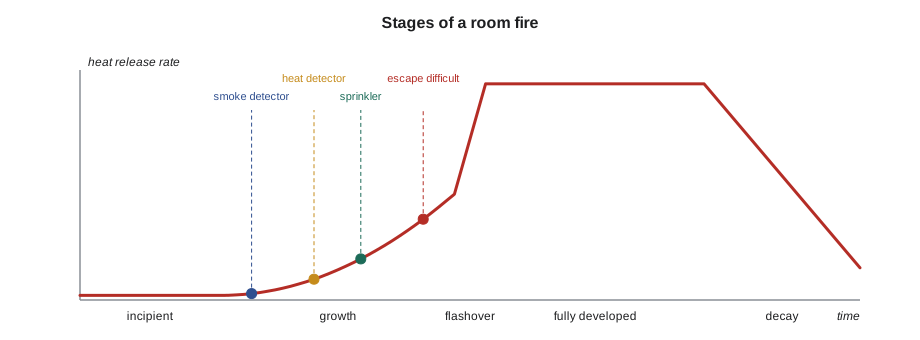
Fire protection is a race against this curve. Smoke detectors are meant to operate in the incipient or early growth stage, while occupants still have time to leave. Heat detectors operate later, when the fire is larger. Sprinklers, which also respond to heat, operate in the growth stage and aim to stop the fire long before flashover. After flashover, nobody in the room can survive, and the fire threatens the rest of the building. Everything a fire alarm system does, it does on the rising part of the curve.
The t-squared fire
Real fires are messy, but in their growth stage many grow roughly with the square of time: double the time since ignition and the heat release rate is four times larger. Designers use this t-squared model because it is simple and matches test data well enough to compare options. The growth rate is set by a single constant, alpha, with units of kilowatts per second squared.
Standard growth classes are defined by the time a fire takes to reach about 1,055 kW, which is 1,000 Btu/s. A slow fire takes 600 seconds, a medium fire 300, a fast fire 150 and an ultra-fast fire 75. Dense paper files might be slow; most furniture and mixed office contents are medium to fast; upholstered furniture with foam and stacked plastic goods are fast; flammable liquids and some foam plastics are ultra-fast. NFPA 72's annex and fire engineering handbooks use these classes when sizing and spacing detectors by performance.
| Growth class | Time to 1,055 kW (s) | Alpha (kW/s²) | Typical fuels |
|---|---|---|---|
| Slow | 600 | 0.00293 | Dense stored paper, solid wood items |
| Medium | 300 | 0.01172 | Mixed office contents, cotton and polyester furniture |
| Fast | 150 | 0.0469 | Upholstered foam furniture, stacked cartons |
| Ultra-fast | 75 | 0.1876 | Flammable liquids, some foam plastics, high-piled storage |
# t-squared fire growth: heat release rate after a given time, and time to reach a target
import math
classes = {"slow": 600, "medium": 300, "fast": 150, "ultra-fast": 75}   # seconds to reach 1,055 kW
for name, tg in classes.items():
    alpha = 1055 / tg ** 2
    t100 = math.sqrt(100 / alpha)       # time to reach 100 kW, a small detectable fire
    t500 = math.sqrt(500 / alpha)
    q60 = alpha * 60 ** 2               # size after one minute
    print(f"{name:10s} alpha={alpha:.5f} kW/s2  100 kW at {t100:4.0f} s, 500 kW at {t500:4.0f} s, "
f"after 60 s: {q60:5.0f} kW")slow alpha=0.00293 kW/s2 100 kW at 185 s, 500 kW at 413 s, after 60 s: 11 kW medium alpha=0.01172 kW/s2 100 kW at 92 s, 500 kW at 207 s, after 60 s: 42 kW fast alpha=0.04689 kW/s2 100 kW at 46 s, 500 kW at 103 s, after 60 s: 169 kW ultra-fast alpha=0.18756 kW/s2 100 kW at 23 s, 500 kW at 52 s, after 60 s: 675 kW
The output shows why fast fires are so dangerous. A medium fire reaches 100 kW, about the size of a burning wastebasket, after roughly a minute and a half; an ultra-fast fire gets there in under 25 seconds and passes 500 kW well inside the first minute. Detection that would be comfortably early for a medium fire can be late for an ultra-fast one. Most real fires also have an incubation period, sometimes minutes or hours of smoldering, before t-squared growth begins, which a smoke detector can catch but a heat detector cannot.
Smoke filling a room
As the plume rises, it draws in, or entrains, the surrounding cool air, so the volume of smoky gas grows larger and cooler with height. At the ceiling, the plume spreads outward as the ceiling jet, reaches the walls, and starts to fill the room from the top down. The hot smoky layer gets deeper and its lower edge, the interface, moves down toward the floor. Occupants can usually keep moving while the interface is above head height and the layer is not hot enough to radiate dangerous heat onto them. Once it comes down to head height, visibility collapses and breathing the smoke becomes dangerous.
High ceilings change the picture. In an atrium, a gymnasium or a warehouse, the plume entrains so much air on its way up that it may be too cool to rise all the way to the roof. Where the air near the roof is warmer, as it often is in summer or under a sunlit roof, a stratification layer can hold a small fire's smoke below the ceiling, where ceiling detectors can't see it. Beam detectors, which shine a light across a large space and alarm when smoke blocks it, and air-sampling systems with pipes at several levels are used in such spaces. In the Cartwright Distribution Center, with a roof more than 40 ft high, the designer relies on sprinklers to control the fire and on their waterflow switches to raise the alarm.
Smoke moving through a building
Smoke doesn't stay in the room of origin. Hot smoke flows out through doorways near the ceiling and into corridors. In tall buildings, the stack effect drives it further: in a cold Charlotte winter, warm air inside a heated building rises and leaks out near the top, pulling air in near the bottom, so smoke from a fire on a lower floor is drawn into stairs, elevator shafts and service shafts and carried upward. Wind, the building's ventilation system and open doors push smoke in other directions. Building codes respond with fire separations and closures that keep smoke out of exits, smoke control systems in some buildings, and fire alarm functions that shut down or switch air handlers and release doors. Lesson 9 covers those interfaces.
The ceiling jet and detector spacing
In the 1970s, Ronald Alpert measured ceiling jets above test fires and fitted simple formulas that are still used to estimate how hot and fast the jet is at a given distance from the plume. For a steady fire of heat release rate Q in kilowatts under a smooth ceiling of height H in meters, the temperature rise of the jet at a radial distance r from the point above the fire is roughly as follows.
Two things stand out. The temperature drops as the ceiling gets higher, and it drops as the detector gets farther from the plume. Double the ceiling height and, far from the plume, the temperature rise halves. That is why detector spacing rules reduce the spacing for high ceilings, and why a detector placed far from where fires are likely may respond late. Smoke follows the same flow, though smoke detectors respond to particle concentration rather than temperature.
# Alpert ceiling-jet temperature rise at detector distances, for a 250 kW fire (illustrative)
def jet_rise(q_kw, h_m, r_m):
    if r_m <= 0.18 * h_m:
        return 16.9 * q_kw ** (2 / 3) / h_m ** (5 / 3)
    return 5.38 * (q_kw / r_m) ** (2 / 3) / h_m
Q = 250
for h in (10, 20, 40):          # ceiling heights (ft)
    row = []
    for r in (3, 10, 16, 23):   # distance from the point above the fire (ft)
        rise_c = jet_rise(Q, h * 0.3048, r * 0.3048)
        row.append(f"{rise_c * 1.8:5.1f}")
print(f"ceiling {h:>4} ft: rise at r = 3/10/16/23 ft -> " + " / ".join(row) + " deg F")ceiling 10 ft: rise at r = 3/10/16/23 ft -> 133.8 / 60.0 / 43.8 / 34.4 deg F ceiling 20 ft: rise at r = 3/10/16/23 ft -> 59.3 / 30.0 / 21.9 / 17.2 deg F ceiling 40 ft: rise at r = 3/10/16/23 ft -> 18.7 / 15.0 / 11.0 / 8.6 deg F
Under a 10 ft ceiling, a 250 kW fire heats the jet by tens of degrees even several feet away, enough to operate a heat detector rated at 135 °F in a room that starts near 68 °F once the detector catches up. Under a 40 ft roof, the rise at the same distances is only a few degrees, and the same fire would never operate that detector. Smoke would still reach the roof, but thinly and late.
Detector response time
A detector in the ceiling jet doesn't respond the instant the jet reaches it. A heat detector's sensing element has to warm up, which takes time, just as a thermometer dipped into hot water takes a few seconds to read. The response time index, or RTI, describes how quickly an element follows the gas temperature around it; a low RTI means a fast element. Sprinklers are rated the same way, with quick-response sprinklers having a much lower RTI than standard-response ones. Smoke detectors also have a lag, because smoke has to enter the chamber through its screen. In a fast-growing fire, these lags can add tens of seconds, which is part of why a heat detector's listed spacing is smaller than a smoke detector's.
Together, fire growth, ceiling height, distance and detector lag decide when the alarm sounds. Most designs follow the prescriptive spacing rules in the installation standard, which already account for typical fires and ceilings, and Lesson 6 and later courses explain how those rules work. For unusual spaces, designers use performance-based methods built on exactly these models to show that detectors will respond in time.
Worked problem
Choosing between two locations
In Tamarind House's new third-floor archive room, Ravi must choose where to place a single smoke detector under a 10 ft ceiling. The likely fire is in shelving along the north wall. Location A is the center of the room, 13 ft from the shelving; location B is 5 ft from it. Which is better, and why?
Show solution
- The plume from a fire in the shelving rises near the north wall and spreads along the ceiling as a ceiling jet.
- Location B is close to where the plume meets the ceiling, so it sees denser smoke and hotter gas sooner.
- Location A still sits within the standard spacing from every wall, so it would satisfy the spacing rule for the room as a whole.
- If the room's area allows one detector anywhere inside the spacing rules, placing it nearer the likely fire gives faster warning without breaking any rule.
Answer: Location B gives earlier detection of the likely fire, as long as it also meets the standard's distance limits from walls and the coverage rules for the rest of the room.
Common mistakes
MistakeTreating every fire as the same size and speed.
InsteadUse growth classes; an ultra-fast fire reaches dangerous size in a fraction of the time of a medium one.
MistakeIgnoring ceiling height.
InsteadJet temperature and smoke concentration fall with height; spacing is reduced for high ceilings.
MistakeExpecting a heat detector to catch an incubating fire.
InsteadSmoldering produces little heat; only smoke detection catches it.
MistakeAssuming smoke always reaches a high roof.
InsteadStratification can hold smoke below the roof; high spaces need beam, air-sampling or sprinkler-based detection.
MistakeForgetting detector lag.
InsteadA detector's element or chamber takes time to respond, which matters most in fast fires.
Summary and key terms
- Room fires pass through incipient, growth, flashover, fully developed and decay stages.
- Detection and sprinkler operation must happen on the rising part of the curve, before flashover.
- The t-squared model, Q = alpha t squared, describes fire growth with slow, medium, fast and ultra-fast classes.
- Smoke fills a room from the ceiling down; in buildings, stack effect, wind and ventilation move smoke between floors.
- Ceiling-jet temperature falls with ceiling height and distance from the plume, which shapes detector spacing.
- The response time index describes how quickly a heat-sensing element follows the gas temperature.
- Flashover
- The transition when everything in a room ignites at once from the hot layer’s radiation.
- T-squared fire
- A model in which heat release rate grows with the square of time since ignition.
- Alpha
- The growth constant in the t-squared model, in kW/s².
- Entrainment
- The drawing of surrounding air into a rising plume.
- Stratification
- Smoke held below a ceiling by warmer air above it.
- Stack effect
- Vertical air movement in tall buildings driven by the inside-outside temperature difference.
- Response time index (RTI)
- A measure of how quickly a heat-sensing element responds to hot gas.
Practice problems
Work each problem on paper first, then reveal the answer to check.
A fast fire has alpha 0.0469 kW/s². How large is it after 100 s?
Show answer
0.0469 x 100² = 469 kW.
How long does a medium fire (alpha 0.01172) take to reach 400 kW?
Show answer
The square root of 400 / 0.01172, about 185 s.
Under Alpert's model, what happens to the jet temperature far from the plume if the ceiling height doubles?
Show answer
The temperature rise roughly halves.
Which detection methods suit a high warehouse roof where smoke may stratify?
Show answer
Beam detectors, air sampling at several levels, or sprinkler waterflow.
Lesson quiz · 5 questions
Score 60% or more to complete this lesson.
Create a free account to save your progress, take quizzes and earn a certificate.