
FAT-110 · Lesson 11 of 12 · 21 min
Safety for fire alarm technicians
Gerry has two rules he repeats so often that Sasha can say them with him. The first is that a fire alarm technician's job is to make other people safe, and that means nothing if the technician gets hurt doing it. The second is that every time a technician touches a fire alarm system, the building is a little less safe until the work is done, so the work must be planned to keep that time short and covered. This lesson is about both: the hazards a technician faces, from electricity and ladders to noise, dust and suppression agents, and the procedures that protect a building's occupants while its system is impaired.
The law and the employer
In North Carolina, workplace safety is governed by the state's occupational safety and health plan, run by the North Carolina Department of Labor and based on federal OSHA standards for construction and general industry. Employers must provide a workplace free of recognized hazards, train workers, provide equipment and supervision, and follow the standards for ladders, scaffolds, electrical work, fall protection and the rest; workers must follow safe procedures and can report hazards without retaliation. Hazardous products on site, such as battery acid, test aerosols and cleaning solvents, come with labels and safety data sheets under the Hazard Communication standard.
Bramwell's safety program turns those duties into daily practice: a hazard assessment at the start of each job, written procedures for common tasks, a toolbox talk each week, and the expectation that anyone, including a first-month trainee, stops work if something looks wrong. Sasha used that right on her third week, when she found the ladder she'd been given had a cracked rail; nobody argued.
Electrical hazards
Fire alarm systems mostly run at 24 volts DC, which is not a shock hazard to healthy dry skin, and technicians work on most circuits with the system powered, because that is how they are tested. But the panel's primary supply is 120 V or more, and it lands on terminals inside the same cabinet as the low-voltage wiring. Power supplies, booster panels for notification circuits and some door holder supplies are also fed at line voltage. Before replacing a power supply or working on its terminals, a technician turns off and locks out the dedicated breaker, tests that the circuit is dead with a tested meter, and only then works on it. The breaker is marked as the fire alarm circuit and often locked on, so opening it means notifying the monitoring station and the building first, because the panel will go into trouble.
Batteries carry their own risks. A pair of 12 V sealed lead-acid batteries can deliver hundreds of amperes into a short circuit, enough to weld a wrench to the terminals and cause severe burns, so tools are kept away from both terminals at once and rings and watches come off. Batteries that are swollen, leaking or very hot have failed and must be handled with gloves and eye protection, because they contain sulfuric acid. Old batteries are recycled as hazardous waste, not thrown in a bin. Higher-voltage battery banks in large voice systems need the same care as any DC power source.
Ladders and lifts
Falls are the injury that worries Gerry most, because most of the devices a technician works on are on ceilings. Portable ladders must be the right type and rating for the work, inspected before use, set on firm level footing, and for extension ladders set at about one unit out for every four units up, extending 3 ft above the landing if used for access. The technician keeps three points of contact while climbing, doesn't stand on the top rungs of a stepladder, and doesn't overreach: moving the ladder is faster than an injury. Test poles exist so that most detectors under high ceilings can be tested from the floor.
# Extension ladder set-up: base distance for the 4-to-1 rule and whether the angle is right
import math
for name, height in [("Cartwright mezzanine edge", 13.0), ("Willowbank gym wall", 20.0), ("Riverlight lobby ceiling", 12.0)]:
    base = height / 4                       # distance from the wall at the base (ft)
    angle = math.degrees(math.atan(height / base))
    print(f"{name:26s} support height {height:4.1f} ft -> base {base:4.2f} ft from the wall, angle {angle:4.1f} degrees")
measured_base = 8.0                        # what was actually set on site for the gym wall (ft)
a = math.degrees(math.atan(20.0 / measured_base))
print(f"Gym ladder as set: angle {a:.1f} degrees -> " + ("acceptable" if 73 <= a <= 77 else "reset the base"))Cartwright mezzanine edge support height 13.0 ft -> base 3.25 ft from the wall, angle 76.0 degrees Willowbank gym wall support height 20.0 ft -> base 5.00 ft from the wall, angle 76.0 degrees Riverlight lobby ceiling support height 12.0 ft -> base 3.00 ft from the wall, angle 76.0 degrees Gym ladder as set: angle 68.2 degrees -> reset the base
Above about 10 ft, and wherever work is long or needs both hands, a mobile elevating work platform, such as a scissor lift, is safer than a ladder. Operating one requires training and, depending on the type and the rules, fall protection worn and attached to the anchor point the manufacturer provides. At the Cartwright warehouse, devices near the roof are reached from a scissor lift, with the aisle closed to forklifts and a spotter on the floor. The lift's guardrails are never climbed or stood on to reach farther.
Noise, light and the occupants
Testing notification appliances is loud. Standing close to a horn or a speaker sounding at 100 dBA or more for long periods can damage hearing, and a technician testing every appliance in a building may be near them all day. Hearing protection is worn during appliance testing, and the test plan limits how long appliances sound: a few seconds per appliance during a walk-through, rather than leaving a whole floor sounding while someone walks it. The occupants matter too. Testing in an occupied building is announced beforehand, done at agreed times, and kept short; people with sensory sensitivities, such as some people with autism, may be badly affected, and some buildings arrange for them to be away during audible testing. Strobes are tested in short bursts as well.
# Noise dose for a technician during an appliance test day (OSHA 90 dBA criterion, 5 dB exchange rate; 85 dBA action level)
segments = [  # activity, level at the ear (dBA, with no hearing protection), hours
    ("Walking floors with horns sounding", 92, 1.5),
    ("Close to a horn while measuring", 101, 0.25),
    ("Panel room, normal work", 70, 4.0),
]
CRITERION, EXCHANGE = 90, 5
dose = 0.0
for name, level, hours in segments:
    allowed = 8 / 2 ** ((level - CRITERION) / EXCHANGE)
    dose += hours / allowed
    print(f"{name:34s} {level} dBA for {hours} h (allowed {allowed:5.2f} h)")
print(f"Daily noise dose: {100 * dose:.0f} % of the limit -> " + ("wear hearing protection and shorten exposure" if dose > 0.5 else "within the limit"))Walking floors with horns sounding 92 dBA for 1.5 h (allowed 6.06 h) Close to a horn while measuring 101 dBA for 0.25 h (allowed 1.74 h) Panel room, normal work 70 dBA for 4.0 h (allowed 128.00 h) Daily noise dose: 42 % of the limit -> within the limit
Under OSHA's rule for general industry and construction, the permissible exposure is 90 dBA for eight hours with a 5 dB exchange rate, and a hearing conservation program is required from an action level of 85 dBA. The day's dose stays inside the permissible limit, but the levels while walking the floors are well above the action level, and the stricter 85 dBA, 3 dB rule used in many other countries would put the same day over the limit. Bramwell's procedure therefore has technicians wear hearing protection during every appliance test.
Dust, asbestos and older buildings
Fire alarm work involves drilling into ceilings, walls and old plaster, and lifting ceiling tiles. In buildings constructed before the 1990s, ceiling tiles, plaster, spray-on fireproofing and pipe insulation may contain asbestos, and disturbing them releases fibers that cause lung disease decades later. Before drilling or cutting in an older building, the technician asks for the owner's hazardous materials survey; if a material may contain asbestos and hasn't been tested, it is treated as if it does, and the work is done only under the procedures the regulations require, or by a qualified abatement contractor. Willowbank School's original wing, built in 1968, has an asbestos survey on file in the office, and Gerry reads it before any new device goes into the old ceilings. Concrete drilling produces silica dust, controlled with drills that have dust extraction and with respirators where needed.
Hospitals add infection control. Lifting a ceiling tile in a patient area can release dust and mold spores that endanger patients with weak immune systems. At Eastview General, work above ceilings needs an infection control permit, and in sensitive areas a portable enclosure with a HEPA-filtered fan is set up around the work. Technicians follow the hospital's rules on hand hygiene and on which areas they may enter.
Elevators, suppression agents and other trades' equipment
Some devices sit in places that belong to another trade's hazards. Hoistway detectors and elevator machine room equipment are reached only with the elevator mechanic, who controls the elevator so it can't move while someone is in the shaft or on the car top. Detectors and releasing panels for clean agent and carbon dioxide systems are tested only after the suppression contractor has isolated the release, by disconnecting the actuators or following the manufacturer's procedure, because an accidental discharge of CO2 can kill anyone in the room and a clean agent discharge is costly. Duct detectors in air handlers are reached with the fan locked out by the HVAC contractor. A fire alarm technician who isn't sure who controls a piece of equipment asks before touching it.
Test equipment has its own cautions. Canned smoke aerosols and canned CO test gas are used as directed and stored away from heat. Heat guns and heat detector testers get hot enough to burn skin and to scorch ceiling tiles, and they are never used near flammable materials; restorable heat detectors are tested with heat, but non-restorable fixed-temperature detectors are not, because heating them past their rating destroys them.
Impairments and fire watches
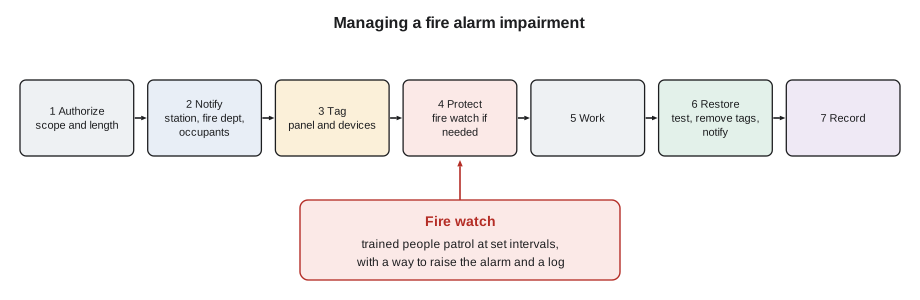
An impairment is any time a fire alarm system, or part of one, is not able to do its job: a zone bypassed for testing, a panel shut down for an upgrade, a circuit damaged by another trade, a communicator disconnected. Planned impairments are part of normal work; unplanned ones happen when something breaks. Either way, the building is less protected, and the fire code and NFPA 72 require the owner to manage it. The owner authorizes the impairment, decides who is notified, and arranges compensating measures, usually with the technician's advice.
Notification typically includes the monitoring station, the fire department where the code or local rules require it, and the building's occupants or their supervisors. The panel and any affected devices are tagged so that anyone looking at the system can see it is impaired. For impairments that last more than a short time, or that leave occupied areas without protection, a fire watch is usually required: one or more trained people patrol the affected area at set intervals, looking for fire and ready to raise the alarm by other means, such as a manual station in an unaffected zone, a phone or a radio. The fire watch keeps a log of each patrol. When the work is finished, the technician restores the system, tests the affected parts, removes the tags, and tells everyone who was notified that the system is back in service; the owner records the impairment and its restoration.
| Step | Who | Record |
|---|---|---|
| Authorize the impairment, define its scope and expected length | Owner or their representative | Impairment form |
| Notify monitoring station, fire department where required, occupants | Owner, often through the technician | Times and names of people notified |
| Tag the panel and affected devices | Technician | Tag numbers |
| Start a fire watch or other measures if needed | Owner | Fire watch log with each patrol |
| Restore, test the affected parts, remove tags | Technician | Test results |
| Notify everyone that service is restored | Owner or technician | Time of restoration |
Working alone and personal safety
Service technicians often work alone, in basements, mechanical rooms and empty buildings at night. Bramwell's lone worker procedure requires a technician working alone to check in with the office at set times and at the end of the job, with a call-out if a check-in is missed. Technicians also meet the public: residents upset by an alarm, building staff who want a nuisance alarm stopped immediately, and occasionally people who are hostile. Gerry's advice is to stay calm, explain what is being done and why, and never to disable or bypass part of a life safety system just because someone demands it; if a situation feels unsafe, leave and call the office.
Worked problem
Planning a panel replacement at Riverlight Tower
Riverlight Tower's panel is being replaced. The work will take the whole building's fire alarm system out of service for about six hours on a weekday. Plan the safety and impairment steps.
Show solution
- Schedule with the owner for a day and time when the fewest residents are home and staff are available; get written authorization describing the impairment.
- Notify the monitoring station and the fire department in advance and on the day; post notices in the lobby, elevators and each floor; tell the residents who need help to evacuate.
- Arrange a fire watch of trained staff patrolling every floor at the interval the authority or the owner's procedure sets, with radios and a log, for the whole time the system is down.
- Lock out the panel's breaker before removing the old panel; handle the old batteries as hazardous waste; keep the work area clear of residents.
- After installing and programming the new panel, test it, restore monitoring, confirm signals are received, end the fire watch, and notify everyone that protection is restored; record the impairment from start to finish.
Answer: The building is never unprotected without someone watching, and the records show it.
Common mistakes
MistakeWorking on the panel's line voltage terminals with the breaker on.
InsteadLock out the breaker, test for dead, then work.
MistakeTesting a clean agent detector without isolating the release.
InsteadThe suppression contractor isolates the release first.
MistakeDrilling old ceilings without checking the asbestos survey.
InsteadRead the hazardous materials survey; treat untested suspect materials as containing asbestos.
MistakeLeaving a floor's horns sounding while walking it.
InsteadSound appliances briefly, wear hearing protection, and announce testing.
MistakeBypassing a zone with no record or fire watch.
InsteadFollow the impairment procedure: authorize, notify, tag, protect, restore, record.
Summary and key terms
- Employers and workers share safety duties under provincial or state occupational health and safety law.
- Panel primary circuits and batteries are real electrical hazards; lock out and test before working on them.
- Falls from ladders are a leading risk; use the 4-to-1 rule, three points of contact, test poles and lifts.
- Appliance testing exposes technicians and occupants to noise and flashing light; keep it brief and protected.
- Asbestos, silica and hospital infection control need planning before drilling or opening ceilings.
- Suppression releases, elevators and fans are made safe by their own trades before testing.
- Every impairment is authorized, notified, tagged, covered by a fire watch if needed, restored and recorded.
- Lockout
- Turning off and locking an energy source so it cannot be turned on while someone works.
- Impairment
- A condition in which a fire protection system or part of it cannot do its job.
- Fire watch
- Trained people patrolling an area to detect fire while protection is impaired.
- Noise dose
- Noise exposure as a percentage of the allowed daily limit.
- Exchange rate
- The increase in level that halves the allowed exposure time.
- Hazardous materials survey
- An owner’s record of where materials such as asbestos are found in a building.
- Isolation
- Disabling a suppression release so testing cannot cause a discharge.
Practice problems
Work each problem on paper first, then reveal the answer to check.
An extension ladder reaches a support 12 ft high. How far from the wall should its base be?
Show answer
About 3 ft.
Why aren't non-restorable heat detectors tested with heat?
Show answer
Heating them past their rating destroys them.
What must happen before a technician tests detectors in a CO2-protected room?
Show answer
The suppression contractor isolates the release.
Name four steps in managing an impairment.
Show answer
Authorize, notify, tag, provide a fire watch if needed, then restore, test and record.
Lesson quiz · 5 questions
Score 60% or more to complete this lesson.
Create a free account to save your progress, take quizzes and earn a certificate.