
ELV-330 · Lesson 9 of 12 · 20 min
Controls, drives and energy-saving operation
Brackenridge's owners wanted to cut the mall's electricity bill, and the eight escalators were on the list. The mall's energy consultant had sent Lena a question: could the escalators run slowly or stop when nobody was on them, as escalators in many European malls do? Lena passed the question to Nell, and Nell turned it into a lesson for Tamsin. "Before you answer an energy question, you need to know how the escalator is controlled now, what the code lets it do when it's empty, and what it costs to run," she said. "Then you can tell the customer what saving is real and what it would take to get it." This lesson covers escalator controllers, starting and running the motor, inspection operation, the energy-saving modes the code allows, and how to estimate what they save.
The escalator controller
The controller sits in the upper machine space or in a separate control room. On older units like the original Brackenridge machines, it is a panel of relays and contactors: a main contactor and a brake contactor, direction contactors for up and down, star and delta contactors for starting, overload relays, and the safety relays fed by the safety device string. On newer units, a microprocessor controller, a variable-frequency drive and a safety controller do the same jobs and add fault logging, remote monitoring and the energy-saving modes. In every case the controller has the same duties: start the escalator only when the key switch is operated and the safety circuit is complete, run it in the selected direction, stop it with the brake whenever a safety device opens, and record what happened.
Starting is done with the key switch at either landing. The person starting the escalator turns the key to the chosen direction after checking that the steps are clear, and the escalator starts. Changing direction requires stopping the escalator first, and the controller will not reverse a moving unit. In buildings and stations, the direction of each unit is part of the building's traffic plan, and staff are trained to start units only in the planned direction.
Starting and running the motor
Escalator motors draw a large current if they are started directly on the line, and the step band jerks into motion. Older controllers reduce both with star-delta starting: the motor windings are connected in star for the first few seconds, which reduces the starting current and torque to about a third, then switched to delta for running. Some older units use soft starters, which ramp the voltage up. Newer units use a variable-frequency drive, which brings the escalator up to speed along a smooth ramp, controls the stop before the brake sets, and makes variable-speed operation possible. On down escalators carrying passengers, a drive with regeneration can return energy to the building's supply instead of turning it into heat in a braking resistor.
Some modern drives bypass themselves once the escalator is at full speed and run the motor directly on the line, switching the drive back in only to start, stop or change speed. That keeps the drive's own losses out of the running energy and lets the escalator keep running at full speed if the drive fails.
Inspection operation
Inspection operation is the mode used for maintenance. A portable control station is plugged into a socket at either landing or in the truss; it has an inspection switch, up and down buttons that must be held for the unit to move, and a stop switch. On inspection, the escalator runs only while a button is held, and the code limits the length of the station's cord so that the mechanic stays near the controls. Some safety devices that would otherwise stop the unit during maintenance, such as the missing step device when steps have been removed, may be bypassed on inspection by the maker's procedure, but normal operation must then be impossible. When the portable station is unplugged, the escalator must not be able to run on inspection, and normal operation must be restored only through the key switch.
Energy-saving modes
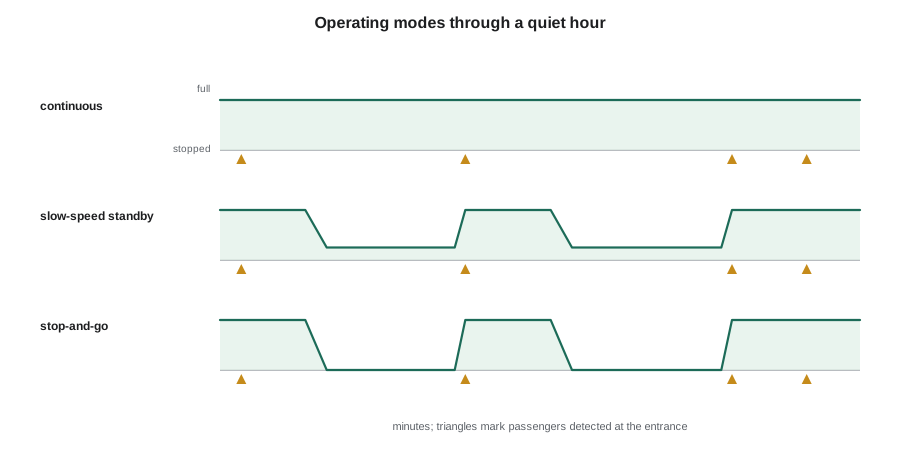
An escalator running empty still uses a good deal of energy, because the motor must overcome the friction of the step band, chains, handrails and gearbox. On a mall unit, that idle power can be several kilowatts, and the mall's escalators run empty for much of the early morning and evening. The code allows two kinds of energy-saving operation, with conditions. In slow-speed standby, also called variable-speed operation, the escalator drops to a low speed when sensors at the entrances detect no passengers for a set time, and returns to full speed when a passenger approaches. In stop-and-go operation, the escalator stops when idle and starts when a passenger approaches.
Both modes depend on detecting passengers early enough. The sensors, usually light beams or radar units on the newels or in the floor, must detect a passenger far enough before the comb that the escalator reaches its full speed, or at least a steady safe speed, before the passenger steps on, and the controller must check that the sensors are working. The escalator must also show passengers which way it is going when it is stopped or slow, with direction indicators at each landing and a no-entry signal at the exit end, so that nobody steps onto a stopped escalator that is about to start against them. Stop-and-go escalators must detect a passenger approaching from the wrong end and either keep the escalator stopped or start it in its set direction while warning the passenger. The conditions, signs and sensor tests are set by the edition in force, and some jurisdictions add their own rules, so a proposal to add these modes to an existing unit is an alteration that needs a permit and an acceptance inspection.
# Annual energy for one mall escalator under three operating modes (illustrative)
hours_open = 15 * 360          # hours per year the escalator is switched on
busy_share = 0.55               # share of those hours with passengers on it
idle_kw = 3.8                  # power to run empty at full speed
loaded_kw = 7.5                # average power with passengers
slow_kw = 1.6                  # power running empty at slow speed
modes = {
    "continuous": hours_open * (busy_share * loaded_kw + (1 - busy_share) * idle_kw),
    "slow-speed standby": hours_open * (busy_share * loaded_kw + (1 - busy_share) * slow_kw),
    "stop-and-go": hours_open * (busy_share * loaded_kw + (1 - busy_share) * 0.25),
}
base = modes["continuous"]
for name, kwh in modes.items():
print(f"{name:<20} {kwh:9,.0f} kWh/yr saving {100 * (1 - kwh / base):4.1f} % ({(base - kwh) * 0.13:,.0f} US dollars per year)")continuous 31,509 kWh/yr saving 0.0 % (0 US dollars per year) slow-speed standby 26,163 kWh/yr saving 17.0 % (695 US dollars per year) stop-and-go 22,882 kWh/yr saving 27.4 % (1,121 US dollars per year)
The illustrative figures assume the escalator is on for fifteen hours a day, 360 days a year, with passengers on it a little over half the time. The 0.25 kW in the stop-and-go case is the controller, sensors and lighting, which stay on when the escalator is stopped. On these figures, slow-speed standby saves about a sixth of the unit's energy and stop-and-go about a quarter. Real savings depend heavily on how busy the escalator is: on a quiet parking-level unit they are much larger, and on a busy main flight they are small, because the escalator is rarely empty.
What Nell told the mall
Nell's reply to the consultant set out what was possible. E7, the new modular unit, already had a drive and sensors capable of slow-speed standby; switching it on was a settings change, but it still had to be done as the maker's documented option with the inspector's acceptance. E8, the other parking-level unit, was a good candidate for a drive upgrade, because it is often empty. The six mall-level units were busy most of the day and would save less, and their original relay controllers would need replacing with a new controller, drive, sensors and signals to gain the modes at all. That made the upgrade a modernization project for later, when the controllers are replaced anyway. She also suggested two savings that cost almost nothing: switching E7 and E8 off when the parking levels close at night, which the mall had never done, and checking the gearbox oil grades and chain lubrication, because a well-maintained escalator simply needs less power to run.
| Option | What it needs | Typical saving | Notes |
|---|---|---|---|
| Switch off when the area is closed | a schedule and staff to start units | all energy in those hours | the cheapest saving |
| Slow-speed standby | drive, entrance sensors, direction signals, acceptance | moderate on quiet units | passengers barely notice |
| Stop-and-go | as above plus approach and wrong-end detection | larger on quiet units | unfamiliar to some passengers |
| Efficient drive and gearbox | helical or planetary gearbox, modern motor | steady saving at all loads | part of a modernization |
| Regeneration on down units | regenerative drive | returns energy from loaded down units | best on busy down units |
| Good maintenance | correct oil, lubrication, adjustment | small but certain | also reduces wear |
Remote monitoring
Transit agencies and large property owners increasingly want to know the state of their escalators without waiting for a phone call. Modern controllers report stops, fault codes, running hours, starts and energy use over the network, and some monitor vibration and motor current to warn of bearing or chain problems before they cause a stop. At the transit station, every escalator's controller reports to the agency's operations center and to Northcrest's dispatch, so a stop is known within seconds. On older units, add-on monitoring units watch the safety circuit and the motor contactors. Monitoring does not replace maintenance and inspection, but it tells the crew which unit to look at first, and its records are evidence when a pattern of stops has to be explained, as with the skirt device operations in lesson 7.
Worked problem
Answering a request to add stop-and-go operation
A building owner asks Northcrest to set an existing escalator to stop when it is idle, using its existing drive, by changing a parameter. Tamsin is asked what has to be considered before saying yes.
Show solution
- Stop-and-go operation is allowed only with passenger detection at both ends, direction and no-entry signals and the other conditions of the edition in force, so the unit must have, or be given, all of that equipment.
- The maker must offer the mode for this unit, and the change is an alteration that needs a permit and an acceptance inspection.
- The building's traffic must suit it: a busy unit gains little, and a unit where passengers often approach from both ends needs careful sensor placement.
- Only after those checks can a price and a program for the work be given.
Answer: It is not just a parameter change: the unit needs approved sensors, signals and the maker's option, and the change must be permitted and accepted by the inspector.
Signals, signs and building systems
Every escalator carries caution signs at both landings telling passengers to hold the handrail, attend children, keep loose clothing clear of the steps and sides, and not to bring strollers, carts or wheelchairs onto it, in the form the code prescribes. Escalators with energy-saving modes add direction indicators and no-entry signals, and their sensors are tested at every visit. Some buildings connect escalators to the fire alarm system so that they stop, or stop after a short delay, when the alarm operates; the sequence is set by the building's fire safety plan and the code, and it is tested with the building's fire alarm technicians, because an escalator that stops suddenly while people are evacuating can cause falls of its own.
Common mistakes
MistakeTreating energy-saving modes as a simple setting change.
InsteadThey need the right sensors and signals, the maker's option, a permit and acceptance.
MistakeReversing an escalator while it is moving.
InsteadStop it first; the controller should not allow a moving unit to reverse.
MistakeLeaving the portable inspection station plugged in when the unit returns to service.
InsteadUnplug it and restore normal operation only through the key switch.
MistakeQuoting energy savings without knowing how busy the escalator is.
InsteadSavings depend on how much of the time the escalator runs empty.
MistakeAssuming remote monitoring replaces maintenance visits.
InsteadIt directs the crew to problems sooner but does not replace inspection and testing.
Summary and key terms
- The controller starts the escalator only from the key switch with the safety circuit complete, runs it in one direction and stops it whenever a device opens.
- Star-delta starting, soft starters and variable-frequency drives limit starting current and jerk; drives also allow controlled stops and energy-saving modes.
- Inspection operation uses a portable station with hold-to-run buttons, and normal operation is impossible while it is in use.
- Slow-speed standby and stop-and-go modes need passenger detection, direction and no-entry signals and the conditions of the edition in force.
- Savings depend on idle time; switching off closed areas and good maintenance are the cheapest savings.
- Remote monitoring reports stops and trends so problems are found sooner.
- Star-delta starting
- Starting a motor with its windings in star, then switching to delta, to reduce starting current.
- Variable-frequency drive
- An electronic drive that controls motor speed by varying frequency and voltage.
- Slow-speed standby
- An operating mode in which an idle escalator runs at reduced speed until a passenger approaches.
- Stop-and-go operation
- An operating mode in which an idle escalator stops and restarts when a passenger approaches.
- Portable control station
- The plug-in station with hold-to-run buttons used for inspection operation.
- Regenerative drive
- A drive that returns energy to the supply when the load drives the motor.
Practice problems
Work each problem on paper first, then reveal the answer to check.
Why do many older escalators start in star and run in delta?
Show answer
Starting in star reduces the starting current and torque to about a third.
What must an energy-saving escalator show passengers when it is stopped or slow?
Show answer
Its direction, with direction indicators and a no-entry signal at the exit end.
Why does slow-speed standby save little on a busy main-flight escalator?
Show answer
It is rarely empty, so it seldom runs at slow speed.
What makes inspection operation safe for maintenance?
Show answer
Hold-to-run buttons on a portable station near the mechanic, with normal operation impossible.
Name the cheapest energy saving Nell proposed.
Show answer
Switching units off when their area of the building is closed.
Lesson quiz · 5 questions
Score 60% or more to complete this lesson.
Create a free account to save your progress, take quizzes and earn a certificate.