
ELV-330 · Lesson 11 of 12 · 21 min
Maintenance, inspection and lubrication
By the middle of the term, Tamsin had a routine. Monday and Tuesday nights at Brackenridge, Wednesday at the airport walks, and Thursday and Friday nights at the transit station after the last trains, when the agency released two units at a time. Each visit followed a printed checklist drawn from the unit's maintenance control program, and each ended with an entry in the unit's record. Nell checked the entries every week. "The checklist tells you what to look at," she said. "The record is what tells the inspector, the owner and the next mechanic that it was looked at, what you found and what you did about it. An escalator that is well maintained but badly recorded looks exactly like one that isn't maintained at all." This lesson covers the maintenance control program, routine maintenance and lubrication, cleaning, the periodic tests and inspections, and the records that tie them together.
The maintenance control program
Part 8 of the code requires every escalator and moving walk to have a maintenance control program, usually called the MCP. It is a written program, specific to the unit, that lists the maintenance tasks, how often each is done, the periodic tests and their intervals, the procedures used, and the records kept. It is based on the maker's instructions and the code, and adjusted for the unit's duty and environment: a transit escalator running twenty hours a day outdoors needs more frequent attention than a mall unit indoors. The MCP must be kept on site or available to the inspector, and the records must show that the work in it has been done. In Washington and Seattle, inspectors routinely review the MCP and the records during periodic inspections, and missing or incomplete records are a common finding.
Northcrest's MCPs for the three sites differ mainly in their intervals. The Brackenridge units are visited twice a month, the airport walks weekly because of the cart damage, and the transit station's units weekly with a daily walk-past by the agency's staff, who check that the units are running, clean and undamaged and report anything unusual. Some items in each MCP are tied to running hours rather than calendar time, such as gearbox oil changes and chain lubricator refills, so the crew reads the running-hours counter at each visit.
| Interval (example) | Typical tasks |
|---|---|
| Every visit | ride both directions, listen and feel; check combs, skirts, brushes, handrails, signs, lighting, stop buttons and safety zones |
| Monthly | inspect steps through the window, lubricator level and delivery, handrail drives, brake operation, controller fault log |
| Quarterly | test safety devices on a rotation, check drive and step chain tension, clean the upper and lower pits |
| Half-yearly | clean the truss and drip pans, inspect tracks at the transitions, check gearbox oil condition |
| Yearly | periodic tests of all safety devices, brake tests, chain stretch measurement, skirt survey and index, handrail speeds |
| By running hours | gearbox oil change, step roller and handrail drive roller replacement, lubricator service |
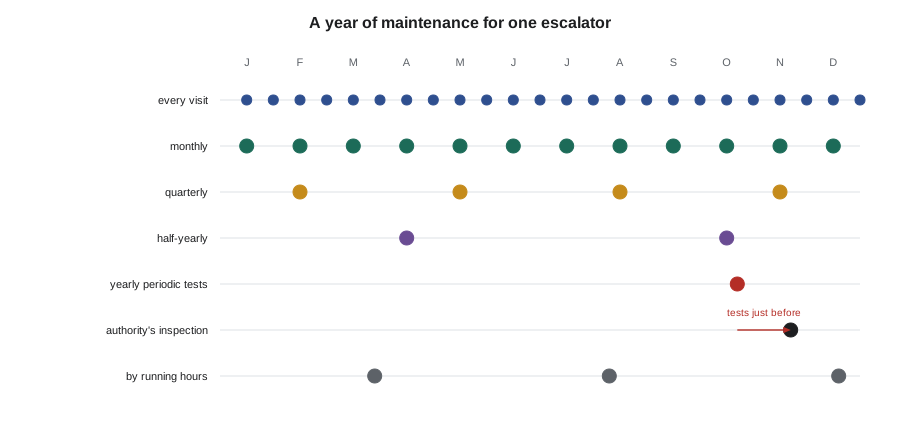
Routine maintenance on a visit
Every visit starts the way lesson 1 described: barricade both landings, inform the building, and ride the escalator in its running direction before anything else. Riding tells a trained mechanic a great deal: a bump at one place, a click on every step, a handrail that drags or lags, a noise from the drive, a vibration through the steps. Then comes the walk-around with the unit running: the comb teeth, the skirt brushes, the handrail surfaces and inlets, the lighting, the caution signs, the stop button covers and the safety zones. Only then is the escalator locked out, the landing plates lifted and the machinery inspected.
In the upper machine space, the mechanic checks the drive for oil leaks, noise and heat, the gearbox oil level, the brake linings and its operation, the main drive chain tension and lubrication, the controller's fault log, and the condition of the wiring and safety devices there. In the lower pit, the tension carriage position and its springs, the broken step chain device, the step upthrust device and the pit's cleanliness are checked. Through the step window, steps, rollers and chains are inspected as the band is inched past. Every item found is either corrected on the visit or written up with a plan, and anything that affects safety is corrected before the unit returns to service.
Lubrication
An escalator has several lubrication systems, each with its own oil or grease. The step chains and the main drive chain are lubricated by the automatic lubricator, whose reservoir is refilled with the maker's chain oil and whose timer and delivery are checked. The gearbox is filled with gear oil of the grade on its data plate, checked at every visit and changed at the maker's interval or when an oil sample shows wear metals, water or breakdown. Motor and shaft bearings are greased to the maker's schedule with the specified grease, in the specified quantity, because over-greasing bearings makes them run hot. Handrail drives, step treads, comb plates and brake linings are never oiled: oil on them causes slip or brake failure.
The rule Nell repeated most often was to use the maker's lubricants and quantities and to keep them out of places they do not belong. Oil that drips from over-oiled chains onto the return steps is carried around the band, picks up dirt and ends up in the drip pans and on the tracks. At the transit station, where the units run long hours, Northcrest has the gearbox oil sampled twice a year; a rise in iron or bronze in the sample is an early warning of gear or bearing wear months before any noise appears.
# Maintenance due dates by calendar and by running hours for one unit
from datetime import date, timedelta
today = date(2026, 11, 2)
hours_now, hours_per_day = 61850, 20
tasks = [("lubricator refill and delivery check", "days", 14, date(2026, 10, 22)),
         ("step inspection through the window", "days", 30, date(2026, 10, 5)),
         ("safety device test rotation", "days", 90, date(2026, 8, 20)),
         ("truss and drip pan cleaning", "days", 180, date(2026, 4, 20)),
         ("gearbox oil change", "hours", 10000, 52300),
         ("handrail drive roller replacement", "hours", 15000, 47200)]
for name, kind, every, last in tasks:
    if kind == "days":
        due = last + timedelta(days=every)
    else:
        due = today + timedelta(days=(last + every - hours_now) / hours_per_day)
    days_left = (due - today).days
    flag = "OVERDUE" if days_left < 0 else ("due soon" if days_left <= 14 else "")
print(f"{name:<38} due {due} ({days_left:+d} days) {flag}")lubricator refill and delivery check due 2026-11-05 (+3 days) due soon step inspection through the window due 2026-11-04 (+2 days) due soon safety device test rotation due 2026-11-18 (+16 days) truss and drip pan cleaning due 2026-10-17 (-16 days) OVERDUE gearbox oil change due 2026-11-24 (+22 days) handrail drive roller replacement due 2026-11-19 (+17 days)
This illustrative run is for one of the transit station's units, which runs about twenty hours a day. The truss cleaning is overdue, which matches what Tamsin had seen: a drip pan with a layer of dirt and oil at the lower end. The gearbox oil change is due in a few weeks, so it was booked for the next release window, and the crew planned to take an oil sample before draining.
Cleaning
Cleaning is a safety task on an escalator, not just appearance. The truss collects dirt, paper, cigarette ends, food, lost items and oil, and on a busy unit the amount is surprising. Built up in the drip pans and the pits, it is a fire load directly under the steps, it hides oil leaks and cracked parts, and it can jam the tension carriage or foul the step devices. Truss cleaning is done with steps removed to open a window, using vacuum equipment and scrapers, with the unit moved only on inspection and nobody inside the truss while it moves. Step treads are cleaned with step-cleaning machines that run on the steps while the escalator moves slowly on inspection; clogged grooves let the comb teeth ride up and can break them. Skirts and handrails are cleaned only with the maker's approved products, for the reasons given in lessons 5 and 6.
Periodic tests and inspections
The code's periodic tests for escalators and moving walks, in section 8.6.8.15, are done at least every year, and the edition in force lists them. They include the operation of every safety device that the unit has, including manual reset where required, the brake tests described in lesson 8, the handrail speed monitoring and inlet devices, the measurement of chain stretch, the step and skirt performance index and loaded gaps, the comb-step impact devices, the step level and upthrust devices, the skirt obstruction devices and, in higher seismic zones, the seismic devices. Each result is recorded with the method used, the values measured, who did it and the date.
Separately, the authority inspects the unit. In Washington, the Department of Labor and Industries inspects escalators and moving walks every year and issues an annual operating permit, which must be displayed; Seattle does the same for units within the city. The inspector looks at the unit, reviews the MCP and the records, may witness tests, and issues a report listing any items to correct, with deadlines. Northcrest's practice is to schedule its own annual tests a few weeks before the authority's inspection, so the inspector sees a unit that has just been tested and records that are complete.
| Record | What it contains | Why it matters |
|---|---|---|
| Maintenance record | each visit: date, tasks done, findings, corrections, mechanic | shows the MCP is being followed |
| Callback log | each unplanned call: time, symptom, cause, repair | reveals patterns and repeat faults |
| Periodic test record | each test, method, values, results, signatures | proves the devices and brake work |
| Repair and replacement record | parts replaced, adjustments, alterations | shows what changed and when |
| Inspection reports | the authority's findings and corrections | proves compliance |
Worked problem
Reading a callback log
The airport's walk 4 callback log for six months shows 23 calls: 14 comb segment replacements at the exit end, 5 stops from the pallet level device, 2 emergency stops by passengers and 2 handrail inlet stops. Nell asks Tamsin what the MCP should change.
Show solution
- The comb replacements at the exit end are the biggest group, and lesson 6 showed they come from luggage carts rolled off without lifting their front wheels.
- The pallet level stops may be connected: cart wheels striking the exit comb can also damage pallet edges or the pallet rollers near the exit.
- So the MCP should add a weekly check of the exit-end pallets and rollers, keep extra comb segments on site, and record each comb break with its location to show whether the airport's cart signs make a difference.
- The stop button and inlet stops are normal for a busy walk and need only to be watched for change.
Answer: Add weekly exit-end pallet and roller checks, keep spare combs on site, and track comb breaks by location; the other calls are normal.
Findings inspectors make most often
Nell kept a list of the items inspectors had written up on Northcrest's escalators over the years, and she gave it to Tamsin as a checklist of her own. The most common were safety zones obstructed by displays or barriers, missing or damaged caution signs, broken comb teeth, worn or missing skirt deflector brushes, handrails with cuts or gaps at the splice, lighting below the required level at a comb, stop button covers whose alarms did not sound, dirty trusses and drip pans, and records that did not show a test had been done. Almost all of them are found and fixed on a routine visit if the mechanic looks for them, which is why the walk-around comes before the machinery on every visit.
Common mistakes
MistakeWriting "all OK" in the maintenance record.
InsteadRecord what was checked, what was found and what was done, with values where there are any.
MistakeGreasing bearings until grease appears.
InsteadUse the maker's quantity; over-greasing makes bearings run hot.
MistakeSkipping truss cleaning because nobody sees the truss.
InsteadDirt and oil in the truss are a fire load and hide faults; clean it on schedule.
MistakeTesting the safety devices only when the inspector is coming.
InsteadTest on the MCP's schedule and before the inspection, and record every result.
MistakeTreating the callback log as a list of finished jobs.
InsteadRead it for patterns; repeat calls usually have a fixable cause.
Summary and key terms
- Every escalator and moving walk needs a maintenance control program setting out its tasks, intervals, tests, procedures and records.
- Intervals are set by the maker, the code and the unit's duty and environment; some tasks follow running hours.
- A visit starts with barricading and riding the unit, then a walk-around, then lockout and machinery inspection.
- Each lubrication system uses the maker's lubricant and quantity, and oil is kept off handrail drives, treads, combs and brakes.
- Cleaning the truss, pits, steps and skirts is a safety task.
- Periodic tests are at least yearly, the authority inspects and issues operating permits, and complete records prove the work was done.
- MCP
- Maintenance control program: the written plan of maintenance, tests and records for a unit.
- Callback log
- The record of unplanned service calls, used to find patterns.
- Running-hours counter
- A meter recording how long the escalator has run, used for hours-based tasks.
- Periodic tests
- The code's regular tests of safety devices, brakes and clearances, at least yearly for escalators.
- Oil sample
- A sample of gearbox oil analyzed for wear metals, water and breakdown.
- Truss cleaning
- Removing dirt and oil from the truss, drip pans and pits through a step window.
Practice problems
Work each problem on paper first, then reveal the answer to check.
What is a maintenance control program?
Show answer
A written, unit-specific program of maintenance tasks, intervals, periodic tests, procedures and records.
Why are some tasks scheduled by running hours?
Show answer
Wear depends on how long the unit runs, which varies greatly between a mall unit and a transit unit.
Name three parts of an escalator that must never be oiled.
Show answer
Handrail drives, step treads and brake linings; also comb plates.
Why is a dirty truss a hazard?
Show answer
It is a fire load under the steps and it hides leaks and damaged parts.
Why does Northcrest test units shortly before the authority's inspection?
Show answer
So the inspector sees freshly tested units with complete records.
Lesson quiz · 5 questions
Score 60% or more to complete this lesson.
Create a free account to save your progress, take quizzes and earn a certificate.