
ELV-330 · Lesson 1 of 12 · 22 min
Escalators and moving walks in buildings
Tamsin Iwasaki's fourth term at Northcrest started at eleven at night, in a shopping mall with the lights half off. Lena Ostrander had moved her from the elevator routes to the escalator crew for the term, and her first shift was with Nell Brady, Northcrest's escalator lead hand, at the Brackenridge mall. Nell had spent twenty years on escalators, first in a department store chain and then on transit contracts. She walked Tamsin past the dark storefronts to unit E3, where the mall's night cleaner had left a note taped to the newel: "Stopped twice tonight by itself." Nell read it, folded it into her pocket and said, "That is how most escalator jobs start. Before you fix one, you need to know how the whole machine works, because an escalator is a lot of moving parts sharing one safety circuit, and the part that stopped it is often not the part that is wrong."
This course covers escalators and moving walks. Elevator mechanics in both countries install, maintain and repair them, and the trade's apprenticeship covers them alongside elevators. They are simpler than elevators in one way, because they run continuously in one direction and have no doors, no car and no dispatching, but harder in another, because the public steps onto a moving machine with no attendant and no door to keep them out. ELV-130 lesson 11 covered rigging escalator trusses into a building; this course starts from a truss that is already in place and follows the machine from its structure to its drive, steps, handrails, landings, safety devices, brake and controls, then to installation, maintenance and a capstone service call.
What escalators and moving walks are
An escalator is a power-driven, inclined, continuous stairway used to carry people between floors. A moving walk is a power-driven, continuous walkway, either level or at a gentle slope, used to carry people along a corridor or between levels where a ramp is acceptable. Both are passenger conveyors: a loop of steps or pallets is pulled around a track inside a steel frame called the truss, a handrail moves with the steps on each side, and a comb at each landing guides passengers' feet off the moving surface onto the fixed floor.
The North American code treats both in Part 6 of ASME A17.1, adopted in Washington by the Department of Labor and Industries' elevator program, with Seattle running its own permits and inspections within the city. Section 6.1 covers escalators and section 6.2 covers moving walks. Maintenance and periodic testing are in Part 8, with the escalator and moving walk tests in section 8.6.8 and the periodic inspection items in section 8.11.4. The Canadian and US codes are published as one harmonized document, and as with elevators, a unit must meet the edition in force when it was installed or last altered, plus any rules the jurisdiction applies to existing equipment.
| Feature | Escalator | Moving walk |
|---|---|---|
| Moving surface | steps that form a stair on the incline and flatten at the landings | pallets or a belt that stay flat |
| Inclination | no more than 30° | no more than 12°, with gentler slopes at the entrances |
| Rated speed | 100 ft/min | higher speeds allowed on level walks, lower on slopes |
| Typical buildings | malls, offices, transit stations, airports | airports, transit transfer corridors, large retail |
| Code section | 6.1 | 6.2 |
| Common hazards | entrapment at skirts and combs, falls, handrail incidents | falls at the exit, entrapment at combs and sides |
The main parts
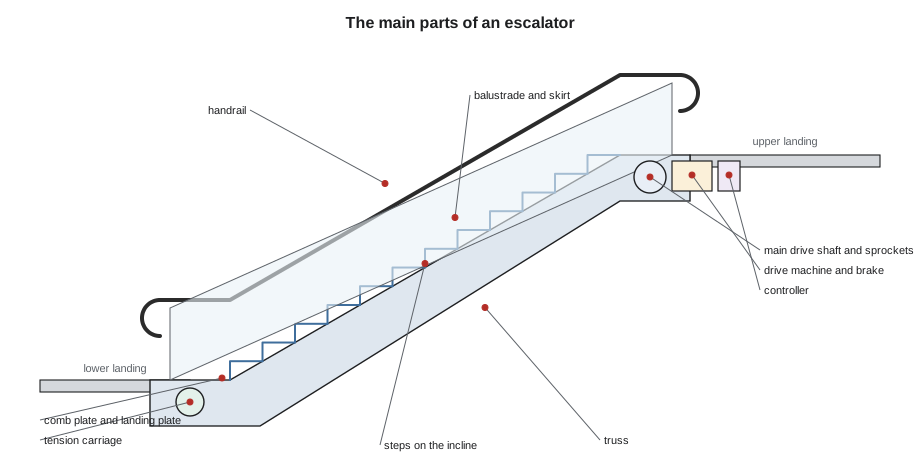
Every escalator has the same basic parts, whatever its maker. The truss is a welded steel frame that spans from the upper landing to the lower landing and carries everything else. Inside it, guide tracks steer the step rollers so that the steps form a stair on the incline and flatten out at the top and bottom. The steps are pulled by two step chains, one on each side, which pass around sprockets on the main drive shaft at the upper landing and around a tension carriage at the lower landing. A drive machine, usually an electric motor and a gearbox at the top, turns the main drive shaft through a main drive chain or a direct coupling. The handrails, one on each side, are driven from the main shaft so that they move with the steps. A brake on the machine stops and holds the escalator, and an auxiliary brake on the main shaft is added on taller or heavier units.
At each end, a landing plate covers the machine space and the tension carriage, and a comb plate carries the combs, whose teeth mesh with the grooves in the step treads. Along each side, a skirt panel runs beside the steps, a balustrade rises above it to carry the handrail, and the deck covers the top of the balustrade. The controller, the safety devices and the wiring complete the machine. The control station at each landing has a key switch to start the escalator in the up or down direction, and an emergency stop button is placed where passengers can reach it.
Where Northcrest's escalators and walks are
Nell's term plan used three sites. The Brackenridge mall has eight escalators. E1 to E4 run between the lower and main levels in two up-and-down pairs, E5 and E6 run from the main level to the upper level, and E7 and E8 bring shoppers up from the parking levels to the lower mall. All eight have 40 in steps, a rated speed of 100 ft/min, an inclination of 30° and a rise of about 18 ft. E1 to E6 and E8 were installed when the mall opened; E7 is a new modular unit whose two truss sections Tamsin helped rig into the building last year, and it will be commissioned this term.
The second site is Rainier Junction, a busy station on the city's light rail network, where Northcrest holds the maintenance contract for six heavy-duty transit escalators. They run about twenty hours a day, seven days a week, at 27° with a rise of about 36 ft, and the street entrance pair is open to the weather. Transit escalators are built heavier than mall units, to guidelines such as those of the American Public Transportation Association, because their duty is far harsher. Both cities' transit agencies are in the middle of replacing their original escalators and elevators, which have reached the end of their service lives, and Northcrest's work at the station includes keeping the old units running until their replacement dates.
The third site is the airport, where Northcrest maintains four level moving walks on the international pier. Each is about 190 ft long with 56 in pallets and runs at 130 ft/min. Travelers push luggage carts onto them, and carts are the main cause of comb damage and stoppages there.
How many people an escalator carries
Designers size escalators by their capacity. The theoretical capacity is the number of people the step band could carry if every step were filled: the number of steps passing a point each hour, multiplied by the number of people a step can hold. A 40 in step holds two people side by side, an 32 in step about one and a half on average, and a 24 in step one. Real escalators never carry their theoretical capacity, because people leave gaps, carry bags and hesitate at the comb; a practical figure is often half to three-quarters of the theoretical value, higher in a transit station rush and lower in a mall.
# Theoretical and practical capacity of an escalator
speed = 100            # rated speed, ft/min
step_depth = 1.3125       # step depth along the incline, ft (15.75 in)
people_per_step = {"24 in": 1.0, "32 in": 1.5, "40 in": 2.0}
practical = 0.6        # share actually achieved at a busy entrance
steps_per_hour = 60 * speed / step_depth
print(f"steps passing a point: {steps_per_hour:,.0f} per hour")
for width, k in people_per_step.items():
    theory = steps_per_hour * k
print(f"{width:>8} step: theoretical {theory:6,.0f} people/h, practical about {theory * practical:6,.0f}")steps passing a point: 4,571 per hour 24 in step: theoretical 4,571 people/h, practical about 2,743 32 in step: theoretical 6,857 people/h, practical about 4,114 40 in step: theoretical 9,143 people/h, practical about 5,486
A 40 in unit running at 100 ft/min can in theory carry about 9,100 people an hour. That figure explains why escalators, not elevators, move crowds between floors in malls and stations: a bank of elevators in an office tower might handle a few hundred people in five minutes, while a single transit escalator can clear a train platform in that time. It also explains why an escalator out of service in a station is a crowd safety problem, not just an inconvenience; the agency's operating plan treats it that way, and so does Northcrest's response time on the contract.
The hazards
Escalator incidents fall into a few groups. Falls are the most common: passengers lose balance on the steps, often while carrying things, pushing strollers or carts, or not holding the handrail, and older passengers are hurt most often. Entrapment is less common but more serious: a shoe, a child's foot, clothing or a finger is drawn into the gap between a step and the skirt panel, between steps, or at the comb. Handrail incidents include children's hands drawn in where the handrail enters the balustrade, and people lifted or pulled over the balustrade when they lean on or ride the handrail. Sudden stops cause falls too, which is why the brake is designed to stop the escalator gently rather than as quickly as possible. Finally, the machine space is dangerous for mechanics: the steps, chains and sprockets are powerful, and a mechanic working in the truss with steps removed is working beside an open pit.
Much of the code's escalator section exists to control these hazards. The skirt clearance, the step and skirt performance index and the skirt deflector devices in lesson 6 address entrapment beside the steps. The comb rules and the comb impact devices address the landings. The handrail entry device and handrail speed monitoring in lesson 5 address the handrail. The brake deceleration limits in lesson 8 address sudden stops. And the many safety devices in lesson 7 stop the escalator when something has gone wrong: a missing step, a broken chain, an obstruction at the skirt or the comb, a step that has dropped or lifted, or a handrail running too slowly.
Working safely on escalators
Northcrest's escalator procedure starts with the public. Before any work, the unit is stopped with the key switch, the landings are barricaded with rigid, lockable barricades that close off both ends, and the building or station staff are told. At Brackenridge the night shift runs from 10 p.m. to 6 a.m. four nights a week, and the mall security desk is told which units are out. In the transit station, any unit taken out of service is reported to the station's control center so that the agency can manage crowds, and the agency decides when a unit can be stopped. Next comes lockout: the mainline disconnect is opened, locked and tagged, and the escalator is tested to prove it will not start before anyone opens a landing plate. Work on a running escalator, such as observing a noise or adjusting a handrail drive, is done on inspection operation with the portable control station, never by standing on moving steps with the landing plates off.
Nell's own rule is about steps. When steps are removed to open a window into the truss, the gap is a hole you can fall through, and the step band can be moved only on inspection operation with a person watching the gap. "An escalator with a step out is a machine with no floor," she said. "Barricade the gap, keep your feet out of it, and never run the step band with anyone inside the truss."
Worked problem
Planning a stop at the transit station
Nell needs to take the down escalator at the station's main entrance out of service for four hours to replace a handrail drive roller. Tamsin is asked what has to be arranged before the work starts.
Show solution
- The agency decides when a unit can be stopped, because the station must still move its crowds; the work is booked in a quiet window, usually after the evening peak.
- The control center must know the unit is out so that train announcements and staff can direct passengers to the stairs, the other escalators or the elevator.
- The unit is stopped empty with the key switch, both landings are closed with rigid barricades, and signs direct passengers elsewhere.
- The disconnect is locked and tagged, and the unit is proved dead before a landing plate is lifted.
Answer: Book the window with the agency, inform the control center, stop and barricade the unit, then lock out and prove it dead.
Common mistakes
MistakeThinking of escalators as simpler, safer machines than elevators.
InsteadPassengers step onto an escalator with no door or attendant; entrapment, falls and handrail injuries make its safety devices just as important.
MistakeStopping a transit escalator without telling the station.
InsteadThe agency must know so it can manage crowds; an unplanned stop can create a dangerous crush.
MistakeBarricading only the end you are working at.
InsteadClose off both landings with rigid barricades so nobody walks onto a stopped unit with plates removed.
MistakeRunning the step band with steps removed and nobody watching the gap.
InsteadMove it only on inspection operation with the gap guarded and nobody inside the truss.
MistakeQuoting theoretical capacity as what an escalator really carries.
InsteadPractical capacity is usually half to three-quarters of theoretical.
Summary and key terms
- Escalators are inclined continuous stairways and moving walks are flat or gently sloped walkways; both are covered by Part 6 of the code, with maintenance and tests in Part 8.
- The main parts are the truss, tracks, steps or pallets, step chains, drive machine, main drive shaft, handrails, combs, skirts, balustrades, brake, controller and safety devices.
- Escalators are limited to 30° and 100 ft/min; moving walks to 12°.
- Theoretical capacity is steps per hour times people per step; practical capacity is much lower.
- Falls, entrapment at skirts and combs, handrail incidents and sudden stops are the main passenger hazards.
- Safe work means barricading both landings, informing the building or agency, locking out, proving dead and never running the step band with a person in the truss.
- Truss
- The steel frame that spans between the landings and carries all of the escalator parts.
- Step band
- The continuous loop of steps joined by the step chains.
- Comb plate
- The plate at each landing carrying the combs that mesh with the step tread grooves.
- Skirt panel
- The fixed side panel beside the steps, below the balustrade.
- Balustrade
- The side structure above the skirt that carries the handrail.
- Theoretical capacity
- The number of people per hour the step band could carry with every step filled.
Practice problems
Work each problem on paper first, then reveal the answer to check.
Which section of the code covers moving walks?
Show answer
Section 6.2; section 6.1 covers escalators.
What is the maximum inclination of an escalator under the North American code?
Show answer
30°.
How many people does the theoretical capacity assume on a 40 in step?
Show answer
Two.
Why do practical capacities fall short of theoretical capacities?
Show answer
Passengers leave gaps, carry bags and hesitate at the combs, so not every step is filled.
What must happen before a landing plate is lifted?
Show answer
The unit is stopped, both landings barricaded, the disconnect locked and tagged, and the unit proved dead.
Lesson quiz · 5 questions
Score 60% or more to complete this lesson.
Create a free account to save your progress, take quizzes and earn a certificate.