
ELV-330 · Lesson 3 of 12 · 21 min
Drive machines, gearboxes and main drive chains
Brackenridge E2 had started to growl. The mall's operations manager heard it from the food court and called Lena, who sent Nell and Tamsin on the next night shift. With E2 locked out and the upper landing plate lifted, the noise was gone, of course; it only happened under load. Nell ran the unit up on inspection with the plate off and the drive guarded, put her hand on the gearbox housing, then on the motor, then on the main drive chain guard, and listened with a mechanic's stethoscope. "Gearbox input bearing," she said. "You can hear it rumble at motor speed, not at chain speed." This lesson covers the machinery that turns electricity into the motion of the step band: the motor, the gearbox, the main drive chain or coupling, the main drive shaft and the brakes that sit on them.
Drive arrangements
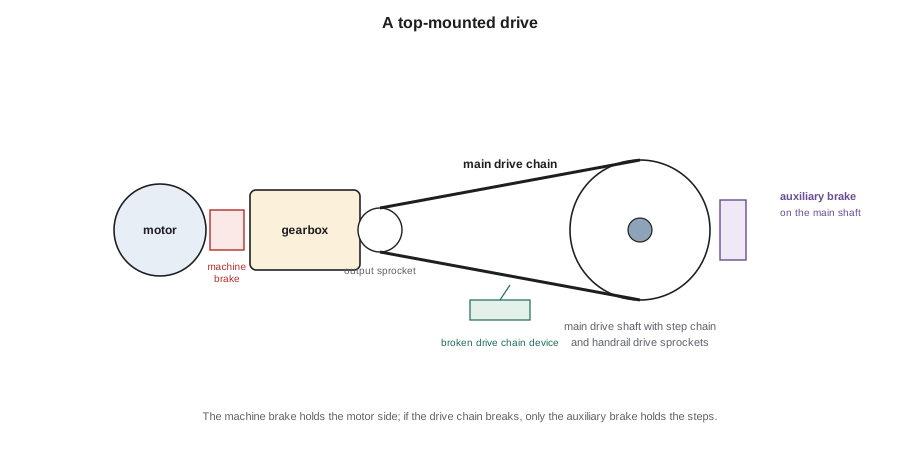
Most escalators in North American buildings use a top-mounted drive. The drive machine sits inside the truss at the upper landing, under the landing plate. It is an electric motor coupled to a gearbox, and the gearbox output turns the main drive shaft, either through a main drive chain or through a direct coupling. The main drive shaft carries the two step chain sprockets and the handrail drive sprockets, so one machine drives the whole escalator. The machine has its own brake, the machine brake, usually on the motor shaft or the gearbox input.
Other arrangements are used where a single top machine would be too large or hard to reach. Some makers build the motor and gearbox into the main drive shaft itself, with a planetary gearbox inside the sprocket hub. Long transit escalators and long moving walks sometimes use more than one drive, placed along the incline, with each drive pulling a section of the step band. Older units, like the original Brackenridge machines, use a worm gearbox, which is compact and quiet but less efficient; newer machines use helical or planetary gears, which waste less energy as heat. The arrangement determines where the brakes must be and how the drive is serviced, so Nell made Tamsin draw each site's drive from memory before she let her work on it.
The motor
Escalator motors are almost always three-phase induction motors, the same family Tamsin studied in ELV-210. They run at a nearly constant speed, so the step speed is set by the gear ratio and the size of the step chain sprockets rather than by the motor control. On older units the motor is started across the line or in star-delta to limit the starting current; newer units use a variable-frequency drive, which starts the escalator gently and allows the energy-saving modes described in lesson 9. The motor is sized for the heaviest passenger load the escalator is designed to carry upward, plus the friction of the step band, handrails, chains and gears. On a down escalator carrying passengers, the load drives the motor rather than the other way around, and the motor acts as a generator; a drive with regeneration can return that energy to the building.
The power needed to lift passengers is the weight of the passengers on the incline multiplied by the vertical component of the step speed. Escalator makers use a design load per exposed step on the incline for this calculation, and the friction of the empty escalator is added as a fixed amount found by testing similar units. Dividing by the efficiency of the gearbox and drive chain gives the motor power, which is then rounded up to a standard motor size.
import math
# Motor power and drive ratio for an escalator (illustrative design figures)
rise, angle = 18.0, 30.0            # ft, degrees
step_depth = 1.3125                    # ft
load_per_step = 265                 # lb design load on each exposed incline step
speed = 100                           # rated speed, ft/min
friction = 3.4                       # hp to run the empty escalator
efficiency = 0.85                    # gearbox and drive chain
incline = rise / math.sin(math.radians(angle))
steps = int(incline / step_depth)
lift = steps * load_per_step * speed * math.sin(math.radians(angle)) / 33000
motor = (lift + friction) / efficiency
sizes = [10, 15, 20, 25, 30]
chosen = next(s for s in sizes if s >= motor)
print(f"exposed incline steps: {steps}, design load {steps * load_per_step:,.0f} lb")
print(f"lifting power {lift:.1f} hp, plus friction {friction:.1f} hp")
print(f"motor power needed {motor:.1f} hp, standard size {chosen} hp")
# drive ratio: motor speed to main shaft speed
pitch, teeth, motor_rpm = 5.25, 16, 1460
sprocket = pitch / math.sin(math.radians(180 / teeth))
shaft_rpm = speed / (math.pi * sprocket / 12)
print(f"step chain sprocket pitch diameter {sprocket:.1f} in, main shaft {shaft_rpm:.2f} rpm")
print(f"overall reduction from the motor: {motor_rpm / shaft_rpm:.0f} to 1")exposed incline steps: 27, design load 7,155 lb lifting power 10.8 hp, plus friction 3.4 hp motor power needed 16.8 hp, standard size 20 hp step chain sprocket pitch diameter 26.9 in, main shaft 14.19 rpm overall reduction from the motor: 103 to 1
E2's original motor is rated 20 hp, which matches the calculation with some margin. The overall reduction of about 100 to 1 between the motor and the main shaft is shared between the gearbox and the main drive chain, whose sprockets give the final reduction and let the maker fine-tune the step speed. A change in sprocket size, or a gearbox replaced with one of a different ratio, changes the step speed, and the step speed must then be measured and the handrail drive checked, because the handrails must still move with the steps.
Gearboxes
The gearbox is the heart of the drive and the part that most often decides when a drive must be overhauled. Worm gearboxes have a steel worm on the input shaft driving a bronze wheel on the output; the bronze wheel wears slowly, the wear shows as increasing backlash at the output, and the oil carries bronze particles that show up as a gold sheen. Helical and planetary gearboxes have hardened steel gears that wear very little but can suffer from bearing failure or pitting of the tooth surfaces. In every type, the bearings and the oil are where trouble starts. Bearings announce themselves with noise and heat: a rumble at motor speed comes from the input shaft bearings, a slower knock from the output. Oil must be at the right level and the right grade, and it must be changed at the maker's interval or when an oil sample shows wear metals or water.
| Symptom | Likely cause | Check |
|---|---|---|
| Rumble that follows motor speed | input bearing wear | stethoscope on the housing, temperature, vibration reading |
| Knock once per output revolution | output bearing or damaged wheel tooth | turn by hand on inspection and feel for the knock |
| Gold sheen in the oil | bronze worm wheel wear | oil sample, backlash measurement |
| Housing much hotter than usual | low oil, wrong grade, failing bearing | oil level and grade, thermometer reading |
| Oil on the drip pan | shaft seal or breather fault | seal condition, breather clear, level |
At E2, the stethoscope and a vibration reading confirmed the input bearing. The gearbox maker's procedure for the original worm box allowed the input bearing to be replaced on site, so the job was booked for two nights: one to remove the motor and input shaft, one to fit the new bearing and seal, refill and run in.
The main drive chain
On most top-mounted drives, the gearbox output sprocket turns the main drive shaft through a main drive chain. This is a heavy roller chain, often duplex or triplex, which carries the full driving force of the escalator. Like any roller chain, it stretches with wear as its pins and bushes wear, and it must be kept at the correct tension and lubricated. A slack drive chain runs noisily and can jump teeth; a tight one wears quickly and loads the bearings. The chain is checked for elongation, side wear and damaged rollers, and the sprocket teeth are checked for the hooked shape that shows they are worn.
The main drive chain is a single point of failure: if it breaks, the main drive shaft is no longer connected to the machine brake, and a loaded down escalator could run away. That is why the code requires a broken drive chain device that stops the escalator if the chain breaks, and why taller escalators and those whose machine is connected to the main shaft by a chain also need an auxiliary brake acting directly on the main drive shaft. Lesson 7 covers the device and lesson 8 the brakes. Heavy-duty transit guidelines go further, ruling out belt drives between the motor and the gearbox and asking for low-oil sensors on gearboxes and long design lives for the bearings.
The main drive shaft and its bearings
The main drive shaft runs across the upper end of the truss and carries the two step chain sprockets, the handrail drive sprockets or wheels and, where fitted, the auxiliary brake disc. It runs in two large bearings, one on each side of the truss. Because the step chains on both sides must stay in step, the two sprockets are fixed to the shaft so that their teeth line up, and the shaft must be square to the truss. If a sprocket slips on its shaft or the shaft goes out of square, one step chain leads the other, the steps run crooked, and they begin to rub the skirt on one side. Tamsin learned to check the shaft bearings for heat and noise and to look at the alignment marks Nell's crew paints across each sprocket hub and its shaft, which show at a glance whether anything has moved.
Worked problem
Choosing the next check on a noisy drive
On a down escalator at the transit station, a regular clatter is heard at the upper landing, about once every four seconds. The main shaft turns at about 14 rpm and the motor at 1,460 rpm. Tamsin is asked what the timing suggests.
Show solution
- The motor turns about 24 times a second, so a noise from the motor or the gearbox input would be a continuous rumble or whine, not a single clatter.
- The main shaft turns once every 60 / 14, or about 4.3 seconds, which matches the clatter.
- So the source is something that turns with the main shaft: a damaged tooth on a step chain sprocket or the main drive chain sprocket, a loose sprocket hub or a main shaft bearing.
- With the unit locked out, check the alignment marks on the sprocket hubs, inspect the sprocket teeth and the shaft bearings, then run on inspection with a stethoscope on each bearing.
Answer: The timing matches one turn of the main shaft, so inspect the sprockets, hubs and bearings on the main shaft first.
Checking drive chain tension
Main drive chain tension is checked with the escalator locked out, by measuring the sag of the slack side of the chain midway between the sprockets with a straightedge and a rule, and comparing it with the maker's figure, often given as a small fraction of the distance between the sprocket centers. The chain is tightened by moving the drive machine on its base or by an idler, never by removing links unless the chain has stretched beyond its adjustment. At the same time, the sprocket alignment is checked with a straightedge across both sprocket faces, because a misaligned drive chain wears the sides of its links and the sprocket teeth. On E2, the drive chain sag was within the maker's range, but the chain guard had been bent inward at some time and was touching the chain, which explained a polished stripe on the guard and part of the noise that had led to the call.
Common mistakes
MistakeChanging a sprocket or gearbox ratio without checking the step speed.
InsteadMeasure the new step speed and confirm the handrails still move with the steps.
MistakeTopping up a gearbox with whatever oil is in the van.
InsteadUse the maker's grade; the wrong oil can destroy a worm wheel or a bearing.
MistakeIgnoring the main drive chain because the brake is on the machine.
InsteadIf the chain breaks, the machine brake no longer holds the main shaft; the chain and its device are safety-critical.
MistakeListening for drive noises only with the plate on.
InsteadUse inspection operation with guards in place and the landing barricaded, and use a stethoscope and timing to find the source.
MistakeForgetting that a down escalator with passengers drives the motor.
InsteadLoaded down units regenerate; the brake and drive must handle that load.
Summary and key terms
- Most escalators have a top-mounted drive: motor, machine brake, gearbox and main drive chain or coupling turning the main drive shaft.
- Motor power comes from the passenger load on the incline times the vertical speed, plus friction, divided by the drive efficiency.
- The step speed is set by the gear ratio and sprocket size, and any change must be checked against the handrail speed.
- Gearbox trouble shows as noise, heat, backlash and wear metals in the oil; bearings and oil are the usual starting points.
- The main drive chain is safety-critical: it needs correct tension and lubrication, a broken drive chain device and, on many units, an auxiliary brake on the main shaft.
- The two step chain sprockets must stay aligned on a square main shaft, or the steps run crooked.
- Main drive shaft
- The shaft at the upper end of the truss carrying the step chain and handrail drive sprockets.
- Machine brake
- The brake on the drive machine, usually on the motor shaft or gearbox input.
- Auxiliary brake
- A brake acting directly on the main drive shaft.
- Main drive chain
- The roller chain connecting the gearbox output to the main drive shaft.
- Backlash
- Free movement between meshing gears, which grows as a worm wheel wears.
- Regeneration
- Return of energy to the supply when the load drives the motor.
Practice problems
Work each problem on paper first, then reveal the answer to check.
Why does a loaded down escalator drive its motor?
Show answer
The passengers' weight moving downward drives the step band, so the motor acts as a generator.
What does a gold sheen in worm gearbox oil suggest?
Show answer
Wear of the bronze worm wheel.
Why is the main drive chain safety-critical?
Show answer
If it breaks, the main shaft is disconnected from the machine brake and a loaded down escalator could run away.
What device must stop the escalator if the main drive chain breaks?
Show answer
The broken drive chain device.
What happens if one step chain sprocket slips on the main shaft?
Show answer
One step chain leads the other, the steps run crooked and can rub the skirt.
Lesson quiz · 5 questions
Score 60% or more to complete this lesson.
Create a free account to save your progress, take quizzes and earn a certificate.