
ELV-330 · Lesson 2 of 12 · 20 min
Truss, tracks and the escalator structure
Nell's first job for Tamsin at Brackenridge was not a repair. She lifted the upper landing plate of E5, with the unit locked out and both ends barricaded, removed six steps to open a window into the truss, and handed Tamsin a flashlight. "Before you touch a drive or a chain, learn the frame," she said. "Everything in an escalator is held in line by the truss and steered by the tracks. When steps start to rattle, rub the skirt or hit the combs, the cause is often in the structure: a track joint that has opened, a support that has settled, or a frame that was never set level." This lesson covers the truss, its supports, the track system that guides the steps, and the geometry that ties them together.
The truss
The truss is a welded steel frame, usually made of angles or rectangular hollow sections, that runs the full length of the escalator from the upper landing to the lower landing. It is a bridge: it carries its own weight, the weight of every part inside it and the passengers on the steps, and it delivers all of those loads to its supports at the two landings. Each end of the truss rests on a support angle or bearing plate on the building structure, and long units also rest on one or more intermediate supports along the incline. The truss is designed for the passenger load set out in the code and for the building's seismic requirements, and its deflection under load is limited so that the tracks stay in line. Transit guidelines go further, asking for deflection under live load of no more than 1/1000 of the span, because heavy-duty units run loaded for hours.
The truss is fabricated in the factory, often in two or three sections for transport, and the sections are bolted or welded together on site. At Brackenridge, E7's new truss came in an upper section with the drive and a lower section, which is why it needed two separate lifts in ELV-130. Inside, the truss carries the drive machine and controller at the upper end, the tension carriage at the lower end, the track system along its length, the handrail guides and drives on the balustrade brackets, and the drip pans that collect oil and dirt. The outside of the truss is clad by the building's finish: ceiling panels below and side cladding that the escalator contractor does not normally own.
Supports and how the truss moves
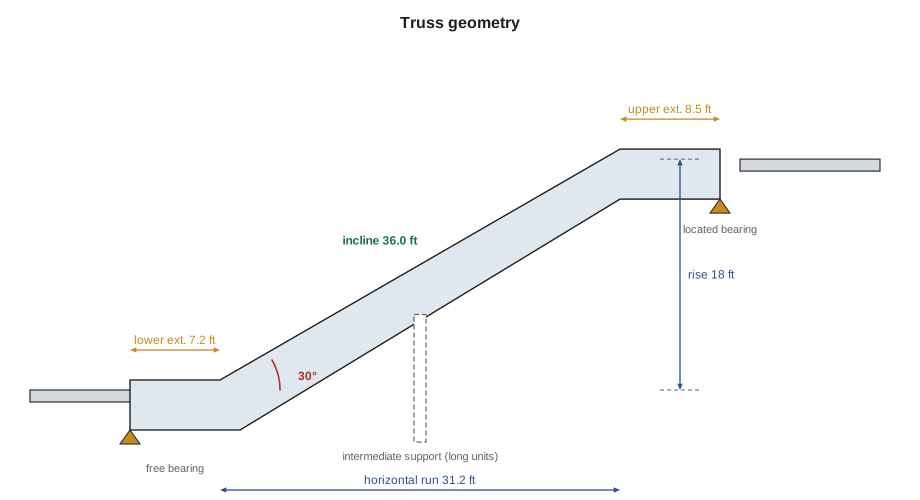
A truss is not fixed rigidly at both ends. One end, usually the upper end, is located on its support, and the other end rests on a bearing that lets the truss slide slightly as the building moves, the steel expands and contracts with temperature, and the floors deflect under load. The bearing plates have a minimum overlap with the support angle so that the truss cannot fall off its support if the building sways in an earthquake, and the code's seismic provisions in Part 8 set the overlap and the restraints for each seismic zone. The Pacific Northwest, on both sides of the border, is a high seismic region, so every escalator Northcrest maintains has seismic restraints, and the inspector checks the bearing overlap and the gap at the free end.
Intermediate supports are steel posts or hangers that carry the truss partway along the incline. They are shimmed during installation so that the truss is straight and the tracks are in line, and they are one of the first things Nell checks when steps begin to bump or rub at the same place on every revolution. A support that has settled, been knocked by a cleaning machine or been re-shimmed badly during building work will put a kink in the track. On a mall unit with a short span there may be no intermediate support at all; on the transit station's 36 ft rise units there are two.
| Support or fixing | What it does | What to check |
|---|---|---|
| Upper end bearing | locates the truss on the building | fixings tight, no cracking in the concrete or steel |
| Lower end bearing | lets the truss slide with movement | overlap on the support, free gap, bearing pad condition |
| Intermediate support | carries the truss partway along the incline | shims in place, no settlement, no impact damage |
| Seismic restraint | holds the truss on its supports in an earthquake | present, undamaged and as designed |
| Truss splice | joins the shipped sections | bolts tight or welds sound, no movement marks |
The geometry of the incline
Two numbers fix the size of an escalator: the rise, which is the vertical distance between the finished floors at the two landings, and the inclination, which in North America is 30° for almost every unit, although transit designers sometimes choose 27° for long rises to make the ride easier for passengers. From those two numbers, simple trigonometry gives the horizontal run of the incline and its sloping length. The truss is longer than the incline because it extends horizontally beyond each landing to hold the drive machine at the top and the tension carriage at the bottom, and because the steps need flat runs at each landing before they meet the combs. Building designers use the overall length to reserve floor space and the support reactions to design the floors.
import math
rise = 18.0           # ft, finished floor to finished floor
angle = 30.0            # degrees
upper_ext = 8.5       # ft, upper landing extension for drive and flat steps
lower_ext = 7.2       # ft, lower landing extension for tension carriage and flat steps
run = rise / math.tan(math.radians(angle))
incline = rise / math.sin(math.radians(angle))
overall = run + upper_ext + lower_ext
print(f"horizontal run of the incline: {run:.2f} ft")
print(f"sloping length of the incline: {incline:.2f} ft")
print(f"overall truss length:           {overall:.2f} ft")
for name, span in (("one span", overall), ("two spans", overall / 2)):
print(f"{name}: deflection limit at span/1000 = {span / 1000 * 12:.1f} in")horizontal run of the incline: 31.18 ft sloping length of the incline: 36.00 ft overall truss length: 46.88 ft one span: deflection limit at span/1000 = 0.6 in two spans: deflection limit at span/1000 = 0.3 in
For Brackenridge's 18 ft rise, the incline is twice the rise long, because the sine of 30° is one half, and its horizontal run is about 1.73 times the rise. The steps on the incline therefore cover about 36 ft of slope, and the whole truss is about 46 ft long. At the transit station, the longer rise and the gentler 27° slope make the truss more than twice as long.
The track system
Inside the truss, the steps run on tracks. Each step has two pairs of rollers: the chain rollers at the front of the step, carried by the step chain, and the trailing rollers at the back of the step, which run on their own track. The two tracks are set at different heights along the incline so that each step stays level as it climbs, and they come together at the landings so that the steps flatten out into a level walking surface. Between the incline and the landings, the tracks follow transition curves. The upper transition has a larger radius than the lower one because steps arriving at the top from the incline are still rising, and the code links the minimum radii to the rated speed. On the return side, below the passenger side, a second set of tracks carries the steps back upside down.
Tracks are made in sections bolted to the truss, and the joints between sections must be smooth and in line. An open or stepped joint makes the rollers jump, which passengers feel as a regular bump and mechanics hear as a click on every step. Worn tracks, particularly at the transitions where the loads are highest, cause the steps to sit low or tilt, and a step that runs low can catch the comb or ride against the skirt. At the landings, hold-down tracks keep the step rollers from lifting, so that a step cannot rise into the comb. Tamsin's flashlight survey of E5 found a lower transition joint on the right-hand trailing roller track with a visible step of about 0.04 in, which matched a click that the night cleaner had complained about for weeks.
| Track part | Purpose | Typical problem |
|---|---|---|
| Chain roller track | carries the step chain rollers on the passenger side | wear at the transitions, open joints |
| Trailing roller track | carries the rear rollers so the step stays level | stepped joints that cause clicks and bumps |
| Transition curves | turn the steps from incline to level | high wear, wrong radius after poor repairs |
| Hold-down tracks | stop rollers lifting at the landings | loose or missing, letting steps rise into the comb |
| Return tracks | carry the steps back on the underside | debris build-up, worn guides |
Flat steps and the landings
As the steps flatten out at each landing, they form a short level walking surface before the comb, so that passengers can find their feet before stepping on or off. The code requires at least two and no more than four flat steps at each landing, measured at the comb; transit guidelines ask for three below a rise of about 33 ft and four above it, because transit passengers are often hurrying and carrying bags. The number of flat steps affects the length of the truss and the design of the transitions, so it is fixed when the escalator is ordered. Mall units like Brackenridge's have two; the transit station's have four at the street entrance and three at the platform level.
Above the truss at each end, the building structure forms the landing pit, where the drive or tension carriage sits below the landing plate. The pit must be kept clean and dry: water from cleaning machines, spilled drinks and, at outdoor units, rain and snow all find their way into it. Oil, dirt and paper collect in the drip pans along the bottom of the truss and are a fire load if they are not cleaned out, which is why cleaning the truss is a routine maintenance task in lesson 11.
Worked problem
Tracing a regular bump
Passengers on Brackenridge E5 feel a small bump about two-thirds of the way up, at the same place every trip. Nell asks Tamsin how to find the cause.
Show solution
- A bump at the same place on every trip, felt by every passenger, points to the structure or the tracks at that place rather than to one step, which would bump only once per revolution of the step band.
- With the unit locked out and barricaded, remove enough steps to open a window at that point and inspect the tracks and the nearest intermediate support.
- Run a straightedge along the chain roller and trailing roller tracks across each joint and check the support shims.
- A stepped track joint or a settled support at that point is the likely cause; realign the joint or re-shim the support, then run the unit on inspection and ride it.
Answer: Inspect the tracks and the support at the point where the bump occurs, because a fixed-position bump comes from the structure, not from a step.
Common mistakes
MistakeBlaming a step for a bump that occurs at the same place every trip.
InsteadA fixed-position bump comes from the tracks or the structure; a faulty step bumps once per revolution of the step band.
MistakeTreating the truss as fixed at both ends.
InsteadOne end must be free to slide; check the bearing overlap and the free gap.
MistakeIgnoring a track joint that clicks.
InsteadOpen or stepped joints wear rollers and can make steps run low enough to catch combs or skirts.
MistakeLeaving oil and debris in the drip pans.
InsteadThey are a fire load and hide leaks; clean them as part of routine maintenance.
MistakeAssuming every escalator is at 30°.
InsteadSome transit units are at 27°; always use the unit's actual drawings.
Summary and key terms
- The truss is a welded steel bridge that carries every part and delivers the loads to supports at the landings and, on long units, intermediate supports.
- One end of the truss is free to slide; seismic rules set the bearing overlap and restraints.
- The rise and the 30° (or 27°) inclination fix the length of the incline; the landing extensions add length for the drive and the tension carriage.
- Chain roller and trailing roller tracks keep each step level on the incline and bring the steps flat at the landings through transition curves.
- Open or stepped track joints and settled supports cause bumps, clicks and steps that run low.
- Two to four flat steps are provided at each landing; transit units use more.
- Rise
- The vertical distance between the finished floors at the two landings.
- Transition curve
- The curved section of track where the steps turn from the incline to the level landing.
- Trailing roller
- The rear roller of a step, running on its own track to keep the step level.
- Intermediate support
- A support partway along the incline that carries a long truss.
- Bearing overlap
- The length of truss bearing resting on its support, which seismic rules set a minimum for.
- Flat steps
- The level steps at each landing before the comb.
Practice problems
Work each problem on paper first, then reveal the answer to check.
An escalator has a rise of 20 ft at 30°. How long is the sloping incline?
Show answer
Twice the rise, 40 ft, because the sine of 30° is 0.5.
Why is one end of the truss free to slide?
Show answer
So that building movement, temperature changes and floor deflection do not load the truss and its supports.
What do the trailing roller tracks do?
Show answer
They carry the rear rollers so that each step stays level on the incline and flattens out at the landings.
How many flat steps does the code allow at each landing?
Show answer
At least two and no more than four.
A click is heard on every step at one point. What is the likely cause?
Show answer
A stepped or open track joint at that point.
Lesson quiz · 5 questions
Score 60% or more to complete this lesson.
Create a free account to save your progress, take quizzes and earn a certificate.