
ELV-330 · Lesson 6 of 12 · 20 min
Combs, skirts and the landing areas
The airport called Northcrest on a Sunday morning. A luggage cart had jammed at the exit comb of moving walk 3 on the international pier, the walk had stopped, and two comb segments had lost most of their teeth. Nell took Tamsin, a box of comb segments and the walk's records. By the time they arrived, the airport's staff had barricaded the walk and freed the cart. Nell knelt at the comb with a flashlight and counted the broken teeth, then checked the pallets nearest the comb for damage. "Combs are designed to break," she said. "A tooth that snaps is doing its job, because the alternative is a tooth that holds and lets something get pulled in. But a comb with a broken tooth cannot go back into service, because the next thing that reaches that gap might be a child's shoe." This lesson covers the places where passengers meet the moving surface: the combs and landing plates at each end, and the skirts along the sides.
Combs and comb plates
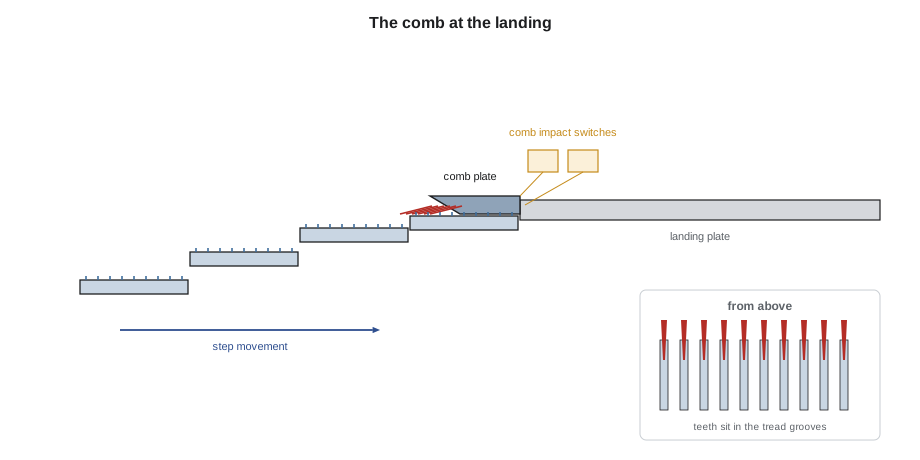
At each landing, the steps or pallets pass under a comb plate fixed across the full width of the escalator. The front edge of the comb plate carries the combs, a row of replaceable comb segments whose teeth reach down into the grooves of the step treads. As each step flattens out and moves under the comb, the teeth lift anything on the tread, a shoe sole, a dropped coin or a cart wheel, up and onto the comb plate and off the moving surface. The teeth must mesh into the grooves to the depth the maker specifies, and they must be straight and unbroken, because a missing tooth leaves a slot into which a thin object, a shoelace or a small finger can be drawn.
Comb segments are usually made of aluminum or a tough plastic and are designed as the weak link, so that a jam breaks the teeth rather than damaging the steps or the comb plate. That is why they break regularly at the airport, where cart wheels meet them dozens of times an hour. Behind the comb plate is a comb impact device: the comb plate is mounted so that it can move slightly if it is struck hard horizontally or lifted vertically, and switches stop the escalator if it moves. The code also requires the comb plate to carry a heavy load at its front edge, about 350 lb over a small area, without touching the steps, so that a person standing at the edge cannot press it down into the step band.
Replacing combs and checking the mesh
Every maintenance visit includes a look at every comb tooth, and any comb segment with a broken or bent tooth is replaced before the unit returns to service. Nell's crew carries spare segments for every unit they maintain, because a missing segment would keep a busy unit stopped. When a segment is replaced, the mesh is checked by running a few steps under it on inspection: the teeth must sit into the grooves to the maker's depth and must not touch the bottom of the grooves or the sides. If several teeth break in one place, the cause is looked for, because a comb plate knocked out of line, a step running high or low, or a damaged step tread will keep breaking new segments.
At the airport, the two damaged segments were replaced, and Tamsin checked the pallets near the comb: one had a dented groove where the cart wheel had been forced against it, and it was replaced too. Nell then tested the comb impact device by pushing the comb plate horizontally with the maker's test tool and lifting it vertically, confirming that the walk stopped each time, and recorded the job. She also wrote a note to the airport's operations manager about cart handling, because the walk's records showed eleven comb replacements in the past year, all at the exit combs of walks 3 and 4, where passengers roll carts off without lifting their front wheels.
| Comb fault | Likely cause | Action |
|---|---|---|
| One broken tooth | a hard object or cart wheel | replace the segment before restarting |
| Several broken teeth at one spot | comb plate out of line, step running high or low, damaged tread | replace segments and find the cause |
| Teeth rubbing the groove bottoms | comb set too deep, worn rollers or tracks | reset the comb, check step height |
| Comb impact switch not opening | seized mounting, misadjusted switch | repair before return to service |
| Comb plate loose or rocking | worn mounting, missing fixings | secure to the maker's details |
Landing plates and the landing area
Behind the comb plate, the landing plate covers the machine space at the upper end and the tension carriage space at the lower end. Landing plates are heavy, hinged or lift-out panels with a slip-resistant surface, and they must sit flush with the surrounding floor so that nobody trips at the change of level. The code limits a step in level between the landing and the adjacent floor to about 1/4 in. The plates are fixed so that they cannot be lifted by passengers, and lifting them is part of every lockout procedure.
In front of each landing, the code requires a clear safety zone where passengers can step off and move away without being pushed back onto the moving steps. The zone must be at least as wide as the distance between the handrail centers plus 8 in, and at least twice that width deep, measured from the end of the newel. Nothing may obstruct it: not a display stand, a sign, a queue barrier or a gate that can close across the exit while the escalator is running. The safety zone is one of the most common inspection findings in malls, because tenants and event organizers like the space in front of an escalator. Headroom above the steps must be at least 84 in, and the landings and steps must be lit to at least 5 footcandles.
Skirt panels
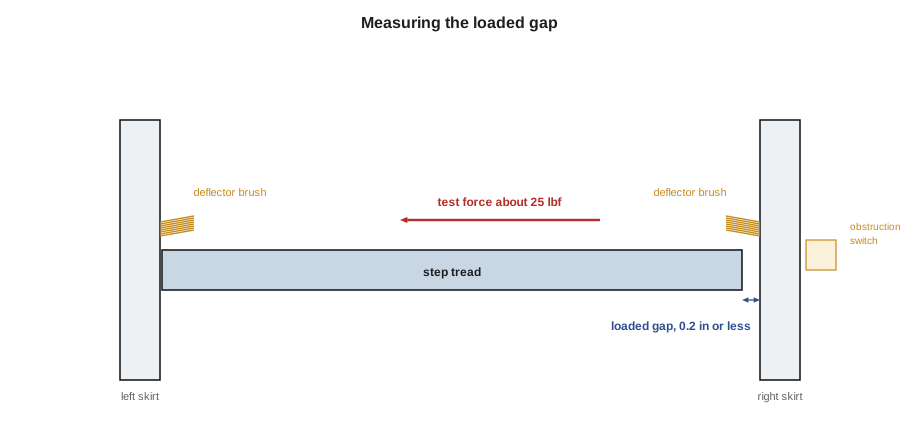
Along each side of the step band, a fixed skirt panel runs from landing to landing just beside the step ends, rising at least 1 in above the line of the step noses. The gap between the step end and the skirt is the most dangerous gap on an escalator, because a soft shoe, especially a child's rubber clog or a sandal, can be wedged into it and drawn in as the steps move toward the comb. The skirt must be stiff, so that it does not bow away from the steps when pushed, and smooth, so that a shoe slides along it instead of being gripped. The code limits how far the skirt may deflect under a heavy push, about 1/16 in under 150 lbf, and requires that the skirt panels' joints and fixings be flush.
The clearance between the step and the skirt is controlled in two ways. First, the gap itself: current editions measure the loaded gap, the clearance on one side when the step is pushed toward the other side with a force of about 25 lbf, and limit it to 0.2 in. Older editions limited the plain clearance on each side and the total of both sides. Second, the step and skirt performance index, a number between 0 and 1 that combines the loaded gap with the friction between a test shoe and the skirt surface into an estimate of how likely an entrapment is. A low index means a tight, slippery skirt; a high index means a loose or grippy one.
import math
# Skirt survey for one escalator: loaded gaps and the step and skirt performance index
loaded_gaps = {"left": 0.15, "right": 0.18}      # largest loaded gap found on each side, in
friction = 0.29                                 # measured skirt friction coefficient
limit = 0.2                                     # in
for side, g in loaded_gaps.items():
    print(f"{side:>5}: largest loaded gap {g} in ({'within' if g <= limit else 'over'} the {limit} in limit)")
gap_mm = max(loaded_gaps.values()) * 25.4
# logistic form used by the code (coefficients as published; check the edition in force)
y = -3.77 + 2.37 * friction + 0.37 * gap_mm
index = math.exp(y) / (1 + math.exp(y))
print(f"step and skirt performance index: {index:.3f}")
if index <= 0.15:
    print("index at or below 0.15: skirt deflectors not needed on this measure")
elif index <= 0.25:
    print("index above 0.15: skirt deflectors required; within the limit for newer units")
else:
print("index above 0.25: check the limit for this unit's installation date and correct the skirt")left: largest loaded gap 0.15 in (within the 0.2 in limit) right: largest loaded gap 0.18 in (within the 0.2 in limit) step and skirt performance index: 0.199 index above 0.15: skirt deflectors required; within the limit for newer units
The calculation shows why skirt maintenance matters. Friction rises when skirts are dirty, sticky with spilled drinks or coated with the wrong cleaner, and the loaded gap grows as step rollers and guides wear. Either change raises the index. Skirt panels are therefore cleaned and treated only with products approved by the maker, which lower friction without making the steps slippery, and the gaps are surveyed at the periodic tests.
Skirt deflectors and skirt obstruction devices
Most escalators now have skirt deflectors: rows of stiff brushes or flexible fins fixed along the skirt just above the step noses, which push feet away from the gap. The code sets how far they may project, how stiff the rigid part must be and how their ends are shaped at the landings. Passengers sometimes call them "the brushes", and they are the most visible part of a modern escalator's entrapment protection. Brushes wear, are bent by luggage and are pulled out by vandals, and missing sections are replaced as soon as they are found.
Behind the skirt at each end, near the combs where the steps flatten out and the gap closes, skirt obstruction devices are fitted. These are switches that open if the skirt is pushed outward by something caught between it and the steps, stopping the escalator before the object reaches the comb. They are manually reset, so the escalator cannot restart until a mechanic or trained attendant has found out why it stopped. Lesson 12's capstone begins with one of these devices.
Worked problem
Choosing what to correct on a skirt
A skirt survey on Brackenridge E4 finds loaded gaps of 0.14 in on the left and 0.21 in on the right, with a skirt friction coefficient of 0.42. Tamsin is asked what needs correcting.
Show solution
- The right side is over the 0.2 in loaded gap limit, so it must be corrected whatever the index is.
- A large gap on one side and a small gap on the other suggests the steps are running off-center or their side guides are worn, rather than both skirts being wrong.
- The friction coefficient is high, which also raises the index; the skirts need cleaning and treatment with the approved product.
- Check the step side guides and the step chains' alignment, correct the step position, clean and treat the skirts, then measure the gaps and friction again and recalculate the index.
Answer: Correct the right-side gap by centering the steps and checking the guides, clean and treat the skirts, then remeasure and recalculate the index.
Common mistakes
MistakeRestarting a unit with one broken comb tooth because the rest are fine.
InsteadA missing tooth leaves a gap that can draw in a shoelace or a finger; replace the segment first.
MistakeReplacing broken comb segments again and again at the same spot.
InsteadFind the cause: a misaligned comb plate, a step running high or low, or a damaged tread.
MistakeAllowing displays or queue barriers in front of the landing.
InsteadThe safety zone must stay clear so passengers can move away from the exit.
MistakeCleaning skirts with ordinary polish.
InsteadUse the maker's approved product; the wrong cleaner can raise friction and the entrapment risk.
MistakeAdjusting only the skirt when the gap is uneven side to side.
InsteadAn uneven gap usually means the steps are off-center; check the step guides and chain alignment.
Summary and key terms
- Comb teeth mesh into the tread grooves and lift objects off the moving surface; broken segments are replaced before restarting.
- The comb impact device stops the escalator if the comb plate is struck horizontally or lifted.
- Landing plates must be flush with the floor, and a clear safety zone is required in front of each landing.
- The step-to-skirt gap is the main entrapment point; current editions limit the loaded gap to 0.2 in.
- The step and skirt performance index combines the loaded gap and skirt friction; cleaning and step alignment keep it low.
- Skirt deflectors push feet away from the gap, and skirt obstruction devices stop the escalator if something is caught.
- Comb segment
- A replaceable section of comb carrying the teeth that mesh with the step tread grooves.
- Comb impact device
- Switches that stop the escalator if the comb plate moves when struck or lifted.
- Safety zone
- The clear floor area required in front of each landing.
- Loaded gap
- The step-to-skirt clearance on one side with the step pushed toward the other side by a set force.
- Step and skirt performance index
- A number combining the loaded gap and skirt friction that estimates entrapment likelihood.
- Skirt deflector
- Brushes or fins along the skirt that keep feet away from the step-to-skirt gap.
Practice problems
Work each problem on paper first, then reveal the answer to check.
Why are comb segments designed to break?
Show answer
So a jam breaks the teeth instead of pulling an object in or damaging the steps and comb plate.
How wide must the safety zone be?
Show answer
At least the distance between handrail centers plus 8 in, and at least twice that width deep.
What is the loaded gap limit in current code editions?
Show answer
0.2 in on one side with the step pushed to the other side by about 25 lbf.
Name two things that raise the step and skirt performance index.
Show answer
A larger loaded gap and higher skirt friction.
What do skirt obstruction devices do?
Show answer
They stop the escalator if the skirt is pushed outward by something caught near the comb, and must be reset manually.
Lesson quiz · 5 questions
Score 60% or more to complete this lesson.
Create a free account to save your progress, take quizzes and earn a certificate.