
ELV-330 · Lesson 7 of 12 · 20 min
Escalator safety devices
Back at Brackenridge E3, the unit with the night cleaner's note from lesson 1, Tamsin opened the controller cabinet in the upper machine space with Nell beside her. The service tool showed the last ten stops: four from emergency stop buttons pressed by passengers, which is normal in a mall, and six from the same device, the right-hand lower step level device. "There's your answer to 'stopped twice by itself'," Nell said. "It didn't stop by itself. Something told it to. Your job is to find out whether the device is right, and if it is, what the step is doing." This lesson describes the safety devices on escalators and moving walks: what each one watches, where it is, how it stops the unit and whether it can be reset automatically or only by hand.
How the devices stop the escalator
An escalator's safety devices work the same way as an elevator's safety circuit. Each device is a contact or a monitored sensor, and they are wired in series, or monitored by a safety controller, so that any one of them opening removes power from the drive motor and the brake, and the brake stops the escalator as described in lesson 8. Some devices, such as the emergency stop buttons, can be reset and the escalator restarted with the key switch as soon as the reason for the stop is understood. Many others are manual-reset devices: once they have operated, they stay open until a person resets them at the device or in the controller, so that a mechanic or trained attendant must go and look at the cause before the escalator can run again. The code lists which devices must be manual-reset, and the periodic tests in section 8.6.8.15 test each of them.
Modern controllers record which device opened and when, which turns troubleshooting from guesswork into reading. On older units with relay controllers, the devices are in one long series string with no record, and the mechanic finds the open device with a meter, exactly as Tamsin learned on the Tillicum relay controller in ELV-310.
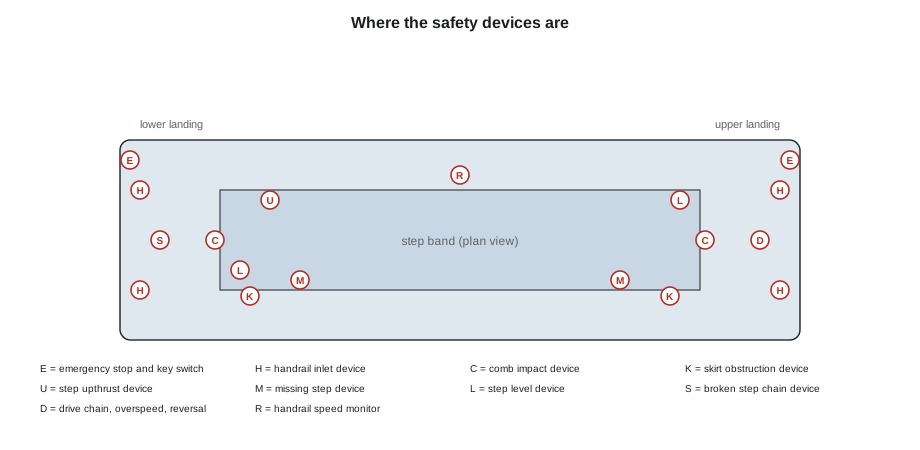
Devices that passengers and staff use
Emergency stop buttons are placed at each landing, on the newel or the skirt where passengers can reach them, behind a hinged cover that sounds an alarm of at least 80 dBA when it is opened, so that nobody presses the button casually. Long escalators also have stop buttons partway along the incline. The button stops the escalator with the brake, and the unit can then be restarted with the key switch at a landing by someone who has checked that the steps are clear. Starting is always done with a key switch, so that only trained staff can start the unit and choose its direction, and the person starting it must be able to see the whole step band, or the escalator must give an audible and visual warning before it moves.
Devices that watch the machinery
Several devices watch the machinery for breakage or loss of control. The broken drive chain device watches the main drive chain and stops the escalator if the chain breaks or jumps. The broken step chain device watches the tension carriage, which moves suddenly if a step chain breaks or stretches abnormally. A speed governor or speed sensor, where the code requires one, stops the escalator if its speed rises to more than about 40 % above rated speed, which would mean the drive has lost control of a loaded down escalator. A non-reversal device stops an up escalator that begins to move downward, which could happen if the drive failed with a heavy load on the steps. A disconnected motor safety device stops the escalator if the motor becomes disconnected from the main shaft on drives where that is possible. Most of these are manual-reset, because each of them operating means something serious has happened.
| Device | Watches for | Reset |
|---|---|---|
| Emergency stop button | a passenger or staff member stopping the unit | restart with key after checking |
| Speed governor or sensor | overspeed above about 140 % of rated speed | manual |
| Non-reversal device | an up escalator starting to run down | manual |
| Broken drive chain device | main drive chain broken or jumped | manual |
| Broken step chain device | step chain broken or abnormally stretched | manual |
| Missing step or pallet device | a gap in the step band | manual |
| Step or pallet level device | a step dropped below its normal position | manual |
| Step upthrust device | a step lifted at the lower transition | manual |
| Comb impact device | comb plate struck or lifted | manual |
| Skirt obstruction device | something caught between skirt and steps | manual |
| Handrail inlet device | something pushed into the handrail inlet | by the code's rules for the unit |
| Handrail speed monitor | handrail 15 % or more off step speed | by the code's rules for the unit |
Devices that watch the steps
The steps themselves are watched by four groups of devices, because a step that is missing, dropped, lifted or out of line is a direct danger to passengers. The missing step device, near each end of the escalator, detects a gap where a step should be, so that if a mechanic forgets to replace a step or one falls out, the escalator stops before the gap reaches the comb and the passenger side. The step level device, placed before each comb, detects a step that has dropped at its trailing edge by about 1/8 in or more, which can happen if a trailing roller fails or a step casting cracks; a dropped step would hit the comb. The step upthrust device at the lower landing detects a step whose riser has been lifted by more than about 0.2 in as it enters the lower transition, which can happen if something is jammed under the step. On some units, a step lateral displacement device detects a step that has moved sideways toward a skirt.
These devices are mostly simple: a lever or a proximity sensor set at a small distance from the passing steps, adjusted with a gauge. They are adjusted carefully, because set too close they cause nuisance stops whenever a normal step passes, and set too far away they will not detect a real fault. A step level device that trips repeatedly, as E3's did, is therefore either misadjusted or telling the truth about a step.
# Find the open device in an escalator safety string from a controller status dump
devices = [("upper emergency stop", "key"), ("lower emergency stop", "key"),
           ("speed governor", "manual"), ("broken drive chain", "manual"),
           ("broken step chain", "manual"), ("missing step upper", "manual"),
           ("missing step lower", "manual"), ("step level upper right", "manual"),
           ("step level lower right", "manual"), ("step upthrust", "manual"),
           ("comb impact upper", "manual"), ("comb impact lower", "manual"),
           ("skirt obstruction lower right", "manual"), ("handrail speed right", "monitor")]
status = {name: "closed" for name, _ in devices}
status["step level lower right"] = "open"          # status read from the service tool
log = ["step level lower right"] * 6 + ["upper emergency stop"] * 3 + ["lower emergency stop"]
for name, reset in devices:
    if status[name] == "open":
        print(f"open device: {name} (reset: {reset})")
counts = {}
for d in log:
    counts[d] = counts.get(d, 0) + 1
print("stops in the log:")
for d, n in sorted(counts.items(), key=lambda kv: -kv[1]):
print(f" {d:<26} {n}")open device: step level lower right (reset: manual) stops in the log: step level lower right 6 upper emergency stop 3 lower emergency stop 1
The string and the log together told Tamsin that the step level device at the lower right was the one stopping E3, that it was a manual-reset device, and that it had done so six times. With the unit locked out and barricaded, she checked the device's setting with the maker's gauge and found it correct. Nell then had her inch the step band past the device on inspection, watching each step's trailing edge with a straightedge. Step 61 sat about 5/32 in low on its right side: its right trailing roller had lost its tire. The device had been right all along. The roller was replaced, the step checked, the device reset, and E3 has not stopped by itself since.
Devices that watch the landings, skirts and handrails
Lessons 5 and 6 described the devices at the passenger interfaces: the comb impact devices at both landings, the skirt obstruction devices near the combs, the handrail inlet devices at all four newels and the handrail speed monitors. Together with the step devices, these are the devices most often operated in normal service, because they react to what passengers do: carts and strollers at the combs, shoes and bags at the skirts, children's hands at the inlets. Each operation is recorded and investigated, because a pattern of operations, like the airport's comb damage, usually points to a cause that can be fixed.
Other devices and controls
Some escalators have further devices depending on where they are and when they were installed. Escalators in higher seismic zones have a seismic detection input that stops them in an earthquake. Where two escalators are arranged one after the other with no exit between them, tandem operation interlocks keep them running in the same direction and stop the first if the second stops, so passengers are not delivered into a crowd on a stopped unit. Some buildings stop escalators when the fire alarm operates, and moving walks can be arranged to stop on smoke detection after a short delay so that passengers are not thrown off. Escalators with variable speed, described in lesson 9, have devices that confirm the unit is at full speed before passengers board. Each unit's wiring diagram and the code edition in force decide exactly which devices it must have.
None of these devices may ever be bypassed for normal service. Inspection operation, with the portable control station plugged in, lets a mechanic move the step band slowly for maintenance with certain devices bypassed under the maker's procedure, but the code requires the unit to be impossible to run on normal operation in that state. Jumpers are never left on a safety device. Before the unit returns to service, every device touched during the work is tested by operating it, and the escalator must stop each time.
Worked problem
Deciding what an operation pattern means
Over a month, the transit station's platform-level down escalator has logged 14 skirt obstruction device operations at the lower right, all between 5 p.m. and 7 p.m. on weekdays. The device tests correctly. Tamsin is asked what the pattern suggests.
Show solution
- The device tests correctly, so it is operating because something really is pushing the skirt outward near the lower comb.
- The operations follow the evening rush, when the escalator is crowded with commuters carrying bags and when many people stand on the right.
- That suggests bags, umbrellas or shoes being pressed against the right skirt, possibly helped by worn or missing skirt deflector brushes, an enlarged gap or a high-friction skirt.
- Inspect the right skirt deflectors and their fixings, measure the loaded gaps and skirt friction at the lower end, and correct what is found.
Answer: The device is working; inspect the right skirt deflectors, gaps and friction at the lower end, because rush-hour crowds are pressing against that skirt.
Common mistakes
MistakeTreating repeated stops from one device as a faulty device.
InsteadCheck its setting with the gauge, then look at what it is watching; it is usually telling the truth.
MistakeRestarting after a manual-reset device without finding the cause.
InsteadManual reset exists so that someone looks first; inspect, correct, then reset.
MistakeSetting step devices further away to stop nuisance trips.
InsteadSet them to the maker's gauge; too far away and they will not detect a real fault.
MistakeLeaving a jumper on a device after inspection work.
InsteadRemove every jumper and test every device you touched before return to service.
MistakeIgnoring emergency stop presses as passenger nuisance.
InsteadLook at the pattern; repeated presses at one landing can point to a real hazard there.
Summary and key terms
- Escalator safety devices open the safety circuit or signal a safety controller, removing power from the motor and applying the brake.
- Many devices are manual-reset, so that someone must find the cause before the unit can run again.
- Machinery devices watch for broken drive or step chains, overspeed, reversal and motor disconnection.
- Step devices detect missing, dropped, lifted or displaced steps before they reach the combs.
- Comb, skirt and handrail devices react to what passengers do and are the ones most often operated.
- Devices are never bypassed for normal service; every device touched is tested by operating it before return to service.
- Manual-reset device
- A safety device that stays open after operating until a person resets it.
- Missing step device
- A device that stops the escalator if there is a gap in the step band.
- Step level device
- A device before each comb that detects a step dropped at its trailing edge.
- Step upthrust device
- A device at the lower landing that detects a step lifted at the transition.
- Non-reversal device
- A device that stops an up escalator that starts to run downward.
- Tandem operation
- Interlocking of escalators arranged in series so they run together.
Practice problems
Work each problem on paper first, then reveal the answer to check.
Why do many escalator devices have to be reset by hand?
Show answer
So that a person must find and correct the cause before the escalator can run again.
What does the step upthrust device detect?
Show answer
A step lifted by more than about 0.2 in as it enters the lower transition.
At what overspeed does the speed governor stop an escalator?
Show answer
At no more than about 40 % above rated speed.
A step level device trips six times and tests correctly. What next?
Show answer
Inch the steps past it on inspection and look for a dropped step, such as one with a failed trailing roller.
What must happen to every device touched during maintenance?
Show answer
It must be tested by operating it, and the escalator must stop.
Lesson quiz · 5 questions
Score 60% or more to complete this lesson.
Create a free account to save your progress, take quizzes and earn a certificate.